A Kingship Transformed1119 CE
In 1119, Muirchertach Ua Briain died at Killaloe, ending a weakened southern bid for island-wide overlordship as Tairdelbach Ua Conchobair expanded Connacht influence across Munster. Ireland remained divided: Domnall Ua Lochlainn retained northern power, while Ua Briain successors faced rivalry, partition and Connacht intervention. Tairdelbach’s Shannon fleet, supported by Leinster, Osraige and Dublin allies, depleted Munster’s resources, though Thomond forces suffered defeat in Kerry. The year also saw massacre of poet Cú Collchaille Ua Baigelláin’s household and Niall Ua Lochlainn’s killing, threatening northern succession. Church reform, monasteries, farming, towns and waterways underpinned political, economic and cultural life in significant ways.
Dateline
The political landscape of Ireland shifted decisively during this year. Muirchertach Ua Briain, the leading southern claimant to the high-kingship for much of the previous generation, died at Killaloe, while Tairdelbach Ua Conchobair of Connacht pressed his authority into Munster by land and water. Yet this was not a simple transfer of a national crown. Ireland remained a mosaic of provincial and local kingdoms, and Domnall Ua Lochlainn still commanded formidable power in the north. What changed was the balance among those rulers and the weakening of the Uí Briain heartland around the lower Shannon.
The surviving annals do not agree in every detail. Some events appear under neighbouring years in different compilations, and later chronicles occasionally rearranged material. The death of Muirchertach and the southern campaigns are firmly associated with 1119, but caution is necessary when assigning every reported killing or expedition to an exact calendar date.
The Death at Killaloe
The Annals of Ulster date Muirchertach Ua Briain’s death to 10 March. They describe him in grand terms as a king of Ireland and a pillar of western honour, while other chronicles call him king of Ireland or of most of Ireland. Such titles expressed a serious claim to island-wide overlordship, not rule through a central administration. His authority had depended upon military success, alliances, hostages, tribute and influence over Dublin and the other coastal towns.
Muirchertach had been gravely ill since 1114 and had spent his final years amid rebellion within the Uí Briain dynasty. In 1116 he went to Lismore and took a pilgrim’s staff, a recognised act of religious retirement or penitence, although he remained politically significant. The annals emphasise that he died after repentance, anointing and reception of the Eucharist. He was buried with honour in the church at Killaloe, the ecclesiastical centre beside the old Dál Cais royal complex of Kincora.
His burial there carried dynastic meaning. Killaloe and Kincora had been associated with the rise of Brian Boru and his descendants, but their physical and political dominance had already been attacked. A Connacht army had dismantled Kincora and cast its timber and stone into the Shannon during the campaign usually dated to 1118. Muirchertach therefore died beside a royal centre whose destruction visibly proclaimed the decline of his house.
Connacht Ascendant
Tairdelbach Ua Conchobair was the principal beneficiary. He had gained the kingship of Connacht in 1106 and gradually extended his influence into Meath, Leinster and Munster. Some annals now style him king of Ireland, but this language should not conceal continuing opposition. Domnall Ua Lochlainn, king of Ailech and overking of much of northern Ireland, remained alive and independent until 1121. Tairdelbach’s supremacy in 1119 was impressive but incomplete.
His methods combined invasion with political division. The preceding settlement in Munster had favoured the Meic Carthaig in Desmond while confining Uí Briain power more closely to Thomond. After Muirchertach’s death, the brothers Conchobar, Tairdelbach and Tadc, sons of Diarmait Ua Briain, emerged as rulers among the Uí Briain. Their inheritance was diminished, however, because the king of Connacht could intervene between rival Munster branches and demand hostages or military support.
This was more than a family succession. It helped establish the enduring political distinction between Thomond in northern Munster and Desmond in the south. Those regions were not created in a single moment, but the contests of 1118–19 gave their separate ruling dynasties firmer political expression.
War on the Shannon
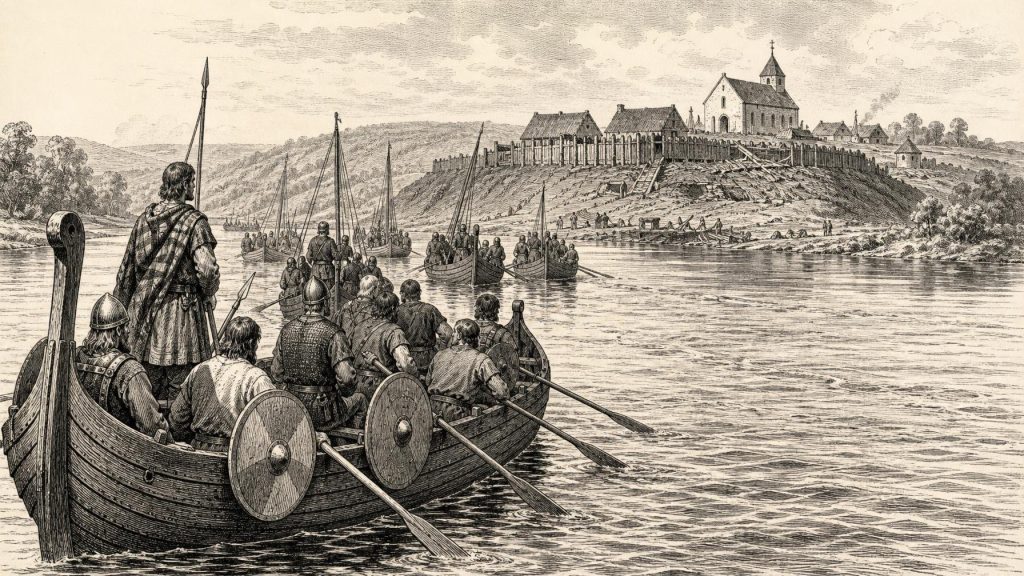
One chronicle records a great fleet led by Tairdelbach to Killaloe. It included Énna Mac Murchada, king of Leinster, Donnchad Mac Gilla Pátraic of Osraige and leading Norse-Gaelic figures from Dublin. The expedition demonstrates the breadth of the Connacht king’s coalition. It also shows that control of Dublin’s ships and fighting men could strengthen a Gaelic ruler far beyond the east coast.
The annalist says that the Shannon had been cleared before the fleet advanced. This probably refers to the removal or overcoming of barriers and defended points that obstructed navigation. Boats could carry warriors and supplies through the midlands more efficiently than an army could drive everything along poor overland routes. The fleet’s purpose was described bluntly: it went to Killaloe to consume Munster’s provisions.
Such consumption was a weapon. Armies were supported from the produce of the districts through which they passed, imposing a heavy burden of grain, cattle, ale and other food. Remaining in hostile territory demonstrated dominance while exhausting a rival’s resources. The campaign was therefore both military and economic, pressing the Uí Briain successors at the moment when Muirchertach’s death had left them most vulnerable.
Resistance in Munster
Connacht did not enjoy uncontested mastery. The Annals of Inisfallen record that the sons of Diarmait Ua Briain and the men of Thomond sent a fleet against Ciarraige Luachra, broadly corresponding to north Kerry and adjoining districts. Local forces led by Mathgamain, Cú Luachra and the Ciarraige inflicted a major slaughter upon the crews.
The entry reveals a complicated struggle rather than a two-sided war. Uí Briain claimants, Meic Carthaig rulers, regional kings and Connacht-backed coalitions all pursued their own interests. It also confirms the importance of fleets along the Shannon, its lakes, estuary and connected coastal waters. Naval campaigning was not merely a survival from the Viking Age; it had become a regular instrument of Irish kingship.
The Killing of a Poet
One of the year’s most disturbing records concerns Cú Collchaille Ua Baigelláin, described as chief ollam of Ireland in poetry. The Annals of Ulster place his killing on 5 April and say that men of Lurg and Tuath Rátha attacked the house containing him. His wife, two sons and thirty-five members of the household and guest company were killed with him. Other annals preserve different figures or place the event under an adjacent year, but they agree on its exceptional violence.
An ollam was not simply an entertainer. A poet of the highest professional grade preserved genealogy, historical tradition and the reputations of rulers. Praise could legitimise a dynasty, while satire and blame could damage honour. The annalists praise Ua Baigelláin for generosity and compassion towards both powerful and weak, presenting his household as a centre of learning and hospitality. The attack violated the expected protection of dependants and guests as well as destroying a learned family. The indignation of the Munster annalist, who called down God’s curse upon the killers, conveys how shocking the deed appeared.
Church and Political Order
Religious institutions remained inseparable from politics. Muirchertach’s career had been closely connected with church reform. He transferred the Rock of Cashel to the clergy in 1101 and supported the Synod of Ráith Bressail in 1111, which advanced a territorial diocesan structure. His penitential death belonged to the same world in which rulers sought salvation, legitimacy and commemoration through churches and religious patrons.
The Annals of Inisfallen also record the deaths of Ua Lennáin, associated with Inis Cathaig or Scattery Island, and Ua Daigthig, bishop of Lismore. Lismore was becoming an important centre of reform, scholarship and royal retirement. Cellach, successor of Patrick at Armagh, remained active as a mediator and reforming bishop, while guarantees sworn before leading clergy and sacred relics continued to lend authority to treaties.
Annals naturally concentrate on bishops, abbots and kings, but monasteries also served broader communities. They were places of worship, burial, education, craft production, hospitality and exchange. Their stored food, precious objects and livestock made them valuable patrons in peaceful times and tempting targets during war.
Work, Trade and Settlement
No chronicle provides a complete description of ordinary life in this particular year. Broader evidence shows an overwhelmingly rural society supported by mixed farming, with cattle holding special importance as food, movable wealth, tribute and plunder. Grain was also essential, as the language of armies consuming provisions makes clear. Most people lived in dispersed farmsteads, including ringforts and unenclosed settlements, in houses built largely from timber, wattle and thatch.
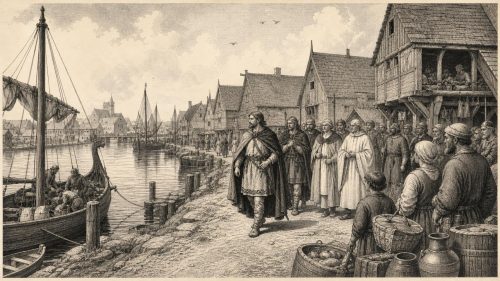
Dublin, Waterford, Wexford, Cork and Limerick formed a different environment. These Norse-Gaelic towns contained merchants, sailors and specialised craftspeople and connected Ireland with Britain, the Irish Sea, Scandinavia and continental markets. Their fleets made them politically valuable. Tairdelbach’s alliance with Dublin’s leading men shows that urban communities were participants in Irish power struggles, not foreign enclaves standing outside them.
Movement between courts, monasteries, farms and ports carried news as well as goods. Clerics travelled on visitation; poets moved among patrons; warriors assembled for seasonal campaigns; and boats linked riverine districts that could be difficult to reach by land. The events around Killaloe demonstrate how a strategic settlement could unite royal residence, church, river crossing and naval route.
A Northern Succession Crisis
The Annals of Ulster record the death of Niall, son of Domnall Ua Lochlainn, on 15 December, although some other chronicles place it in the following annal. Niall, aged twenty-eight, was regarded as heir to Ailech and a possible future king of Ireland. He was killed by Cenél Moain, a branch within the wider Cenél nÉogain political world.
His death exposed the dangers of dynastic politics even within a dominant northern kingdom. It did not immediately destroy Domnall Ua Lochlainn’s authority, but it removed his designated successor. Niall’s young son, Muirchertach Mac Lochlainn, would later become king of Ailech and a formidable claimant to the high-kingship, giving the killing consequences far beyond the immediate feud.
The Year’s Significance
The central development was the passing of Muirchertach Ua Briain and the acceleration of Tairdelbach Ua Conchobair’s rise. Munster remained wealthy, populous and politically important, but its rulers were divided and increasingly exposed to intervention. The fleets on the Shannon, the resistance of Ciarraige Luachra, the massacre of a learned household and the disputed northern succession all reveal an Ireland bound together by warfare, alliance, religion, hospitality and waterways. Power was becoming more ambitious and geographically extensive, but it was still negotiated region by region and could never be assumed secure.
Primary Sources
- The Annals of Ulster
- The Annals of Tigernach
- Annals of Inisfallen
- Annals of Inisfallen: Irish Text
- Annals of the Four Masters
- Chronicon Scotorum: Annals 1115–1119
- Mac Carthaigh’s Book
- Ua Briain, Muirchertach
- Ua Conchobair, Tairdelbach (O’Conor, Turlough)
- Ua Lochlainn (Mac Lochlainn), Domnall
- Mac Lochlainn, Muirchertach
- Ua Briain, Conchobar
- Ua Briain, Tairdelbach
- Ua Máelshechlainn, Murchad
- Cellach (Celsus)
- Malachy (Máel-M’áedóc) Ua Morgair
- The Viking Age in Ireland
- Rock of Cashel Site Guide
- The Economy of Early Medieval Ireland
- Early Medieval Ireland, AD 400–1100: The Evidence from Archaeological Excavations
- The Practice of Irish Kingship in the Central Middle Ages
- Landscapes of Kingship in Early Medieval Ireland, AD 400–1150
- Britain and Ireland 1050–1530: Economy and Society
- Dublin, Part I, to 1610: Irish Historic Towns Atlas, No. 11
- Medieval Irish Literary Theory and Criticism