Midlandian Glacial Stage31928 BCE
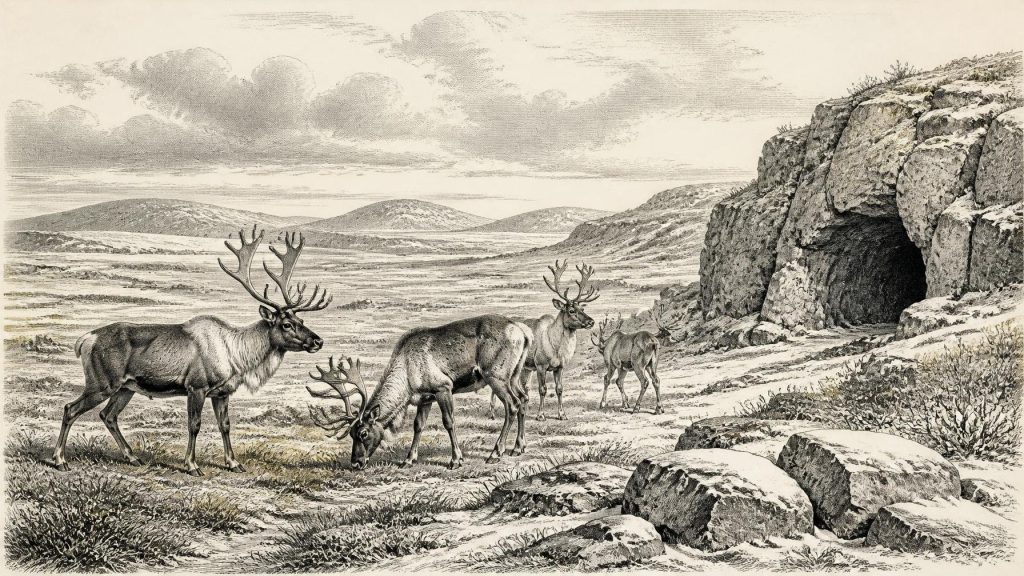
Around 31,928 BCE, Ireland lay in the Midlandian glacial stage, before the Last Glacial Maximum. Cold, unstable conditions created open grassland, periglacial erosion, altered rivers and lower sea levels, while expanding ice increasingly reshaped landscapes. Later glaciation destroyed much evidence, making caves crucial archives. Castlepook Cave in County Cork preserves remains of mammoth, giant deer, reindeer, predators and small cold-adapted mammals, demonstrating a varied fauna. A possibly tool-marked reindeer bone may indicate fleeting Upper Palaeolithic human contact, but cannot prove settlement. No associated tools, hearths, dwellings or social record survive. Ireland was a marginal, changing environment, not a human homeland.
Dateline
“31,928 BCE” is a modern chronological label, not a year for which Ireland has an event record. It falls roughly 33,900 calendar years before AD 1950, the conventional reference point for radiocarbon dating, in the Late Pleistocene and towards the close of Marine Isotope Stage 3. No written evidence, named individuals, communities, political boundaries or annual calendar survives from this depth of time. Even the natural record is dated in wide ranges, not individual years. The responsible history of Ireland at this point is therefore an account of changing climate, animal life, landscapes and the extremely limited possibility of human visits—not a reconstruction of a particular winter, hunt or settlement.
At this date, Ireland was in the Midlandian glacial stage, the last major Ice Age of the island. It was not yet at the Last Glacial Maximum, when the British–Irish Ice Sheet attained its widest extent around 27,000–23,000 years before present and later covered almost all of Ireland. Around 33,900 years ago, however, the climate was already cold and unstable, and ice was becoming an increasingly important force in the region. Reconstructions differ over precisely when individual Irish uplands, coasts and basins first became glaciated. That uncertainty matters: no credible study can draw an exact ice margin across Ireland for 31,928 BCE. Broadly, the evidence suggests a pre-maximum landscape in which substantial ice-free ground still existed, particularly at lower elevations and in the south, while glaciers and ice-sheet growth were beginning to transform the country.
A Landscape Before Maximum Glaciation
The familiar green, wooded Ireland of later millennia did not exist. Cold-stage conditions supported largely open vegetation: grasses, sedges, herbs and low shrubs rather than dense forest. The terrain would have varied sharply with altitude, exposure, soils and proximity to ice. Frost fractured rock, seasonal thaw moved sediment downslope, and sparse plant cover left ground vulnerable to wind and water erosion. Rivers behaved differently from their modern descendants, carrying greater loads of glacial or periglacial sediment. In limestone districts, caves and fissures offered sheltered traps in which bones, sediments and occasional traces of activity could accumulate.
Sea level was far lower than it is today because so much water was stored in northern ice sheets. The outlines of the Irish Sea basin and adjacent shelves were consequently very different. Yet lower seas do not automatically mean that people or animals could simply walk to Ireland. The exact arrangement of land, shallow water, sea ice and ice-sheet margins changed through time and remains debated. The island’s position on Europe’s north-western edge was a serious ecological barrier, especially as climate worsened. Its later archaeological record shows how consequential that barrier could be: sustained human settlement is not securely visible until the Mesolithic, many tens of millennia after the period considered here.
The evidence for this older environment is fragmentary because the later expansion of ice was destructive. Moving ice eroded bedrock and sediment, reworked deposits and removed many exposed traces that might once have existed. Coastal change has also submerged or destroyed former shorelines. Caves are therefore disproportionately important. They are not neat time capsules: carnivores drag in prey, water shifts bones, animals die naturally in shelter, and nineteenth- and early twentieth-century excavators often removed material before modern recording methods existed. Nonetheless, caves preserve some of the strongest evidence for the kinds of animals that reached Ice Age Ireland.
Castlepook Cave and Its Fauna
Castlepook Cave near Doneraile in north County Cork is central to understanding Ireland in the long interval around this date. Excavated principally by Richard J. Ussher in the early twentieth century and investigated again with modern methods, it has produced one of the island’s richest Pleistocene faunal assemblages. Its dated and identified remains show that, at different points before the Last Glacial Maximum, southern Ireland supported or received an imposing cold-climate fauna. Mammoth, giant deer, reindeer, brown bear, wolf, Arctic fox, mountain hare, collared lemming, Norwegian lemming and spotted hyaena are among the animals represented in the wider Castlepook record.
This list must not be turned into a literal roll-call for one day in 31,928 BCE. Individual bones have different dates, and old cave deposits can mix material from separate episodes. Some early radiocarbon results have also been revised after advances in collagen preparation and measurement. Modern re-dating has shown that certain Castlepook specimens are substantially older than once thought, reinforcing the importance of Marine Isotope Stage 3 fauna but also warning against easy chronological assumptions. What the assemblage securely establishes is a broad ecological fact: Ice Age Ireland was not an empty ice desert throughout the whole period before maximum glaciation. It contained, or was intermittently reached by, large grazers and their predators.
Reindeer are especially relevant. Their presence implies open, cold-adapted grazing country, though it does not tell us the size, seasonality or permanence of herds. Mammoth and giant deer likewise point to landscapes capable of supporting large herbivores, while hyaena, wolf and bear show that Ireland’s food webs included major scavengers and predators. A cave with hyaena remains need not have been a human shelter at all: carnivores themselves may have made it a den, feeding place or accidental bone repository. The animal evidence is compelling; any direct account of human behaviour must be much more restrained.
The Question of Human Presence
A reindeer bone from the Castlepook collection has been reported as bearing a mark consistent with cutting or chopping by a sharp stone tool and as dating to approximately 33,000 BCE. If that interpretation is confirmed, it may represent the earliest known indication of human activity in Ireland, perhaps a brief visit by Upper Palaeolithic hunters who processed reindeer. It is an intriguing possibility, particularly because hunter-gatherer communities were established elsewhere in north-west Europe during this broad era.
It is not, however, evidence for a settled Irish population in 31,928 BCE. The specimen derives from an old collection rather than a modern excavation of an undisturbed camp floor. No securely associated stone-tool assemblage, hearth, dwelling, human bone, burial, repeated butchery area or occupation surface of comparable age has been recovered at Castlepook. The identification of a surface mark as human-made requires taphonomic judgement, separate from the dating of the animal itself. Earlier assessments of the Castlepook collection stressed the absence of demonstrable human traces there; later reports have urged renewed examination. The proper conclusion is that the cave offers a potentially important clue, not proof of continuous habitation.
This distinction is more than technical. A single hunter’s visit, if it occurred, would not establish a population, a territory or an enduring route into Ireland. It tells us nothing secure about the visitors’ language, kinship, clothing, shelters, social organisation or whether they returned. Nor should Ireland be assigned the cave art, elaborate ornaments, graves or named archaeological cultures documented elsewhere in Upper Palaeolithic Europe. Such material is valuable comparative context, but it has not been found in securely dated Irish contexts of this age.
Society Without a Record
For the same reason, political affairs, warfare, diplomacy and trade cannot responsibly be described for Ireland around 31,928 BCE. There were no states, chiefs or peoples known by name, and there is no evidence for negotiated alliances, organised conflict, exchange networks or territorial rule on the island. If small groups of people reached Ireland, they would have belonged to mobile foraging societies whose decisions were shaped by weather, animal movements, fuel, safe routes and the availability of shelter. That is a general inference from Upper Palaeolithic lifeways elsewhere, not a demonstrated description of Irish society.
Economy, in the later sense of managed production and trade, is equally invisible. The only possible subsistence activity suggested near this date is the processing of an animal, probably reindeer, at or in connection with Castlepook Cave. There is no evidence for farming, livestock keeping, pottery, metalworking, permanent built settlement or long-distance commerce. Flint or another suitable stone could theoretically have been used to butcher an animal, but no tool securely linked to the disputed reindeer mark has been identified. Even the existence of a hunting party remains an interpretation awaiting stronger contextual evidence.
Religion and learning also lie beyond the surviving record. Caves can acquire ritual meanings in many societies, but that fact does not make Castlepook a sanctuary. No Irish Ice Age image, sculpture, musical instrument, grave good, symbolic deposit or inscription can securely be assigned to this period. The absence of such evidence is not evidence that people lacked beliefs or knowledge; it means only that archaeology cannot recover them here. At this chronological depth, intellectual honesty requires silence where the material record is silent.
What Endured
The most important development around 31,928 BCE was environmental rather than political: Ireland was entering the severe climatic trajectory that would culminate in widespread ice-sheet occupation and erase or bury much of the preceding landscape. Castlepook Cave preserves a rare glimpse of the world before that transformation—an Ireland of cold open ground, large herbivores and dangerous carnivores, not yet the fully glaciated land of the Last Glacial Maximum.
Whether people were also present remains a live archaeological question. The reported modified reindeer bone deserves careful testing through renewed excavation, direct dating, microscopic study and secure association with sediments or tools. Until such evidence accumulates, Ireland at this date should be understood neither as certainly unpeopled nor as a settled Ice Age homeland. It was a marginal, changing northern landscape with a documented animal community and, at most, a tantalising indication of fleeting human contact. That narrow but significant evidence is the true historical inheritance of 31,928 BCE.
Primary Sources
- A Reconsideration of the Radiocarbon Dating of the Marine Isotope Stage 3 Fauna from Southern Ireland
- The Irish Quaternary Fauna Project
- 2022:564 – Castlepook Cave, Castlepook South, Cork
- Archaeology Research Excavation Grant 2022: Final Report, Castlepook Cave
- Archaeological Heritage of County Cork
- Heritage Artefacts of County Cork
- Ireland’s Palaeolithic Archaeology – Fleeting Footprints in a Frozen Land
- New Insights on the Fauna of Ireland’s Younger Dryas and Early Holocene from Alice & Gwendoline Cave
- The Colonization of Ireland: A Human Ecology Perspective
- Ireland: Submerged Prehistoric Sites and Landscapes
- Growth and Retreat of the Last British–Irish Ice Sheet, 31,000 to 15,000 Years Ago: the BRITICE-CHRONO Reconstruction
- Timing, Pace and Controls on Ice Sheet Retreat: an Introduction to the BRITICE-CHRONO Transect Reconstructions of the British-Irish Ice Sheet
- Deglaciation Chronology of the Donegal Ice Centre, North-west Ireland
- Dimensions and Chronology of the Last Ice Sheet in Western Ireland
- Trimlines, Blockfields and the Vertical Extent of the Last Ice Sheet in Southern Ireland
- Maximum Extent and Dynamic Behaviour of the Last British–Irish Ice Sheet West of Ireland
- Stratigraphic and Palaeo-geomorphological Evidence for the Glacial-deglacial History of the Last British-Irish Ice Sheet in the North-western Irish Sea
- Figure 6—The Subdivision of the Quaternary Period in Ireland
- Quaternary Geology
- The Mesolithic in Ireland: When Was It?