Doneraile’s Butchery Debate31858 BCE
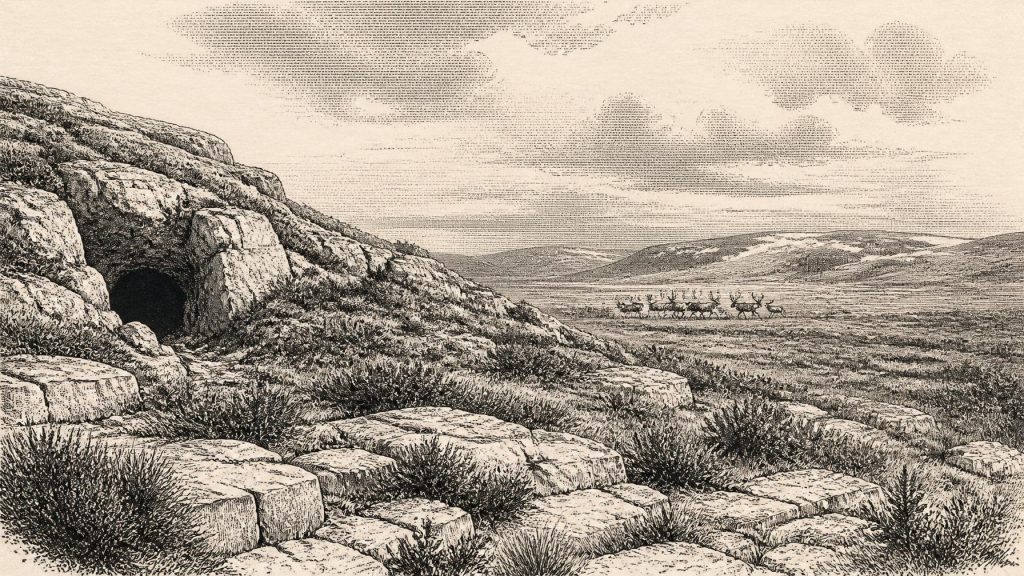
Around 34,000 years ago, Ireland was a climatically unstable late-Pleistocene landscape supporting diverse mammals, including mammoth, reindeer, giant deer, hyaena and bear. Castlepook Cave near Doneraile, County Cork, preserves important but disturbed faunal remains. A reindeer femur, tentatively dated around 31,000 BC, bears a mark interpreted as possible stone-tool butchery, raising the prospect of an exceptionally early human visit. However, the bone does not prove settlement, hunting, cultural affiliation or a permanent population. Cave deposits may reflect predators, natural processes and antiquarian excavation. Renewed research seeks intact stratigraphy, reliable dating and associated artefacts to clarify Ireland’s earliest possible human presence.
Dateline
The label 31,858 BCE is a modern convenience, not a year that anyone living in prehistoric Ireland could have named or recorded. No written calendars, individuals, events or political communities can be recovered at such precision. In archaeological terms, this notional point falls at roughly 33,800 years before present (where “present” conventionally means AD 1950), within the later part of Marine Isotope Stage 3, a highly variable interval of the last Ice Age. The responsible history of Ireland at this date is therefore a history of ranges, deposits and probabilities rather than anniversaries. It centres on an exceptionally important but still debated fragment of evidence from Castlepook Cave near Doneraile, County Cork.
Dating a Notional Year
Radiocarbon dating does not normally yield a single prehistoric calendar year. It measures the decay of radioactive carbon in once-living material, produces a result with an error range, and must then be calibrated against changing atmospheric carbon levels. A date expressed as 31,858 BCE should consequently be read as an approximate place on a deep-time timeline, not as a day or season fixed in the Irish archaeological record. The best chronological language is “around 34,000 calendar years ago”, while recognising that individual bones and sediments may be older or younger than that broad reference point.
This distinction matters especially at Castlepook. Early twentieth-century excavations recovered a rich collection of animal remains from a complicated cave system, but much of it came from antiquarian digging rather than modern, finely recorded excavation. Subsequent research has shown that improved sample preparation and accelerator radiocarbon dating can substantially revise earlier ages for southern Irish cave fauna. The deposits cannot simply be treated as one undisturbed moment in time: bones may have been accumulated by predators, moved through the cave, deposited in different episodes, or mixed during excavation.
A Reindeer Bone and Its Limits
The object most directly relevant to this article is a reindeer femur from Castlepook, held in the National Museum of Ireland’s Natural History collections. County Cork’s heritage publication assigns it an approximate date of 31,000 BC and presents a mark on the bone as having been made with a sharp stone tool during butchery. Ruth Carden’s identification of potentially human-made modifications made the specimen nationally significant: if the interpretation is upheld, it would carry evidence of human handling of an animal in Ireland far back into the Upper Palaeolithic.
Yet the claim requires careful wording. A date on the femur establishes, within a range, when the reindeer died; it does not alone date a person, a camp or a journey. Nor does a single surface incision automatically prove human action. Archaeologists distinguish cut marks from damage caused by teeth, trampling, sediment abrasion, breakage and excavation, using their shape, placement and microscopic characteristics. The interpretation of the Castlepook mark as butchery is important and plausible enough to have prompted renewed fieldwork, but it is not the same thing as a securely excavated hearth with tools scattered around it.
Accordingly, the bone cannot demonstrate a permanent population in Ireland in 31,858 BCE. It may indicate a short visit by one or more people who encountered or processed a reindeer; it may also preserve the residue of a more complex chain in which predators later dragged discarded remains into the cave. Even the attractive picture of a hunting party following a herd remains an interpretation, not an excavated scene. No securely associated Irish stone-tool assemblage, built shelter, human burial, art panel or settlement surface of this age has yet been established.
Castlepook’s Animal World
The cave nevertheless offers powerful evidence for an Ice-Age Irish landscape that was not lifeless. Its Pleistocene fauna has included woolly mammoth, reindeer, giant deer, brown bear, wolf, foxes, mountain hare, lemmings and spotted hyaena. Older assessments already identified Castlepook as Ireland’s principal assemblage for pre-Last Glacial Maximum vertebrates; more recent redating has reinforced the importance of southern Irish caves for Marine Isotope Stage 3, while also demonstrating that their animals do not all belong to a single date.
That qualification changes how the fauna should be imagined. It is reasonable to infer open, cold environments capable of supporting grazing and browsing mammals, together with carnivores and scavengers. It is not responsible to place every recorded species beside the Doneraile cave entrance in the same season of 31,858 BCE. The animal list is an archive accumulated across environmental changes. Mammoth and reindeer suggest broad, productive but exposed country; hyaenas point to a predator guild quite unlike any later historical Irish fauna. Their presence tells us that Ireland was repeatedly accessible to sizeable land mammals during parts of the late Pleistocene. It does not provide a population census or an exact map of habitats.
Predators were central agents in this archaeological record. Hyenas carry carcass parts into dens, chew bone and rearrange material; bears may use caves for shelter or hibernation; water and frost can shift sediments and bones. Thus a cave is not necessarily a place where every animal died, much less where people lived. Castlepook may preserve an animal den and natural trap as much as a human locality. This is why renewed work has sought intact deposits, careful stratigraphy, new dates and evidence such as lithics, charcoal and further modified bone rather than relying solely on old collections.
Climate Before the Ice Peak
At around 33,800 years ago Ireland lay in a climatically unstable northern Atlantic world. Marine Isotope Stage 3 included abrupt cold and milder episodes, rather than one uniform “Ice Age climate”. The continental ice sheets had not yet reached their later maximum configuration. Major modern reconstructions show that the British–Irish Ice Sheet grew from upland centres around 31,000 years before present and advanced dramatically towards the continental shelf between about 30,000 and 26,000 years ago, though its timing varied from sector to sector. This sequence warns against assuming that all of Ireland was either clear ground or continuously buried ice at the article’s nominal date.
For southern Ireland, the Castlepook fauna is the strongest indication that phases of open country existed before the Last Glacial Maximum. Elsewhere, buried organic deposits beneath later glacial sediments, notably in Fermanagh and Antrim, show that parts of Ireland experienced earlier intervals with vegetation, insects and freshwater environments before later ice overran or sealed them. Such deposits are invaluable environmental records, but their particular pollen spectra cannot be transferred wholesale to north Cork or assigned to 31,858 BCE. They demonstrate regional change and the fragmentary survival of evidence, not a national weather report.
Sea levels were far lower than today because so much water was locked in northern ice sheets. Areas of the present continental shelf were exposed, but Ireland’s precise connection with Britain or the Continent remains a difficult question shaped by ice, crustal movement, local relative sea level and changing coastlines. It is therefore safer not to claim a simple dry land bridge or a known migration route. Human or animal arrival, if it occurred at this time, could have involved exposed terrain, ice margins and water crossings whose character cannot yet be reconstructed in detail.
People Without a Recorded Society
There is no evidence for kingdoms, chiefs, tribal names, laws, diplomacy or organised warfare in Ireland at this date. There is equally no basis for applying later labels such as Irish, Gaelic or Celtic to any possible visitors. If people did reach the island, they belonged to the wider Upper Palaeolithic human world of north-west Europe, but Castlepook has yielded no diagnostic toolkit with which to identify an Aurignacian, Gravettian or other archaeological tradition. Cultural affiliation must therefore remain unknown.
A possible butchery mark permits only modest conclusions about everyday life. Processing a large ungulate could have supplied meat, marrow, hide, sinew, fat and bone, all materials of great value to mobile hunter-gatherers in cold country. A sharp stone edge would imply practical technological knowledge, but the tool itself is absent. We do not know whether the animal was hunted, found already dead, scavenged from another predator, or butchered by a group passing through. Nor do we know whether the people travelled as a family party, a seasonal hunting unit or a very small task group.
Religion, formal learning, exchange systems and artistic practice are beyond the reach of the evidence. Continental Upper Palaeolithic communities made sophisticated stone and bone equipment, ornaments and cave art, but that wider European record cannot fill Ireland’s evidential silence. There is no Irish object of about 31,858 BCE that demonstrates ritual, trade or teaching. The absence of proof should not be mistaken for proof that people lacked culture; it means that Ireland’s surviving record is too thin to describe it responsibly.
An Island of Fleeting Footprints
The central historical fact is uncertainty. Castlepook’s reindeer femur opens the possibility of a human presence in Ireland roughly twenty millennia earlier than the well-known late Upper Palaeolithic evidence from Alice and Gwendoline Cave, County Clare, dated to about 12,810–12,590 calibrated years before present. But the later Clare patella has the advantages of direct dating and detailed published analysis; it cannot validate every earlier claim automatically.
For 31,858 BCE, then, Ireland should be pictured neither as a settled homeland nor as a blank white void. It was a changing late-Pleistocene landscape intermittently capable of sustaining large mammals, predators and perhaps rare human visitors. At Doneraile, a reindeer bone bears a mark that may record deliberate carcass processing with a stone tool. That single possible action is historically momentous, but its proper power lies in what it asks archaeologists to investigate next: intact cave sediments, reliable chronologies and material evidence that can reveal whether this was an isolated encounter or part of a deeper, still largely hidden human story.
Primary Sources
- A reconsideration of the radiocarbon dating of the Marine Isotope Stage 3 fauna from southern Ireland
- The Irish Quaternary Fauna Project
- First evidence of a Late Upper Palaeolithic human presence in Ireland
- New insights on the fauna of Ireland's Younger Dryas and Early Holocene from Alice & Gwendoline Cave
- Growth and retreat of the last British–Irish Ice Sheet, 31,000 to 15,000 years ago: the BRITICE-CHRONO reconstruction
- Growth and retreat of the last British–Irish Ice Sheet, 31 000 to 15 000 years ago: the BRITICE-CHRONO reconstruction
- New data for the Last Glacial Maximum in Great Britain and Ireland
- Pattern and timing of retreat of the last British-Irish Ice Sheet
- Early deglaciation of the British-Irish Ice Sheet on the Atlantic margin of Ireland and Britain
- The problem of a late quaternary landbridge between Britain and Ireland
- The Island of Ireland: Drowning the Myth of an Irish Land-Bridge?
- Deglaciation, Earth crustal behaviour and sea-level changes in the determination of insularity: A perspective from Ireland
- Pleistocene vertebrates in the British Isles
- Heritage Artefacts of County Cork
- Archaeology Research Excavation Grant 2022
- 2022:564 – Castlepook Cave, Castlepook South, Cork
- Introduction to the Late Quaternary and Holocene of Northern Ireland
- Palaeoecology
- Phylogeographic, ancient DNA, fossil and morphometric analyses reveal ancient and modern introductions of a large mammal: the complex case of red deer (Cervus elaphus) in Ireland
- Stratigraphic and palaeo-geomorphological evidence for the glacial-deglacial history of the last British-Irish Ice Sheet in the north-western Irish Sea