Doneraile’s Reindeer Trace31859 BCE
Around 31,859 BCE, Ireland lay within the climatically unstable Marine Isotope Stage 3 of the last Ice Age, although conditions and ice extent varied regionally. Freshwater deposits at Derryvree, County Fermanagh, preserve evidence of cold, open, wet tundra-like terrain, while other deposits remain fragmentary and difficult to date. Castlepook Cave, County Cork, yielded reindeer, mammoth, giant deer, bear and hyaena remains, demonstrating intermittent animal use of southern Ireland. Re-dating has complicated their chronology. A marked reindeer femur may indicate human butchery about 33,000 years ago, but lacks excavation context. No established Palaeolithic settlement, tools, hearths or social history is known.

Dateline
The label 31,859 BCE offers a useful point on a modern timeline, but it cannot identify an event that happened in one knowable Irish calendar year. No writing, calendar or named community existed on the island, and evidence from this depth of time is dated in broad scientific ranges rather than to individual years. In conventional archaeological terms, the date falls within the Late Pleistocene, during Marine Isotope Stage 3 (MIS 3), an unstable interval of the last Ice Age. The responsible history of Ireland at this point is therefore a history of sediments, fossils, ice and uncertainty.
In “years before present” terminology, with “present” conventionally fixed at 1950, 31,859 BCE is roughly 33,800 calendar years ago. That places it within the calibrated range associated with the freshwater deposits at Derryvree, near Maguiresbridge in County Fermanagh: a radiocarbon determination of 30,500 ± c.1,100 radiocarbon years BP has been calibrated approximately to 36.9–31.7 thousand calendar years BP. This does not mean that Derryvree records the particular notional year 31,859 BCE. It means that its fossils offer one of the closest securely relevant environmental windows onto Ireland in the same broad time horizon.
A Country of Uneven Cold
Ireland was not a timeless, uniformly frozen wasteland. MIS 3 was marked by sharp climatic fluctuations, and the growth of the British–Irish Ice Sheet was neither simple nor simultaneous in every region. Recent reconstructions emphasise that ice-sheet expansion and retreat differed around its perimeter. Modelling of conditions around 31,000 years BP has even produced small ice caps in north-west Ireland while not requiring an island-wide marine-based ice sheet at that moment. Other work argues that significant ice may have developed earlier in parts of the wider British–Irish system. The exact extent of ice over Ireland around 33,800 calendar years ago consequently remains debated.
That uncertainty matters. It rules out an overconfident map showing either a wholly ice-covered Ireland or a wholly open island in this particular year. The surviving record instead indicates a changing patchwork: glaciers and snowfields in some uplands or northern districts, periglacial terrain beyond them, and at least periodically habitable, ice-free environments in the south and north. Later ice advances also scraped, buried and rearranged older deposits. Much of the evidence that might once have survived—soil surfaces, campsites, tracks, shorelines and light structures—was destroyed or lies concealed beneath till, peat, sea or modern ground.
Derryvree’s Wet Tundra
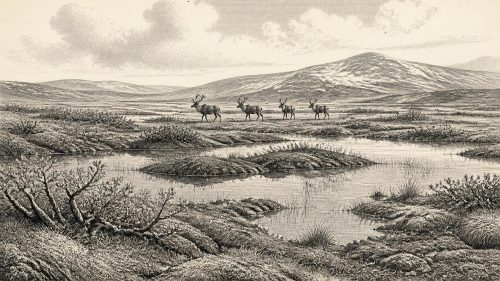
The Derryvree exposure is especially valuable because organic-rich freshwater silts and fine sands were preserved between two separate sheets of glacial till within a drumlin. Mosses, sedges and other plant remains, together with insects adapted to cold northern conditions, point to an open, treeless landscape. Earlier descriptions used the term “muskeg”: wet, peat-forming ground with shallow pools, plant-rich mud and mossy margins. It was a landscape shaped by frost, poor drainage and strong seasonality rather than by forest.
This is evidence, not a complete scenic reconstruction. Fossils from one locality describe the setting in which they accumulated; they do not establish the weather across all Ireland on a particular day, nor prove that every district had identical vegetation. Yet the Derryvree sequence strongly supports the wider conclusion that parts of Ireland experienced cold, open, non-forested conditions during this phase. Greenagho, also in Fermanagh, has yielded organic material beneath till with a reported radiocarbon age of about 32,460 BP, although specialists treat that old result cautiously and regard it as a minimum age. Taken together, such sites show both the value and the limits of Ireland’s fragmentary MIS 3 archive.
Animals at Castlepook
The most evocative evidence comes from Castlepook Cave near Doneraile in north County Cork. Collections made during early twentieth-century cave exploration contained remains attributed to animals including reindeer, woolly mammoth, giant deer, brown bear and spotted hyaena. The cave fauna demonstrates that southern Ireland was reached, at least intermittently, by a varied Pleistocene animal community. Reindeer and mammoth imply cold, open country with sufficient grazing or browse; hyaenas and bears remind us that caves were not neutral storage places but could be dens, shelters and traps within animal territories.
There is an important warning attached to this richness. Many Irish cave collections were excavated before modern standards of stratigraphic recording, and bones could have been moved by carnivores, water, excavation and later disturbance. A cave bone proves the presence of an animal, or the arrival of its remains, during a dated interval; it does not necessarily prove a stable breeding population nearby. Nor does a list of species from several dated specimens show that all lived together at the exact same moment. The Irish Quaternary Fauna Project and subsequent redating work have therefore been crucial: they test old collections with accelerator radiocarbon methods and improved chemical pretreatment rather than accepting Victorian or early twentieth-century associations at face value.
That work has complicated, rather than simplified, the chronology. Re-dating of southern Irish cave material has shown that several former radiocarbon determinations were too young, and has suggested that some Castlepook animals belonged earlier in MIS 3 than previously thought. Older published dates of roughly 34,000–35,000 radiocarbon years BP for mammoth and spotted hyaena were once used to group much of the fauna near this broad horizon; newer results indicate a more extended and potentially older sequence. The sound conclusion for 31,859 BCE is not that a particular mammoth, hyaena or reindeer was certainly alive that year, but that Ice Age animal life had reached and used parts of Ireland within the wider period.
A Possible Human Encounter
A reindeer femur fragment from Castlepook has made this interval especially significant. It has been reported as bearing a deep mark consistent with the use of a sharp stone tool in the processing of fresh bone, and public accounts have associated it with an age of about 33,000 years ago. If the mark is confirmed as anthropogenic and securely related to the dated bone, it would be evidence that people handled a reindeer in Ireland during MIS 3—far earlier than the long-accepted record of post-glacial settlement.
The conditional language is essential. The specimen derives from an old cave collection, not from a recently excavated occupation floor containing tools, hearths, butchered remains and datable charcoal in an intact sequence. No unequivocal Palaeolithic stone-tool assemblage, dwelling, hearth or cemetery has yet been established in Ireland for this horizon. Carnivore tooth damage, sediment abrasion and excavation damage can sometimes resemble human modification, so the diagnosis of a cut or chop mark must withstand microscopic comparison and renewed contextual research. The reindeer femur is best understood as a potentially transformative trace, not as proof of a resident population.
No Kingdoms, No Known Camps
There is accordingly no evidence for political affairs, diplomacy, organised warfare, chiefs, tribes or territories in Ireland around this date. There are no institutions, laws, monuments or named places in the historical sense. It would be misleading to write of an “Irish people” pursuing a national past: Ireland was a geographical region within a shifting north-west European Ice Age world, not a society documented by history.
Nor can religion, learning or culture be recovered directly. A cave’s later importance in ritual life cannot be projected backwards into MIS 3, and an isolated animal bone cannot reveal language, belief or ceremony. If people did reach the island, they may have travelled as a very small mobile hunting party, but even that is an interpretation rather than an established fact. The evidence does not support permanent settlement, family life, seasonal rounds, boat-building or repeated occupation.
The same restraint applies to economy and trade. The possible reindeer mark permits one narrow inference: a sharp edge may have been used to process animal tissue or separate bone. It does not demonstrate organised hunting, exchange networks, ownership of herds or commerce across the sea. Any movement of people and animals between Ireland, Britain and continental Europe depended on changing coastlines, sea levels, ice margins and exposed shelf terrain, but the routes available in one particular millennium remain incompletely known. The record documents opportunity and movement; it does not yet document an Irish trading world.
The Deep Record’s Meaning
What, then, can responsibly be said about Ireland around 31,859 BCE? It was part of a climatically volatile northern landscape in which ice, cold wetlands, open tundra-like vegetation and mobile animal populations repeatedly transformed the possibilities of life. Derryvree preserves a cold freshwater environment within a calibrated range that encompasses this nominal date. Castlepook preserves the bones of animals that occupied or reached southern Ireland during MIS 3 and a reindeer specimen that may, if further confirmed, preserve the island’s earliest known sign of human action.
Those are substantial discoveries precisely because they are so rare. They push Irish history beyond written narrative and even beyond the relatively well-attested Mesolithic, but they do not fill the silence with invented hunters, camps or ceremonies. The central development was environmental: Ireland stood within the advancing and fluctuating world of the last Ice Age. Its most important human story at this date remains a question written as a single possible tool-mark on reindeer bone.
Primary Sources
- A Reconsideration of the Radiocarbon Dating of the Marine Isotope Stage 3 Fauna from Southern Ireland
- The Irish Quaternary Fauna Project
- A Middle Midlandian Freshwater Series at Derryvree, Maguiresbridge, County Fermanagh, Northern Ireland
- Early Midlandian–Middle Midlandian, Pleistocene, Northern Ireland
- Figure 6: The Subdivision of the Quaternary Period in Ireland
- Occurrence of Mammalia Relicts at Site Castlepook Cave
- The Exploration of Castlepook Cave, County Cork, Being the Third Report from the Committee Appointed to Explore Irish Caves
- Heritage Artefacts of County Cork
- Growth and Retreat of the Last British–Irish Ice Sheet, 31,000 to 15,000 Years Ago: the BRITICE-CHRONO Reconstruction
- Behavioural Tendencies of the Last British–Irish Ice Sheet Revealed by Data–Model Comparison
- The Timing and Magnitude of the British–Irish Ice Sheet Between Marine Isotope Stages 5d and 2
- Pattern and Timing of Retreat of the Last British-Irish Ice Sheet
- Dynamic Cycles, Ice Streams and Their Impact on the Extent, Chronology and Deglaciation of the British–Irish Ice Sheet
- Trimlines, Blockfields and the Vertical Extent of the Last Ice Sheet in Southern Ireland
- Exploring Controls of the Early and Stepped Deglaciation of the Donegal Bay Ice Stream, British–Irish Ice Sheet
- The Last Glacial Maximum British-Irish Ice Sheet: a Reconstruction Using Digital Terrain Mapping
- BRITICE Glacial Map, Version 2: a Map and GIS Database of Glacial Landforms of the Last British–Irish Ice Sheet
- The IntCal20 Northern Hemisphere Radiocarbon Age Calibration Curve (0–55 cal kBP)
- The IntCal20 Approach to Radiocarbon Calibration Curve Construction: a New Methodology Using Bayesian Splines and Errors-in-Variables
- UCD School of Archaeology Research Day 2022
- Archaeological Survey
- Recorded Monuments Protected under Section 12: County Cork
- What Was on the Menu in Prehistoric Ireland?
- The Late-Glacial Sequence in Britain and Ireland