

Birm-166’s Tundra Basin31659 BCE
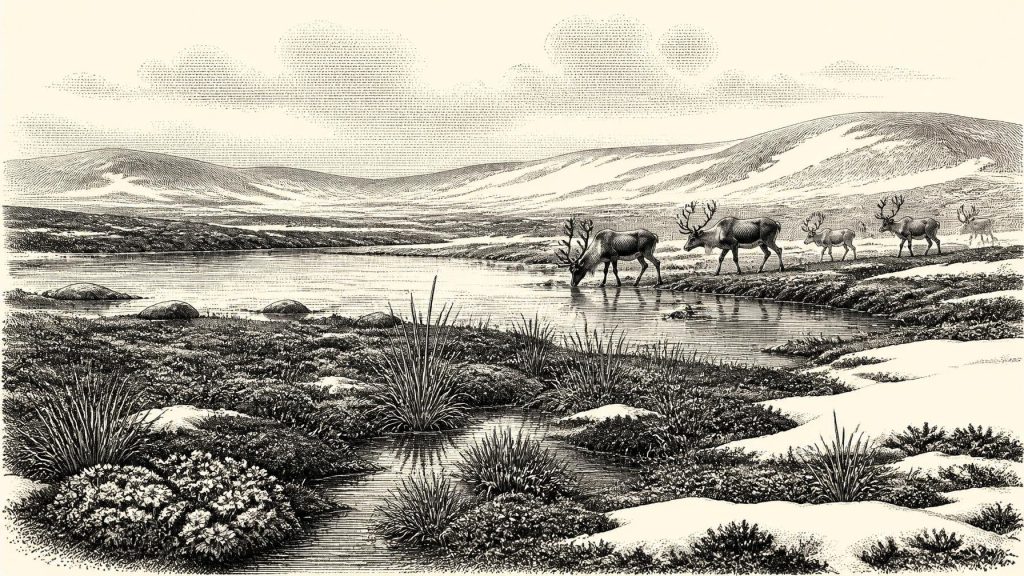
Around 33,600 calibrated years before 1950, Ireland lay within the unstable MIS 3 cold phase, rather than a precisely datable historical year. Derryvree, County Fermanagh, preserves freshwater sediments between glacial tills, indicating locally ice-free, treeless tundra with wet hollows, hardy plants and insects. Cave finds at Castlepook, County Cork, show that reindeer, mammoth, giant deer, predators and other cold-adapted animals occurred in Ireland during MIS 3, though not necessarily simultaneously. A possibly cut-marked reindeer bone may indicate fleeting human activity, but cannot prove settlement. Expanding ice and changing seas shaped uncertain connections with Britain and Europe during this changing period.
Dateline
“31,659 BCE” is a modern label, not a date that can be recovered from prehistoric Ireland with calendar-year precision. It corresponds broadly to about 33,600 calibrated years before AD 1950, within Marine Isotope Stage 3 (MIS 3), a climatically unstable stretch of the Late Pleistocene. No Irish event, individual, community or season can responsibly be assigned to that particular year. The evidence instead consists of deposits with wide chronological ranges, animal bones from caves, glacial landforms and modern re-analysis of old collections. The closest dated Irish environmental archive, at Derryvree near Maguiresbridge in County Fermanagh, has a conventional radiocarbon age of 30,500 ± roughly 1,100 radiocarbon years BP; published calibration places its formation broadly between about 36,900 and 31,700 calibrated years BP. The notional year falls within that broad interval, not at a pinpoint within it.
A Wetland Sealed by Ice
Derryvree is valuable because later glaciation both altered Ireland profoundly and destroyed much of the evidence for earlier landscapes. Road works in 1969 cut through a drumlin and exposed a sequence of fine sands and organic silts between two tills: unsorted sediment laid down directly by glacier ice. The lower till shows that ice had previously affected the site; the upper till shows that glacier ice returned after the freshwater deposits accumulated. Between them survives a brief geological archive of an ice-free or locally ice-free landscape: water, mud, plants, insects and small animal remains preserved in a hollow that would eventually be buried beneath a streamlined hill of glacial sediment.
That archive does not describe the whole island. It describes conditions near one Fermanagh basin during one extended period of deposition. Yet its plant and animal remains provide the soundest direct picture available for Ireland around this broad phase. They indicate open tundra vegetation and a periglacial climate: a landscape strongly governed by freezing and thawing, short growing seasons, wet hollows and sparse cover on exposed ground. Mosses, sedges, hardy herbs and aquatic plants grew around freshwater. Fossil records of bogbean (Menyanthes trifoliata) and mountain avens (Dryas octopetala) are particularly evocative, but they should not be made to carry more meaning than they can bear. They demonstrate suitable local habitats; they do not yield a complete map of vegetation or an annual weather record.
Open Ground, Not a Forested Island
The strongest interpretation is of largely treeless, heterogeneous country. There were wet, mossy margins around shallow water, sedgy patches, herb-rich ground and drier, wind-exposed surfaces. Snow and frozen ground may have endured for long periods, while summer thaw created pools, saturated soils and shifting channels. This was not necessarily a uniform white wilderness. Tundra supports life unevenly, and sheltered low ground could be markedly more productive than a nearby ridge. But neither is there evidence for the broad woodland familiar from later post-glacial Ireland. Pollen is often fragile, mobile and capable of being redeposited; isolated tree pollen grains cannot outweigh the wider assemblage of cold-climate plant macrofossils and insects.
The future contours of Ireland were also being prepared, though not in any human sense. The island’s later drumlins, rock basins, redistributed soils and modified drainage systems owed much to repeated ice advances and meltwater action. The last major British-Irish Ice Sheet had not yet reached its best-established maximum extent: evidence places the southern Irish maximum much later, around 26,000–21,000 calibrated years BP, while large-scale reconstructions show ice expansion beginning unevenly across these islands from about 31,000 years BP. At the time represented by Derryvree, therefore, Ireland contained an unstable mixture of cold open habitats, local ice masses and landscapes vulnerable to a renewed, much more extensive glaciation.
Animals at the North-Western Margin
Caves in the limestone country of north Cork supply a complementary, though differently dated and more complicated, record. Castlepook Cave near Doneraile has produced Ireland’s richest known Late Pleistocene vertebrate assemblage. Re-dating has shown that some older radiocarbon determinations from the cave understated the age of material by thousands of years. The resulting record establishes that, at different points in MIS 3, southern Ireland was reached by animals including reindeer, giant deer, brown bear, wolf, arctic fox, lemmings, spotted hyaena and woolly mammoth. These finds are proof that Ireland was not biologically empty in the decades of thousands of years before the Last Glacial Maximum.
They are not, however, a census for 31,659 BCE. Cave deposits may accumulate over millennia; bones can be moved by carnivores, water, collapse, digging and later excavation. Species dated at Castlepook need not all have lived together, nor can their presence in north Cork be mechanically transferred to Fermanagh. The important conclusion is more restrained: cold-adapted and open-country mammals repeatedly entered or survived in parts of Ireland during favourable intervals. Reindeer imply grazing country and seasonal mobility; hyaenas and wolves point to predators and scavengers within a food web capable of supporting large herbivores. A mammoth bone, bear remains and giant-deer bones make this fauna striking, but they do not turn Ireland into an African-style abundance of game.
The Castlepook Human Question
The period has acquired exceptional importance because a fragment of reindeer femur from Castlepook has been reported as about 33,000 years old and as bearing a mark interpreted by zooarchaeologist Ruth Carden as modification of fresh bone by a sharp stone tool. If that diagnosis is sustained, it would be the earliest known indication of human activity in Ireland, potentially placing a person or small party here far earlier than the well-established Mesolithic settlement record. It is an exciting proposition precisely because a cut on a bone can preserve the otherwise fleeting contact between people, an animal and a tool.
But the claim must be framed carefully. The bone does not come from a newly excavated occupation surface containing a hearth, stone-tool assemblage, shelter, human remains or repeated butchery evidence. Castlepook’s old excavations and the later reworking of cave sediments limit what can be inferred. A radiocarbon result dates the animal bone, while the interpretation of a surface mark as human cutting is a separate taphonomic judgement. Even accepting the mark as anthropogenic would demonstrate an episode of carcass processing, not permanent settlement, a named people, a hunting camp, or a continuous population. It cannot tell us whether the reindeer was hunted, scavenged or acquired after a predator kill. Recent investigations have sought intact, stratified Pleistocene deposits in the cave precisely because better contexts are needed to test such questions.
No Polities, No Chronicle
There is no evidence for political affairs in Ireland at this time: no rulers, territories, assemblies, diplomatic ties, warfare, law or institutional authority. Nor is there evidence for farms, fields, domesticated animals, metalworking, monuments, formal cemeteries, shrines, writing or a market economy. Such absences should not be disguised by the language of later history. The archaeological record does not permit an account of Irish “tribes”, nor should the presence of large mammals be converted into a claim that communities were established beside them.
If people did enter Ireland during this part of MIS 3, comparisons with Upper Palaeolithic groups elsewhere in north-west Europe make it reasonable to suppose that they would have depended on practical knowledge of animal behaviour, stone-working, clothing, fire and social co-operation. Yet that is comparative context, not Irish evidence. No securely associated Irish lithic technology, ornament, art, dwelling or burial reveals their identity, language, beliefs, kinship system or routes of travel. The intellectually honest position is that human presence around this date remains possible and potentially supported by one remarkable bone, whereas a resident society remains unproven.
Movement and Connection
Ireland’s apparent remoteness today can mislead. Global sea level was lower during the cold stages because much water was locked in ice sheets, exposing broad areas of the continental shelf. But lower sea level does not automatically demonstrate a broad, dry and dependable land bridge from Ireland to Britain at this specific time. Ice loading, crustal movement, meltwater, shallow seas and changing coastlines produced a complex palaeogeography. Scholarly reconstructions differ in details, and the evidence cannot specify whether animals — or any people — arrived across dry land, coastal corridors, seasonal ice, short sea crossings, or combinations of these routes at different times.
It is safer to describe Ireland as intermittently connected within a wider north-west European ecological zone than to draw a single route on a map. The Castlepook fauna shows that movement occurred; the Derryvree wetland shows that a cold but living inland environment existed; neither proves the exact geography of a crossing in one modernly numbered year. This distinction matters because later Irish isolation, and the much later arrival of settled communities, were not inevitable facts of nature but outcomes of changing ice, sea and climate.
What This Date Can Mean
The historical significance of this year lies not in an invented episode but in a threshold of evidence. Around 33,600 calibrated years ago, Ireland was part of a changing Late Pleistocene world: open, cold and locally wet; inhabited by a variable fauna; increasingly shaped by expanding ice; and perhaps visited by people whose trace survives, if at all, in the contested incision on a reindeer bone. Derryvree’s Birm-166 horizon gives the most direct local environmental anchor, while Castlepook demonstrates the wider animal world of southern Ireland. Together they replace the old image of an entirely blank Ice Age island with something richer, but also more demanding: a landscape known in fragments, whose silences are as important as its fossils.
Primary Sources
- A Middle Midlandian Freshwater Series at Derryvree, Maguiresbridge, County Fermanagh, Northern Ireland
- A Reconsideration of the Radiocarbon Dating of the Marine Isotope Stage 3 Fauna from Southern Ireland
- The Irish Quaternary Fauna Project
- Growth and Retreat of the Last British–Irish Ice Sheet, 31,000 to 15,000 Years Ago: The BRITICE-CHRONO Reconstruction
- Growth and Retreat of the Last British–Irish Ice Sheet, 31,000 to 15,000 Years Ago: The BRITICE-CHRONO Reconstruction
- Late Pleistocene Chronostratigraphy and Ice Sheet Limits, Southern Ireland
- Trimlines, Blockfields and the Vertical Extent of the Last Ice Sheet in Southern Ireland
- Dimensions and Chronology of the Last Ice Sheet in Western Ireland
- Timing and Pace of Ice-Sheet Withdrawal Across the Marine–Terrestrial Transition West of Ireland During the Last Glaciation
- Radiocarbon Constraints on the Age of the Maximum Advance of the British–Irish Ice Sheet in the Celtic Sea
- The Island of Ireland: Drowning the Myth of an Irish Land-Bridge?
- The Problem of a Late Quaternary Landbridge Between Britain and Ireland
- Deglaciation, Earth Crustal Behaviour and Sea-Level Changes in the Determination of Insularity: A Perspective from Ireland
- The IntCal20 Northern Hemisphere Radiocarbon Age Calibration Curve (0–55 cal kBP)
- The IntCal20 Northern Hemisphere Radiocarbon Age Calibration Curve (0–55 cal kBP)
- Irish Pleistocene Biostratigraphy
- Pleistocene Vertebrates in the British Isles
- Heritage Artefacts of County Cork 2021
- Archaeological Heritage of County Cork 2020
- Castlepook Cave, County Cork, 2022 Excavation Report
- Ireland’s Palaeolithic Archaeology – Fleeting Footprints in a Frozen Land
- Guide to the National Museum of Ireland
- BSBI: Menyanthes trifoliata
- BSBI: Dryas octopetala