Castlepook’s Incised Reindeer31353 BCE
Circa 31,353 BCE, Ireland lay within an unstable Late Pleistocene cold phase, not a datable historical year. Derryvree, County Fermanagh, preserves a wetland between glacial tills, dated broadly enough to encompass this period, indicating open, treeless tundra with freshwater habitats, grasses, sedges, mosses and cold-adapted plants. Castlepook Cave, County Cork, yielded mammoth, reindeer, giant deer and predators, demonstrating intermittent cold-open habitats and ecological links with north-western Europe. An incised reindeer femur may record stone-tool butchery and brief Upper Palaeolithic human presence, but cannot prove settlement. Glaciation, erosion and sea-level change likely destroyed evidence, requiring cautious interpretation of Ireland’s early record.
Dateline
The numbered year 31,353 BCE cannot be treated as a date in the ordinary historical sense. No contemporary Irish calendar, written record or annually resolved archaeological sequence exists for this part of the last Ice Age. It is therefore impossible to say what happened on the island in that particular year, to name an individual, or to describe a political event. What can be responsibly examined is a broad Late Pleistocene horizon, within Marine Isotope Stage 3 (MIS 3), represented by scientific dates with substantial margins of uncertainty and by deposits whose formation may itself have taken centuries.
In calendar terms, 31,353 BCE is about 33,300 years before the radiocarbon reference year of 1950. It falls within a long, unstable cold phase before the Last Glacial Maximum, when the British–Irish Ice Sheet later reached its greatest known extent, broadly around 25,000–23,000 years ago. Ireland was not the familiar green and wooded island of later prehistory. Its landscapes were repeatedly altered by cold, ice growth, meltwater, wind and changing sea levels. The evidence is sparse, but it is unusually revealing in two places: a buried wetland at Derryvree near Maguiresbridge in County Fermanagh, and the bone-bearing passages of Castlepook Cave near Doneraile in north County Cork.
Dating a Deep-Time Ireland
The closest firm environmental chronology comes from Derryvree. Roadworks in 1969 cut through a drumlin and exposed fine sands, silts and organic-rich material sealed between two deposits of till, the unsorted debris left by glacier ice. The organic layer produced a conventional radiocarbon determination of 30,500 ± 1,100 radiocarbon years BP, known as BIRM-166. Calibration converts radiocarbon measurements into estimated calendar ages, but it does not create annual precision. Published calibrations place this determination broadly around 36,900–31,700 calibrated years BP, approximately 34,950–29,750 BCE. The requested year lies within that large range, not at a securely identifiable point within it.
This distinction matters. The Derryvree sediments are evidence that their locality supported freshwater and wet ground during an interval before a later advance of ice covered the deposit. They are not proof that all Ireland was ice-free at once, nor a complete weather record for the island. Equally, the range should not be compressed into a neat claim that the deposit represents “Ireland in 31,353 BCE”. It offers a time-window, not a snapshot.
The Derryvree Wetland
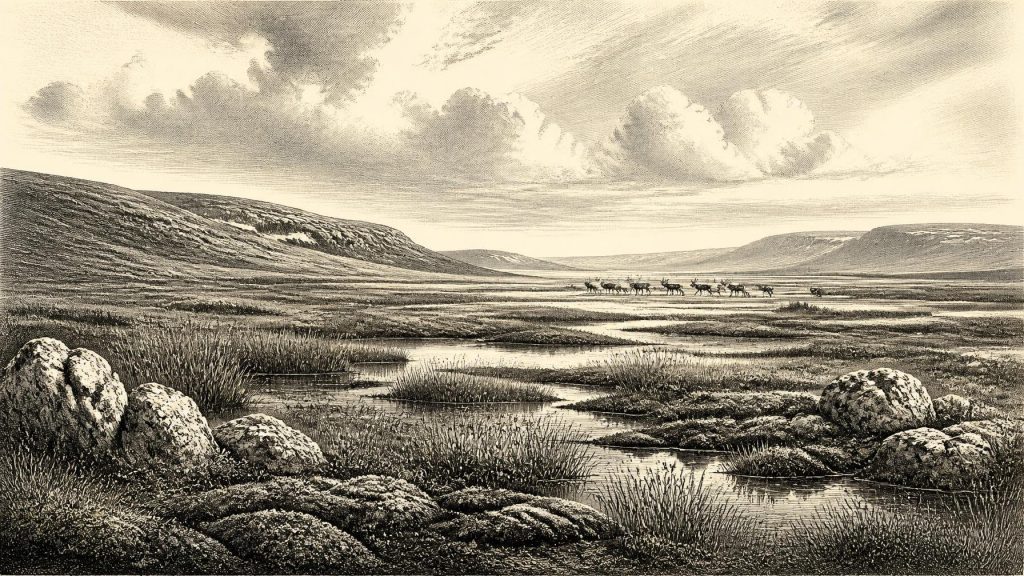
Within that window, Derryvree gives the clearest impression of an Irish environment capable of supporting life in a severe climate. Pollen, plant macrofossils, mosses and insects indicate an open, largely treeless tundra or muskeg landscape. Grasses and sedges were important; remains of plants associated with cold, wet ground include bogbean, mountain-avens and eight-petalled mountain-avens, alongside a varied moss flora. The insect assemblage suggests pools, plant-rich water margins and mossy surfaces. Sparse juniper pollen has been recorded, but it is not evidence for woodland. The broader signal is of exposed vegetation low to the ground, with cold winters and periglacial conditions.
Such terrain was neither lifeless nor uniform. Water gathered in hollows; silts accumulated where flow slackened; summer growth could exploit the short season. Yet it was a difficult country, vulnerable to frost action, wind exposure and abrupt climatic shifts. The surrounding drumlin geology also preserves the larger rhythm: before the upper till was laid down, water and plants occupied the hollow; afterwards, glacier ice had advanced over or near it. The wetland is thus a record of environmental opportunity bracketed by glacial change.
Fermanagh’s evidence should be read alongside, not projected wholesale onto, Cork. Regional conditions varied with altitude, latitude, distance from ice margins and the changing circulation of sea and air. Nevertheless, Derryvree demonstrates that parts of Ireland could contain freshwater habitats and open vegetation in the later range of the date under discussion. It corrects any simple image of an island continuously entombed beneath ice, while still leaving no grounds for imagining a temperate forest or a settled agricultural landscape.
Animals in the Awbeg Valley
Castlepook Cave, in limestone beside the Awbeg Valley below the Ballyhoura Hills, provides a different archive. Excavations there recovered a remarkable Ice Age fauna: woolly mammoth, reindeer, giant deer, brown bear, wolf, Arctic fox, lemmings and spotted hyaena. These finds demonstrate that Irish environments, at differing moments before the Last Glacial Maximum, were connected ecologically to the cold-open worlds of north-western Europe. Large herbivores could use grassland and herb-rich habitats; carnivores and scavengers followed the opportunities they created.
But a cave assemblage is not a census of animals living together on one day. Castlepook’s old collections came from several passages and sedimentary contexts, and caves are places where bones can be accumulated, moved and mixed by carnivores, water, collapse and excavation. Improved methods have also shown that some older radiocarbon determinations require reassessment. The secure conclusion is that a distinctive cold-climate fauna reached southern Ireland during parts of the Late Pleistocene. It is less secure to assign every species, or every bone, to one precisely simultaneous landscape.
Reindeer are especially relevant. They were well adapted to seasonal, open country, but their presence does not demonstrate an unbroken migration route, a fixed herd territory, or permanent human hunting grounds. Mammoths and spotted hyaenas are equally important reminders that Pleistocene Ireland had faunal combinations absent from the modern island. Their bones speak to shifting habitats and animal movements; they do not by themselves describe human society.
A Mark on a Reindeer Femur
The most provocative item for this broad period is a reindeer hind-leg bone from Castlepook. County Cork heritage publications place it at about 31,000 BCE and report a deep incision interpreted by zooarchaeologist Ruth Carden as having been made on fresh bone by a sharp stone implement during carcass processing. If that interpretation is upheld, it is evidence that people handled and butchered reindeer in Ireland during the Upper Palaeolithic, vastly earlier than the island’s long-recognised Mesolithic settlement record.
The evidence must nevertheless be kept in proportion. The dated bone establishes the approximate age of the animal, while identification of its mark as a tool incision is a separate zooarchaeological judgement. One modified bone does not prove that the reindeer was killed at the cave, that people occupied the cave, or that a permanent community lived in the Awbeg Valley. Carnivores may have brought a discarded or scavenged portion of carcass into the passages; later disturbance may have affected its context. Nor have diagnostic Upper Palaeolithic stone tools, hearths, dwellings or a securely stratified occupation surface been recovered from Ireland for this horizon.
The cautious interpretation is therefore an episode of human presence, perhaps brief and mobile, rather than established colonisation. A small party could have processed an animal elsewhere and left, lost or discarded part of the limb before the bone entered the cave’s complex depositional history. That is an inference, not a demonstrated narrative. Yet even such a limited encounter would be significant: it would place human activity at the far north-western edge of Upper Palaeolithic Europe during a period when climate and habitat were fluctuating sharply.
People Without a Recorded Society
There is no evidence from Ireland around this date for political institutions, chiefs, territories, diplomacy, warfare or law. No settlement is known, and there are no buildings, burials, monuments, art objects or named groups. It would be misleading to attach later Irish identities, Celtic traditions or medieval origin stories to people who may have visited this landscape more than thirty-three millennia before the historical record.
Nor can an economy or trade system be reconstructed. If the Castlepook mark was made by people, the act implies knowledge of a sharp stone edge and the practical value of a reindeer carcass: meat, hide, sinew, marrow or bone were potentially useful resources. But none of those products survives as a demonstrable Irish assemblage from this moment, and there is no Irish evidence for exchange networks. Likewise, ritual, language, teaching, music and artistic expression are beyond recovery here. Upper Palaeolithic communities elsewhere in Europe possessed rich cultural traditions, but importing those traditions into Ireland without local material evidence would turn analogy into assertion.
Threshold Rather Than Beginning
For Ireland, this is best understood as a threshold landscape. Derryvree records wet, open ground between phases of glaciation. Castlepook preserves animals adapted to tundra and steppe-like country, and perhaps one trace of human butchery. Together they show that Late Pleistocene Ireland was intermittently habitable for plants and animals, and possibly accessible to people, even though the later advance of the British–Irish Ice Sheet would scour, bury and destroy much evidence.
That destructive history helps explain the silence. Coastal plains now drowned or reshaped by later sea-level rise may once have contained routes, camps or hunting places; glacial erosion removed or disturbed many land surfaces; caves preserve bones more readily than light organic shelters or small hearths. Absence of evidence is not proof that no person ever entered Ireland, but it does set a strict limit on what can be claimed. Around 31,353 BCE, the responsible history of Ireland is not of kingdoms or communities. It is of a changing Ice Age environment, reindeer and other cold-climate animals, and a single incised bone that may mark a fleeting human encounter.
Primary Sources
- First evidence of a Late Upper Palaeolithic human presence in Ireland
- New insights on the fauna of Ireland's Younger Dryas and Early Holocene from Alice & Gwendoline Cave
- The colonization of Ireland: A human ecology perspective
- Ireland: Submerged Prehistoric Sites and Landscapes
- Palaeoecology
- Figure 6.— The subdivision of the Quaternary Period in Ireland
- Exploring controls of the early and stepped deglaciation on the western margin of the British-Irish Ice Sheet
- Growth and retreat of the last British–Irish Ice Sheet, 31,000 to 15,000 years ago: the BRITICE-CHRONO reconstruction
- Stratigraphic and palaeo-geomorphological evidence for the glacial-deglacial history of the last British-Irish Ice Sheet in the north-western Irish Sea
- Castlepook Caves
- Heritage Artefacts of County Cork
- The Irish Quaternary Fauna Project
- Genetic and archaeological evidence for the late introduction of the red deer to Ireland
- Archaeological excavations at Killuragh Cave, Co. Limerick
- Zoological Perspectives on the Late Glacial
- On the Cave of Castlepook, near Doneraile, Co. Cork
- Revisiting Alice and Gwendoline Cave, Co. Clare: New light on the 1902 excavations
- Ireland's Palaeolithic Archaeology – Fleeting Footprints in a Frozen Land
- BSBI: Menyanthes trifoliata
- BSBI: Dryas octopetala