
Castlepook’s Butchery Scar31352 BCE
31,352 BCE is a modern approximation within late Marine Isotope Stage 3, not a precisely datable Irish year. Derryvree sediments in Fermanagh, preserved between glacial tills, record local treeless tundra wetlands with cold-adapted plants and insects. Castlepook Cave in Cork contains Late Pleistocene bones of mammoth, hyaena, reindeer and other fauna, demonstrating episodic animal dispersal across changing Ice Age geography. A marked reindeer femur may indicate stone-tool butchery by visiting Upper Palaeolithic people, but lacks secure context and cannot prove settlement. No polities, religion or continuous population are evidenced. Environmental instability, glacial change and fragmentary archives define this period overall.
Dateline
The label 31,352 BCE should not be mistaken for a date in the historical sense. No calendar, written testimony, settlement sequence or archaeological layer allows events in Ireland to be fixed to this individual year. It is a modern way of placing a point roughly 33,300 calendar years before AD 1950, within the later part of the Pleistocene Ice Age. The responsible scale is therefore not a year but a broad span of millennia: the later Middle Midlandian, generally correlated with Marine Isotope Stage 3 (MIS 3), a climatically unstable interval before the fullest expansion of the last British–Irish Ice Sheet.
What can be said is important, if necessarily qualified. Parts of the landmass now called Ireland supported cold-adapted plants and animals during portions of this period. In County Fermanagh, sediments preserved beneath a drumlin record a treeless freshwater and tundra environment. In north Cork, the remarkable bone collection from Castlepook Cave shows that mammoth, spotted hyaena, reindeer and other large mammals reached Ireland in the Late Pleistocene. A reindeer femur from that cave has also been interpreted as carrying a stone-tool butchery mark. If that interpretation is sustained, it may represent a fleeting human action close to this broad period; it does not demonstrate an Irish population, settlement or political community.
A Date Made from Ranges
Scientific dating at this depth is expressed through measured ages, laboratory uncertainty and calibration, not by a neat BCE anniversary. Radiocarbon years and calendar years are not identical, because atmospheric carbon levels varied through time. The conversion is especially wide and difficult beyond about 30,000 radiocarbon years ago. Nor does a date on animal bone automatically date every event in that bone’s history: it estimates when the animal died, not necessarily when a surface mark was made, when the bone entered a cave, or when it was excavated.
The point represented by 31,352 BCE belongs near the transition towards a colder, more glaciated world. The later Last Glacial Maximum, when ice expanded over much or all of Ireland, lay millennia ahead. Yet this was not a benign prelude to it. North Atlantic climate shifted abruptly, glaciers waxed and waned, and local environments could differ sharply according to elevation, exposure, drainage and proximity to ice. Ireland was not a fixed modern island with familiar coasts, rivers or vegetation. Lower global sea levels exposed larger areas of continental shelf, while ice and sea conditions altered the practical geography of routes between Ireland, Britain and continental Europe.
The Derryvree Wetland
The clearest environmental archive relevant to this era lies at Derryvree, near Maguiresbridge in County Fermanagh. Roadworks in 1969 cut through a drumlin and exposed organic silts and fine sands between two thick, distinct sheets of till. Till is debris laid down by glacier ice. The intervening organic deposit therefore records a period when this particular site was not overridden by the ice that formed the enclosing layers. It is not evidence that the whole of Ireland was ice-free at the same instant, but it is compelling local evidence for a non-glacial landscape between separate glacial episodes.
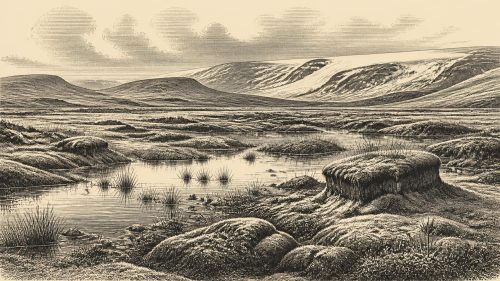
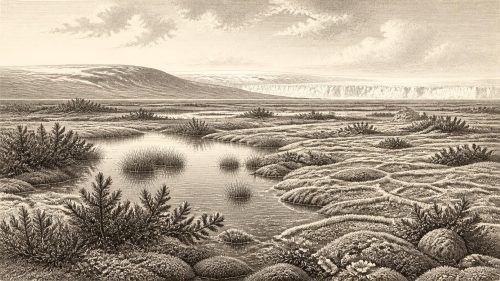
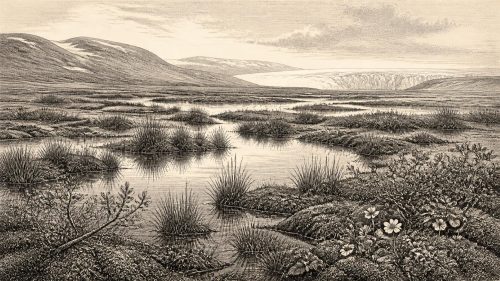
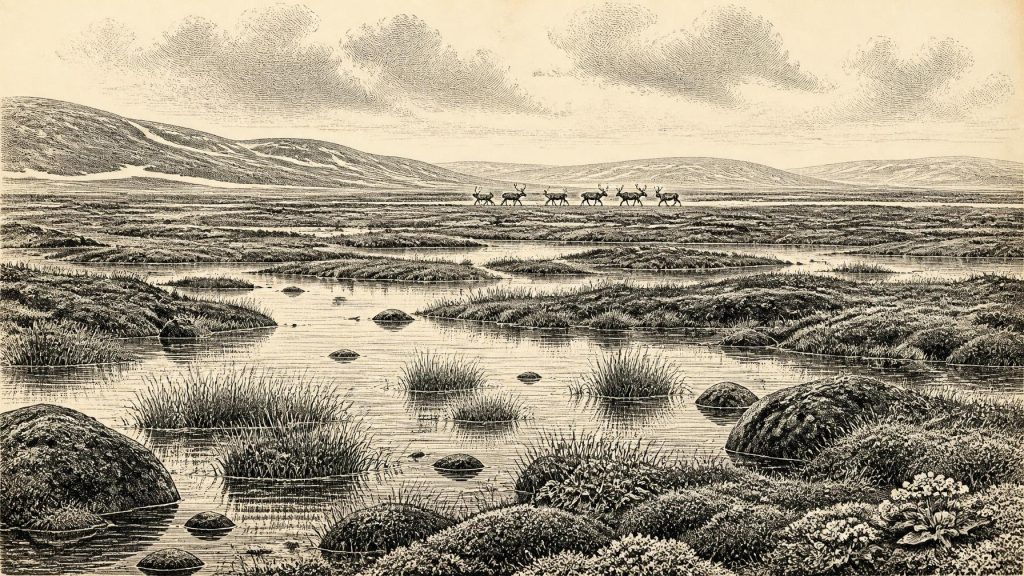
The Derryvree material returned a conventional radiocarbon determination of 30,500 radiocarbon years BP, with a substantial uncertainty. It should not be treated as an exact match for 31,352 BCE. Rather, it places the deposit in the same broad late-MIS-3 environmental world and demonstrates why year-by-year certainty is impossible. Pollen, plant macrofossils, mosses and insect remains preserve a detailed but local ecological record. They point to open tundra or muskeg: wet, peaty ground with shallow freshwater, mossy margins, sedges, grasses and hardy herbs, rather than forest.
Among the identified plants were species whose modern distributions evoke cold, open ground or northern wetland habitats: mountain avens, dwarf willow, bogbean, water-milfoil and a rich moss flora. These remains are observations from the sediments. The wider reconstruction—a landscape of harsh winters, frozen or seasonally frozen ground, short growing seasons and sparse dry-land cover—is an interpretation based on the ecological requirements of the plants, the insect evidence and the deposit’s glacial setting. It is a well-supported interpretation, but not a photograph of every valley in Ireland.
Animals at the Atlantic Edge
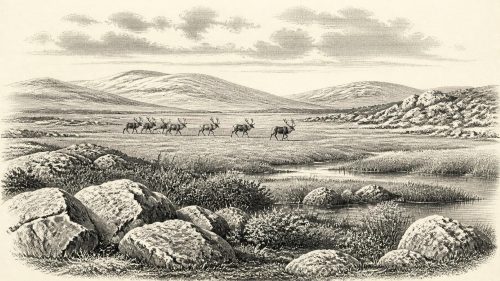
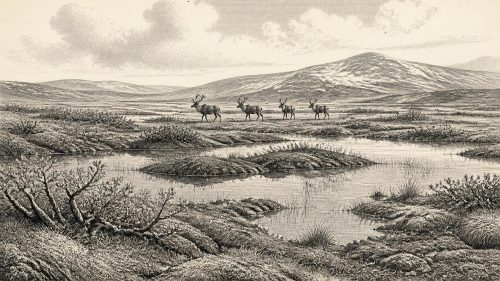
Castlepook Cave, near Doneraile in County Cork, supplies a different kind of evidence: animal bones accumulated in a limestone cave system. Its Late Pleistocene fauna includes woolly mammoth, spotted hyaena, reindeer, brown bear, wolf, foxes, hare, lemmings and giant deer. The assemblage makes clear that Ice Age Ireland, when conditions allowed, was home to animal communities wholly unlike those of later historic centuries. Large grazers and browsers could exploit open vegetation, while carnivores and scavengers followed their prey and their carcasses.
That does not mean all those animals stood together on one day, or that Castlepook was a pristine hunting camp. Cave deposits are complicated archives. Carnivores may carry bones into dens; water can move material; animals can die naturally in fissures; and many of the original excavations occurred in the early twentieth century, before modern standards of stratigraphic recording. Radiocarbon work has greatly improved the chronological picture, but some older collections remain mixed or poorly contextualised. The right conclusion is that the cave attests to repeated animal use and changing faunas across a long period, not a single intact scene.
The geographical implication is nonetheless striking. Mammoth and hyaena could only have reached Ireland through episodes of dispersal across a much altered north-west European landscape. Low sea levels may have narrowed or rearranged water barriers, but do not justify a simple image of a permanent, dependable land bridge. Ice, meltwater, estuaries, sea ice, seasonal weather and shifting coastlines mattered. Animal arrivals were episodic, and Ireland’s Pleistocene fauna was less diverse than that of larger connected regions. The island—or periodically island-like landmass—was an exposed western margin, not an automatic extension of the continent.
The Reindeer Femur
One object gives this remote period an unusual human dimension. A reindeer femur from Castlepook Cave, held in the National Museum of Ireland’s natural-history collections, has been presented by Ruth Carden and County Cork heritage material as dating to about 31,000 BC and bearing a deep incision made while the bone was fresh. The mark has been interpreted as damage from a sharp stone implement during carcass processing. If it is indeed a human-made cut or chop and contemporary with the animal’s death, the most economical explanation is that one or more Upper Palaeolithic people butchered a reindeer somewhere in the locality.
That possibility deserves attention, but it cannot carry more historical weight than the evidence permits. The bone was recovered from a cave collection rather than from a newly excavated occupation floor where tools, hearths, food refuse and dating samples lay securely together. A cut mark must be distinguished from carnivore damage, trampling, weathering, sediment abrasion, breakage and earlier excavation damage. The bone’s radiocarbon age dates the reindeer, not the person who may have cut it. No securely associated stone-tool assemblage, hearth, dwelling, burial or repeated settlement of comparable age has yet been identified in Ireland.
Accordingly, this is not a basis for describing a named people, a permanent colonisation, a hunting territory or a continuous Irish ancestry at 31,352 BCE. It is better understood as a serious but still limited clue: potentially the trace of a very small, mobile party at the western fringe of Upper Palaeolithic Europe. The difference between a possible visit and a demonstrable resident population is fundamental.
No Polities, No Proven Religion
There were no Irish kingdoms, tribes, diplomatic alliances, laws or political borders that can responsibly be recovered for this period. Nor is there evidence from Ireland for temples, formal burial grounds, ceremonial monuments, writing, art or a defined religious tradition around this notional date. It would be misleading to borrow cave art, weapons, clothing or ritual from continental Upper Palaeolithic sites and present them as Irish facts. Such material can provide a broad European comparison, not evidence that the same practices occurred at Castlepook or Derryvree.
If people did visit Ireland, their knowledge would have been practical, learned and socially shared: reading animal tracks, choosing routes through wet ground, handling stone, anticipating weather and making use of carcasses. But this remains inference from the demands of survival and from better documented Upper Palaeolithic societies elsewhere. It cannot be converted into a detailed account of Irish everyday life. Even the femur, if humanly modified, records one act of carcass processing rather than a domestic economy.
An Environmental History
The most important development around this date was therefore environmental instability. Locally ice-free tundra wetlands could sustain plants, insects and mammals, yet expanding ice sheets would later erase, bury or reshape much of the evidence. Derryvree survived precisely because its freshwater deposits were sealed beneath glacial sediment; Castlepook preserved bones because its limestone cavities accumulated them. Such chance survivals explain both the richness and the severe limits of the record.
Ireland at this time is best seen as a changing Ice Age landscape of pools, sedge-rich margins, open ground and mobile animal populations, set beneath a volatile northern climate. The possible butchery scar on a Cork reindeer bone adds a tantalising human question to that landscape. It does not answer it conclusively. For 31,352 BCE, the honest history is one of calibrated ranges, surviving deposits and carefully bounded possibilities—not an invented event in a calendar year.
Primary Sources
- A Middle Midlandian Freshwater Series at Derryvree, Maguiresbridge, County Fermanagh, Northern Ireland
- The Irish Quaternary Fauna Project
- Growth and Retreat of the Last British–Irish Ice Sheet, 31 000 to 15 000 Years Ago: the BRITICE-CHRONO Reconstruction
- Response of the Irish Ice Sheet to Abrupt Climate Change During the Last Deglaciation
- Dimensions and Chronology of the Last Ice Sheet in Western Ireland
- Radiocarbon Constraints on the Age of the Maximum Advance of the British–Irish Ice Sheet in the Celtic Sea
- Oscillating Retreat of the Last British-Irish Ice Sheet on the Continental Shelf Offshore Galway Bay, Western Ireland
- Ice Sheet Extension to the Celtic Sea Shelf Edge at the Last Glacial Maximum
- First Evidence of a Late Upper Palaeolithic Human Presence in Ireland
- Heritage Artefacts of County Cork
- The Mesolithic in Ireland: When Was It?
- Ireland’s Palaeolithic Archaeology – Fleeting Footprints in a Frozen Land
- UCD School of Archaeology Research Day 2022
- Palaeoecology: Irish Association for Quaternary Studies Field Guide
- The Subdivision of the Quaternary Period in Ireland
- The Geology of Ireland: Cenozoic, Tertiary and Quaternary
- Dryas octopetala L.
- Menyanthes trifoliata L.
- Salix herbacea L.
- Myriophyllum alterniflorum DC.