The Awbeg Reindeer Enigma31173 BCE
Around 31,173 BCE, Ireland lay in the unstable cold conditions of Marine Isotope Stage 3, with episodic glaciation and temporary habitable areas. Organic sediments at Derryvree record freshwater tundra-like wetlands, though only across broad dated ranges. Castlepook Cave preserves diverse pre-Last Glacial Maximum fauna, including reindeer, mammoth, predators and cold-adapted mammals, demonstrating intermittent connections to north-western Europe when lower sea levels exposed land. A cut-marked reindeer femur may indicate early human carcass processing, but cannot establish settlement or continuous occupation. Later ice destroyed much evidence, leaving a fragmentary picture of changing wetlands, mobile animals and uncertain human presence in Ireland.
Dateline
“31,173 BCE” is a useful modern label, not a year that anyone in prehistoric Ireland could have named, recorded or experienced as a calendar date. In scientific terms it falls roughly 33,100 years before present, where “present” conventionally means 1950. Archaeology cannot identify an event in this single year. The responsible picture is therefore one of overlapping, calibrated ranges, sedimentary sequences and cautiously interpreted animal remains. Around this point in the Late Pleistocene, Ireland lay within the long cold phase known locally as the Midlandian and internationally within Marine Isotope Stage 3. It was not yet at the fullest extent of the Last Glacial Maximum, but climate was unstable, ice was growing in the wider region, and habitable ground could be temporary and unevenly distributed.
A Date Within a Range
The most relevant Irish chronological evidence comes from deposits whose dates span centuries or millennia. At Derryvree, near Maguiresbridge in County Fermanagh, road works exposed organic freshwater silts and sands sealed between two tills: sediment laid down by ice. The order of the layers provides the essential fact. There had been glaciation, then an interval when this locality supported fresh water and organic accumulation, followed by renewed glaciation. A conventional radiocarbon determination from the organic series was 30,500 radiocarbon years BP, with a substantial uncertainty. When calibrated, estimates for the sequence extend broadly through the later part of Marine Isotope Stage 3, with one published reconstruction placing it about 36,900–31,700 calibrated years BP.
That is the scale at which this history must be written. The date in the heading falls within a broad window relevant to Derryvree, but it cannot be attached to the formation of a particular pool, the passage of a particular animal, or an individual human visit. Nor does Derryvree prove that every part of Ireland was ice-free at once. It is a local archive beneath a drumlin, extraordinarily valuable precisely because later ice buried rather than entirely removed it. Its evidence establishes conditions at and around one northern locality; regional reconstruction requires comparison with other deposits, cave records, landforms and offshore evidence.
Fresh Water Between the Tills
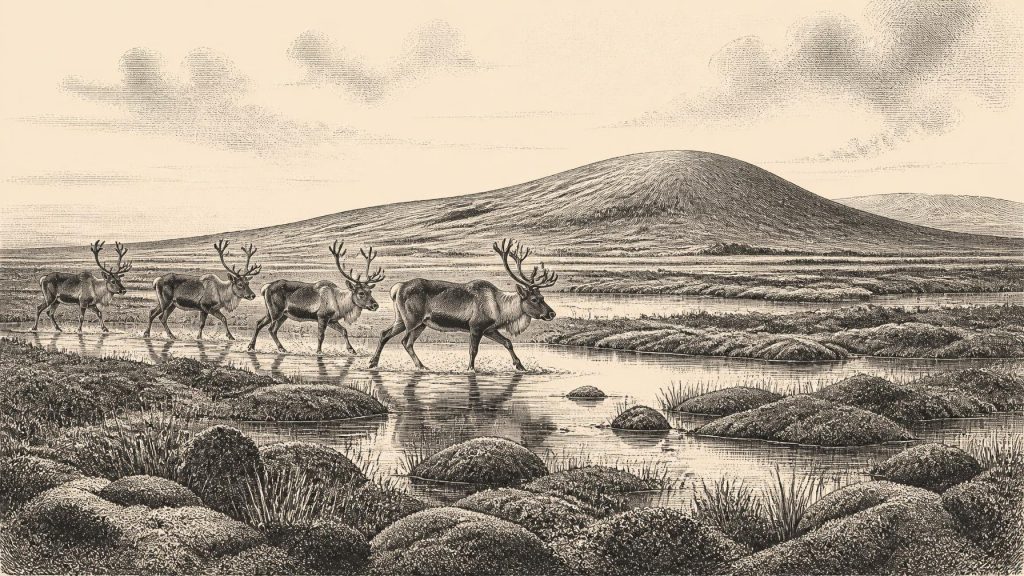
The Derryvree sediments offer the closest Irish glimpse of the living landscape relevant to this date. Fossil pollen, plant macrofossils and insects indicate a cold, open setting, conventionally described as treeless tundra or muskeg. This was not an empty snowfield. It included wet, moss-rich ground, sedges and grasses, low herbs and dwarf shrubs, with shallow pools, waterlogged channels and patches of exposed mineral soil. Aquatic and waterside plants demonstrate that unfrozen water persisted seasonally or locally long enough for a freshwater community to develop.
Such evidence supports a landscape of strong contrasts. Winters were severe and growing seasons short; frost, snow cover, waterlogging and seasonal thaw would all have shaped where plants could grow. Yet wet hollows could be productive places. They trapped organic matter, sheltered insects and supported the plants on which larger food webs depended. The term “tundra” should not suggest a uniform plain. Even in a generally open environment, differences in drainage, slope, soil and snow accumulation would have created a mosaic of pools, sedge margins, grassy ground and sparse shrub cover. The later Irish Ice Sheet would remodel or erase much of this terrain, which is one reason intact environmental sequences are so rare.
Elsewhere, inter-till and organic deposits in northern Ireland, including Greenagho near Belcoo and Aghnadarragh by Lough Neagh, reinforce the larger conclusion that ice cover during the Midlandian was episodic rather than permanently uniform. Their sequences record climatic oscillation and changing depositional environments. They should not be treated as duplicate snapshots of the same year, but together they show an Ireland repeatedly affected by the advance, decay and renewed growth of glacier ice.
The Animals of an Open Country
At Castlepook Cave near Doneraile in north Cork, south of the Awbeg valley, excavations recovered Ireland’s richest known assemblage of pre-Last Glacial Maximum vertebrate remains. The collection includes woolly mammoth, giant deer, reindeer, brown bear, wolf, Arctic fox, mountain hare, lemmings and spotted hyaena. These remains are direct evidence that such animals reached Ireland during parts of the Late Pleistocene. They also reveal a food web suited to open, cold-country habitats: grazers and browsers, small mammals, scavengers and predators.
There is an important limit, however. A cave bone collection is not a census taken on one day. Bones may have arrived through carnivore activity, natural death, water movement or disturbance during early excavations. Species represented in the same cave need not have lived there simultaneously, and the cave was not necessarily a dwelling place for every animal whose remains entered it. Modern reassessment of old radiocarbon measurements has also shown why apparent precision must be treated sceptically: some earlier dates from Castlepook require revision, and the chronological relationship between particular specimens is not always secure.
Nevertheless, the assemblage makes the broad setting vivid. Reindeer could have found forage across open country; lemmings and Arctic fox indicate cold-adapted ecological conditions; hyaenas, wolves and bears demonstrate that Ireland was connected, at least intermittently, to wider north-west European animal populations. Sea levels were much lower than today, exposing extensive shelf landscapes. Ireland was not necessarily an island in the modern geographical sense, although ice margins, rivers, coasts and changing sea level made movement routes variable and difficult. Animal dispersal was possible in windows that later closed.
A Possible Human Trace
The most arresting evidence relevant to this period is a reindeer femur from Castlepook. Reported work on the bone identified a mark interpreted as having been made by a sharp stone tool while fresh tissue was being cut. The specimen has been publicly associated with an age of about 33,000 years ago, placing it broadly near the date represented here. If the interpretation and association are sustained, it is evidence that a person, or a very small group, processed a reindeer in Ireland during the Upper Palaeolithic, much earlier than the formerly accepted evidence for human activity on the island.
Its importance is matched by the need for restraint. One marked bone is not proof of a permanent population, a village, a named people or continuous occupation. Castlepook has not yielded a securely associated stone-tool assemblage, hearth, built shelter, human burial, artwork or durable occupation surface of this age. Nor is there evidence sufficient to assign any possible visitors to a particular continental archaeological tradition such as the Aurignacian or Gravettian. The femur may record a brief episode of hunting, scavenging or carcass processing at the far north-west of the Upper Palaeolithic world; it cannot tell us how long people stayed, whether they returned, or how they travelled.
The distinction matters especially when considering everyday life. A party capable of processing a reindeer would have possessed practical knowledge of meat, marrow, hide, sinew, bone and perhaps antler. They would also have needed clothing, fire-making knowledge, social co-operation and strategies for surviving exposed country. These are reasonable inferences from Upper Palaeolithic life elsewhere in Europe, not things demonstrated by the Castlepook bone itself. No Irish evidence from around this date identifies houses, family groups, seasonal camps or a local technology.
No Polities, No Diplomacy
Political affairs, formal conflict, diplomacy, religion and learning cannot responsibly be recovered for Ireland around 31,173 BCE. There were no states, kingships, written records, monuments or institutions known from the island at this time. Nor is there evidence for organised warfare. If humans were present, their social world was almost certainly that of mobile hunter-gatherers operating in small groups, but even that description is an archaeological model rather than a fact established for a particular Irish community.
Trade is similarly beyond demonstration. The lower-sea-level geography of north-west Europe made movements of animals and people more feasible than they are now, but no securely dated Irish exchange network belongs to this point. The essential regional change was environmental: fluctuating climate and expanding ice repeatedly altered corridors, coastlines and habitable zones. These processes governed opportunity more profoundly than any identifiable political decision could have done.
What the Evidence Can Say
For this notional year, Ireland’s history is therefore a history of traces rather than events. The Derryvree organic beds show that cold-stage freshwater habitats existed in at least one part of the island during a broad interval encompassing this date. Castlepook’s bones show that a varied Ice Age fauna reached southern Ireland during Marine Isotope Stage 3. The disputed or provisional human significance of a cut-marked reindeer femur raises the possibility of a remarkably early human visit, but does not yet demonstrate settlement.
These fragments are significant because subsequent glaciation was destructive. Ice scoured bedrock, transported sediment and rearranged older deposits, leaving an incomplete archive. The absence of a settlement should not be mistaken for proof that people never came; equally, a single possible butchery mark should not be enlarged into a lost society. Around 31,173 BCE, the most secure image is of a cold, open and changing Ireland: wetlands in sheltered basins, mobile animal populations, uncertain human contact, and a landscape increasingly vulnerable to the ice that would later reshape it.
Primary Sources
- A reconsideration of the radiocarbon dating of the Marine Isotope Stage 3 fauna from southern Ireland
- The Irish Quaternary Fauna Project
- Castlepook Cave, County Geological Site Report
- A Middle Midlandian Freshwater Series at Derryvree, Maguiresbridge, County Fermanagh, Northern Ireland
- Early Midlandian–Middle Midlandian, Pleistocene, Northern Ireland
- Figure 6.— The subdivision of the Quaternary Period in Ireland
- Freshwater organic deposits and stratified sediments between Early and Late Midlandian (Devensian) till sheets, at Aghnadarragh, County Antrim, Northern Ireland
- Aghnadarragh
- New data for the Last Glacial Maximum in Great Britain and Ireland
- Dimensions and chronology of the last ice sheet in Western Ireland
- Maximum extent and dynamic behaviour of the last British–Irish Ice Sheet west of Ireland
- Advance and retreat of the marine-terminating Irish Sea Ice Stream into the Celtic Sea during the Last Glacial: Timing and maximum extent
- BRITICE-CHRONO: Introduction
- Ireland Through Geological Time
- Quaternary Geological Map of Ireland
- Irish Quaternary Association: Publications
- Irish Quaternary Association: Field Guides
- Irish Quaternary Association: Outreach and Education Resources
- Archaeological Heritage of County Cork
- Ireland’s Palaeolithic Archaeology – Fleeting Footprints in a Frozen Land
- Reindeer bone found in Cork cave shows human activity in Ireland 33,000 years ago
- What was on the menu in prehistoric Ireland?
- Occurrence of mammalia relicts at site Castlepook Cave
- Pleistocene vertebrates in the British Isles
- New insights on the fauna of Ireland’s Younger Dryas and Early Holocene from Alice & Gwendoline Cave