Cave Hyenas31146 BCE
Thirty-one thousand years BCE is an imprecise modern label for a Late Pleistocene interval, not a documented Irish year. During Marine Isotope Stage 3, Ireland experienced cold, treeless, changing conditions, with ice margins and sea levels fluctuating. Derryvree, County Fermanagh, preserves wetland deposits indicating ice-free ground before later glacial advance. Castlepook Cave, County Cork, contains diverse fauna, including reindeer, mammoth, giant deer, bear, Arctic fox, lemmings and cave hyena, demonstrating intermittent ecological connections with Eurasia. Possible butchery marks suggest human presence, but remain unconfirmed. No settlements are known. Later ice expansion transformed habitats and destroyed or buried much physical evidence.
Dateline
“31,146 BCE” is a modern calendar label, not a recoverable year in Ireland’s deep past. No written record, annual chronology, named ruler or dated human event exists for this point in time. Indeed, archaeological and environmental evidence cannot ordinarily distinguish one year from the next at such a distance. The responsible approach is to place the date within broad, calibrated Late Pleistocene ranges. In simple calendar arithmetic it lies about 33,095 years before AD 1950, the conventional “present” of radiocarbon dating, but radiocarbon results require calibration and commonly carry uncertainties measured in centuries or millennia.
The best-supported setting is therefore Ireland during Marine Isotope Stage 3, a fluctuating phase of the last Ice Age before the coldest and most extensive phase of the Last Glacial Maximum. Around this notional date, the island was approaching a major environmental transformation. It was not yet safe to imagine every district beneath an unbroken ice sheet, nor to picture a stable, temperate Ireland. The evidence instead indicates a cold, open and changeable north-west European landscape in which ice margins, snow cover, vegetation, animal populations and coastlines altered over long periods.
A Date Within Ranges
The precision of the number should not conceal the imprecision of the evidence. IntCal20, the principal Northern Hemisphere calibration framework, reaches back to 55,000 calibrated years before present, but it does not turn a radiocarbon result of this age into an exact calendar year. The dated materials from Ireland are also not an annual archive. They are bone, organic sediment, pollen, plant remains and glacial deposits, usually preserved or redeposited by natural processes. Their significance lies in the ranges they illuminate.
One particularly important range comes from Derryvree in County Fermanagh. There, freshwater organic silts and fine sands were found between two substantial bodies of glacial sediment in a road cutting through a drumlin. The conventional radiocarbon measurement Birm-166 was reported as 30.5 ± 1.1 radiocarbon thousand years BP. Later modelling has expressed it at approximately 33.5 ± 1.2 thousand calibrated years BP. That range overlaps the broad calendar horizon represented by 31,146 BCE and provides strong evidence that this part of Fermanagh had ice-free ground and freshwater conditions before a later advance of ice.
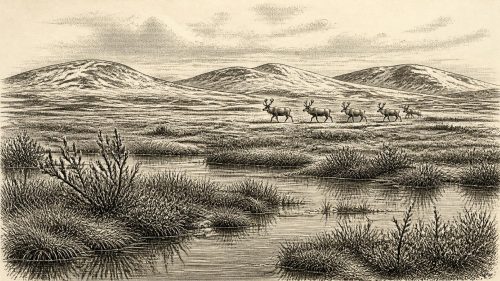
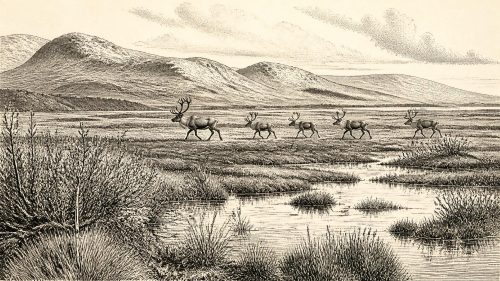
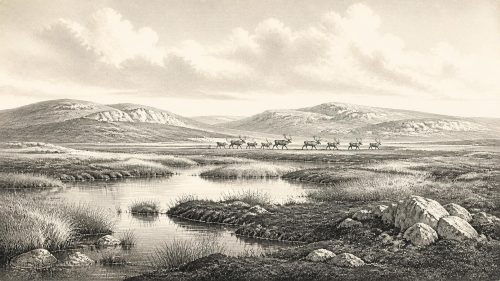
Derryvree does not supply a diary of the whole island, and its deposits should not be treated as proof that all of Ireland looked alike. It does, however, correct a simplistic image of an eternally ice-covered island. The organic bed records a treeless, cold muskeg or wetland environment: waterlogged ground with sedges, mosses and other hardy plants, rather than woodland or later Irish pasture. Its position beneath later till is equally important. The landscape that sustained that wetland was subsequently overridden, buried and reshaped by glacial action.
Cold Ground, Moving Ice
At this stage, Ireland belonged to the wider British–Irish Ice Sheet system, but that system did not grow everywhere at one pace. A major synthesis of Irish glacial evidence concluded that much of Ireland remained largely ice-free until about 32,000 years ago, followed by thickening and expansion of the last Irish ice sheet. More recent work stresses regional complexity, especially in the north-western marine sector. Derryvree is among the crucial pre-advance constraints: it indicates ice-free conditions in north-central Ireland until roughly 33,500 calibrated years BP, while modelled ice build-up followed much later, about 26,600 calibrated years BP in the relevant Donegal Bay sequence.
Thus, at the approximate horizon of this article, deterioration and eventual glaciation mattered more than any supposed single moment of advance. Uplands may have held persistent snowfields or local ice while lower terrain, valleys and sheltered basins retained cold-season wetlands, exposed soils and patches of vegetation. Frost, seasonal freezing and meltwater would have been powerful landscape-forming forces. Later glaciers scoured bedrock, pushed sediments into drumlins and moraines, and disturbed or destroyed many older deposits. This destructive history helps explain why the archaeological record for Ireland at this age is extraordinarily sparse.
Sea level was lower than today because vast quantities of water were locked in global ice sheets. The present shoreline is therefore a poor guide to the geography through which animals moved. Parts of the continental shelf were exposed at various times, and routes between Ireland, Britain and continental Europe changed as sea level, ice and marine barriers changed. It is reasonable to infer ecological connectivity from the animal evidence; it is not reasonable to draw a neat, permanent land bridge across the Irish Sea for the calendar year 31,146 BCE. The routes available at any particular moment remain debated.
Castlepook’s Animal World
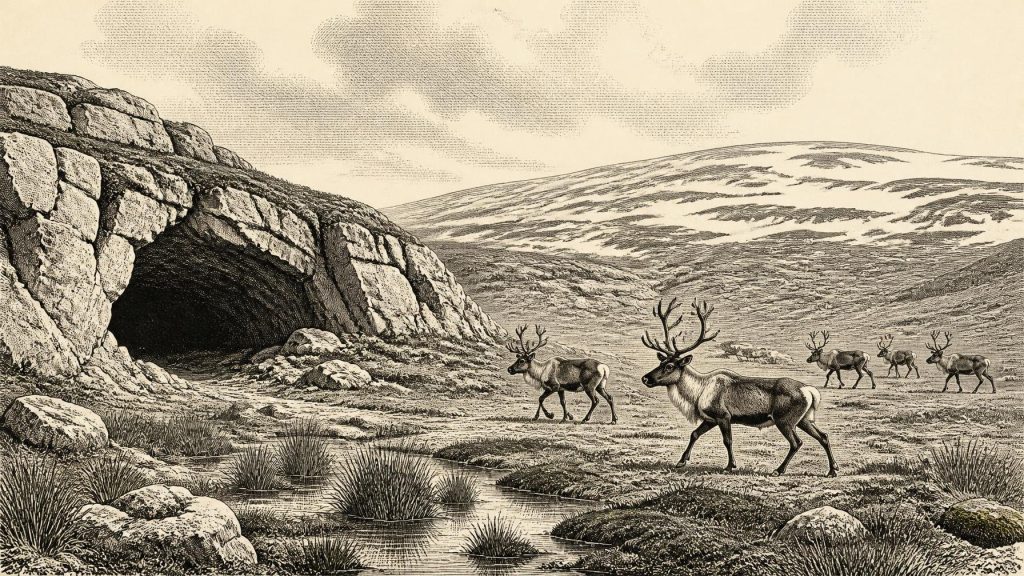
The clearest Irish evidence for this broad interval comes from Castlepook Cave, also known as Mammoth Cave, near Doneraile in north County Cork. It is Ireland’s most important known concentration of last-cold-stage mammal remains. Radiocarbon study has shown that mammals reached Ireland intermittently between at least about 45,000 and 20,000 years ago, well before the island’s final glacial maximum. Castlepook has yielded remains attributed to reindeer, woolly mammoth, giant deer, brown bear, Arctic fox, lemmings and cave hyena, alongside other fauna from deposits with complicated histories.
Some older dates from the cave are revealing rather than exact. Mammoth and hyena material was reported around 33,500 and 34,300 radiocarbon years BP respectively, while later accelerator dates demonstrated that Castlepook material spans very different phases of the Late Pleistocene. A giant-deer astragalus, for example, dated to 32,060 ± 630 radiocarbon years BP, whereas an Arctic-fox bone and lemming remains belong to later cold episodes. The lesson is methodological as well as historical: Castlepook is a rich archive, but not a sealed floor occupied by all species at once.
Cave hyenas are especially striking. Their occurrence in Ireland is known securely from Castlepook, and gnawed bones show that large carnivores helped accumulate or modify cave deposits. A hyena den is not evidence of human settlement, but it demonstrates that Ireland could support a food web containing substantial herbivores, scavengers and predators. Reindeer point to open, cold environments; lemmings and Arctic fox reinforce the picture of severe conditions in at least some phases. Mammoth, giant deer and bear remind us that the island’s Ice Age fauna was far more varied than its later historic fauna.
A 2026 sedimentary ancient-DNA study, currently available as a preprint rather than a final peer-reviewed article, adds a further line of evidence. It detected DNA from twelve ancient taxa at Castlepook and recovered mitochondrial sequences from Irish cave hyenas and woolly mammoths. The authors interpret these results as support for faunal links between Ireland and wider Eurasian populations before the Last Glacial Maximum. That is a valuable inference about connectivity, though it does not establish exactly when, how often or by which physical route every species arrived.
The Human Question
Human history at this date is possible, but not securely demonstrable in the way that the animal and environmental history is. A reindeer femur from Castlepook has been reported as dating to about 33,000 years ago and bearing a deep mark interpreted by palaeozoologist Ruth Carden as the result of butchery with a sharp stone tool. If this interpretation is confirmed, it would be evidence that an Upper Palaeolithic person handled a reindeer in Ireland in the broad period close to the date considered here.
That conditional language matters. The bone is a major research lead, not proof of a permanent Irish population, a settlement, a named migration or continuous occupation. Castlepook has not produced a securely associated stone-tool assemblage, hearth, hut floor, human burial or stratified camp of this age. Marks on bone must be distinguished carefully from damage caused by carnivores, trampling, excavation or other processes. The generally secure early evidence for human activity in Ireland remains much later: the cut-marked brown-bear patella from Alice and Gwendoline Cave in County Clare, dated to about 12,800–12,600 calibrated years BP.
Accordingly, politics, diplomacy, warfare, religion, language, learning and art cannot responsibly be described for Ireland in 31,146 BCE. There are no identifiable communities through which to reconstruct them. Nor can trade be inferred merely because animals or perhaps people reached the island. The most that can be said is that, if people briefly visited, they would have belonged to mobile Upper Palaeolithic hunter-gatherer worlds already established elsewhere in north-west Europe, where stone technology, hunting knowledge, clothing and long-distance social ties were important. Those wider comparisons are context, not direct evidence for Irish camps.
What Everyday Life Cannot Yet Show
No settlement pattern can presently be mapped for Ireland at this horizon. There is no basis for assigning population numbers, houses, family groups, food-sharing rules, ritual places or seasonal territories. A visitor might have followed animal movements, sheltered in caves or passed through a coastal corridor now drowned or altered by later ice; each remains an hypothesis. The absence of evidence is partly a product of preservation. Ice, meltwater, later soil formation and rising seas have removed or concealed the places where short-lived camps would most likely have stood.
Yet the record is not silent. Derryvree preserves an ice-free freshwater wetland within a cold treeless landscape. Castlepook preserves animals that demonstrate a connected and occasionally habitable Irish environment before full glacial conditions. Together they show an Ireland neither timelessly empty nor historically knowable in the ordinary sense: a shifting Pleistocene edge-land, rich in ecological evidence but poor in direct traces of people. Its most important development was environmental. The approaching expansion of ice would transform habitats, restrict animal movement and bury much of the physical evidence from which this early chapter of Irish history must be reconstructed.
Source References
Hover over a number to see the source. Select it to open the source.

- [1] Prehistoric Details
- [2] Spotted Hyena Skull
- [3] The Irish Quaternary Fauna Project
- [4] The Last Irish Ice Sheet: Extent and Chronology
- [5] Exploring Controls of the Early and Stepped Deglaciation on the Western Margin of the British Irish Ice Sheet
- [6] Timing and Pace of Ice-Sheet Withdrawal Across the Marine–Terrestrial Transition West of Ireland During the Last Glaciation
- [7] Irish Pleistocene Biostratigraphy
- [8] The Quaternary of South Fermanagh, Northern Ireland
- [9] The Subdivision of the Quaternary Period in Ireland
- [10] Quaternary Site Descriptions
- [11] Outreach and Education Resources
- [12] The Archaeological Heritage of County Cork
- [13] Our Ancient Landscapes: Hunter-Gatherers in Ireland
- [14] The IntCal20 Northern Hemisphere Radiocarbon Age Calibration Curve (0–55 cal kBP)
- [15] IntCal Publications
- [16] Sedimentary Ancient DNA Reveals Late Pleistocene Faunal Connectivity Between Ireland and Eurasia
- [17] Occurrence of Mammalia Relicts at Site Castlepook Cave
- [18] Trimlines, Blockfields and the Vertical Extent of the Last Ice Sheet in Southern Ireland
- [19] Maximum Extent and Dynamic Behaviour of the Last British–Irish Ice Sheet West of Ireland
- [20] Ireland: Submerged Prehistoric Sites and Landscapes
- [21] A North-Western Habitat: The Paleoethology and Colonisation of a European Peninsula
- [22] Early Deglaciation of the British-Irish Ice Sheet on the Atlantic Margin of Northwest Ireland
Primary Sources
- Prehistoric Details
- Spotted Hyena Skull
- The Irish Quaternary Fauna Project
- The Last Irish Ice Sheet: Extent and Chronology
- Exploring Controls of the Early and Stepped Deglaciation on the Western Margin of the British Irish Ice Sheet
- Timing and Pace of Ice-Sheet Withdrawal Across the Marine–Terrestrial Transition West of Ireland During the Last Glaciation
- Irish Pleistocene Biostratigraphy
- The Quaternary of South Fermanagh, Northern Ireland
- The Subdivision of the Quaternary Period in Ireland
- Quaternary Site Descriptions
- Outreach and Education Resources
- The Archaeological Heritage of County Cork
- Our Ancient Landscapes: Hunter-Gatherers in Ireland
- The IntCal20 Northern Hemisphere Radiocarbon Age Calibration Curve (0–55 cal kBP)
- IntCal Publications
- Sedimentary Ancient DNA Reveals Late Pleistocene Faunal Connectivity Between Ireland and Eurasia
- Occurrence of Mammalia Relicts at Site Castlepook Cave
- Trimlines, Blockfields and the Vertical Extent of the Last Ice Sheet in Southern Ireland
- Maximum Extent and Dynamic Behaviour of the Last British–Irish Ice Sheet West of Ireland
- Ireland: Submerged Prehistoric Sites and Landscapes
- A North-Western Habitat: The Paleoethology and Colonisation of a European Peninsula
- Early Deglaciation of the British-Irish Ice Sheet on the Atlantic Margin of Northwest Ireland