Hyena Hall’s Open Country31002 BCE
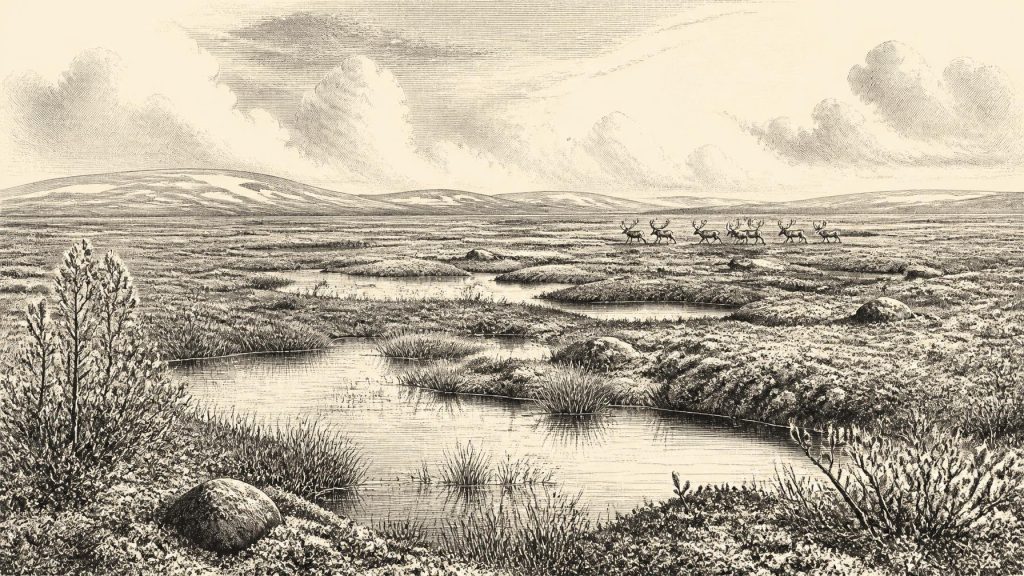
Around 31,002 BCE, Ireland was a climatically unstable Late Pleistocene landscape, not a documented historical society. Derryvree, County Fermanagh, records an ice-free periglacial interval between glacial deposits, with treeless tundra vegetation, wetlands and freshwater habitats, though its radiocarbon evidence permits only broad dating. Castlepook Cave, County Cork, preserves diverse fauna, including mammoth, reindeer, giant deer and hyena, demonstrating ecological connections with Europe and abundant open-country wildlife. A marked reindeer bone may indicate human activity, but cannot establish settlement or hunting. As the British–Irish Ice Sheet expanded, habitats and possible travel corridors shifted, leaving fragmentary evidence of a dynamic, diverse island.
Dateline
“31,002 BCE” is a modern label for a point deep in the Late Pleistocene, not a year that can be recovered from an Irish calendar. No written record, named individual, political event or securely dated human settlement belongs to this precise year. The evidence works at a much broader scale: radiocarbon determinations with substantial uncertainty, calibrated ranges, cave deposits, fossil bones, pollen and plant macrofossils, and the landforms left by moving ice. In calendar terms, the label falls roughly 32,950 years before AD 1950, but that arithmetic conversion must not be confused with a calibrated archaeological date.
The relevant period is the later part of Marine Isotope Stage 3, within the Irish Middle Midlandian cold stage and close to the large-scale growth of the last British–Irish Ice Sheet. It was a world of abrupt climatic shifts rather than a single unchanging “Ice Age”. Ireland was not uniformly buried beneath ice at every moment. Crucially, however, evidence from one locality cannot be made to stand for the whole island. Around this notional date, Ireland is best understood as a changing north-western European landscape in which open ground, wetlands, animals and advancing ice shaped the possibilities for any human visitor.
A Date Measured in Ranges
The most illuminating environmental sequence is at Derryvree, near Maguiresbridge in County Fermanagh. In 1969, road works cut through a drumlin and exposed freshwater silts and fine sands lying between two substantial layers of till, sediment deposited directly by glacier ice. The sequence shows that ice had occupied the locality, that a later ice-free interval allowed freshwater sediments and organic material to accumulate, and that renewed glaciation subsequently sealed them beneath another till sheet. It is powerful evidence for environmental change, but it does not identify what happened at Derryvree in any particular calendar year.
Organic material from the freshwater deposit returned a conventional radiocarbon determination of 30,500 ± c.1,100 radiocarbon years BP. Such a result is not the same thing as a calendar age: radiocarbon years must be calibrated against changing atmospheric carbon-14 levels, and the uncertainty is considerable at this depth of time. The deposit has therefore been used responsibly to place an ice-free, periglacial episode in south Fermanagh broadly within late MIS 3, rather than to pin it to 31,002 BCE. More recent ice-sheet modelling similarly treats Derryvree as a constraint on the timing of ice expansion, not as a dated historical episode.
Wet Ground Beneath a Cold Sky
Derryvree preserves a rare glimpse of an Irish cold-stage ecosystem. Its pollen was poorly preserved, yet was predominantly herbaceous. Mosses and other plant macrofossils included taxa associated with tundra and wet habitats; bogbean, sedges, mountain-avens, dwarf willow and clubmoss are among the plants reported from the sequence. These remains support an interpretation of treeless, open vegetation with freshwater pools, marshy ground and sparse dry-land cover. They do not prove a continuous carpet of the same vegetation across Ireland, nor do they recreate a picturesque, stable tundra. The landscape would have been patchy, seasonally exacting and altered by frost, waterlogging, snow cover and changing temperatures.
That environmental setting matters because it defines everyday survival for animals and any people who may have entered the island. There is no evidence here for farms, cleared fields, domestic livestock, pottery, metalworking or permanent villages. Woodlands of the kind familiar from later prehistoric Ireland had not developed. Fuel, shelter material and edible plants would have been scarce and unevenly distributed. Fresh water was available locally, but living beside it was not necessarily easy: freezing conditions, exposure and unstable ground could make a wetland as much an obstacle as a resource.
The broader glacial history reinforces the need for caution. The last British–Irish Ice Sheet expanded substantially after this phase and reached its greatest overall extent at different times in different sectors, rather than in one simultaneous island-wide event. Reconstructions indicate major ice growth across the wider Irish and British region from about 31,000 years ago, with extensive shelf-edge glaciation later, around 27,000–26,000 years ago. Thus 31,002 BCE belongs to an interval of growing climatic severity and changing ice margins, not necessarily to a moment when every part of Ireland was engulfed by ice.
Castlepook and the Animal Record
In north Cork, Castlepook Cave near Doneraile—also called Mammoth Cave—provides Ireland’s most important archive of mammal remains from before the Last Glacial Maximum. Its evocatively named chambers, including Hyena Hall and Elephant Hall, produced bones of woolly mammoth, reindeer, giant deer, brown bear, wolf, foxes, Arctic fox, lemmings and spotted hyena. Taken together, the fauna indicates repeated ecological links with the wider European landmass and an open, cold environment capable of supporting large herbivores and their predators or scavengers.
Yet Castlepook is not a neatly preserved snapshot of one day or one community. Early excavations removed large quantities of material; water movement and later disturbance complicated the deposits; and bones accumulated through more than one process. Hyenas could drag carcass parts into caves, gnaw bones and leave droppings. Animals could die naturally, and water could move remains from one place to another. Radiocarbon programmes have shown that the Irish cave fauna spans long intervals, while later reassessment has stressed the limitations of some older determinations. A mammoth, a reindeer and a hyena found in the same cave do not automatically prove that they met at the same time.
Nevertheless, Castlepook makes one central point secure: late Pleistocene Ireland supported a much richer large-mammal fauna than the modern island. Reindeer imply grazing or browsing opportunities over open terrain; mammoths and giant deer point to substantial available forage, though their precise local population sizes cannot be calculated from scattered bones. Hyenas reveal a food web in which carcasses were contested and caves could be dens or scavenging places. The term “Irish elk”, often used for giant deer, is misleading: the animal was neither uniquely Irish nor an elk, although Irish deposits later became famous for its spectacular antlers.
The Reindeer Bone Question
Castlepook also bears on the most difficult question of all: were people in Ireland around this broad period? A reindeer femur in the National Museum of Ireland collection has been presented in Cork heritage material as dating to about 31,000 BC and as carrying a deep mark interpreted as a fresh-bone cut or chopping mark made with a sharp stone implement. If that interpretation and association are upheld, it may record human handling of a reindeer far earlier than the previously recognised terminal-Pleistocene evidence from Alice and Gwendoline Cave in County Clare.
The proper conclusion remains deliberately limited. One marked animal bone is not proof of a resident population, a hunting camp or a migration route. Castlepook has produced no securely associated hearth, stone-tool assemblage, habitation floor, burial, repeated refuse deposit or human bone of this age. The bone’s date is the date of the animal’s death, while identifying a surface modification as a human tool mark is a separate taphonomic judgement. It cannot tell us whether a person killed the reindeer, scavenged it, removed meat, hide or sinew, or encountered it elsewhere before the bone reached the cave. The most that can be said is that it is a significant possible trace of human activity, demanding further scientific testing and contextual excavation.
No Kingdoms, No Frontiers
Political affairs, diplomacy and organised warfare cannot responsibly be reconstructed for Ireland at this date. There were no known kingdoms, borders, chiefs, treaties or institutions, and no evidence for a settled Irish population from which such structures might be inferred. Nor can language, kinship rules, religious belief, art or formal learning be recovered from the Derryvree sediments or the Castlepook bones. To invent them would turn a thin archaeological record into fiction.
If people did reach Ireland, they were likely mobile foragers operating within a much wider north-west European world, but even that is an inference from the ecological setting and contemporary human presence elsewhere, not a demonstrated Irish society. Travel itself is unresolved. Lower sea levels altered coastlines, but water, ice and changing channels still made access contingent; there is no excavated boat, route or shore camp. “Trade” in the later sense is equally unsupported. The only exchange plainly visible is ecological: animals and perhaps occasional people moving when terrain, climate and food allowed.
The history of Ireland around 31,002 BCE is therefore not a story of rulers or monuments. It is the story of a cold, open country in transition: freshwater tundra wetlands at Derryvree, a formidable mammal community recorded at Castlepook, and a possible human cut mark whose importance lies precisely in its uncertainty. As the ice sheet built towards its later maximum, such habitats and corridors would have narrowed, shifted or vanished. What survives is fragmentary, but it is enough to show that the deep past of Ireland was environmentally dynamic, biologically diverse and far less empty than older accounts once suggested.
Primary Sources
- A Middle Midlandian Freshwater Series at Derryvree, Maguiresbridge, County Fermanagh, Northern Ireland
- Palaeoecology
- Figure 6.— The Subdivision of the Quaternary Period in Ireland
- Castlepook Cave, County Geological Site Report
- Heritage Artefacts of County Cork
- Proceedings of the Royal Irish Academy: Castlepook Cave
- The Irish Quaternary Fauna Project
- Red Deer (Cervus elaphus) in Ireland: The Current Status of the Species and Its History
- Late Pleistocene Chronostratigraphy and Ice Sheet Limits, Southern Ireland
- Exploring Controls of the Early and Stepped Deglaciation on the Western Margin of the British Irish Ice Sheet
- Growth and Retreat of the Last British–Irish Ice Sheet, 31,000 to 15,000 Years Ago: The BRITICE-CHRONO Reconstruction
- Growth and Retreat of the Last British–Irish Ice Sheet, 31,000 to 15,000 Years Ago: The BRITICE-CHRONO Reconstruction
- The Timing and Magnitude of the British–Irish Ice Sheet Between Marine Isotope Stages 5d and 2
- Character of Advance and Retreat of the Southwest Sector of the British-Irish Ice Sheet During the Last Glaciation
- Stratigraphic and Palaeo-Geomorphological Evidence for the Glacial-Deglacial History of the Last British-Irish Ice Sheet in the North-Western Irish Sea
- The Colonization of Ireland: A Human Ecology Perspective
- New Insights on the Fauna of Ireland’s Younger Dryas and Early Holocene from Alice & Gwendoline Cave
- 2022:564 – Castlepook Cave, Castlepook South, Cork
- Occurrence of Mammalia Relicts at Site Castlepook Cave
- IAH Field Trip 2014
- The IntCal20 Northern Hemisphere Radiocarbon Age Calibration Curve (0–55 cal kBP)