BIRM-166’s Tundra Waters30925 BCE
30,925 BCE is a modern label within a broad late Marine Isotope Stage 3 range, rather than a datable Irish year. Derryvree sediments in County Fermanagh, later buried by ice, show ice-free tundra wetlands with sedges, mosses, dwarf shrubs and aquatic plants under cold, unstable conditions. Cave evidence from Castlepook, County Cork, records diverse cold-stage fauna, including reindeer, mammoth, giant deer and predators, though deposits combine different periods. A marked reindeer bone may indicate human butchery, but no secure occupation evidence exists. As the British–Irish Ice Sheet expanded, environmental constraints, animal movement and advancing glaciation shaped Ireland’s pre-maximum physical landscape.
Dateline
“30,925 BCE” is a modern chronological label, not a date that can be matched to an Irish event, ruler, settlement or season. There were no written records, calendars or named communities in Ireland from which such precision could be recovered. The most responsible approach is to place this notional year within the later part of Marine Isotope Stage 3, a long and climatically unstable phase of the last Ice Age. The strongest local evidence comes not from an excavated camp but from sediments, plant remains and animal bones. Together they reveal an Ireland in transition: cold, largely treeless and inhabited by mobile animals, with advancing ice increasingly reshaping what land could sustain life.
A Date Within a Range
The closest well-studied environmental archive is Derryvree, near Maguiresbridge in County Fermanagh. Roadworks there exposed freshwater silts and fine sands trapped between two thick layers of glacial till in a drumlin. The organic sediments produced radiocarbon determination Birm-166, conventionally dated to 30,500 radiocarbon years before present, with a substantial uncertainty. Radiocarbon years are not calendar years: once calibrated, the published range lies broadly around 36,900–31,700 calibrated years before present, approximately 34,950–29,750 BCE. The label 30,925 BCE therefore falls within the broad chronological window illuminated by the deposit, but it cannot be assigned to a particular layer, pool, plant or animal.
This distinction matters. Derryvree records an interval during which freshwater and organic sediment accumulated at one location before later ice buried and incorporated it into a drumlin. It is evidence for conditions in north-central Ireland over a span of time, not a diary entry for one year. Nor should a single record be made to stand for every valley, coast and upland on the island. Its importance is that it gives rare, direct evidence that at least part of Ireland was ice-free during the later Middle Midlandian, before the British–Irish Ice Sheet reached its eventual maximum extent.
Cold Wetlands Beneath Later Ice
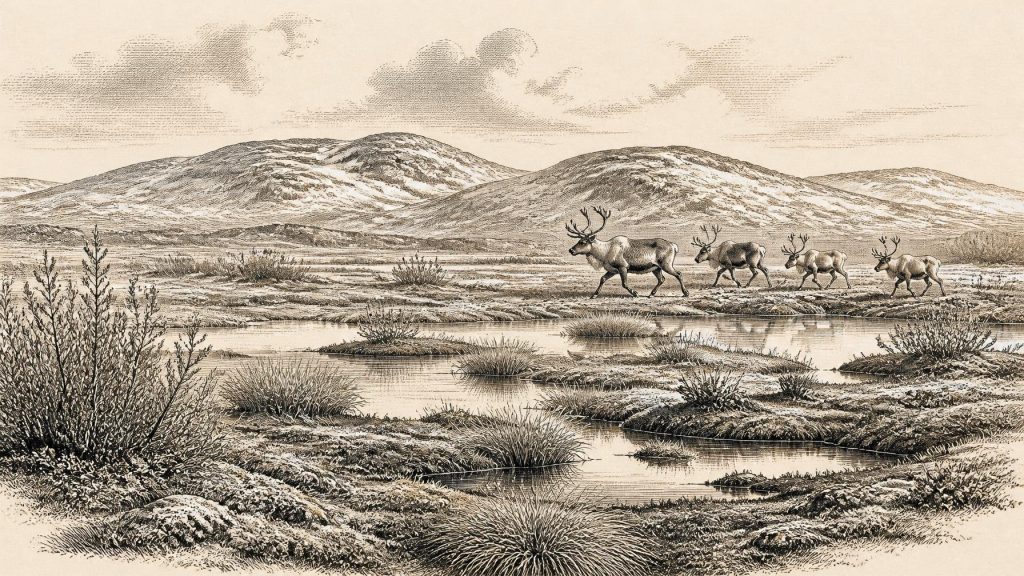
The Derryvree plant and animal microfossils indicate open tundra and a periglacial climate. Rather than forests, the landscape supported low, cold-adapted vegetation and wet ground: sedges, mosses, dwarf shrubs and aquatic plants associated with shallow freshwater. Fossil finds including bogbean, water-milfoil, mountain avens, dwarf willow and clubmoss point to a mosaic of pools, marshy margins and sparsely vegetated ground. “Muskeg”, the term used in the original interpretation, conveys a waterlogged, peat-forming tundra environment rather than a modern Irish bog exactly reproduced in the deep past.
Such a setting would have changed sharply through the year. Winters were long and severe; freezing and thawing disturbed exposed soils; meltwater and shallow standing water could be important during warmer months. The evidence does not permit a local thermometer reading, but it does show that this was not an ice-free woodland landscape resembling later prehistoric Ireland. Trees had little or no place in the Derryvree assemblage. Open ground and wetland plants instead testify to a cold climate with a short growing season.
Crag Cave in County Kerry offers complementary, though differently dated, evidence for the wider climatic rhythm. Uranium-series dates from broken cave formations show that calcite growth occurred episodically during warmer interstadials of the last glacial period, when liquid water could move through the shallow karst system. These episodes align broadly with Greenland interstadials, abrupt northern climatic ameliorations visible in ice-core records. Around the modern label 30,925 BCE, Ireland was thus part of a North Atlantic world prone to swift shifts between relatively milder intervals and renewed cold. Derryvree should be understood against that restless background, not as a stable age of unchanging tundra.
Animals on an Open Island
Southern Irish caves provide the principal evidence for the larger animals that reached Ireland in this part of the Pleistocene. Castlepook Cave near Doneraile, County Cork, is especially significant. Its antiquarian excavations recovered a mixed and complicated accumulation of bones from different episodes, later disturbed by water, carnivores and excavation itself. Modern radiocarbon reassessment has nevertheless shown that some of its fauna belongs to Marine Isotope Stage 3, much earlier than older dating programmes suggested.
The fauna demonstrates that Ireland could support, or at least receive, an imposing range of cold-stage mammals. Reindeer, woolly mammoth, giant deer, brown bear, wolf, Arctic fox, mountain hare, lemmings and spotted hyaena are among the animals recorded from Castlepook’s Pleistocene assemblage. They should not be imagined as a single herd or a perfectly simultaneous community. Cave deposits often combine material accumulated across centuries or millennia. Yet their presence establishes an ecological reality: open habitats, prey animals and predators existed in Ireland before the Last Glacial Maximum.
Reindeer are particularly useful for visualising this world. Herds could exploit patchy tundra vegetation and ranged across very large territories. Mammoths and giant deer, where present, would likewise have required extensive feeding grounds, while hyaenas, wolves and bears indicate competing scavengers and predators. Caves were not necessarily homes for every species represented in them. A cave could be a carnivore den, a trap, a shelter used intermittently, or a place where water and sediment concentrated remains. The Castlepook bones reveal animal movement and survival more securely than they reveal a settled landscape.
The Castlepook Human Question
The most tantalising possible evidence for people is a reindeer femur from Castlepook. It has been directly dated to roughly 33,000 radiocarbon years before present and bears a deep mark interpreted by palaeozoologist Ruth Carden as a fresh-bone cut or chop made with a sharp stone tool during carcass processing. If that interpretation is confirmed, it would indicate that a human or humans handled reindeer in Ireland during the Upper Palaeolithic, far earlier than the once accepted record of post-glacial settlement.
It would be wrong, however, to turn one marked bone into a population, a tribe or a village. The specimen derives from an old cave collection rather than a newly excavated, sealed occupation surface. Ireland has not yet produced a securely associated stone-tool assemblage, hearth, dwelling floor, burial, human bone or concentrated butchered food waste of comparable age. The mark is important proposed evidence of human action; it is not proof of permanent settlement or continuous occupation.
If people did visit Ireland around this broad period, the most cautious inference is that they were highly mobile Upper Palaeolithic hunter-gatherers, perhaps following animal movements or making a short foray into a marginal landscape. Even that remains an interpretation, not a demonstrated itinerary. The routes available to animals and people are uncertain. Lower sea levels exposed much more of the continental shelf than exists today, but the precise configuration of land, water, ice and passable corridors between Ireland, Britain and continental Europe remains debated. Movement need not imply a simple, continuous “land bridge”.
No Polities, but Real Constraints
There is no evidence from which to reconstruct political affairs, diplomacy, warfare, social rank, language, formal religion or named groups for Ireland in 30,925 BCE. There were no states, kingdoms, farms, monuments or trading settlements. Claims about chiefs, rituals, alliances or conflicts would be invention. The available record is environmental and zooarchaeological, with one possible trace of butchery.
Nevertheless, the evidence speaks to the basic conditions from which social life, if present, had to proceed. Food would have depended on knowledge of seasonal animal behaviour, weather, shelter and terrain. A small hunting party would have faced exposure, uncertain prey and dangerous carnivores; it may have used portable stone tools, hides and fire, but none of these has yet been securely recovered from Ireland for this horizon. Exchange and diplomacy cannot be demonstrated. Nor can any permanent settlement pattern. What can be said is that access to game and safe movement across wet, frost-affected ground would have mattered more than boundaries or institutions.
Ice-Sheet Build-Up
The greater historical development was geological. The British–Irish Ice Sheet was building after about 35,000–32,000 years ago, although its growth was neither simple nor synchronous across Ireland and Britain. Later it would cover all or almost all of Ireland’s low ground, scour older landscapes and leave drumlins, tills, meltwater channels and offshore landforms that still define much of the island’s physical geography. At the date represented here, Derryvree’s freshwater deposits preserve a valuable pre-maximum window: not a timeless wilderness, but a vulnerable episode before advancing ice sealed its wetland archive below glacial sediment.
For Ireland, then, 30,925 BCE is best remembered not as the year of an identifiable human event but as part of the Derryvree interval. Freshwater lay among tundra plants in Fermanagh; large mammals moved through open country in places such as north Cork; and the climatic system was heading towards more extensive glaciation. The silence of the human record is itself historically important. It sets a firm boundary between evidence and wishful storytelling, while leaving open the possibility that future excavation, dating and microscopic analysis may clarify whether people briefly entered this demanding Ice-Age Ireland.
Primary Sources
- A Middle Midlandian Freshwater Series at Derryvree, Maguiresbridge, County Fermanagh, Northern Ireland
- The Irish Quaternary Fauna Project
- A Reconsideration of the Radiocarbon Dating of the Marine Isotope Stage 3 Fauna from Southern Ireland
- New Insights on the Fauna of Ireland’s Younger Dryas and Early Holocene from Alice & Gwendoline Cave
- Episodic Speleothem Deposition Tracks the Terrestrial Impact of Millennial-Scale Last Glacial Climate Variability in SW Ireland
- Extent and Timing of the Last Glacial Maximum (LGM) in Britain and Ireland: A Review
- New Data for the Last Glacial Maximum in Great Britain and Ireland
- Oscillating Retreat of the Last British-Irish Ice Sheet on the Continental Shelf Offshore Galway Bay, Western Ireland
- Timing and Pace of Ice-Sheet Withdrawal Across the Marine–Terrestrial Transition West of Ireland During the Last Glaciation
- Exploring Changes in the Dynamics of the Last British-Irish Ice Sheet
- Pattern and Timing of Retreat of the Last British-Irish Ice Sheet
- Growth and Retreat of the Last British–Irish Ice Sheet, 31,000 to 15,000 Years Ago: the BRITICE-CHRONO Reconstruction
- The Timing and Magnitude of the British–Irish Ice Sheet Between Marine Isotope Stages 5d and 2
- A Critical Review and Re-Investigation of the Pleistocene Deposits Between Cranfield Point and Kilkeel, Northern Ireland
- The Problem of a Late Quaternary Landbridge Between Britain and Ireland
- Deglaciation, Earth Crustal Behaviour and Sea-Level Changes in the Determination of Insularity: A Perspective from Ireland
- Figure 6: The Subdivision of the Quaternary Period in Ireland
- Occurrence of Mammalia Relicts at Site Castlepook Cave
- Pleistocene Vertebrates in the British Isles
- The Exploration of Castlepook Cave, Co. Cork. With 3 Plates
- Proceedings of the Royal Irish Academy, Volume 34
- Heritage Artefacts of County Cork