Derryvree’s Drumlin Waters30926 BCE
The label 30,926 BCE cannot identify a recoverable Irish year, but denotes a Late Pleistocene MIS 3 setting before maximum glaciation. Ireland experienced variable cold conditions, lower seas and limited ecological connections with Britain and Europe. Derryvree, County Fermanagh, preserves freshwater deposits between tills, indicating a locally ice-free, periglacial wetland with treeless tundra vegetation, insects and aquatic plants. Castlepook Cave, County Cork, documents diverse cold-stage fauna, although bones accumulated over time and cannot date species precisely to this year. A marked reindeer bone suggests possible brief human activity, but no secure evidence supports permanent settlement in Ireland, society or institutions.
Dateline
“30,926 BCE” is a modern chronological label, not a recoverable year in Ireland’s deep past. No Irish calendar, settlement sequence, named person or event can be assigned to these twelve months. In relation to the conventional radiocarbon reference year of 1950, the label falls about 32,875 years before present. It belongs to the Late Pleistocene, broadly Marine Isotope Stage 3 (MIS 3): a long, climatically unstable interval before the Last Glacial Maximum. The responsible history of Ireland at this depth is therefore not an annal of political acts, but an account of landscapes, animal populations, sediments and the limits of what they can show.
A Date Within a Long Cold Stage
Ireland was not yet at the fullest extent of the last British–Irish Ice Sheet. Current syntheses place the major build-up of that ice sheet after roughly 35,000–32,000 years ago, with its maximum extent much later, about 27,000–21,000 years ago. Around the nominal date, then, the island was entering a period in which expanding ice, severe winters, changing sea levels and shifting routes of animal movement increasingly governed what life was possible. Conditions did not remain uniform from one century to the next, much less from one region to another. Shorter climatic oscillations could alter snow cover, vegetation, water supply and the viability of travel across the north-west European landmass.
The familiar map of a modern island should not be projected unchanged on to this world. Sea level was far lower than today because enormous volumes of water were locked in ice sheets. Ireland’s coastlines and the surrounding shelf were consequently very different, and marine barriers were reduced in some directions. Yet lower seas did not make movement easy. Any crossing or overland approach was constrained by cold, exposed terrain, unstable weather, rivers, ice margins and the availability of food. It is safest to say that Ireland was intermittently connected ecologically to Britain and continental north-west Europe, allowing animals—and perhaps people—to reach it during favourable phases. The evidence does not permit a simple claim of a permanent land bridge, continuous occupation or unrestricted migration.
The Derryvree Record
The clearest Irish environmental archive relevant to this broad period lies at Derryvree, near Maguiresbridge in County Fermanagh. Road works in 1969 cut through a drumlin and exposed an exceptional sequence: freshwater silts, fine sands and organic deposits sealed between two thick layers of glacial till. The lower till records an earlier advance of ice; the upper till demonstrates that ice later returned. Between them was the remnant of a time when ice was absent locally and shallow freshwater, wet ground and tundra vegetation existed in the hollow.
A radiocarbon determination from the Derryvree organic material, Birm-166, produced an age of 30,500 ± 1,100 radiocarbon years BP. This is not equivalent to 30,500 BCE. Radiocarbon years must be calibrated because atmospheric carbon-14 has varied through time, and the uncertainty is substantial at this antiquity. Published treatments place the deposit broadly in the mid-to-late 30,000s calibrated years BP; one synthesis gives about 35.9 ± 1.1 thousand calibrated years BP. It is thus evidence for a broad cold-stage environment, not proof that a specific pond, plant or animal was present in 30,926 BCE. The nominal year sits within the same larger climatic world, while remaining beyond calendar-year resolution.
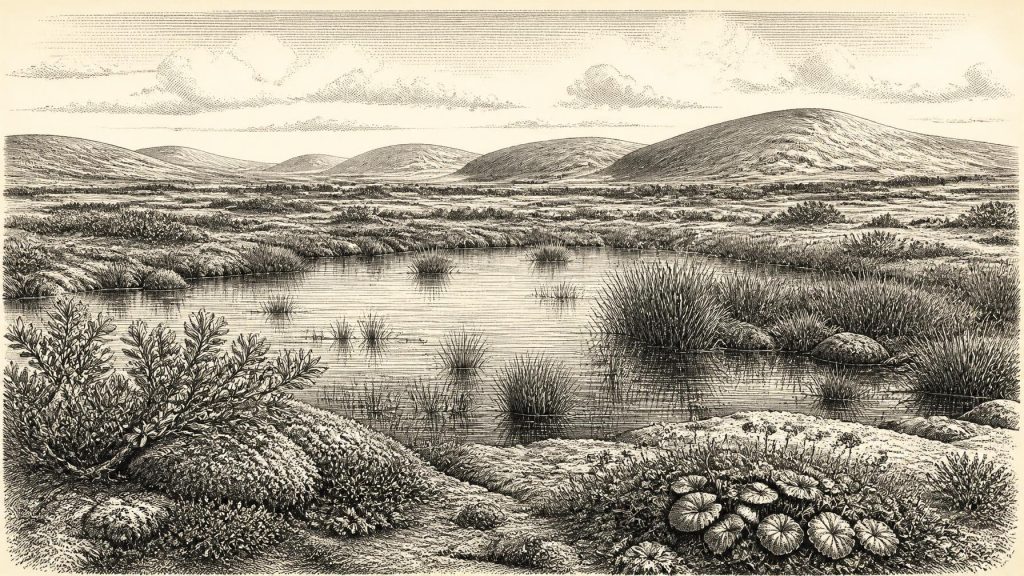
Derryvree’s fossils nevertheless provide an unusually vivid view of that world. Pollen, plant macrofossils, mosses and insects indicate open, treeless vegetation rather than forest. Grasses, sedges, juniper and herbs were important elements. Finds recorded from the deposit include dwarf willow, mountain avens and bogbean, while aquatic plants show that standing or slow-moving freshwater survived locally. The insect evidence likewise points to a cold, periglacial setting. “Periglacial” does not mean permanently buried beneath a glacier: it describes land strongly affected by frost, seasonal freezing and thawing, sparse cover and short growing seasons near an ice margin.
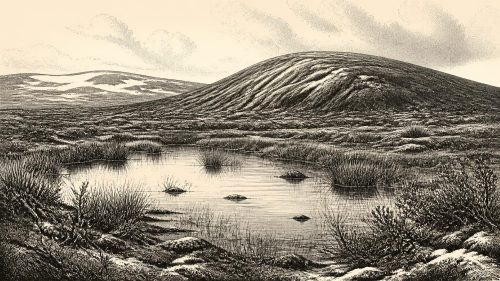
The most supportable reconstruction is therefore of a wet, open mosaic. Pools and sedgy margins lay amid low vegetation, mosses and frost-worked ground. In summer, long daylight may have supported a brief flush of growth; in winter, frozen soil, snow and wind would have imposed powerful limits. It was not a lush green Ireland, nor a featureless sheet of ice. The Derryvree deposits preserve local conditions in and around water, not a complete map of the island, but they establish that freshwater refuges and tundra-like vegetation occurred in Fermanagh during part of the pre-maximum glacial interval.
Cork’s Cave Fauna
In southern Ireland, Castlepook Cave near Doneraile in north County Cork offers a different kind of evidence. Excavations beginning in the early twentieth century recovered one of Ireland’s richest Pleistocene vertebrate assemblages. The collection includes remains attributed to woolly mammoth, giant deer, reindeer, brown bear, wolf, fox, mountain hare, lemmings and spotted hyaena. Later radiocarbon work has shown that important parts of this fauna belong to MIS 3, and improved laboratory preparation has revised some earlier measurements substantially older. In particular, reassessment indicates that some species, including spotted hyaena and giant deer, may have disappeared locally before about 40,000 calibrated years BP.
This is crucial for interpreting 30,926 BCE. Castlepook demonstrates that Ireland could support a much richer cold-stage mammal community than later glacial Ireland, but it is not a census for one year. Cave bones accumulated over long spans. Carnivores could carry prey into passages; hyaenas may have used parts of the cave system as a den; animals could die near fissures; water and collapse could move remains. Early excavators did not have the stratigraphic methods, recording standards or dating techniques available now. A mammoth bone does not prove a mammoth herd in the adjacent valley at the same moment, and a species list does not prove all species were contemporaries.
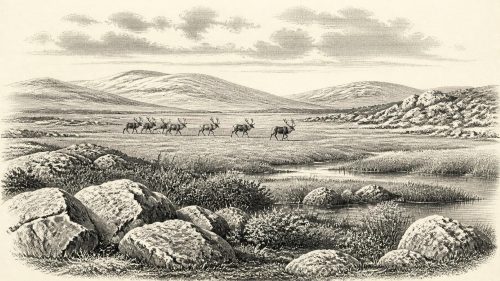
Even so, the fauna indicates the scale of environmental change that shaped Ireland. Reindeer, Arctic fox, lemmings and mountain hare fit an open, cold landscape. Mammoth and giant deer point to the wider availability, at some times, of grazing and mixed open habitats capable of sustaining very large herbivores. Wolves and spotted hyaenas reveal a predator and scavenger community far removed from later Irish ecosystems. These animals were not merely picturesque Ice Age visitors: their arrival and survival depended on fluctuating habitats and access routes across the wider region.
The Human Question
Human history at this date is possible, but not securely established. A reindeer femur from Castlepook has been reported as dating to around 33,000 years ago and as bearing a deep mark interpreted by zooarchaeologist Ruth Carden as a stone-tool cut or chop made while the bone was fresh. If that interpretation is confirmed, it would be important evidence that people briefly reached Ireland before the Last Glacial Maximum and processed a reindeer carcass there.
It must not, however, be enlarged into a settled Palaeolithic Ireland. The bone is an isolated find from a complicated old cave collection, without an associated hearth, stone-tool assemblage, dwelling surface, human burial or securely excavated hunting camp. Dating an animal bone and identifying a surface modification as human action are related but separate questions. Natural breakage, carnivore damage, sediment abrasion and excavation history all require close taphonomic assessment. The cautious conclusion is that Castlepook presents a serious, testable possibility of a fleeting human presence, not evidence for a permanent population, a named culture or a continuous ancestral community.
The secure evidence for later Upper Palaeolithic activity in Ireland comes from a butchered brown-bear patella at Alice and Gwendoline Cave in County Clare, dated to about 12,810–12,590 calibrated BP. That much later find shows why revisiting museum collections matters, but it cannot be used to fill the enormous chronological gap back to MIS 3. Nor may tools, shelters, art, clothing, language or ritual be inferred for Ireland specifically from better-known Upper Palaeolithic groups elsewhere in Europe. Such comparisons can suggest what travelling hunter-gatherers may have needed to survive, but they are interpretation, not Irish evidence.
No Polities, Only Constraints
There is no evidence for political authority, warfare, diplomacy, formal religion, trade networks or learned traditions in Ireland at this date. Nor is there evidence for farming, livestock, permanent villages, fields, boats or monuments. These absences matter. They are not simply gaps waiting to be supplied from imagination; they define the kind of history that can honestly be written. If people did enter Ireland during MIS 3, they were most plausibly small and highly mobile groups operating within a severe seasonal environment. That is an inference from the wider Upper Palaeolithic world and the practical demands of the landscape, not a demonstrated Irish social system.
The principal development was environmental: a changing edge-land of open vegetation, freshwater pockets, large mammals, carnivores and increasingly formidable ice. Derryvree records life in a cold wetland temporarily preserved between glacial advances. Castlepook records a longer and more complex history of animals reaching southern Ireland, dying or being carried into caves, and leaving remains later re-examined by scientists. Together they make 30,926 BCE meaningful without pretending that it was a year Ireland’s archaeological record can isolate.
Primary Sources
- A Middle Midlandian Freshwater Series at Derryvree, Maguiresbridge, County Fermanagh, Northern Ireland
- The Irish Quaternary Fauna Project
- A Reconsideration of the Radiocarbon Dating of the Marine Isotope Stage 3 Fauna from Southern Ireland
- Late Pleistocene Chronostratigraphy and Ice Sheet Limits, Southern Ireland
- Extent and Timing of the Last Glacial Maximum (LGM) in Britain and Ireland: A Review
- Pattern and Timing of Retreat of the Last British-Irish Ice Sheet
- The IntCal20 Northern Hemisphere Radiocarbon Age Calibration Curve (0–55 cal kBP)
- First Evidence of a Late Upper Palaeolithic Human Presence in Ireland
- New Insights on the Fauna of Ireland's Younger Dryas and Early Holocene from Alice & Gwendoline Cave
- The Exploration of Castlepook Cave, Co. Cork. With 3 Plates
- Castlepook Cave: County Geological Site Report
- Irish Pleistocene Biostratigraphy
- Dating Constraints on the Last British-Irish Ice Sheet: A Map and Database
- Trimlines, Blockfields and the Vertical Extent of the Last Ice Sheet in Southern Ireland
- Last Glacial Maximum Cirque Glaciation in Ireland and Implications for Reconstructions of the Irish Ice Sheet
- New Data for the Last Glacial Maximum in Great Britain and Ireland
- Early Deglaciation of the British-Irish Ice Sheet on the Atlantic Margin
- Exploring Controls of the Early and Stepped Deglaciation on the Western Margin of the British Irish Ice Sheet
- Menyanthes Trifoliata: Fossil Record in Fermanagh
- Salix Herbacea: Fossil History in Fermanagh
- Quaternary Data and Maps
- Research Groups and Publications