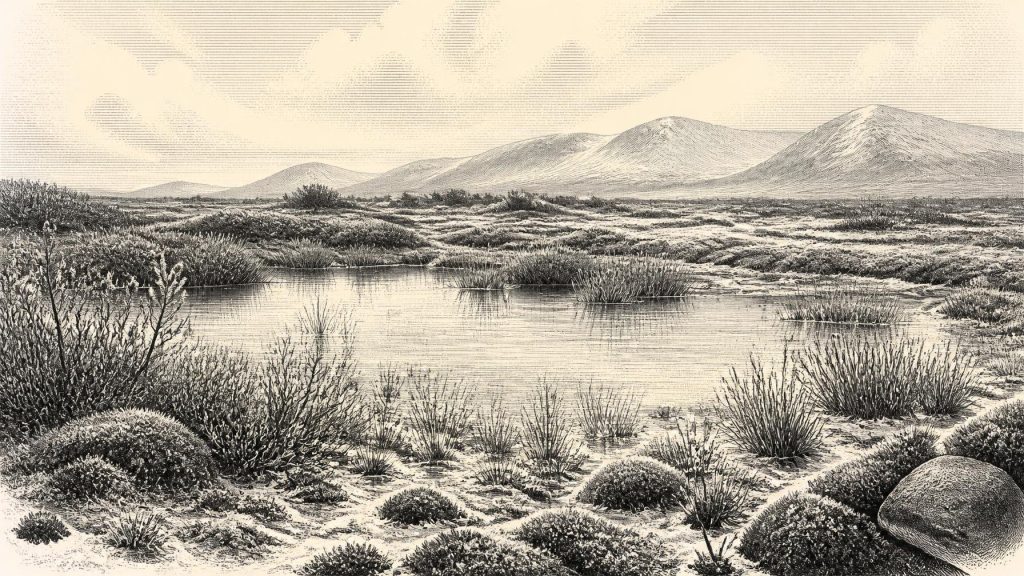
Derryvree’s Bogbean Shore30817 BCE
Around 30,817 BCE, Ireland’s past can only be described through broad Late Pleistocene evidence, not annual events. At Derryvree, County Fermanagh, sediments record an ice-free interval between glacial advances, with cold, open freshwater wetlands supporting sedges, mosses, aquatic plants and insects. Castlepook Cave, County Cork, preserves remains of mammoth, reindeer, giant deer and predators, although its disturbed deposits cannot reconstruct a single ecosystem. A cut-marked reindeer femur may indicate brief Upper Palaeolithic human activity, but proves neither settlement nor continuity. Environmental instability dominated, preceding the Last Glacial Maximum; no evidence exists for politics, farming, villages or institutions at this date.
Dateline
30,817 BCE is a modern calendar label, not a recoverable year in Ireland’s deepest past. No inhabitants left a written calendar, named a season, or recorded an event that can be placed in that particular year. Nor can archaeology identify a ruler, battle, treaty or settlement for it. The responsible approach is therefore chronological rather than annual: this point falls in the Late Pleistocene, during Marine Isotope Stage 3 (MIS 3), a long and climatically unstable part of the last Ice Age. The most useful evidence comes from dated deposits and animal remains whose ranges overlap this notional date, not from an event of 30,817 BCE itself.
That distinction matters. A radiocarbon result is not a calendar year, and a fossil deposit is not a diary. The Northern Hemisphere IntCal20 calibration curve permits radiocarbon ages to be expressed as probability ranges in calendar years, but uncertainty remains substantial at this depth in time. Around 30,817 BCE, Ireland can be discussed through a broad environmental horizon, perhaps roughly 32,800 calibrated years before AD 1950, rather than with the precision available for later archaeology or history. The evidence illuminates changing ice, water, plants, animals and the possibility of human visitation; it does not furnish a conventional national narrative.
Fresh Water Between Ice Advances
The most informative Irish site close to this date lies at Derryvree, near Maguiresbridge in County Fermanagh. Road works in 1969 cut through a drumlin and exposed a remarkable sequence: glacial till below, then fine sands, freshwater organic muds and silts, followed by proglacial sediment and another cover of till. Till is the unsorted mixture of clay, stones and other debris laid down directly by glacier ice. The order of these layers establishes a local sequence beyond reasonable doubt. Ice had covered the ground; a non-glacial interval followed in which water and organic material accumulated; then renewed ice or ice-proximal processes buried that living surface.
Organic material from the Derryvree mud, laboratory number BIRM-166, returned a conventional radiocarbon age of 30,500 ± 1,100 years BP. Modern calibration places the relevant interval broadly in the later part of MIS 3, approximately 36,900–31,700 calibrated years BP, or about 34,950–29,750 BCE. The wide range encompasses 30,817 BCE, but it cannot identify a particular season, plant, animal or human action in that year. The sample is best treated as evidence for a phase of sediment accumulation and wetland life, not as a pinpoint date. A later synthesis also flags this early measurement as a legacy, pre-Last Glacial Maximum determination requiring cautious use.
Within those limits, Derryvree is exceptionally eloquent. Its pollen, plant macrofossils, mosses and insects indicate cold, open, largely treeless country with wet hollows and standing or slow-moving freshwater. Grasses, sedges, juniper and herbs form the broad vegetation signal. Finds associated with the deposit include bogbean, water-milfoil, dwarf willow, mountain-avens and lesser clubmoss. Bogbean and water-milfoil particularly support the presence of freshwater margins and pools; mountain-avens and dwarf willow fit exposed, cold-ground conditions. Insect evidence likewise suggested what earlier researchers termed a muskeg environment: waterlogged, organic-rich ground with pools, mossy margins and plentiful plant debris.
This was not an unbroken desert of snow, but neither was it the wooded, pasture-rich Ireland of later millennia. Frost, wind, short growing seasons and saturated soils shaped a patchwork of shallow water, sedge beds, low vegetation and exposed mineral ground. The evidence supports local ice-free conditions in this part of Fermanagh while the organic layers formed. It does not prove that the whole island was ice-free at once, that every region shared the same habitat, or that modern rivers and coastlines existed in recognisable form. The survival of one buried wetland is valuable precisely because much evidence from this period was later eroded, reworked or concealed by ice.
Animals at Castlepook
County Cork provides a different, more dramatic archive. Castlepook Cave, also known as Mammoth Cave, near Doneraile, yielded the richest known Irish assemblage of Pleistocene vertebrates. Antiquarian excavations in the early twentieth century recovered remains attributed to woolly mammoth, reindeer, giant deer, brown bear, wolf, fox, mountain hare, lemmings and spotted hyaena. Such a list demonstrates that Ireland was connected, at least intermittently and ecologically, to the wider cold-stage world of north-west Europe. Reindeer and lemmings point to cold open habitats; mammoth, giant deer and large carnivores suggest a much richer faunal landscape than the modern island supports.
However, Castlepook must not be turned into a single imagined scene. Cave deposits can accumulate through animal deaths, carnivore activity, water movement, sediment disturbance and excavation practices separated by long periods. The Irish Quaternary Fauna Project stressed that many Irish cave collections came from nineteenth- and early twentieth-century excavations and that deposits were often disturbed. Dates from mammoth remains support a Middle Devensian or Midlandian cold-stage age for important parts of the Castlepook fauna, but they do not show that every recorded species lived together, or that they occupied the cave in 30,817 BCE. The cave is strong evidence for a regional faunal world, weak evidence for a single day’s ecology.
A Possible Human Trace
The most consequential, and most restricted, evidence for people is a reindeer femur from Castlepook. Re-examination of the old collection identified a deep mark interpreted as having been made on fresh bone by a sharp stone implement during butchery. The bone has been publicised as approximately 33,000 years old, raising the possibility that Upper Palaeolithic hunter-gatherers reached Ireland far earlier than the previously established late-glacial evidence. The interpretation deserves serious attention: if the mark is human-made and contemporary with the animal’s death, it would show that at least one reindeer carcass was processed by people during a cold-stage phase close to the horizon under discussion.
Yet the inference must stop there. One marked bone is not a settlement, a population estimate or proof of continuous occupation. No securely associated hearth, stone-tool assemblage, dwelling, burial, human remains or repeatedly used hunting camp of comparable age has been recovered in Ireland. It cannot establish the size of a party, whether hunters killed the animal or found it, how long they remained, which route they used, or whether they returned. It certainly cannot identify a language, ethnic identity, belief system or political organisation. The marked femur is best understood as a potentially transformative trace of brief human activity, still requiring further contextual and microscopic investigation, rather than as evidence for a settled Palaeolithic Ireland.
If people did enter the island during MIS 3, they would have encountered a challenging Atlantic-edge environment in which weather, animal movements, coastlines and ice margins changed over long timescales. Lower sea levels exposed more of the continental shelf than exists today, but lower water alone does not demonstrate a permanent, dry land bridge or a known route from Britain or continental Europe. Any account of a crossing, seasonal reindeer hunt, camp routine or social network would be an inference from Upper Palaeolithic evidence elsewhere, not an observed fact in Ireland.
Environmental Change, Not Politics
The major development relevant to 30,817 BCE was environmental transformation. Derryvree records freshwater life on ground later sealed beneath glacial sediments. Castlepook preserves animals adapted to, or able to exploit, open cold landscapes. Within several millennia, the Irish Ice Sheet would attain its final major advance, dated broadly to about 27,000–23,000 calibrated years BP. That maximum still lay ahead of this article’s horizon, but Ireland was already part of a highly variable North Atlantic climatic system in which ice sheets could expand, retreat and reorganise rapidly. These changes altered drainage, soils, available habitat and the survival of archaeological evidence itself.
There is no direct evidence for political affairs, conflict, diplomacy, trade, religion, formal learning, art or institutions in Ireland at this date. There is equally no evidence for farming, domestic livestock, metalworking, villages or territorial monuments. It would be misleading to fill those silences with familiar prehistoric themes from much later periods. If humans were present, their immediate concerns may have included shelter, fuel, food, animal behaviour and the risks of severe weather; but this is a reasonable general inference about mobile hunter-gatherers, not a documented description of Irish daily life.
What can responsibly be said is both modest and important. Around the broad calibrated interval containing 30,817 BCE, Fermanagh held a cold freshwater wetland between glacial advances, where mosses, sedges, aquatic plants and insects lived in open periglacial terrain. Elsewhere, Irish cave deposits preserve a cold-stage fauna of large herbivores and predators. A single reindeer bone from Cork raises the possibility of a fleeting human encounter with that world. Derryvree’s bogbean shore therefore represents not a lost year of Irish history, but a rare surviving fragment of the island’s living Ice Age landscape.
Primary Sources
- The IntCal20 Northern Hemisphere Radiocarbon Age Calibration Curve (0–55 cal kBP)
- Cenozoic: Tertiary and Quaternary
- Palaeoecology
- A review of terrestrial cosmogenic-nuclide and radiocarbon chronologies of the last British–Irish Ice Sheet
- The Glacial Deposits of the Maguiresbridge Area, County Fermanagh, Northern Ireland
- Clogher Valley
- BSBI: Menyanthes trifoliata
- BSBI: Salix herbacea
- BSBI: Selaginella selaginoides
- BSBI: Dryas octopetala
- Castlepook Cave
- The Irish Quaternary Fauna Project
- Pleistocene Vertebrates in the British Isles
- Occurrence of mammalia relicts at site Castlepook Cave
- Castlepook Cave, Co. Cork, 2022:0258
- Proceedings of the Royal Irish Academy: Castlepook Cave report
- Response of the Irish Ice Sheet to Abrupt Climate Change During the Last Deglaciation
- Last Glacial Maximum Cirque Glaciation in Ireland and Implications for Reconstructions of the Irish Ice Sheet
- Dimensions and Chronology of the Last Ice Sheet in Western Ireland
- The Colonization of Ireland: A Human Ecology Perspective
- Heritage Artefacts of County Cork
- The Subdivision of the Quaternary Period in Ireland