Maguirebridge’s Stadial Wetland30802 BCE
30,802 BCE is a modern label within Marine Isotope Stage 3, not a precisely recoverable Irish year. At Derryvree near Maguiresbridge, Fermanagh, freshwater organic silts between two tills record a cold, treeless tundra wetland during an interval of glacial retreat, later sealed by returning ice. Plants, pollen and insects show productive but severe conditions. Castlepook Cave, Cork, preserves a mixed late Pleistocene fauna, including cold-adapted mammals, though its deposits cannot represent one community or moment. A marked reindeer femur may indicate brief human butchery, but remains inconclusive. Evidence reveals environmental instability, not settled societies, institutions or permanent human occupation there.
Dateline
“30,802 BCE” is a useful modern filing label, not a date at which Irish prehistory can be reconstructed year by year. No written calendar existed in Ireland, and no archaeological layer can be assigned responsibly to that single year. The evidence instead belongs to the later Middle Palaeolithic climatic world of Marine Isotope Stage 3, within the Irish Midlandian cold stage. Radiocarbon and ice-core chronologies provide broad, calibrated ranges rather than annual precision. On the Greenland ice-core timescale, this nominal point falls approximately within Greenland Stadial 5.2, a cold interval beginning about 32,040 years before AD 2000; that correlation is a guide to North Atlantic climate, not proof that every part of Ireland experienced identical conditions at the same moment.
A Landscape Recorded in Fragments
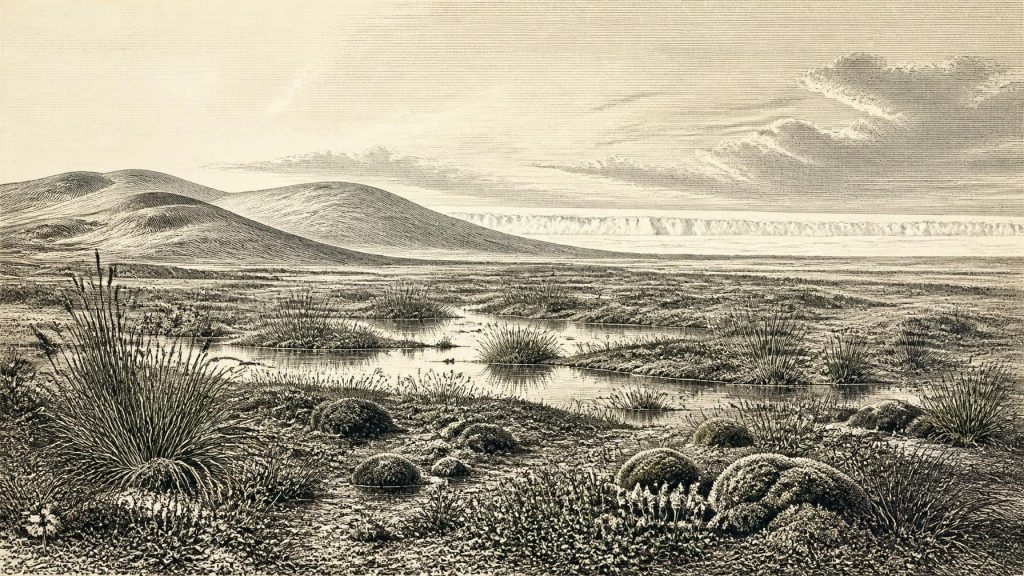
The best Irish evidence relevant to this broad period comes not from a settlement but from deposits exposed at Derryvree, near Maguiresbridge in County Fermanagh. Roadworks in 1969 cut through a drumlin and revealed a remarkable sequence: one thick layer of till, laid down beneath glacier ice; freshwater silts and fine sands with organic remains; and a second till above them. The order of those layers is secure. Ice had occupied the locality, then a non-glacial interval permitted a wetland or shallow-water environment to form, and later ice overrode and sealed it. It is precisely this burial that preserved a fleeting environmental record which might otherwise have vanished.
A conventional radiocarbon determination from the Derryvree organic series was 30,500 radiocarbon years BP, with a substantial uncertainty. Modern calibration places the deposit broadly within roughly 36,900–31,700 calibrated years BP, or about 34,950–29,750 BCE. The wide range matters. It includes 30,802 BCE, but does not establish that a particular pool, plant or animal was present in Fermanagh in that exact calendar year. Nor should Derryvree be enlarged into a picture of the whole island. It demonstrates a cold, biologically productive locality in Ulster during part of this lengthy interval; it cannot, by itself, map the exact limits of ice across Ireland at any one time.
Cold Water Beneath the Drumlins
The Derryvree silts nonetheless offer unusually vivid evidence for the kind of country that could exist between glacial advances. Plant remains and pollen indicate open, treeless vegetation rather than woodland. Grasses, sedges, dwarf shrubs, herbs and mosses point to a tundra or muskeg-like mosaic, with wet ground, pools and waterlogged vegetation. Fossil insects reinforce the picture of cold, open ground and organic-rich water margins. In older Irish Quaternary terminology, this setting lent its name to the Derryvree Cold Phase. It was not a sterile white wilderness: during suitable seasons, wetland plants, invertebrates and grazing animals could use particular sheltered landscapes. Yet it was a severe environment, marked by long cold winters, short growing seasons and periglacial processes in ground not necessarily covered by permanent ice.
This is an important corrective to two tempting simplifications. Ireland was neither uniformly ice-covered nor uniformly habitable throughout the last glacial cycle. Ice sheets advanced, stagnated and retreated at different times and in different regions; local terrain, proximity to ice margins and changing North Atlantic conditions mattered greatly. Equally, an organic bed between tills is not evidence of a mild interglacial Ireland. Derryvree’s flora and fauna indicate cold conditions, even while showing that freshwater life persisted. The upper till records a later return of glacier ice, making the sequence a warning against treating a brief environmental opening as permanent security.
Cork’s Cave Fauna
Far to the south, Castlepook Cave near Doneraile in County Cork supplies a different kind of evidence. Its historic excavations produced a large and complicated collection of animal bones from deposits accumulated over a long span of the Late Pleistocene and later periods. Dating and reassessment have associated elements of its older fauna with the broad Middle Midlandian interval. Mammoth, reindeer, giant deer, spotted hyaena, wolf, brown bear, foxes, hares and lemmings have all figured in discussion of the cave assemblage. Such animals do not prove that every species shared the cave at one instant, or that they ranged evenly across Ireland. A cave is a selective archive: animals may die there, be carried in by carnivores, fall into openings, or be redeposited by water and sediment.
Even so, Castlepook establishes that parts of Ireland were connected to a wider north-west European cold-stage fauna. Reindeer and lemmings accord with open, cold habitats; mammoth and hyaena evoke the broader mammoth-steppe and tundra environments known elsewhere in Europe. The cave’s fauna should not be imagined as a neatly balanced community or a single hunting scene. Some specimens have separate ages, and antiquarian collecting removed much of the original spatial and stratigraphic context. The prudent conclusion is narrower but still striking: during the wider period around this nominal date, southern Ireland could at times support, or at least receive, cold-adapted large mammals and predators.
The Reindeer Femur Question
Castlepook also raises the most consequential question about people in Ireland at this depth of time. A reindeer femur fragment, found in 1972 and subsequently dated to about 33,000 years ago, has a deep mark interpreted by palaeozoologist Ruth Carden as consistent with cutting by a sharp stone tool during butchery. County Cork heritage material presents it as evidence for human activity around 31,000 BCE. If that interpretation is confirmed, it would indicate that Upper Palaeolithic people reached Ireland far earlier than the once-standard narrative of post-glacial settlement allowed.
However, this one bone must bear only the weight it can carry. It is not from a securely excavated camp floor and has no directly associated hearth, stone-tool assemblage, dwelling, burial or concentration of food waste. The cut mark is therefore evidence requiring continued scrutiny, not a licence to describe a village, a named people or a permanent population in 30,802 BCE. At most, it may record a brief encounter: one or more people processing a reindeer carcass, perhaps during a short foray into a landscape also used by carnivores. Whether they killed the animal, how long they stayed, what route they took, or whether they ever returned cannot presently be recovered.
No Kingdoms, No Known Communities
Political affairs, diplomacy and organised conflict are wholly beyond the evidence for Ireland at this date. There are no polities, leaders, boundaries, alliances or battles that archaeology can identify. Nor is there evidence for an Irish language, a religion with recognised places of worship, formal art, literacy, farming, metalworking or trade networks. Absence of evidence is not proof that visitors had no beliefs, social ties or practical knowledge; every Upper Palaeolithic hunting party would have relied on shared skills, memory and co-operation. But those human capacities cannot be converted into specific Irish institutions without material support.
The same restraint applies to everyday life and economy. If people did reach Ireland during this phase, they would almost certainly have depended on mobility, weather knowledge, clothing, fire, portable tools and the careful use of animal resources. Reindeer could provide meat, fat, marrow, hide, sinew and bone. These are reasonable inferences from hunter-gatherer lifeways and from the animal itself, not demonstrated facts about a settled Irish group. No securely dated house, hearth, worked lithic assemblage, boat, storage pit or exchange object tells us how people lived here in this particular interval. The first substantial archaeological evidence for enduring human settlement belongs many millennia later.
Changing Ground and Deep Time
The principal historical development relevant to 30,802 BCE was environmental instability. The North Atlantic climate oscillated sharply on millennial and shorter timescales, while the British–Irish Ice Sheet changed in extent and behaviour. Studies of the wider ice sheet suggest advancing ice in northern sectors during the later part of MIS 3, but the timing, thickness and reach of ice in Ireland remain matters of regional reconstruction rather than settled fact. Derryvree’s paired tills show that glacier ice did return to its Fermanagh locality. They do not permit an annual weather report, nor do they make it possible to draw a single firm coastline or ice margin for this nominal year.
What survives from Ireland around this point in deep time is therefore a landscape history rather than a conventional human history: silt settling in cold freshwater; sedges and mosses growing at a wet margin; insects occupying open tundra ground; large mammals moving through suitable habitats; and ice eventually burying the evidence beneath a drumlin. Castlepook’s reindeer femur may add a tantalising human trace, but it remains isolated. The responsible picture is not of an established Ice Age Ireland with its own known society, but of a changing, severe and intermittently living land at Europe’s north-western edge—one whose archives are precious precisely because they are so rare.
Primary Sources
- A Middle Midlandian Freshwater Series at Derryvree, Maguiresbridge, County Fermanagh, Northern Ireland
- Quaternary Deposits and Glacial Stratigraphy in Ireland
- Irish Pleistocene Biostratigraphy
- The Irish Quaternary Fauna Project
- Advances in Irish Quaternary Studies
- The Quaternary History of Ireland: A Field Guide
- The Subdivision of the Quaternary Period in Ireland
- Quaternary
- Quaternary Geological Map of Ireland
- Pattern, Style and Timing of British–Irish Ice Sheet Advance and Retreat Over the Last 45,000 Years: Evidence from NW Scotland and the Adjacent Continental Shelf
- Growth and Retreat of the Last British–Irish Ice Sheet, 31,000 to 15,000 Years Ago: the BRITICE-CHRONO Reconstruction
- Timing and Pace of Ice-Sheet Withdrawal Across the Marine–Terrestrial Transition West of Ireland During the Last Glaciation
- A Stratigraphic Framework for Abrupt Climatic Changes During the Last Glacial Period Based on Three Synchronized Greenland Ice-Core Records
- IntCal Publications
- The IntCal20 Northern Hemisphere Radiocarbon Age Calibration Curve (0–55 cal kBP)
- Prehistoric Details
- Heritage Artefacts of County Cork 2021
- Ireland's Palaeolithic Archaeology – Fleeting Footprints in a Frozen Land
- First Evidence of a Late Upper Palaeolithic Human Presence in Ireland
- New Insights on the Fauna of Ireland's Younger Dryas and Early Holocene from Alice & Gwendoline Cave
- The Colonization of Ireland: A Human Ecology Perspective
- The Mesolithic in Ireland: When Was It?