
Fermanagh’s Freshwater Interlude30803 BCE
Thirty thousand eight hundred and three BCE is an imprecise label for a Late Pleistocene interval, not a Irish year. At Derryvree, County Fermanagh, freshwater silts, organic layers and tundra flora between two tills record an ice-free phase around 33,500 years BP, later buried by renewed glaciation. Mosses, sedges, insects and open vegetation indicate cold periglacial wetlands, not forest or settlement. Irish cave remains show cold-adapted mammals, including reindeer and mammoth, during wider MIS 3, though dates and associations remain uncertain. Human activity is possible but unproven; no secure contemporary settlement, tools or social history survives. Only environmental evidence survives.
Dateline
30,803 BCE is a modern chronological label, not a year for which Ireland possesses an event, a ruler, a community or even a season that can be securely identified. In archaeological terms it converts only approximately to 32,750 years before AD 1950, the reference point used for ‘before present’ (BP). That arithmetic does not create calendar-year precision. At this depth of time, radiocarbon results require calibration and retain substantial uncertainty; the appropriate history is consequently a reconstruction of environments and evidence, rather than an annal of human affairs.
The broad setting was the Late Pleistocene, during Marine Isotope Stage 3 (MIS 3), within the long Midlandian glacial episode in Ireland. This was not yet the global Last Glacial Maximum, which followed later, but it was a world of abrupt climatic oscillations, advancing and retreating ice margins, sparse vegetation and radically altered coastlines. Ireland’s surviving record is patchy because later glaciers repeatedly eroded, moved and buried older deposits. What remains is unusually precious: a few protected sediments, cave assemblages and landforms preserve brief, local windows onto a landscape otherwise largely lost.
A Date Within a Range
The closest Irish evidence to this notional date comes from Derryvree townland, near Maguiresbridge in County Fermanagh. Road works in February and March 1969 cut through a drumlin, exposing a striking sequence. A lower layer of till—unsorted material deposited directly by glacier ice—was overlain by freshwater silts, fine sands and organic layers, which in turn were sealed beneath another thick till sheet. The order is clear even where the calendar is not: ice had occupied the site; an interval without local glacier cover permitted freshwater sediment and organic matter to accumulate; then ice later returned and buried the deposit.
Organic material from this freshwater series produced the conventional radiocarbon determination Birm-166: 30,500 radiocarbon years BP, with a large stated uncertainty. A radiocarbon age is not a direct calendar age, because atmospheric carbon-14 concentrations have changed through time. Modern calibration curves extend to 55,000 calendar years BP, but their older sections are constructed from several kinds of independently dated evidence and cannot turn one old measurement into an exact historical year. A later Bayesian treatment places the Derryvree result at about 33.5 ± 1.2 thousand years BP. Thus 30,803 BCE falls within the broad chronological neighbourhood illuminated by Derryvree, but cannot be assigned to a particular plant bed, animal visit or human action.
Water Between the Ice Sheets
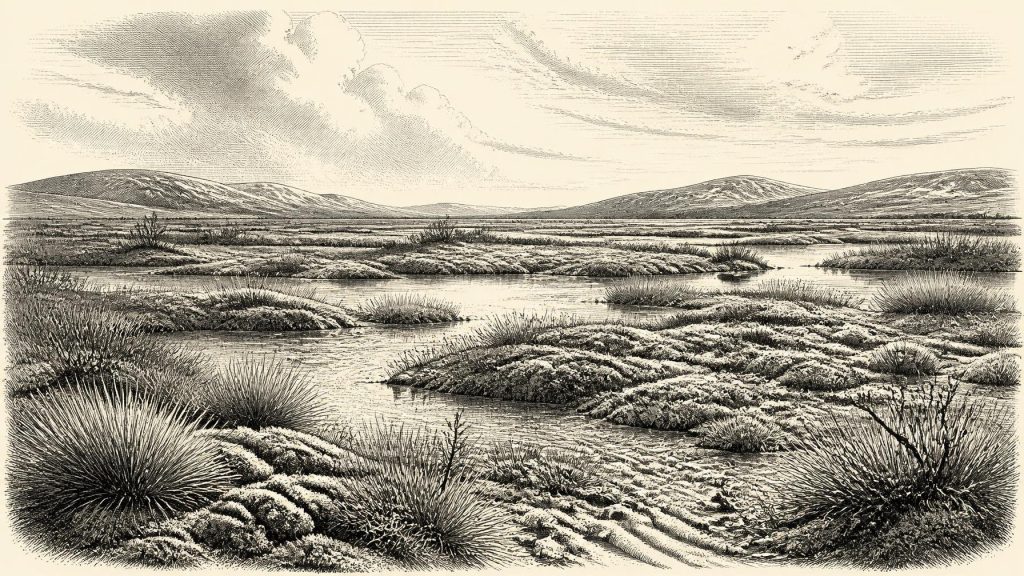
Derryvree provides direct evidence for a local freshwater environment in Fermanagh during a cold, non-glacial interval. Its flora and insect fauna were described by the original investigators as having a full-glacial, northern character. Mosses, sedges and other wetland plants grew in or beside shallow water; the wider pollen and macrofossil evidence indicates open tundra vegetation rather than woodland. The record includes plants suited to exposed, cool ground, including mountain avens, while its aquatic and marsh plants show that liquid freshwater persisted seasonally or more continuously at the site.
This was not a gentle pastoral landscape and not an empty frozen desert. It was a periglacial environment: ground subject to severe cold, frost action and short growing seasons, but capable of supporting low vegetation, insects and animals. A patchwork of sedge-rich margins, shallow pools, mineral ground and sparse shrub or herb cover is a reasonable interpretation of the evidence immediately around Derryvree. It is not evidence for a forest, fields or permanent villages. Nor should a site beneath a Fermanagh drumlin be converted into a map of the entire island: conditions could vary greatly with altitude, exposure, latitude and the shifting position of ice.
An Island of Moving Frontiers
At this stage, the British–Irish Ice Sheet was growing in a complex and geographically uneven fashion. Later evidence demonstrates that ice expanded to the Atlantic shelf edge west of Ireland, but the timing of maximum extent differed between sectors; ice-sheet reconstructions identify advances and maxima between roughly 30,000 and 22,000 years BP. Derryvree’s inter-till deposit is therefore important precisely because it prevents a simple picture in which Ireland was either wholly ice-covered or wholly ice-free. It records one locality where freshwater and tundra conditions existed between two glacial episodes.
What followed was more destructive than constructive for the archive. The upper till at Derryvree proves that a later glacier crossed the locality, incorporating the freshwater deposits into the body of a drumlin. Across Ireland, ice erosion reshaped older surfaces, excavated basins, redistributed stone and sediment, and removed many traces that might otherwise have recorded plants, animals or people. The eventual Last Glacial Maximum saw a large Irish component within the wider British–Irish Ice Sheet. It should not, however, be projected backwards as a precise condition for 30,803 BCE: the evidence supports changing ice margins, not a single island-wide snapshot.
Animals and the Limits of Cave Evidence
The Irish cave record confirms that a diverse cold-stage fauna reached the island during MIS 3. Castlepook Cave, near Doneraile in County Cork, has produced remains attributed to mammoth, reindeer, giant deer, wolf, Arctic fox, brown bear, spotted hyaena and lemmings. Taken together with other Irish finds, these remains show that Ireland was repeatedly accessible to animals adapted to open and often cold environments. Reindeer in particular suit the image of a tundra or steppe-tundra mosaic, while hyena and wolf remind us that large herbivores moved within a food web of scavengers and predators.
Yet cave bones cannot safely be treated as a census for one moment. Castlepook was excavated long ago, and its deposits include sediments of different ages, disturbed material and later intrusive fauna. Some older radiocarbon measurements from Irish caves have been reassessed as methods of bone preparation improved. The responsible conclusion is therefore modest: mammals such as reindeer and mammoth occurred in Ireland during parts of the wider middle-to-late MIS 3 interval; their simultaneous presence at Castlepook, or their presence in every region in 30,803 BCE, is not established.
People: Possibility Without a Settlement
There is no securely excavated dwelling, hearth, tool-making floor, burial, artistic site or settlement from Ireland that can be placed in this particular period. That absence matters. It means there is no evidential basis for naming an Irish population, reconstructing kinship, describing a language, identifying a political territory, or claiming regular trade and diplomacy. Farming, livestock husbandry, pottery and built monuments lay far in the future. Even if people occasionally entered Ireland, the surviving record cannot show whether they formed a small hunting party, a short-lived camp or something more durable.
A reindeer femur from Castlepook has been publicly reported as approximately 33,000 years old and as bearing a deep mark interpreted as stone-tool butchery. If this interpretation is sustained by detailed contextual and microscopic study, it would be potentially important evidence for Upper Palaeolithic human activity in Ireland close to the broader period under discussion. But it is one bone from an old cave collection rather than a sealed occupation surface, and it cannot support a narrative of established settlement. The better documented published evidence for human presence in Ireland remains much later: a cut-marked brown-bear patella from Alice and Gwendoline Cave in County Clare, dated to around 12,810–12,590 calibrated BP.
Society Beyond Recovery
Consequently, political history at this date is not merely unknown; the available evidence does not allow it to be asked in the usual way. There were no states, written agreements, chiefs or conflicts identifiable in the Irish record. Nor can religious belief, ritual practice, visual culture or teaching traditions be recovered from Derryvree’s plants and sediments. European Upper Palaeolithic groups elsewhere possessed sophisticated technologies and cultural practices, but similarities cannot be assumed for Ireland without Irish artefacts or contexts. The most that can responsibly be said is that any people present would have faced a demanding northern landscape in which mobility, knowledge of animals, shelter and fuel would have been vital.
Economy, in the modern sense, is equally beyond reach. The Derryvree archive records natural production—wetland plants, insects and the habitats supporting animals—not human exploitation of it. Reindeer, other grazing mammals and freshwater margins may have offered opportunities to mobile foragers, but no butchered assemblage, hunting weapon or camp equipment demonstrates how such resources were used at this date. Likewise, lowered sea levels altered the surrounding seascape, but the exact routes by which animals or people might have travelled cannot be reconstructed from the evidence for a single year.
What This Year Can Mean
The significance of 30,803 BCE lies not in an invented episode but in a buried Fermanagh marsh. Derryvree shows that, during a cold phase of the last Ice Age, an interval of ice-free freshwater conditions existed at least locally between separate glacial advances. Its silts, mosses, sedges and insects preserve a landscape of open tundra and shallow water; Irish cave faunas indicate that large mammals had reached the island during the wider period. Human presence remains possible but unproven as a settled reality. This is Ireland before history, but not before evidence: a land whose story survives in layers of mud, plant fragments, bones and ice-borne stone.
Primary Sources
- A Middle Midlandian Freshwater Series at Derryvree, Maguiresbridge, County Fermanagh, Northern Ireland
- Exploring Controls of the Early and Stepped Deglaciation on the Western Margin of the British Irish Ice Sheet
- Growth and Retreat of the Last British–Irish Ice Sheet, 31,000 to 15,000 Years Ago: The BRITICE-CHRONO Reconstruction
- Timing and Pace of Ice-Sheet Withdrawal Across the Marine–Terrestrial Transition West of Ireland During the Last Glaciation
- Early Deglaciation of the British-Irish Ice Sheet on the Atlantic Shelf Northwest of Ireland Driven by Glacioisostatic Depression and High Relative Sea Level
- The Deglaciation of the Western Sector of the Irish Ice Sheet From the Inner Continental Shelf to its Terrestrial Margin
- Deglaciation Chronology of the Donegal Ice Centre, North-West Ireland
- Trimlines, Blockfields and the Vertical Extent of the Last Ice Sheet in Southern Ireland
- A Reconsideration of the Radiocarbon Dating of the Marine Isotope Stage 3 Fauna From Southern Ireland
- The Irish Quaternary Fauna Project
- Pleistocene Vertebrates in the British Isles
- Early Midlandian–Middle Midlandian, Pleistocene, Northern Ireland
- The IntCal20 Northern Hemisphere Radiocarbon Age Calibration Curve (0–55 cal kBP)
- IntCal Publications
- Prehistoric Details: Stone Age
- First Evidence of a Late Upper Palaeolithic Human Presence in Ireland
- New Insights on the Fauna of Ireland's Younger Dryas and Early Holocene From Alice & Gwendoline Cave
- Dryas Octopetala
- Heritage Artefacts of County Cork
- Mammoth Cave, County Cork
- Occurrence of Mammalia Relicts at Site Castlepook Cave
- Irish Quaternary Association
- References and Recommended Reading: IQUA Guide 16