Derryvree’s Threeleaf Fen30555 BCE
At around 30,555 BCE, Ireland lay within the unstable middle phase of the last glacial period, not a precisely datable year. Derryvree’s freshwater deposits, preserved between glacial tills in County Fermanagh, record a local ice-free wetland between roughly 36,900 and 31,700 years ago. Its treeless tundra-like environment supported sedges, mosses, aquatic plants, willow and juniper amid severe seasonal conditions. Castlepook Cave in County Cork yielded diverse MIS 3 fauna, including mammoth, reindeer and hyaena. A marked reindeer femur may indicate human carcass processing, but settlement remains unproven. These scarce records show biologically active landscapes before later ice-sheet expansion transformed Ireland.
Dateline
“30,555 BCE” is a useful modern label, not a date that can be recovered with calendar-year precision from Irish Ice Age evidence. In radiocarbon terms it falls roughly 32,505 years before 1950, but the deposits relevant to this moment have margins of error measured in centuries or millennia. The responsible view is therefore of Ireland during the middle part of the last glacial period, within Marine Isotope Stage 3, rather than of events occurring in one identifiable year. The best Irish environmental evidence is a freshwater sequence uncovered at Derryvree, near Maguiresbridge in County Fermanagh. Its calibrated age range, about 31,700–36,900 years before present, encompasses this notional date.
A Wetland Between Ice Advances
Derryvree was exposed in 1969 when roadworks cut through a drumlin. Beneath the familiar streamlined hill lay an unusual sequence: freshwater silts and fine sands containing organic material, sealed between two substantial layers of glacial till. This stratigraphy matters. The lower till records an earlier ice advance; the organic bed indicates a subsequent interval in which ice had withdrawn locally and freshwater conditions developed; the upper till shows that ice later returned. Derryvree is thus not evidence for a permanently benign Ireland. It is evidence for an ice-free episode in one northern basin during a long, unstable cold age.
A conventional radiocarbon determination from the organic material, BIRM-166, produced an age of 30,500 ± 1,100 radiocarbon years before present. Radiocarbon years are not calendar years, particularly at this depth of time. Later calibration places the deposit broadly between c. 36,900 and 31,700 calibrated years before present. That range is more informative than pretending to locate it at 30,555 BCE precisely. It also overlaps several abrupt Greenland interstadial and stadial fluctuations, but no secure Irish annual chronology exists which can attach Derryvree to a single named warm pulse.
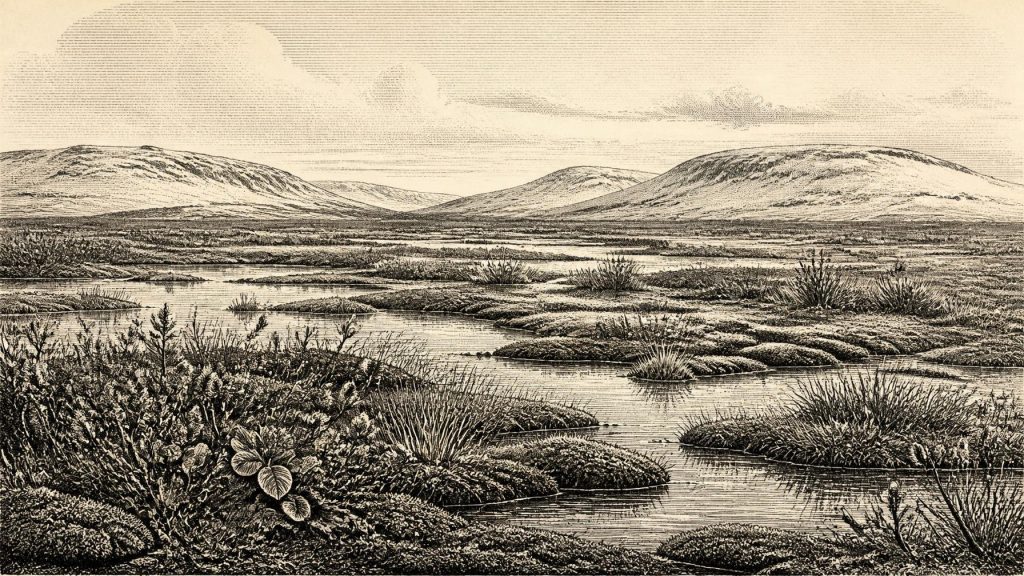
The deposit preserves a landscape unlike later wooded Ireland. Plant macrofossils, pollen, mosses and insects point to a treeless, cold-ground wetland often described as muskeg: waterlogged ground with sedges, mosses, shallow pools and patches of herb-rich vegetation. Bogbean or three-leaved buckbean (Menyanthes trifoliata), water-milfoil, dwarf willow, juniper and Arctic-alpine plants occur among the evidence. These were not forest plants flourishing in a mild countryside. They suggest a low, damp basin in an open tundra or tundra-steppe setting, where short summers could sustain freshwater vegetation but winters were severe and permafrost-related processes shaped the ground.
What Derryvree Can, and Cannot, Show
The Fermanagh sequence is exceptionally valuable because organic material rarely survives later glacial erosion. Yet it must not be made to speak for the entire island. It offers a close view of conditions near Maguiresbridge, not a complete map of Cork, the western seaboard, the mountains or the then-submerged continental shelf. Irish climate and ice margins were variable. The presence of a freshwater basin at Derryvree demonstrates local ice-free terrain and water; it does not prove that all of Ireland was open, habitable or continuously connected from coast to coast.
Nor should the wetland be imagined as a tranquil modern bog. The fossil assemblages indicate a productive but exposed mosaic. Sedges and mosses could colonise saturated ground, while open water supported aquatic plants and insects. Sparse willow and juniper gave some low cover rather than woodland. In such a setting, seasonality would have governed life: a brief growing season, cold winds, frozen or waterlogged soils, and rapid ecological responses when temperature or snowfall changed. The landscape was capable of sustaining plants and animals, but it stood within a climate system prone to sharp reversals.
At about this broad stage of the last glacial cycle, the British–Irish Ice Sheet had not yet reached its later maximum extent. Major syntheses place the decisive expansion towards the Last Glacial Maximum after this period, with extensive ice reaching the continental shelf around Ireland during the subsequent millennia. Derryvree’s upper till is the local reminder of that future transformation. Later advancing ice would cover, erode and rearrange much of the country, destroying or burying evidence of earlier land surfaces. This is one reason the archaeological record for this age is so fragmentary.
Caves and the Mammal Landscape
The other major Irish window is in limestone caves, especially Castlepook Cave—also called Mammoth Cave—near Doneraile in north County Cork. Old excavations there produced a striking collection of Late Pleistocene animal remains. Modern re-dating has shown that several animals from southern Irish caves were substantially older than earlier results had suggested, belonging to Marine Isotope Stage 3 rather than only to the final retreat of the ice. Castlepook’s fauna includes woolly mammoth, reindeer, giant deer, brown bear, wolf, Arctic fox, lemmings and spotted hyaena.
These animals should not be treated as though they all stood together on one day in a single Cork valley. Cave collections accumulated over long intervals and can be altered by carnivores, water, excavation and nineteenth- or early twentieth-century collecting methods. Nonetheless, the fauna establishes that Ireland supported, at different points in this broad period, cold-adapted and open-country mammals as well as large predators and scavengers. Reindeer and lemmings fit a cold, open environment; mammoth and giant deer imply substantial grazing opportunities; hyaenas, wolves and bears reveal a more complex animal community than Ireland possesses today.
Caves were important parts of that animal world, but not necessarily human homes. Hyaenas may have brought carcass parts underground, bears may have denned, and water or gravity may have moved bones. A cave bone deposit is therefore an archive requiring careful reconstruction, not a ready-made settlement site. The National Museum of Ireland’s historic collections and recent work at Castlepook remain crucial because re-examination, direct dating and microscopic study can overturn assumptions derived from old excavations.
The Reindeer Femur Question
One Castlepook reindeer femur has particular importance. It bears a deep linear modification interpreted by zooarchaeologist Ruth Carden as a cut or chop made with a sharp stone tool while the bone was fresh. If that interpretation is sustained, it would represent extraordinarily early evidence that people handled an animal in Ireland—far earlier than the well-established Late Upper Palaeolithic evidence from Alice and Gwendoline Cave in County Clare, dated to roughly 12,800–12,590 calibrated years before present.
But the word “if” is essential. The marked femur is a serious and intriguing piece of proposed evidence, not a licence to populate Ice Age Ireland with a known tribe, permanent village or named archaeological culture. No securely associated stone-tool assemblage, hearth, dwelling floor, burial, human bone, artwork or occupation surface of comparable age has been recovered from Ireland. The specimen derives from an old cave collection, where original spatial context is limited. Its mark may support an episode of carcass processing by people; it cannot establish the duration, size, route, language or social organisation of any visiting group.
This distinction changes how everyday life can be described. If people did reach Ireland during this interval, they were almost certainly mobile hunter-gatherers using organic equipment and stone tools comparable in broad function to those known elsewhere in Upper Palaeolithic Europe. Reindeer offered meat, hide, sinew, fat and bone. Yet these are inferences from the wider European record, not directly demonstrated Irish practices. It would be irresponsible to assert a camp at Doneraile, a particular hunting season, boat travel, a land crossing, or a continuous population descended from such visitors.
No Polities, No Proven Religion
There is no evidence for political institutions, chiefs, territories, diplomacy, warfare or formal alliances in Ireland at this time. There are likewise no Irish burials, shrines, figurative art, monuments, inscriptions or ritual deposits that can responsibly be assigned to around 30,555 BCE. The absence of evidence cannot prove that visiting people had no beliefs, kin obligations or cultural traditions. It means only that Irish archaeology cannot identify them. Modern terms such as “Ireland” and “Irish” here describe a place, not a people with a recorded identity.
Economy and trade must be handled with the same restraint. The Derryvree plants and Castlepook animals illuminate natural resources, not an economy documented by tools, exchange goods or settlements. No imported artefacts demonstrate trade networks. Low sea levels altered the geography of north-west Europe, and land connections or narrow-water crossings may at times have made animal and human movement easier than today; nevertheless, the routes available at any particular century remain uncertain. Ireland was on Europe’s Atlantic margin, not outside the ecological and geographical changes of the wider continent.
An Archive of Survival
The most important development represented by this date is therefore environmental, not political: parts of Ireland could briefly support wetlands, tundra vegetation and large mammals between glacial advances. Derryvree records the local persistence of freshwater life in a cold interval; Castlepook records the remarkable animal communities that ranged across southern Ireland at different times in the same broad age. Together they complicate the old image of an island that was simply empty beneath ice until the end of the Pleistocene.
They also impose discipline. Around 30,555 BCE, calendar precision is unavailable; settlement is unproven; and the possible human signal is exceptionally slight. What survives is more compelling for its limits: silts under a Fermanagh drumlin, plant remains from a vanished fen, and bones from a Cork cave. These traces reveal a changing Ice Age Ireland—open, cold and biologically active—on the threshold of the much greater glacial expansion that would again transform the island.
Primary Sources
- A Middle Midlandian Freshwater Series at Derryvree, Maguiresbridge, County Fermanagh, Northern Ireland
- A Reconsideration of the Radiocarbon Dating of the Marine Isotope Stage 3 Fauna from Southern Ireland
- The Irish Quaternary Fauna Project
- Exploring Controls of the Early and Stepped Deglaciation on the Western Margin of the British-Irish Ice Sheet
- Episodic Speleothem Deposition Tracks the Terrestrial Impact of Millennial-Scale Climate Variability in Western Europe
- Growth and Retreat of the Last British–Irish Ice Sheet, 31,000 to 15,000 Years Ago: the BRITICE-CHRONO Reconstruction
- Timing, Pace and Controls on Ice Sheet Retreat: an Introduction to the BRITICE-CHRONO Transect Reconstructions of the British–Irish Ice Sheet
- Pattern and Timing of Retreat of the Last British-Irish Ice Sheet
- Oscillating Retreat of the Last British-Irish Ice Sheet on the Continental Shelf Offshore Galway Bay, Western Ireland
- The Deglaciation of the Western Sector of the Irish Ice Sheet from the Inner Continental Shelf to its Terrestrial Margin
- Dimensions and Chronology of the Last Ice Sheet in Western Ireland
- Trimlines, Blockfields and the Vertical Extent of the Last Ice Sheet in Southern Ireland
- New Insights on the Fauna of Ireland's Younger Dryas and Early Holocene from Alice & Gwendoline Cave
- New Insights on the Fauna of Ireland's Younger Dryas and Early Holocene from Alice & Gwendoline Cave (open-access PDF)
- The Mesolithic in Ireland: When Was It?
- The Quaternary Period in Ireland: Field Guide 17
- Palaeoecology: Quaternary Research Association Field Guide 16
- The Irish Quaternary Fauna Project (full-text repository record)
- Heritage Artefacts of County Cork
- Castlepook Cave, Co. Cork: 2022 Excavation Report
- Could Brown Bears Have Survived in Ireland During the Last Glacial Maximum?
- Stratigraphic and Palaeo-Geomorphological Evidence for the Glacial-Deglacial History of the Last British-Irish Ice Sheet in the North-Western Irish Sea