Fermanagh–Cork Ice-Free Mosaic30364 BCE
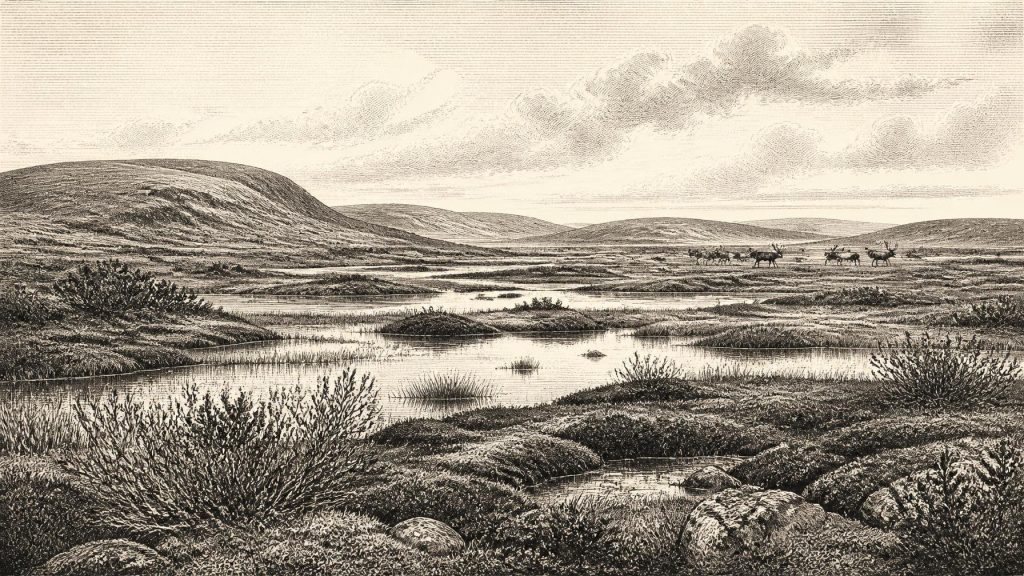
30,364 BCE is not a precisely recoverable Irish year but falls within late Marine Isotope Stage 3. Derryvree, County Fermanagh, preserves freshwater sediments between glacial tills, indicating a cold, treeless, periglacial wetland with tundra vegetation before renewed ice advance. Castlepook Cave, County Cork, contains a long-accumulated fauna including reindeer, mammoth, giant deer, bear, wolf, Arctic fox and hyaena, demonstrating changing cold-stage habitats. A possibly cut-marked reindeer bone suggests, but does not prove, early human presence. No settlement evidence exists. The record depicts a dynamic regional mosaic of wetlands, open ground, animal movement and later glacial destruction across Ireland over millennia.
Dateline
30,364 BCE is a modern chronological label, not a year that can be isolated in Ireland’s prehistoric record. Counting from the archaeological convention of AD 1950, it falls roughly 32,313 calendar years before present. At that depth of time, no Irish document, annual layer, settlement sequence or securely dated human event permits calendar-year precision. The responsible approach is therefore to place the date within broad calibrated ranges and to ask what the surviving evidence can reveal about Ireland during this phase of the last Ice Age.
The period belongs to Marine Isotope Stage 3, a long and climatically unstable portion of the Late Pleistocene. Ireland was not simply a land continuously hidden beneath a single unchanging ice sheet. Ice margins, local glaciers, permafrost conditions, open ground, wetlands and animal habitats shifted repeatedly as North Atlantic climate altered. The evidence is fragmentary and strongly regional, but two places are especially important for an Ireland around this broad horizon: Derryvree near Maguiresbridge in County Fermanagh, and Castlepook Cave near Doneraile in north County Cork.
Dating a Vanished Landscape
The strongest warning against false precision comes from radiocarbon dating itself. A radiocarbon measurement is not a calendar date: it records the remaining carbon-14 in once-living material, and must be calibrated against changing atmospheric carbon-14 levels. At more than 30,000 years ago, the calibrated results are broad ranges rather than exact historical points. The modern IntCal20 calibration curve reaches back 55,000 calendar years, but it does not convert a bone or layer of organic mud into a diary entry.
Derryvree provides the closest substantial environmental archive. In a road cutting through a drumlin, investigators found freshwater silts and fine sands sandwiched between two thick, distinct layers of till, sediment laid down by glacier ice. The organic sequence produced the conventional radiocarbon determination BIRM-166, 30,500 ± 1,100 radiocarbon years BP. Published calibrations and later chronological modelling place its significance within a wide late-MIS-3 window, rather than at a single moment; one published expression of the range is about 36.9–31.7 thousand calibrated years BP. The nominal date of 30,364 BCE falls within that broad uncertainty, not at its centre as a demonstrable event.
That distinction matters. The Derryvree deposit establishes that, before a later ice advance buried it beneath till, part of Fermanagh supported freshwater conditions and vegetation. It cannot prove that every Irish region had the same climate, nor can it tell us the weather in one particular year. Yet its very survival between glacial deposits is decisive evidence that the landscape experienced major change: an ice-free interval capable of sustaining wetlands was followed by renewed glaciation.
Wetlands Beneath the Drumlins
The Derryvree plant and animal evidence indicates a cold, treeless and periglacial environment rather than a wooded Ireland resembling the modern island. Fine sediments preserved pollen, plant macrofossils, mosses and small invertebrate remains. Freshwater mosses, sedges, dwarf willow, mountain avens, bogbean and aquatic plants such as water-milfoil point to shallow water, marshy margins and open ground. Such species do not make the site temperate or comfortable; rather, they show that short growing seasons could sustain a patchwork of pools, wet sedge ground and sparse tundra-like vegetation.
Permafrost and freeze–thaw processes would have shaped the ground beyond the wettest hollows. In winter, waterlogged soils froze; during seasonal thaw, meltwater could spread across low ground and carry silt into ponds and channels. The thick till above the Derryvree sequence records the eventual destruction or burial of that living surface by ice. Modern drumlin country in Fermanagh is therefore partly a palimpsest: its smooth hills conceal sediments laid down in a landscape radically unlike the present.
There is no basis for imagining fields, cleared farms, villages or a stable territorial population. The wetland record nevertheless illuminates everyday ecological realities. Herbivores could find browse, sedges and grasses in suitable seasons; predators and scavengers could follow them; birds and small mammals occupied niches now known only through their preserved traces. The landscape was productive in local pockets, but vulnerable to abrupt climatic deterioration and advancing ice.
Castlepook and the Ice-Age Fauna
Far to the south, Castlepook Cave is Ireland’s richest known archive of pre-Last Glacial Maximum vertebrate remains. Its nineteenth- and early twentieth-century excavations, followed by later reassessment and fresh fieldwork, recovered a striking range of animals: woolly mammoth, reindeer, giant deer, brown bear, wolf, Arctic fox, hare, lemmings and spotted hyaena. Not every species was necessarily present together, and the cave deposits were accumulated over a very long period. Individual bones may have arrived through carnivore activity, natural deaths, water movement, collapse and earlier disturbance. The assemblage is therefore an archive of changing faunas, not a census from one season.
Even so, directly dated bones demonstrate that Ireland supported cold-stage mammals during Marine Isotope Stage 3. Reindeer are especially significant for a date in the early thirty-first millennium BCE, because they imply open country and grazing habitats. Mammoth and giant deer convey the scale and diversity of the larger fauna, while hyaena remains remind us that caves could be dens or scavenging locations rather than safe repositories of material left by people. The Cork evidence complements rather than duplicates Derryvree: one site preserves a cave-based record of animal life, the other an inter-till freshwater landscape in the north.
These animals did not inhabit an isolated island in the later historic sense. Lower global sea levels changed coastlines and the configuration of surrounding shelves, although the exact availability, timing and character of land connections or sea crossings remain matters for reconstruction rather than direct observation at either Irish site. What can be said securely is that animal populations reached Ireland repeatedly during suitable intervals, while later ice-sheet growth could erase habitats and interrupt or eliminate those populations.
People: A Possibility, Not a Population
The human story at this date must be expressed even more carefully. A reindeer femur from Castlepook has been reported as bearing a deep mark interpreted by zoologist Ruth Carden as possible stone-tool damage made while fresh bone was being processed. Its reported age, about 33,000 years ago, makes it broadly relevant to the period under discussion. If the mark is confirmed as anthropogenic, it would indicate that an Upper Palaeolithic person handled a reindeer carcass in Ireland far earlier than the island’s long-established post-glacial archaeological record.
But the inference has firm limits. A radiocarbon date on the animal dates its death, not the exact time of any incision, the location where it died, or the duration of a human visit. A single modified bone would not establish a permanent settlement, a camp, a family group, a migration route or continuous occupation. Nor does it identify whether people hunted the animal, encountered it after death, removed meat, hide or sinew, or lost the bone before carnivores and natural processes carried it into the cave. The Castlepook proposal is important precisely because it is potentially transformative, but it remains a narrow and contested form of evidence.
No hearth, tool assemblage, dwelling floor, human burial or securely stratified occupation surface is currently known from Ireland for 30,364 BCE. Later evidence from Alice and Gwendoline Cave in County Clare securely demonstrates human activity during the terminal Pleistocene, many millennia afterwards, through cut-marked brown-bear bone. That later find cannot be projected backwards to fill the much earlier gap. For this date, people remain possible visitors rather than an archaeologically visible Irish population.
What Cannot Be Written
Accordingly, political affairs, diplomacy and organised warfare are absent from the evidence. There were no states, kings, named communities, frontiers or treaties that can responsibly be assigned to Ireland at this time. There is also no evidence for religion, formal learning, monuments, pottery, metalworking, farming, seaborne trade or exchange networks in the later prehistoric sense. Silence on these matters is not a failure to search for a familiar historical narrative; it is the necessary result of the surviving record.
Culture can only be approached indirectly. If people did reach Ireland in this interval, they would have been mobile Upper Palaeolithic hunter-gatherers operating in a wider north-west European world, where stone technology, animal processing, clothing and social knowledge enabled groups to survive cold environments. Yet none of those practices is directly documented in Ireland around this date. The cautious conclusion is smaller but more revealing: Ireland contained habitable, though harsh and changeable, ice-age environments; large mammals moved through them; and perhaps, briefly, people did too.
The principal development represented by 30,364 BCE is therefore environmental, not political. The Derryvree wetland and the Castlepook fauna overturn any simple picture of an eternally frozen or empty island. They show a regional mosaic of open ground, freshwater, animal corridors and later glacial burial. They also show why Ireland’s earliest past is difficult to recover: advancing ice, moving water, cave disturbance and deep time have destroyed or scrambled much of the record. What remains is enough to establish a dynamic Late Pleistocene Ireland, but not enough to turn a modern calendar number into a known year of events.
Primary Sources
- A Middle Midlandian Freshwater Series at Derryvree, Maguiresbridge, County Fermanagh, Northern Ireland
- South Fermanagh, Northern Ireland: Irish Quaternary Association Field Guide 16
- Early Midlandian–Middle Midlandian, Pleistocene, Northern Ireland
- The Irish Quaternary Fauna Project
- A Reconsideration of the Radiocarbon Dating of the Marine Isotope Stage 3 Fauna from Southern Ireland
- Castlepook Cave, County Geological Site Report CK032
- The Exploration of Castlepook Cave, County Cork
- Castlepook Cave, Castlepook South, County Cork: Excavation Report 2022
- Pleistocene Glaciations in Ireland
- Maximum Extent and Readvance Dynamics of the Irish Sea Ice Stream and Irish Sea Glacier during the Last Glacial Cycle
- The Timing and Magnitude of the British–Irish Ice Sheet between Marine Isotope Stages 5d and 2
- New Data for the Last Glacial Maximum in Great Britain and Ireland
- Response of the Irish Ice Sheet to Abrupt Climate Change During the Last Deglaciation
- The IntCal20 Northern Hemisphere Radiocarbon Age Calibration Curve (0–55 cal kBP)
- The IntCal20 Northern Hemisphere Radiocarbon Age Calibration Curve (open-access version)
- IntCal: Radiocarbon Dating Research
- IntCal20 Radiocarbon Calibration Curve
- First Evidence of a Late Upper Palaeolithic Human Presence in Ireland
- The Colonization of Ireland: A Human Ecology Perspective
- The Mesolithic in Ireland: When Was It?
- New Insights on the Fauna of Ireland’s Younger Dryas and Early Holocene from Alice & Gwendoline Cave
- Quaternary Site Descriptions: Ireland
- Field Guides
- Occurrence of Mammalia Relicts at Site Castlepook Cave
- Pleistocene Glaciations in Ireland: Trinity College Dublin Publication Record