
Decimal Coins, Detention Camps1971 CE
In 1971, Ireland underwent modernisation while Northern Ireland descended into deeper conflict. Decimalisation transformed transactions across the island, while censuses recorded populations north and south. Northern reforms included local-government boundaries and a province-wide Housing Executive; southern welfare and health changes also reshaped public services. Brian Faulkner succeeded James Chichester-Clark amid worsening unrest. Internment without trial, introduced in August, alienated nationalists, prompted killings, displacement and the SDLP’s withdrawal from Stormont, and led Ireland to challenge Britain in Europe. Republican and loyalist violence persisted, including the McGurk’s Bar bombing. Meanwhile, European Community negotiations, colour television, broadcasting restrictions and literary publication reflected society.
Dateline
In 1971, Ireland experienced two sharply contrasting kinds of change. Across the island, people learned to reckon prices, wages, stamps and savings in decimal currency. In Northern Ireland, meanwhile, mounting violence, political failure and the return of detention without trial transformed the conflict into a deeper and more enduring crisis. The year’s most consequential developments were not all military: census-taking, local-government reform, welfare changes, broadcasting and European negotiations also reveal a society being reorganised, modernised and increasingly unsettled.
A New Political Emergency
Northern Ireland entered 1971 with the institutions at Stormont under severe strain. The civil-rights movement had exposed long-standing grievances over housing, electoral arrangements and policing, while republican and loyalist violence, alongside the expanding British Army presence, had made everyday security precarious in many places. The split between the Official and Provisional wings of the Irish Republican movement, completed in 1970, had also created competing armed organisations rather than reducing republican militancy.
The pressures were evident in the early months. On 10 March, three off-duty soldiers of the Royal Highland Fusiliers were killed after being lured from a Belfast public house; the killings prompted demands within unionism for tougher action against the IRA. Thousands of Belfast shipyard workers marched for internment on 12 March. James Chichester-Clark, the Northern Ireland Prime Minister, travelled to London seeking a stronger British security response. Dissatisfied with what he received, he resigned on 20 March.
Brian Faulkner succeeded him on 23 March after defeating William Craig in the Ulster Unionist leadership contest. Faulkner inherited a government attempting reform while facing pressure from unionists who regarded reform as concession and from nationalists who judged it inadequate. That same day, the Local Government (Boundaries) Act became law. It began the process of replacing the older patchwork of local authorities with twenty-six new districts and new wards. The measure was part of a wider restructuring of Northern Ireland’s local administration, though its practical effects would unfold later.
Housing was another central issue. The Northern Ireland Housing Executive, created under legislation passed in February, held its first meeting at Stormont on 4 March. Its establishment placed public-sector housing on a province-wide footing rather than leaving provision chiefly to local councils. This did not by itself resolve the distrust generated by past allocation practices, but it was a substantial institutional response to a grievance at the heart of the civil-rights agitation.
Political alternatives were visible, if fragile. The Alliance Party of Northern Ireland held its first annual conference at Belfast’s Ulster Hall on 27 March, presenting itself as a province-wide, non-sectarian party. The Social Democratic and Labour Party (SDLP), meanwhile, pressed for constitutional change and participation on terms that could command nationalist confidence. Faulkner proposed departmental committees at Stormont in June as a means of involving opposition politicians. Events soon made such initiatives seem remote. The SDLP and Nationalist MPs had already refused to attend the state opening of Parliament on 18 June, signalling the widening breach between Stormont and much of the nationalist electorate.
Internment and Its Consequences
The decisive turning point came on 9 August. In Operation Demetrius, the Northern Ireland authorities introduced internment without trial. During raids in the early hours, 342 people were arrested and taken into custody. The policy was officially presented as an emergency security measure directed against republican violence, at a time when the authorities claimed ordinary criminal proceedings could not deal effectively with armed organisations. In practice, the arrests were overwhelmingly directed at the Catholic and nationalist community, and intelligence failures meant that many of those sought were not detained while others with little or no connection to current paramilitary activity were seized.
Faulkner publicly argued that firm action was needed against armed groups and that it was not intended as a measure against Catholics as a community. For many nationalists, however, the dawn raids confirmed precisely the opposite impression. Internment immediately intensified alienation from the Northern Ireland government and from the Army. Violence surged. In the forty-eight hours following its introduction, seventeen people were killed. In Ballymurphy, west Belfast, eleven civilians, including Fr Hugh Mullan, died in shootings involving British Army soldiers between 9 and 11 August. Thousands of people, principally Catholics, fled homes during the disturbances; some crossed the border into the Republic.
The consequences reached far beyond those detained. Families lost breadwinners without a criminal trial; neighbourhoods experienced raids, barricades, curfews and the movement of troops; and political representatives faced a sharper choice between engagement and protest. The SDLP withdrew from Stormont and later met in an alternative assembly at Strabane. The move underlined that Northern Ireland’s parliamentary institutions could no longer plausibly claim the active participation of the principal constitutional nationalist party.
Internment also intensified debate in the Republic. Taoiseach Jack Lynch condemned its introduction on 9 August, arguing that it could not supply the long-term political solution Northern Ireland required. His government instructed Army authorities to make accommodation available for dependants of internees who sought it. This was a practical humanitarian response, but it also showed how rapidly disorder in the North affected southern state agencies, communities near the border and public feeling throughout the Republic.
Opposition to internment became a mass public cause in Dublin as well as Northern Ireland. At a ‘Free The People’ rally in the National Stadium in September, SDLP figures John Hume and Austin Currie appeared with representatives of the Republic’s principal political parties. The gathering combined constitutional nationalist protest, popular music and fundraising for passive resistance. It demonstrated that the Northern crisis was not a distant matter for the Republic, even though Lynch’s government remained committed to condemning violence and resisting extra-constitutional action.
By year’s end, the dispute had acquired an international legal dimension. On 15 December, the Government of Ireland lodged an interstate application against the United Kingdom before the European Commission of Human Rights concerning alleged mistreatment of internees. The eventual case, Ireland v United Kingdom, became one of the most important human-rights cases connected with the conflict. In 1971 itself, the application marked Dublin’s decision to pursue a formal European challenge rather than rely only on diplomatic protest.
Violence, Fear and Public Space
Internment did not bring the hoped-for respite. Armed attacks, shootings and bombings continued across Northern Ireland. The British Army, Royal Ulster Constabulary and Ulster Defence Regiment faced an increasingly sustained campaign from republican organisations, while loyalist paramilitarism was becoming more lethal. On 4 December, a bomb planted by the Ulster Volunteer Force destroyed McGurk’s Bar on North Queen Street in Belfast, killing fifteen Catholic civilians. The attack was among the deadliest single incidents of the year and made clear that the conflict was not reducible to a campaign by one armed side against the state.
Public order also affected civic and religious life. An attempt by members of the Orange Order to parade through the predominantly Catholic town of Dungiven on 13 June, despite a ban, led to confrontation with police and soldiers. Faulkner condemned the assembly as an illegal parade. Such episodes mattered because routes, processions and the right to occupy public space had become inseparable from questions of identity, authority and security.
On 1 October, Lynch issued the first directive under section 31 of the Broadcasting Authority Act 1960. It instructed RTÉ not to broadcast material that could promote the aims or activities of organisations pursuing objectives by violent means. The order reflected the Republic’s anxiety over propaganda and political legitimacy during the worsening conflict. It also introduced a lasting tension between state security, public information and editorial independence.
Counting, Spending and Modernising
Amid the emergency, ordinary administration continued. The Republic’s census was taken on 18 April and recorded a population of 2,978,248. Its figures supplied a detailed contemporary measure of a state still shaped by migration, uneven regional development and the gradual growth of towns. Northern Ireland held its own census on 25 April, recording 1,519,640 people. A large number of respondents did not state a religious denomination, an omission that itself reflected the sensitivity of communal classification.
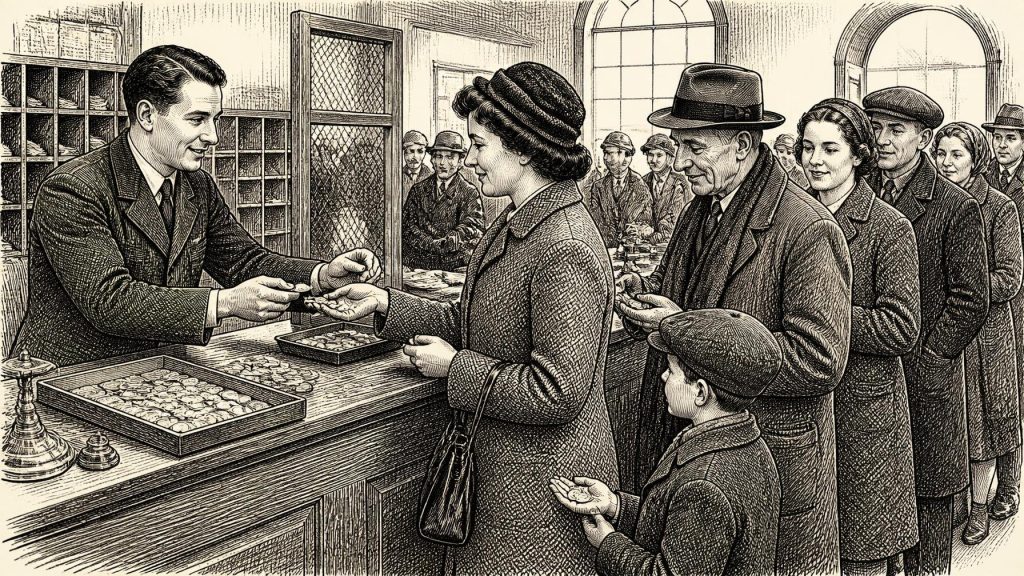
For most households in the Republic, the most visible change arrived on 15 February: Decimal Day. Pounds remained the principal unit, but the familiar pounds, shillings and pence system gave way to one hundred new pence in the pound. Banks closed for several days before the changeover to convert accounts and machinery; post offices exchanged stamps, money orders and other routine instruments; shops altered prices and tills; and schoolchildren accustomed to shilling-and-pence arithmetic had to use a new calculation system. Because Northern Ireland changed at the same time within the United Kingdom, travellers and traders crossing the border encountered a shared decimal coinage transition even while the political border became more charged.
The change was more than a matter of coins. It reached pensions, benefit rates, contracts, tax references, telephone boxes and postal charges. The Social Welfare Act 1971 increased several pensions and benefits, with important provisions commencing in October. Administrative reforms under the Health Act 1970 also came into operation during 1971, part of the Republic’s move towards reorganised regional health services. These measures were less dramatic than the Northern crisis, but they affected the material routines of old age, unemployment, illness and family life.
Ireland’s longer economic horizon lay in Europe. Negotiations for entry to the European Economic Community, opened in 1970, continued through 1971. The accession treaty would not be signed until January 1972, so it would be wrong to treat membership as accomplished in this year. Yet the negotiations already obliged Irish officials to consider farming, trade, tariffs and the status of the Irish language within a prospective European framework. In a country whose economy remained closely linked to Britain, the possibility of both states entering the Communities was of exceptional importance.
Culture in a Troubled Year
Irish public culture also registered technological and political change. On 17 March, RTÉ broadcast the Railway Cup finals from Croke Park in colour, its first domestic colour television production. In April, Dublin hosted the Eurovision Song Contest at the Gaiety Theatre, another early colour broadcast. These occasions projected confidence and international connection, even as television news brought images of unrest, funerals and military operations into homes.
In literature, John Banville published Nightspawn, Thomas Kilroy published The Big Chapel, and Seán Ó Ríordáin’s poetry collection Línte Liombó appeared. Their publication cannot be made to stand for a single national mood, but it is a reminder that Ireland in 1971 was not only a place of political emergency. It was also a society producing new fiction, poetry, television and public debate while its institutions, currency and relationship with Europe were being remade.
Primary Sources
- CAIN: A Chronology of the Conflict – 1971
- CAIN: Internment – A Chronology of the Main Events
- CAIN: Chronology of Major Violent Incidents, 1969–1998
- CAIN: Civil Rights – A Chronology of Main Events, 1964–1972
- Ireland v. the United Kingdom, European Court of Human Rights Judgment
- Counterfoil of the claim submitted by Ireland against the United Kingdom to the European Commission of Human Rights
- Statement issued on behalf of Taoiseach Jack Lynch following the introduction of internment in Northern Ireland
- Statement by Brian Faulkner on the introduction of internment in Northern Ireland
- Local Government (Boundaries) Act (Northern Ireland) 1971
- Alliance Party of Northern Ireland – Alliance Annual Conference 1971
- Census 1971 Volume 1 – Population
- Census 1971: Population of Each Province, County and County Borough in 1966 and 1971
- Annual Report of the Registrar-General of Marriages, Births, and Deaths in Ireland, 1971
- Decimal Currency Bill, 1970: Explanatory Memorandum
- Committee on Finance: Vote 42, Posts and Telegraphs, 25 February 1971
- Social Welfare Act, 1971
- Statutory Instruments, 1971
- RTÉ Archives: End Internment Without Trial 1971
- RTÉ Archives: History of RTÉ – RTÉ 1970s
- RTÉ Archives: Broadcasting Under Section 31
- The Accession of Ireland to the European Communities, 1972–2022
- Ireland and the EU: A History
- Documents – Irish Diplomacy Project, University College Cork
- The Report of the Bloody Sunday Inquiry, Volume I