Bloody Sunday and Direct Rule1972 CE
In 1972, violence and constitutional change reshaped Ireland. Bloody Sunday in Derry, when British soldiers killed fourteen civilians, intensified nationalist anger and accelerated Northern Ireland’s political crisis. Westminster suspended Stormont in March, imposing direct rule, while paramilitary violence, Bloody Friday and Operation Motorman deepened insecurity. The Republic strengthened emergency powers after violence spread south, including Dublin bombings. Simultaneously, Jack Lynch’s government pursued European integration. Voters overwhelmingly approved the constitutional amendment enabling EEC accession, due in 1973. December referendums also lowered the voting age to eighteen and removed constitutional recognition of the Catholic Church’s special position, signalling a more pluralist State.
Dateline
For Ireland, 1972 was a year in which political assumptions collapsed with startling speed. In Northern Ireland, the killing of civil-rights marchers in Derry, the end of the Stormont government and an escalating campaign of bombings and shootings made the conflict feel less like a crisis that might be contained than a war shaping ordinary life. In the Republic, Jack Lynch’s government faced the northern emergency while also steering the State towards membership of the European Economic Community (EEC). The year therefore joined violence and constitutional change: grim evidence of division on the island, alongside a popular decision to bind the Republic more closely to Europe.
Derry, 30 January
The defining event came on Sunday 30 January, when the Northern Ireland Civil Rights Association held a march in Derry against internment without trial. The march had been prohibited under the ban on public processions introduced earlier that month by the Northern Ireland government. It nevertheless drew a large crowd from the Creggan through the Bogside, a predominantly nationalist area whose inhabitants had experienced sustained confrontation with the security forces.
During the afternoon, soldiers of the British Army’s 1st Battalion, Parachute Regiment entered the Bogside. Thirteen civilians were killed by gunfire that day and another wounded man, John Johnston, died later; many others were injured. The later Saville Inquiry concluded that none of those killed or wounded by Support Company had been posing a threat justifying the shooting, and that the shootings were unjustified and unjustifiable. Those later findings must not be confused with what was known in 1972, but they establish the historical character of the killings far more securely than the immediate official accounts did.
Bloody Sunday transformed politics and feeling far beyond Derry. Funerals on 2 February brought collective mourning and anger; in Dublin, a huge demonstration culminated in the burning of the British embassy on Merrion Square. The event intensified nationalist alienation from the British Army, supplied republican organisations with a powerful grievance, and deepened the conviction among many unionists that public order and constitutional security were under mortal threat. Its consequences were felt in homes, workplaces, schools and streets, where checkpoints, barricades, raids, anxiety and bereavement had become part of daily experience.
Stormont Falls
By March, the Unionist administration at Stormont could no longer command either political confidence or effective control. Brian Faulkner’s government had been challenged by the worsening security situation, by the aftermath of Bloody Sunday and by its inability to secure agreement on reforms. On 30 March, Westminster enacted the Northern Ireland (Temporary Provisions) Act. It prorogued the Parliament of Northern Ireland and transferred governing authority to the British Secretary of State through Orders in Council. William Whitelaw, appointed Secretary of State for Northern Ireland shortly beforehand, became the central political figure in the new system.
Direct rule was presented as temporary, but it was a profound constitutional rupture. The devolved Parliament created in 1921 had ceased to make Northern Ireland’s laws. Westminster retained the statutory declaration that Northern Ireland remained part of the United Kingdom, while accepting in practice that the old unionist-majority structure could not continue as before. The new Northern Ireland Office had to administer ordinary services as well as security amid extraordinary instability. Direct rule did not resolve the constitutional conflict; rather, it created a new framework in which arguments about power-sharing, British-Irish relations and the place of nationalists would be pursued.
Attempts at a political opening ran alongside violence. The Official IRA declared a ceasefire in February, but the Provisional IRA’s campaign continued, as did loyalist paramilitary violence and state security operations. Contacts between British representatives and the Provisional IRA during the summer produced a short-lived truce, but no settlement. For civilians, the distinction between political initiative and military escalation could seem painfully remote.
Bombs, Barricades and the Republic
The scale of violence rose further in July. On 21 July, the Provisional IRA planted 22 bombs across Belfast within about 75 minutes. Nine people were killed and roughly 130 seriously injured in what became known as Bloody Friday. The bombs struck commercial districts, transport sites and streets used by workers and shoppers. The episode demonstrated both the IRA’s capacity to disrupt a city and the terrible vulnerability of people trying to go about everyday business.
On 31 July, Operation Motorman brought a major British Army operation into the barricaded ‘no-go’ areas of Derry and Belfast. Troops dismantled barriers and re-entered neighbourhoods which security forces had largely avoided. The operation altered control of urban space, but it did not end violence or remove the political causes of conflict. In the autumn, discussion of a future political settlement resumed: the Northern Ireland Office published The Future of Northern Ireland on 30 October, putting power-sharing and other constitutional possibilities into public debate without yet producing agreement.
The Republic was not insulated. On 30 May the Irish Government re-established the non-jury Special Criminal Court, judging ordinary courts inadequate to secure public peace and order in the circumstances. The Offences against the State (Amendment) Act, enacted in December, strengthened the legal apparatus used against unlawful organisations. These measures were contentious, but they showed that Dublin regarded armed activity as a direct threat to the State as well as a northern problem.
Bombings also brought the conflict physically into Dublin. On 1 December, car bombs exploded at Eden Quay and Sackville Place. Two men, George Bradshaw and Thomas Duffy, were killed at Sackville Place and many people were injured. The attacks occurred as the Dáil was considering the Offences against the State (Amendment) Bill. They made plain that the capital’s streets, buses, offices and shops could be endangered by the widening conflict. The later official inquiry examined these attacks as part of the Dublin bombings of 1972 and 1973; responsibility for individual incidents should not be simplified beyond the evidence available.
Europe Chosen
Yet 1972 was not defined solely by emergency. On 22 January, Taoiseach Jack Lynch and Minister for Foreign Affairs Patrick Hillery signed Ireland’s Treaty of Accession to the EEC in Brussels. The decision was closely connected to the Republic’s trading relationship with Britain: if the United Kingdom entered the enlarged Community while Ireland remained outside, economic separation could become more difficult. It also offered a small state a new diplomatic arena, access to a larger common market and the prospect of participating directly in European decisions.
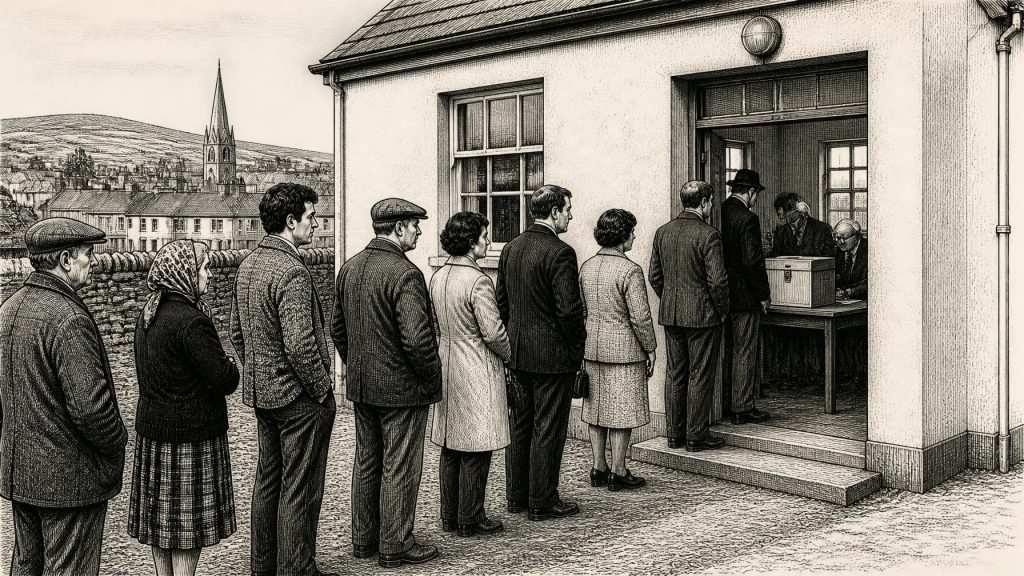
Because accession would give binding force in the State to Community obligations, constitutional amendment was required. The referendum of 10 May approved the Third Amendment by 83.1 per cent of valid votes, on a turnout of 70.9 per cent. The result was an emphatic democratic endorsement, not merely an elite treaty decision. It did not itself make Ireland an EEC member during 1972: the constitutional amendment was signed into law on 8 June, while membership was due to begin on 1 January 1973. Nonetheless, the referendum set the Republic on a major new economic and international course.
The campaign also had an all-Ireland dimension. Northern Ireland would enter through the United Kingdom, and advocates argued that common membership could reduce economic barriers across the border. That hope did not displace the immediate violence, but it revealed a different imagined future: one in which cooperation with Britain and continental Europe might serve Irish interests better than isolation.
Votes on Church and Citizenship
Two further referendums, held on 7 December, recorded important changes in the Republic’s constitutional culture. Voters approved the Fourth Amendment, lowering the voting age for Dáil and presidential elections and referendums from 21 to 18. They also approved the Fifth Amendment, removing the Constitution’s recognition of the Catholic Church’s ‘special position’ and its naming of several other denominations. Both proposals won large majorities, although turnout, at just over half of the electorate, was considerably lower than in the EEC vote.
The legal amendments were not signed by President Éamon de Valera until 5 January 1973, so it would be inaccurate to say that the constitutional text changed during 1972 itself. What belongs firmly to 1972 is the popular approval of the changes. The religious referendum did not end the Catholic Church’s extensive social influence, nor did it instantly remake laws or institutions. It did, however, remove a formal constitutional hierarchy among religions and marked a significant gesture towards a more pluralist civic order. Lowering the voting age similarly widened the political community, even though those newly enfranchised could not vote until subsequent elections and referendums.
A Divided Island, Changing State
By year’s end, Ireland had endured its bloodiest year of the Troubles. Northern Ireland had lost its devolved government, while the Republic had strengthened emergency institutions in response to a conflict crossing the border. At the same time, Irish voters had approved entry into Europe, a lower voting age and a less confessional Constitution. The coexistence of these developments is the key to 1972: fear and coercion were shaping public life, but constitutional politics and popular voting were also opening paths towards a different Ireland.
Primary Sources
- CAIN: Chronology of the Conflict 1972
- Report of the Bloody Sunday Inquiry
- PM: Statement on Saville Inquiry
- Northern Ireland (Temporary Provisions) Act 1972
- Direct Rule
- CAIN: Events: Civil Rights – A Chronology of Main Events, 1964-1972
- CAIN: 'Bloody Friday' – Main Events
- CAIN: Key Events – 'Bloody Friday', Belfast 21 July 1972
- CAIN: Issues: Politics: Political Initiatives During the Conflict
- EU50: Marking 50 Years of Ireland’s Membership of the European Union over the Course of 2022–2023
- Third Amendment of the Constitution Act, 1972
- Ireland and the EU: Timeline of Key Events
- RTÉ Archives: Europe Yes Or No? 1972
- Previous Referendums
- Referendum on the Fifth Amendment of the Constitution Bill, 1972 – Recognition of Specified Religions
- Fourth Amendment of the Constitution Act, 1972
- Constitution of Ireland
- The Special Criminal Court
- Offences against the State (Amendment) Act 1972
- Report No. 04 – Interim Report into Dublin Bombings of 1972 and 1973