Membership is completely free, giving members unlimited access to all available resources, services, features, and benefits without any restrictions or fees.
Welcome back. Sign in to continue enjoying unlimited access to all available resources, services, features, and member benefits at no cost.
The year began with a disaster on the south-west coast. Shortly before 1 a.m. on 8 January, the French tanker Betelgeuse exploded while discharging crude oil at the Gulf Oil terminal off Whiddy Island in Bantry Bay. The vessel broke apart and burned; emergency crews faced an immense fire at the offshore jetty, while families living on the island were evacuated. Fifty people died in the explosion and its immediate aftermath, among them French, Irish and British workers; a Dutch diver later died during the salvage operation.
Lynch remained Taoiseach throughout 1978, leading the Fifteenth Government and working with George Colley as Tánaiste and Minister for Finance. Fianna Fáil had entered office after its emphatic 1977 election victory, with enough Dáil seats to govern alone. That strength allowed it to act on conspicuous election commitments, but it also made its judgement highly visible. From 1 January, the old office of parliamentary secretary was replaced by that of minister of state, a small but meaningful reorganisation of the machinery of government.
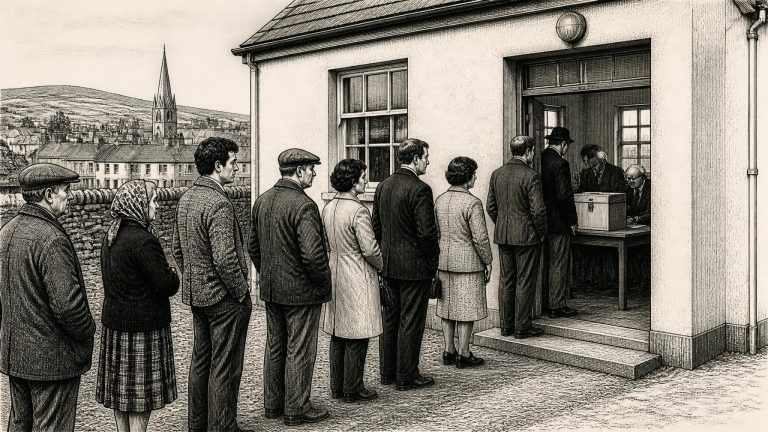
In 1977, political life on the island moved in sharply different directions. In the Republic, the general election of 16 June gave Fianna Fáil and its leader, Jack Lynch, an emphatic democratic mandate. In Northern Ireland, still governed directly from Westminster, an attempted loyalist general strike demonstrated both the continuing capacity for disruption and the limits of a strategy that had succeeded only three years earlier. Violence, prison protest and profound communal division remained facts of daily life in the North; south of the Border, voters rewarded promises of relief from taxation and a more confident response to economic difficulty.
Ireland became a member of the EEC on 1 January 1973. The step followed the accession treaty signed in Brussels in January 1972 and the Irish referendum of May 1972, in which an overwhelming majority had approved entry. Membership did not instantly transform farms, factories or family budgets. It did, however, alter the framework within which Irish governments, businesses and farmers would make decisions. Ireland now participated directly in a Community enlarged from six to nine states, while Britain’s simultaneous entry mattered especially because Irish trade had long been tied closely to the British market.
The defining event came on Sunday 30 January, when the Northern Ireland Civil Rights Association held a march in Derry against internment without trial. The march had been prohibited under the ban on public processions introduced earlier that month by the Northern Ireland government. It nevertheless drew a large crowd from the Creggan through the Bogside, a predominantly nationalist area whose inhabitants had experienced sustained confrontation with the security forces.
Northern Ireland entered 1971 with the institutions at Stormont under severe strain. The civil-rights movement had exposed long-standing grievances over housing, electoral arrangements and policing, while republican and loyalist violence, alongside the expanding British Army presence, had made everyday security precarious in many places. The split between the Official and Provisional wings of the Irish Republican movement, completed in 1970, had also created competing armed organisations rather than reducing republican militancy.