Browne’s June Memorandum1950 CE
In 1950, Ireland combined republican independence with economic dependence on Britain, persistent poverty, emigration and partition. Dr Noël Browne’s June memorandum proposing free healthcare for mothers and children exposed conflict between universal welfare, medical interests, Catholic authority and parental rights, foreshadowing his 1951 resignation. Tuberculosis remained severe despite expanded State treatment. Legislation reorganised social welfare, improved agricultural workers’ rights, addressed housing, and strengthened transport and industrial development. Ireland appointed its first ambassador to London and signed the European Convention on Human Rights. Cultural events included Alfred Chester Beatty’s arrival and George Bernard Shaw’s death. Social and economic problems remained unresolved.
Dateline
Ireland in 1950 was a state of contrasts: formally a republic after the constitutional break with the Commonwealth in 1949, but still economically and socially tied closely to Britain; active in new European institutions, but divided by the border; capable of ambitious public-health planning, yet marked by poverty, disease and outward migration. The most revealing development of the year was not a completed reform but a proposal. In June, the Minister for Health, Dr Noël Browne, circulated plans for a free mother-and-child health service. The proposal exposed a profound argument about medicine, family authority, religion and the reach of the State. It also showed how far the problems of ordinary life—especially illness and the cost of treatment—were pressing upon politics.
A Coalition Under Pressure
The Republic was governed by the First Inter-Party Government, led by Taoiseach John A. Costello. It brought together Fine Gael, Labour, Clann na Poblachta, Clann na Talmhan and independents, an arrangement held together less by ideological uniformity than by the desire to keep Fianna Fáil out of office. Seán MacBride, leader of the small but influential Clann na Poblachta, was Minister for External Affairs; Browne, one of the party’s most energetic figures, held Health. Their presence gave the government a reforming edge, but also added to the strains of coalition government.
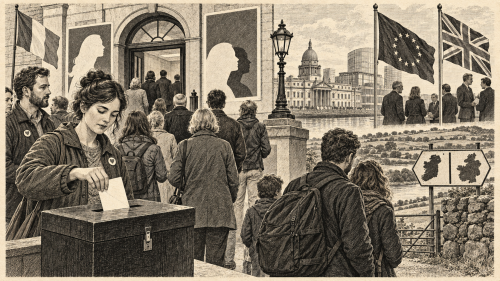
Partition remained the central constitutional grievance. The six counties of Northern Ireland stayed within the United Kingdom under the Unionist administration at Stormont, headed by Sir Basil Brooke. The Republic’s claim to national unity was written into its constitutional language and repeatedly asserted in public life, while the British government’s Ireland Act of 1949 had confirmed that Northern Ireland would remain in the United Kingdom unless its own parliament consented otherwise. In 1950, therefore, the border was not an immediate military front but a settled political obstacle: it shaped diplomacy, electoral language, trade routes, family connections and assumptions about the island’s future.
For people in Northern Ireland, the political division was accompanied by a distinctive economic dependence on the British market and on older industries. Belfast’s shipbuilding, engineering and linen sectors had benefited from wartime demand, but their longer-term vulnerability was already apparent. Across the border, rural and small-town communities in the Republic faced different but equally persistent difficulties: limited employment, small farms, inadequate housing and the prospect that younger relatives would leave for Britain or farther overseas.
Tuberculosis and the Cost of Care
Health was the field in which the urgency of social conditions could be most plainly measured. Tuberculosis had long been a major killer in Ireland. Its death rate had been falling, helped by improved diagnosis, sanatorium treatment, vaccination and the construction of new facilities, but it still weighed heavily on families. The later official vital-statistics series recorded 2,922 deaths from respiratory tuberculosis in the State in 1950, with a further 580 from other forms of the disease. Behind those totals were prolonged illness, separation from family, lost wages and fear of infection.
Browne had personal experience of tuberculosis and had made its eradication the priority of his ministry after taking office in 1948. Hospital Sweepstakes funds supported a major drive to increase beds and improve treatment. The campaign involved mass X-ray provision, sanatorium building and public exhortation as well as administration from Dublin. It is important not to treat 1950 as the year tuberculosis was conquered: it was not. Rather, it was a year in which the State’s intervention against the disease was visibly being expanded, and in which public health seemed to offer a case for more ambitious social provision.
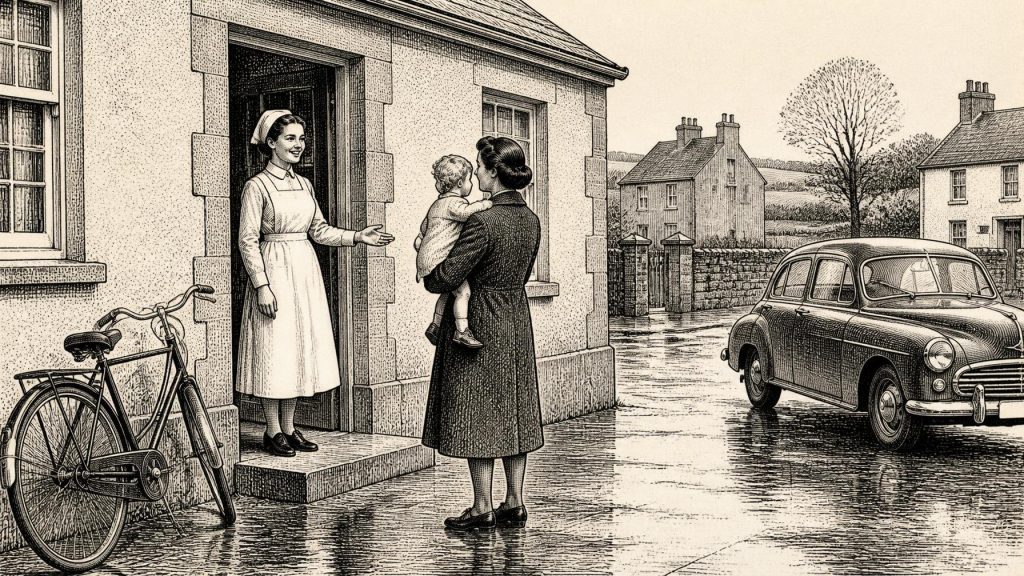
That logic carried Browne to maternal and child welfare. Part III of the Health Act 1947 had made provision for a service of this kind, but implementation had been left to the incoming coalition. In June 1950 Browne sent his draft scheme to cabinet colleagues and the Irish Medical Association. It envisaged free medical care for mothers and for children up to sixteen, without a means test. Antenatal and postnatal care, children’s health and preventive medicine were connected in a single conception of public responsibility.
The scheme did not become law in 1950. That distinction matters. Its most dramatic political crisis, Browne’s resignation, lay in April 1951. Yet the lines of conflict were already emerging during 1950. Catholic bishops feared that a State service might intrude upon parental authority and expose families to advice contrary to Catholic moral teaching. Many doctors opposed a universal, free service in part because it threatened the position and income of private general practice. Costello’s cabinet, anxious about cohesion and relations with the hierarchy, did not provide Browne with the united backing he needed.
The dispute was consequently about more than one programme. It revealed the authority held by the Catholic Church in the overwhelmingly Catholic Republic, the importance of voluntary hospitals and private practitioners within health provision, and the political limits on universal welfare. It also showed that women and children could be discussed chiefly as objects of policy while the principal negotiators were male politicians, bishops and medical representatives. The proposal nevertheless placed maternal health, infant welfare and access to doctors at the centre of national debate.
Migration, Work and State Enterprise
The daily economic background was bleak enough to make health reform inseparable from wider questions of livelihood. Agriculture remained crucial to the Republic’s economy, and cattle and livestock products were central to trade with Britain. Yet many farms were too small to sustain a growing family securely, while protected manufacturing had not produced employment on a sufficient scale. The Republic had participated in post-war European recovery arrangements through the Organisation for European Economic Co-operation, but international assistance did not remove the country’s structural weakness or its dependence on British markets.
Emigration was again becoming a fact of life. It would reach still more severe levels after 1951, so it would be misleading to attach the later peak directly to this single year. But the 1956 Census calculated that net emigration averaged 24,384 people annually between the 1946 and 1951 censuses—a five-year interval which includes 1950. Departure was often a household strategy as much as an individual choice: sons and daughters sought work in Britain; remittances and return visits tied emigrants to home; and communities lost young adults at a stage when they might otherwise have formed families or businesses locally.
The Oireachtas responded in 1950 with a substantial body of practical legislation. The Social Welfare Act reorganised national health-insurance administration by dissolving Cumann an Árachais Náisiúnta ar Shláinte and transferring its functions to the Minister for Social Welfare. The Agricultural Workers (Holidays) Act recognised paid holiday entitlements in an occupation often excluded from the assumptions of industrial labour law. Housing and rent-restriction measures addressed continuing shortages and insecurity, although legislation alone could not quickly transform the quality of many dwellings.
Other Acts pointed to a State seeking to organise essential infrastructure and create new employment. The Transport Act made Córas Iompair Éireann a semi-state body and brought the Grand Canal Company into its orbit. This was a practical acknowledgement that railways, buses, road freight and canals were matters of national coordination rather than simply private commerce. The Industrial Development Authority Act put the IDA on a statutory footing. Its later role in attracting industry was not yet foreseeable in its mature form, but the 1950 legislation established an institution intended to promote industrial development and employment.
Even the Irish Whiskey Act of 23 March had economic significance beyond its narrow wording. It legally defined Irish whiskey and Irish pot still whiskey for documentation accompanying spirits in transit, tying the name to production in the State and to specified methods and ingredients. At a time when exports and national distinctiveness mattered greatly, the Act protected a valuable product designation. It was a small but clear example of the State using law to connect identity, standards and trade.
Europe, London and a New Diplomatic Status
Irish foreign policy in 1950 balanced independence from Britain with the practical necessity of working closely with it. In July, Frederick H. Boland became the first Irish ambassador to the Court of St James’s. Ireland’s representative in London had previously held the lesser rank of high commissioner; the new title followed the Republic’s departure from the Commonwealth. The change was symbolic, but symbols mattered. It marked a relationship between two states rather than a connection within a shared imperial association, even as Britain remained Ireland’s dominant trading partner and the principal destination for emigrants.
Ireland also took a careful place in post-war European diplomacy. It had been a founding member of the Council of Europe in 1949. On 4 November 1950 it signed the European Convention on Human Rights in Rome, though ratification would not follow until 1953. The signature did not erase domestic inequalities or settle the dispute over partition. It did, however, attach the Republic to a new European framework in which rights, democracy and the rule of law were expressed as common international commitments.
Culture Beyond the Crisis
Public life was not composed solely of cabinet memoranda and economic anxiety. In 1950 the mining magnate and collector Sir Alfred Chester Beatty moved to Ireland, beginning the process that would lead to the opening of his Dublin library in 1953 and eventually to one of the country’s great cultural collections. His arrival suggested a cosmopolitan strand within a society often portrayed only as isolated and inward-looking.
On 2 November, George Bernard Shaw died at his home in Hertfordshire, aged ninety-four. Born in Dublin in 1856, Shaw had spent most of his working life in England and was never an uncomplicated emblem of Irish nationalism. Yet his death prompted reflection on an Irish-born writer whose plays, criticism and public controversies had achieved global reach. In a year defined by arguments over the State’s obligations to families, Shaw’s career also offered a reminder that Irish cultural influence could be international, irreverent and resistant to easy national labels.
Thus 1950 stands less as a year of final outcomes than of exposed choices. Browne’s memorandum made universal healthcare imaginable but also revealed the forces ranged against it. New laws strengthened the machinery of welfare, transport and industrial policy while emigration underlined the insufficiency of jobs at home. A first ambassador in London and a signature in Rome expressed a more independent Republic, yet partition and economic dependence remained stubborn realities. Ireland entered the decade with institutions being built, but with its central social questions unresolved.
Primary Sources
- Ireland Through the Decades
- Browne, Noel Christopher
- Committee on Finance: Vote 67—Health, 11 July 1950
- Church-State Relations and the Development of Irish Health Policy: The Mother-and-Child Scheme, 1944–53
- Social Welfare Bill, 1949
- Chronological Table of the Statutes: 1950
- Irish Whiskey Act, 1950
- History of CIÉ
- The Embassy’s History
- Memorandum for Government by the Department of External Affairs, 15 May 1950
- Ireland & the Council of Europe Overview
- European Convention on Human Rights
- Full List: Ireland, Treaty Office
- Census 1951 Volume 1: Population, Area and Valuation
- 1956 Census of Population, Volume 1
- The Changing Nature of Life Expectancy and Causes of Death in Ireland, 1922–2023
- Annual Report of the Registrar-General of Marriages, Births, and Deaths in Ireland, 1953
- Explorations in OEEC History
- The Irish Economy During the Century After Partition
- Miscellaneous Financial Provisions Bill, 28 June 1950
- Shaw, George Bernard
- Chester Beatty Collections Acquisition Policy 2022–2027