
Foyle Waters and Family Law1952 CE
Ireland in 1952 combined political continuity with economic and social change. De Valera’s government, facing balance-of-payments difficulties, unemployment and emigration, imposed austerity while pursuing regional development, consolidated social welfare, protected agricultural workers and reorganised tourism. The Foyle Fisheries Act created cross-border machinery for managing shared waters, while Northern Ireland expanded Belfast’s water supply despite joblessness. The Adoption Act established the Republic’s first legal adoption framework, though its eligibility and religious rules reflected contemporary values. Public life included an Aer Lingus disaster, sporting and cultural achievements, and O’Kelly’s uncontested re-election. The year produced institutions without resolving partition, poverty or population loss.
Dateline
The Ireland of 1952 was divided by a border and marked by economic uncertainty, but it was not static. In the Republic, Éamon de Valera’s Fianna Fáil administration grappled with a deteriorating balance of payments, persistent unemployment and emigration. Its legislative programme nevertheless reached deeply into ordinary life: social insurance was recast, tourism was reorganised, agricultural workers’ hours received protection, and the State finally enacted a general adoption law. Across the border, Northern Ireland faced its own severe unemployment while investing in the water infrastructure on which Belfast depended. The year is therefore best understood not as one dramatic political rupture, but as a series of consequential decisions about welfare, work, family, natural resources and the future of a country losing many of its young people.
Government Without an Election
There was no general election in the Republic in 1952. De Valera remained Taoiseach, with Seán Lemass as Tánaiste and Seán MacEntee as Minister for Finance, in the Fourteenth Dáil elected the previous year. The most conspicuous constitutional event came in June. Seán T. O’Kelly, the sitting President, was the only candidate nominated for the presidency and was therefore declared elected without a poll. He began his second seven-year term on 25 June. The uncontested result conveyed institutional continuity at the summit of the still young republic rather than a popular electoral verdict.
Continuity was tested later in the year by de Valera’s health. He travelled to Utrecht for eye treatment and underwent two operations in August and September. Diplomatic correspondence records his convalescence in the Netherlands; he did not return to Dublin until late December. His absence was lengthy, but the machinery of cabinet government continued. It also reminded the public that the leader who had dominated Irish politics since the revolutionary era was ageing: de Valera was nearly seventy in 1952.
Austerity and Departure
The most immediate pressure on the Republic’s government was economic. The post-war expansion of consumption had outrun national resources and worsened the balance of payments. In his Budget speech of 2 April, MacEntee argued that continued external deficit threatened the currency and that investment in productive capacity, housing, hospitals and employment required greater national saving. The government’s response was restrictive: spending and imports came under pressure, while taxation and duties helped defend the external position. Later assessments have judged the 1952 budget a notably deflationary intervention, but its underlying anxieties were already explicit at the time.
For many households, the language of payments deficits was translated into familiar experiences: uncertain employment, expensive goods, limited opportunities outside the land, and the prospect of leaving. A Department of Social Welfare review reported in the press in March 1952 that 342,732 people had emigrated from the State between 1940 and 1950, including more than 140,000 women. That figure did not describe a single-year exodus, but it framed 1952 as part of an extended demographic drain. Britain remained the principal destination for workers seeking wages unavailable at home.
Newly issued material from the 1951 census added a statistical map to these concerns. The census itself had been taken the previous year; its publication in 1952 made visible the distribution of people, housing and valuation across every district electoral division. It documented a predominantly rural society in which small farms still shaped much of the landscape and labour market. Yet farming could not absorb all who depended upon it. Emigration and underemployment were not marginal topics: they lay behind the government’s concern with industrial development, welfare provision and rural incomes.
Work, Welfare and Peripheral Development
Several Acts passed during the year show the State attempting to manage those pressures. The Undeveloped Areas Act, in force from 22 January, established a framework for assistance to industry in designated underdeveloped districts. Its practical reach should not be overstated: it did not reverse regional inequality in 1952. But it signalled recognition that remoter places required more than general national policy if employment was to be created beyond the larger towns.
The Social Welfare Act, enacted on 14 June, was more sweeping. It consolidated and coordinated a fragmented body of insurance and assistance law, covering unemployment and disability benefit, maternity provision, widows’ and orphans’ pensions, old-age pensions and related schemes. It created a single Social Insurance Fund and set out structures for decisions and appeals. This was a significant administrative achievement, although access to benefits remained dependent on contribution records, means rules and the conditions of particular schemes. It represented a firmer State role in cushioning misfortune, not a comprehensive welfare state in the later sense.
Work on the land also received a modest but revealing legal protection. The Agricultural Workers (Weekly Half-Holidays) Act, passed on 17 December, required employers to provide a weekday half-holiday, normally no later than 1 p.m., for qualifying workers. There were exceptions for special periods and arrangements to pay for work performed instead. The detail matters. A legal right to an afternoon away from work, framed around a forty-five-hour qualifying week, gives a glimpse of the long and regulated rhythms of hired agricultural labour in a country still defined by farming.
Tourism and the Foyle
Economic policy in 1952 was not concerned only with restraint. The Tourist Traffic Act of 3 July renamed the Irish Tourist Board as An Bord Fáilte and charged it with encouraging tourist traffic in and to the State. The Act authorised publicity, grants, loans and support for local development companies; it also addressed hotel and holiday-camp licensing, as well as access and signage at historic sites. Tourism was still a comparatively small sector, but the legislation treated scenery, heritage, accommodation and overseas visitors as economic assets capable of earning vital income.
The Foyle Fisheries Act, enacted on 25 March, provided another example of practical co-operation across the partition line. It enabled the acquisition and joint management of fishery rights in Lough Foyle and the River Foyle area, and established the Foyle Fisheries Commission to conserve, protect and improve the fisheries. The arrangement involved authorities in Dublin and Belfast and addressed such concrete matters as seasons, nets, licences, pollution and river watching. In an era when sovereignty and partition remained politically charged, the shared management of a salmon fishery was a limited but important form of all-island administration.
Family Law at Year’s End
The Adoption Act, signed on 13 December, was the year’s most consequential social legislation. Before it, adoption in the Republic had no general statutory basis: children could be placed informally, but there was no legal process creating the full parent-child relationship later associated with adoption. The Act established An Bord Uchtála, the Adoption Board, empowered to make adoption orders and to maintain an Adopted Children Register.
Its protections and restrictions illuminate the values of the period. Only children resident in the State who were illegitimate or orphaned, and aged from six months to seven years when an application was made, could be adopted. Married couples living together, certain relatives, natural parents and widows could apply; unmarried people other than widows were excluded. The legislation required consent in prescribed circumstances and restricted advertisements and payments connected with adoption. It also prohibited most removals of Irish citizen children under seven from the State.
Religion was written directly into the law. Ordinarily, adopters had to share the religion of the child and parents, or, for an illegitimate child, that of the mother. The provision reflected the powerful denominational assumptions of mid-century Ireland and the concern that children should be brought up within a defined religious community. The Act was enacted in 1952 but came into operation on 1 January 1953. It is therefore accurate to call 1952 the year the legal framework was created, not the year in which the new system began processing adoptions.
Loss, Water and Public Culture
On 10 January, an Aer Lingus Douglas DC-3 flying from London to Dublin crashed in Snowdonia, Wales, killing all twenty-three people aboard: twenty passengers and three crew. It was Aer Lingus’s first fatal accident. The disaster was felt in Ireland as a national loss and was a sombre reminder that post-war air travel, though increasingly important for links with Britain, still carried grave risks.
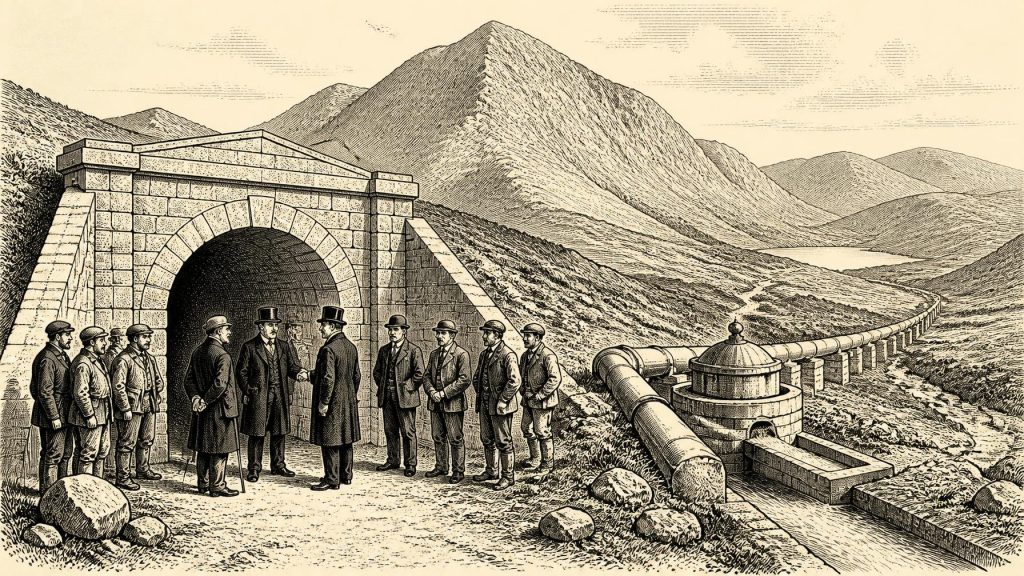
Northern Ireland’s economy was also under strain. Post-war industrial contraction left unemployment exceptionally high, averaging more than ten per cent of the insured population in 1952 by later parliamentary estimates. Yet public works continued. On 28 August, Northern Ireland’s Prime Minister, Lord Brookeborough, opened the Binnian Tunnel beneath the Mourne Mountains. The engineering work diverted water from the Annalong catchment into the Silent Valley Reservoir, strengthening a vital part of Belfast’s water supply. It was an ambitious infrastructural answer to urban need, constructed amid a region’s wider employment difficulties.
Public culture supplied moments of connection across the island. At the Helsinki Olympics, Belfast boxer John McNally won bantamweight silver on 2 August, Ireland’s first Olympic boxing medal. His achievement was celebrated in Belfast, where he returned to a large welcome, while he had competed under the Irish Olympic banner. In literary Ireland, Seán Ó Ríordáin published Eireaball Spideoige, his first collection of poetry in Irish. Meanwhile, the veteran Blasket storyteller Peig Sayers, receiving hospital treatment in Dublin, made further recordings and dictated stories for the Irish Folklore Commission. These were different forms of cultural visibility: an urban sporting triumph, a modern Irish-language poetic voice, and the preservation of a Gaeltacht oral tradition.
By the close of 1952, Ireland had not solved the problems of low employment, regional weakness or emigration. Nor had partition become less real in political life. But the year’s laws and institutions show governments and communities responding in practical ways: regulating work, organising welfare, conserving shared waters, promoting visitors, securing an urban water supply and placing adoption on a legal footing. The changes were bounded by the assumptions of their time, especially regarding family and religion, but they helped shape the social and administrative Ireland that followed.
Primary Sources
- Chronological Table of the Statutes (1952)
- Undeveloped Areas Act 1952
- Social Welfare Act, 1952
- Tourist Traffic Act, 1952
- Foyle Fisheries Act, 1952
- Adoption Act, 1952
- Adoption Act, 1952, Section 12: Religion
- Agricultural Workers (Weekly Half-Holidays) Act, 1952
- Financial Statement: Budget, 1952, Dáil Éireann, 2 April 1952
- Presidential Elections 1938–2025
- Census 1951 Volume 1: Population, Area and Valuation of Each DED and Each Larger Unit of Area
- Farming and Fishing: Ireland and the EU at 50
- Women in 20th-Century Ireland, 1922–1966: Sources from the Department of the Taoiseach
- The Irish Economy During the Century After Partition
- OECD Economic Surveys: Ireland 1970
- Letter, McNeill to Nunan, 22 September 1952
- Eamon de Valera Papers: Descriptive Catalogue
- Service Will Recall Air-Crash Victims
- Historic Building Details: Binnian Tunnel and Intercepting Weir
- Silent Valley Visitor Centre
- Parliament and Northern Ireland, 1921–2021
- Helsinki 1952
- John McNally
- Peig Sayers: Volume 2: Not the Final Word
- Sayers, Peig (‘Peig Mhór’)
- Portrait Bust, Séamus Murphy RHA, ‘Seán Ó Riordáin’
- Mother and Baby Homes Commission of Investigation Report: Chapter 32, Adoption