Hyde’s Last Journey1949 CE
In 1949 Ireland became a republic, ending the Crown’s remaining external role, while Britain’s Ireland Act reinforced Northern Ireland’s constitutional position within the United Kingdom. Southern political leaders united publicly against partition, but efforts to link reunification with NATO membership failed. Post-war recovery remained uneven, with shortages, emigration, rural poverty and extensive state regulation continuing alongside electrification, statistical development and welfare administration. Housing, health and public services expanded gradually. Douglas Hyde’s funeral honoured a founder of cultural nationalism whilst exposing denominational divisions in public ceremony. The year combined republican assertion with enduring partition, social constraints, institutional growth and cultural ambition.
Dateline
On Easter Monday, 18 April 1949, the Republic of Ireland Act 1948 came into operation. Its timing deliberately linked a constitutional change to the anniversary of the Easter Rising, but its legal effect was precise rather than theatrical: the Act declared that the description of the State should be the Republic of Ireland, ended the External Relations Act 1936, and placed the President at the centre of the State’s external functions. The constitutional names remained Éire in Irish and Ireland in English. For people in the twenty-six counties, the day offered a potent public statement that the remaining statutory role of the Crown in Irish external relations had ended. It did not, however, settle the island’s central constitutional dispute. Partition remained, and 1949 would make that fact still more conspicuous.
A Republic, Not a Reunification
John A. Costello’s Inter-Party Government could present the new republican description as a completion of constitutional independence. Costello, a Fine Gael Taoiseach leading a coalition that included Clann na Poblachta and Labour, had piloted the legislation after his unexpected announcement in Canada in September 1948. There was broad political appeal in removing an ambiguity that had survived since 1936. For republicans, it removed a residual constitutional connection with the British monarch; for Fine Gael, it helped loosen an inherited identification with the Treaty settlement and Commonwealth association. Yet the public symbolism of 18 April should not obscure continuity. The State’s institutions, Constitution, territory under its effective jurisdiction, currency links and extensive movement and trading relationship with Britain did not suddenly become new.
Britain’s response proved the point. The Ireland Act received royal assent at Westminster on 2 June 1949. It recognised that the part of Ireland formerly called “Eire” had ceased, from 18 April, to be within the King’s dominions. It also ensured that the Republic would not be treated as a foreign country for the purposes of British law, preserving important practical arrangements in nationality, travel and everyday cross-channel life. At the same time, the Act declared Northern Ireland part of the United Kingdom and affirmed that it would not leave without the consent of the Parliament of Northern Ireland. This was not merely legal housekeeping. In Dublin and among northern nationalists, it was received as a British statutory strengthening of partition; among unionists it was a reassurance in a year when the southern State had formally become a republic.
Partition Takes Centre Stage
The Ireland Act transformed a constitutional milestone into an all-island political grievance. On 10 May the Dáil recorded an indignant protest against the proposed British legislation. Three days later Costello, Éamon de Valera, Tánaiste William Norton and Minister for External Affairs Seán MacBride shared a platform at a large anti-partition meeting in Dublin’s O’Connell Street. The gathering mattered because these men represented the principal rival traditions of southern politics. Their appearance together displayed a measure of unity on partition even as they differed sharply over domestic policy, the Treaty legacy and the Government’s direction. It also demonstrated the limits of that unity: rhetoric and publicity could register protest, but neither changed the political majority at Stormont nor the policy of the Attlee government in London.
MacBride sought to make partition an international question. Ireland’s attitude to the new North Atlantic Treaty Organisation made the difficulty especially clear. The North Atlantic Treaty was signed on 4 April 1949 without Ireland. In a conversation with US Secretary of State Dean Acheson on 11 April, MacBride said that Ireland favoured the Atlantic Pact and would have wished to join it, but argued that no Irish government could survive membership while partition remained unresolved. He hoped American influence might help secure a settlement; Acheson firmly rejected the idea that partition was connected with the pact. Thus the Government’s pro-Western and anti-communist outlook did not produce NATO membership. Partition, rather than a simple preference for aloofness, was central to the decision.
There were quieter cross-border matters beneath the political confrontation. Officials north and south continued practical discussions involving the Erne hydro-electric project, Foyle fisheries and the Dublin–Belfast railway. Such work did not resolve sovereignty, but it showed that partition did not prevent every form of administrative contact. The contrast was striking: while public campaigns represented the border as the defining national injury, engineers, civil servants and ministers could still address electricity, fisheries and transport as shared problems. In 1949, however, these functional contacts attracted far less attention than the Ireland Act and the anti-partition campaign.
Recovery in an Unequal Economy
Constitutional drama unfolded amid a society still emerging from wartime scarcity. The Emergency had ended in 1945, but controls and shortages did not disappear at once. During 1949 many rationing arrangements were dismantled, although government orders still regulated imports, prices and supplies ranging from motor spirit and sugar to fresh meat, timber and agricultural products. The year’s statute book also recorded continuing state intervention in housing, rent restriction, land reclamation, fisheries, electricity and agricultural inputs. These measures reveal an economy in which public administration reached deeply into ordinary provision, while farm output, sterling links and the British market remained of first importance.
Recovery did not mean comfort for everyone. Contemporary statistical retrospectives describe 1949 as a year of economic growth after the war, but also one in which emigration remained high, the population was still falling despite a high birth rate, imports outweighed exports, and household budgets devoted a large share to food and clothing. Ireland was predominantly rural: only about two-fifths of the population lived in towns with more than 1,500 inhabitants. Cars and telephones were scarce, while radio was a far more familiar household technology. The Rural Electrification Scheme, launched in 1946, was nevertheless beginning to alter village and farm life, extending power lines to rural areas and creating demand for electric lighting and appliances.
Institution-building was also under way. In June 1949 the Statistics Branch of the Department of Industry and Commerce became the independent Central Statistics Office, located within the Department of the Taoiseach. Dr Roy Geary, who had led the earlier branch, became its first director. The change was modest in outward appearance but significant in state capacity: policy makers confronting housing need, farm production, emigration and trade deficits required dependable national information. That same year saw publication of the first volume of the 1946 census reports, detailing population, area and valuation down to district level. The republic was therefore not only asserted in constitutional language; it was also being counted, mapped and administered more systematically.
Health, Housing and Public Provision
Everyday welfare remained a pressing question. The 1947 Health Act had already created the framework for a mother-and-child health service, and regulations made in 1949 assigned health-authority officers responsibilities for operating it alongside infectious-disease, food and sanitation services. This was not yet the later political crisis commonly remembered as the Mother and Child Scheme controversy; it was the administrative groundwork for an enlarged public health system. Tuberculosis and other infectious diseases still carried grave risks, making sanatoria, local health administration, maternity provision and preventive care matters of immediate practical importance rather than abstract social policy.
Housing likewise remained a durable concern. The Housing (Amendment) Act 1949 and a separate Gaeltacht housing amendment continued the post-war pattern of grants, loans and local-authority involvement, while rent restrictions remained in force. In a country of extensive rural poverty and uneven urban accommodation, a house with electric light, sound sanitation and reliable fuel could mark a profound change in family life. The legislation does not prove that every household received such benefits in 1949; rather, it shows where the State directed its attention and resources. It also reminds us that the republic proclaimed in April rested upon local councils, dispensaries, building schemes and the slow extension of basic amenities.
Hyde’s Funeral and a Cultural Contradiction
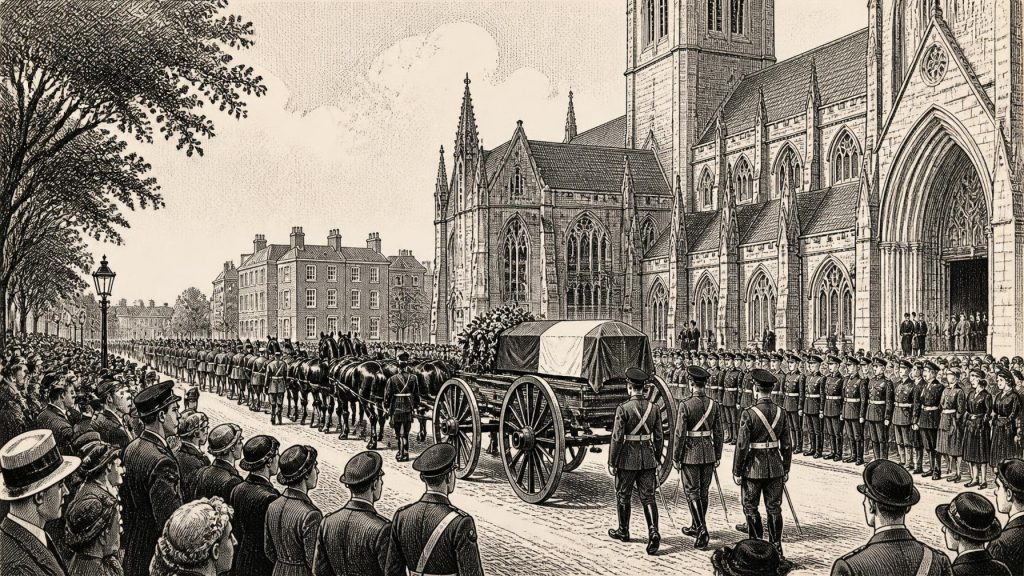
On 12 July, Douglas Hyde, the first President of Ireland, died. Hyde had been a Church of Ireland scholar, co-founder and first president of the Gaelic League, professor of Modern Irish and a formative figure in the cultural revival that preceded independence. His state funeral on 14 July in St Patrick’s Cathedral, Dublin, drew national mourning and military ceremony before burial at Frenchpark, County Roscommon. Yet it exposed a constraining feature of public life: Catholic political leaders and officials remained outside the Anglican service under the religious rules then observed by the hierarchy. The death of a Protestant founder of the language revival therefore became a revealing moment. The State honoured Hyde as a national figure, but its ceremonial practice displayed the denominational boundaries still shaping Irish civic life.
There were smaller signs of cultural and institutional ambition. The Irish News Agency Act, enacted on 3 August, provided a statutory basis for an agency associated with the Government’s effort to distribute Irish news abroad, particularly in the context of anti-partition publicity. Sport offered a different kind of shared public occasion: on 25 September Meath defeated Cavan by 1–10 to 1–6 before 79,460 spectators in the All-Ireland senior football final at Croke Park, securing the county’s first title. Neither development altered the constitutional deadlock, but both belonged to the texture of 1949: an outward-looking State promoting its case, and a mass sporting culture capable of gathering an immense crowd in Dublin.
By the end of 1949, Ireland could call itself a republic in statute and diplomatic usage, yet the year had underlined how incomplete a simple story of national completion would be. The legal break with the Commonwealth coincided with Britain’s emphatic guarantee of Northern Ireland’s position, a failed attempt to connect Atlantic security with reunification, and persistent economic and social constraints at home. Hyde’s final journey from Dublin to Roscommon supplied a more reflective image of the year: a State honouring one of its cultural architects while revealing the religious, territorial and material limits within which the new republic had to live.
Primary Sources
- Republic of Ireland Act, 1948 – History of this Act
- Notable Debates in the Dáil
- Ireland Act 1949
- Ireland Bill, House of Commons Debate, 16 May 1949
- Volume 9 – Documents on Irish Foreign Policy
- Actions Required in the United States Regarding the Ireland Act
- Memorandum of Conversation, Dean Acheson and Seán MacBride, 11 April 1949
- Costello, John Aloysius – Dictionary of Irish Biography
- MacBride, Seán – Dictionary of Irish Biography
- Meeting with Bevin Regarding the Ireland Act
- Irish Statute Book: Public Acts of 1949
- Irish Statute Book: Statutory Instruments of 1949
- Health (Duties of Officers) Order, 1949
- Ireland Through the Decades
- Historical Perspective – Central Statistics Office
- Census 1946 Reports
- That Was Then, This Is Now
- Statistical Abstracts – Historical Series
- Rural Electrification – ESB Archives
- The President: Douglas Hyde
- Douglas Hyde Tribute Volume – Irish Capuchin Archives
- Hyde, Douglas (de hÍde, Dubhghlas) – Dictionary of Irish Biography
- Funeral of Doctor Douglas Hyde
- The Road to Glory – Meath GAA
- Parliament and Northern Ireland, 1921–2021