Home Rule1914 CE
In 1914, Ireland experienced social hardship after the Dublin Lockout, escalating conflict over Home Rule, and the growth of armed volunteer movements. The Curragh crisis undermined army neutrality, while Ulster Volunteers imported arms at Larne. Nationalists responded through Cumann na mBan’s formation and the Howth gun-running, followed by fatal shootings at Bachelor’s Walk. Efforts to resolve Ulster’s status at the Buckingham Palace Conference failed. Britain’s entry into the First World War transformed priorities. Although the Third Home Rule Act received Royal Assent in September, it was immediately suspended. Redmond’s call for wartime enlistment divided the Irish Volunteers, deepening political uncertainty.
Dateline
For Ireland, 1914 began with the political temperature already dangerously high and ended with the constitutional future formally altered yet practically postponed. The year joined several crises that had previously seemed separate: the bitter social aftermath of Dublin’s Lockout, the confrontation over Home Rule and Ulster, the creation and arming of rival volunteer forces, and the European war that began in August. Firmly dated episodes – the Curragh crisis in March, the Larne and Howth gun-runnings, the Buckingham Palace Conference, and the Royal Assent to Home Rule – made Ireland central to the constitutional politics of the United Kingdom. Yet the wider consequence was paradoxical. The Home Rule measure became law on 18 September, only to be suspended before an Irish parliament could be created.
After the Lockout
January brought an unhappy conclusion to the great Dublin Lockout of 1913–14. On 18 January, transport workers began returning to work as the prolonged struggle collapsed under hunger, evictions, employer resistance and the withdrawal of support from the British Trades Union Congress. It was not a settlement on equal terms. Many workers went back under conditions hostile to union organisation; women workers, including those associated with Jacob’s biscuit factory, were among those especially badly affected by prolonged unemployment. For families in overcrowded tenements, the political drama of Home Rule coexisted with the immediate problems of rent, food and insecure work.
The Lockout’s conclusion did not make labour politics disappear. The Irish Transport and General Workers’ Union survived, as did the Irish Citizen Army created during the dispute to defend workers’ meetings from police attack. But early 1914 left organised labour weakened in Dublin, while public debate increasingly revolved around the possibility of armed resistance to Home Rule. It would be misleading to treat the Lockout simply as a prelude to later revolutionary events: its central significance in 1914 was social, exposing the divide between the city’s wealthy commercial interests and a large urban population living with acute poverty.
The Curragh and Larne
The Home Rule Bill had been introduced in 1912 by the Liberal government, dependent at Westminster on the Irish Parliamentary Party led by John Redmond. By 1914, the Parliament Act had reduced the House of Lords’ power to block it indefinitely. Ulster unionists, led by Sir Edward Carson and James Craig, nevertheless rejected an all-Ireland parliament in Dublin. Their Ulster Volunteer Force had been organised to resist Home Rule, if necessary by force. Nationalists answered with the Irish Volunteers, founded in late 1913 to defend the prospect of Irish self-government.
On 20–21 March, the constitutional contest reached the British Army’s principal Irish base at the Curragh, County Kildare. Officers of the 3rd Cavalry Brigade, led by Brigadier-General Hubert Gough, indicated that they would resign rather than take part in operations against Ulster unionists. It is often called the Curragh “mutiny”, though that term needs care: no direct order to fight the Ulster Volunteer Force had been issued or disobeyed. The crisis instead revealed that officers believed they might be used to impose Home Rule by force and that many would refuse such a role. The government’s later assurances that they would not be sent on military operations in Ulster eased the immediate confrontation, but the authority and political neutrality of the army had been severely damaged.
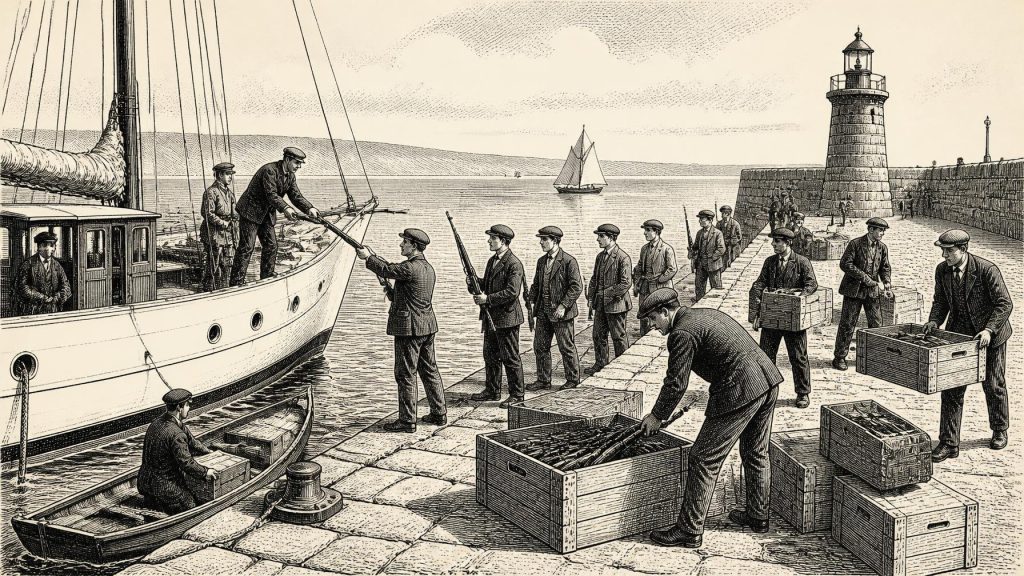
Unionist preparation became materially visible on the nights of 24 and 25 April. In a carefully organised operation, weapons from Germany were landed at Larne, Bangor and Donaghadee for the Ulster Volunteer Force. About 24,600 rifles, together with millions of rounds of ammunition, were rapidly distributed through a network of volunteer units and motor transport. The scale and efficiency of the Larne gun-running transformed the crisis. It demonstrated that an organisation pledged to oppose Home Rule could arm openly enough to make resistance credible, while the authorities proved unwilling or unable to stop it.
The episode also sharpened nationalist arguments that the Irish Volunteers could not remain unarmed. Their purpose was not uniform: many members saw the force as a constitutional safeguard for Home Rule, while a smaller but influential separatist current hoped it could serve a more radical national aim. In June, Redmond secured the addition of twenty-five nominees to the Irish Volunteer provisional committee, bringing the movement more closely under Irish Parliamentary Party influence. That compromise briefly widened the organisation, but stored up a dispute over who could define its policy.
Women Organise
Women claimed an organised place within this changing public world. On 2 April, Cumann na mBan was founded at Wynn’s Hotel on Abbey Street, Dublin, as an autonomous auxiliary to the Irish Volunteers. Agnes O’Farrelly, a lecturer in Modern Irish at University College Dublin, presided at the inaugural meeting. Its constitution committed the organisation to advancing Irish liberty and organising Irishwomen in that cause. Figures who would become prominent in national life, including Constance Markievicz, Elizabeth O’Farrell and Mary MacSwiney, were associated with it.
Its formation belonged to a broader cultural and political revival rather than to military affairs alone. Networks built through the Irish-language movement, nationalist clubs, education and civic associations helped women organise meetings, raise funds and circulate information. Cumann na mBan’s creation is firmly dated to 1914; its later prominence should not obscure the uncertainty of its first months. At the time, its members entered a political field in which constitutional nationalists, cultural activists, labour supporters and separatists could still overlap, even as their priorities increasingly diverged.
Howth and Bachelor’s Walk
Nationalist arming followed in July. The yacht Asgard, owned by Erskine and Molly Childers, landed approximately 900 German Mauser rifles and ammunition at Howth on 26 July. The enterprise had been planned by a circle including Roger Casement, Mary Spring Rice, Darrell Figgis and others sympathetic to the Irish Volunteers. Volunteer companies, called out under the appearance of a route march, collected the weapons on the pier and carried them towards Dublin. A further consignment associated with the operation was landed at Kilcoole, County Wicklow, on 1 August.
Howth was far smaller than Larne in quantity of arms, but it had immense symbolic weight. The rifles showed that the Irish Volunteers could act with discipline, secrecy and public confidence. When police and troops tried to intercept and disarm the returning Volunteers near Clontarf, many rifles were concealed or dispersed successfully. The day’s gravest violence came later, after a detachment of the King’s Own Scottish Borderers returned towards the city centre. At Bachelor’s Walk they fired on an unarmed civilian crowd amid a hostile confrontation. Three civilians were killed and many others wounded; a fourth victim later died of his injuries. The shootings created public outrage in nationalist Dublin and gave the gun-running consequences far beyond the number of rifles landed.
The July crisis exposed a striking imbalance in official treatment as nationalists understood it. Unionist arms had arrived in April on a vastly larger scale without a comparable bloodshed in the streets; nationalist volunteers encountered an attempted seizure of arms and then lethal military firing in Dublin. This perception deepened distrust of Dublin Castle and the British administration. It also brought recruitment to the Irish Volunteers, whose weekly routines of drill, marching and collecting subscriptions for equipment were becoming a conspicuous feature of political life in towns and cities.
Conference, War and Statute
Political leaders still attempted a negotiated settlement. From 21 to 24 July, King George V convened the Buckingham Palace Conference with British, Irish nationalist and unionist representatives. The central problem was exclusion: whether part of Ulster should be kept outside a Home Rule Ireland, which counties might be included, and whether exclusion would be temporary or permanent. The conference ended without agreement. It did, however, make clear that the question was no longer merely whether Ireland would have devolved government, but whether its territory would be divided in order to obtain it.
Events in Europe overtook the negotiations. Britain declared war on Germany on 4 August after Germany’s invasion of Belgium, and Ireland, then part of the United Kingdom, entered the war with it. The outbreak did not erase Irish divisions. It changed their setting: government attention, military priorities and public language now turned towards imperial defence, Belgium and the claimed rights of small nations.
On 18 September the Government of Ireland Act received Royal Assent. This was the long-sought Third Home Rule Act, providing for devolved government within the United Kingdom rather than Irish independence. Its achievement was real: after decades of failed bills, Home Rule had entered the statute book. But on the same day the Suspensory Act prevented steps being taken to put it into operation, initially for twelve months and thereafter while the war continued. The promised parliament was therefore both enacted and withheld. Nor had the Ulster question been settled; the prospective amending arrangements on exclusion had not been agreed.
Woodenbridge and Division
John Redmond made his decisive wartime intervention at Woodenbridge, County Wicklow, on 20 September. Addressing Irish Volunteers, he urged them to support Britain and the Allied cause, including by joining the British Army. Redmond believed that participation in the war would demonstrate Irish national responsibility, protect Home Rule’s future and allow nationalists and unionists to stand together against German aggression. Many Irish men did enlist, for motives that could include political loyalty, employment, local ties, adventure and military tradition.
For the Volunteers, however, Redmond’s appeal proved divisive. His supporters became the Irish National Volunteers and constituted the larger body. The minority who rejected enlistment abroad retained the name Irish Volunteers under Eoin MacNeill’s leadership. This was not yet a simple division between peace and war, or between constitutionalism and revolution: members made choices amid uncertainty over Home Rule, empire, Ulster and Europe. But the separation created two markedly different paths of Irish nationalism.
By the close of 1914, Ireland had moved from the expectation of Home Rule to a condition of armed political uncertainty. The year’s firmly dated landmarks – Curragh, Larne, Howth, Bachelor’s Walk, Buckingham Palace, Royal Assent and Woodenbridge – were not isolated dramas. Together they changed the practical meaning of authority, citizenship and political allegiance across the island. Home Rule had become law, but war had postponed it; volunteer forces had become central to public life; and the constitutional settlement that had seemed close in spring was farther from resolution by winter.

Primary Sources
- Government of Ireland Act 1914
- Clause 1.—(Suspension of the Operation of the Government of Ireland Act, 1914, and the Welsh Church Act, 1914)
- Suspensory Bill
- 1912–1923 Timeline
- Irish Home Rule
- The Curragh Crisis, March 1914
- Ireland 1900–1925: Crisis, War and Revolution
- 1914: Timeline of Events
- 1914: The Howth Gun Running
- Discover the Historic Asgard Yacht
- Log of the Gun-Running Cruise in the ‘Asgard’, July 1914
- Personal Account by Eoin Mac Neill of His Role in the Howth Gunrunning on 26th July 1914
- Mary Spring Rice Letters to Michael Joseph (The) O’Rahilly, 1 and 9 May 1914
- The Ulster Volunteers 1913–1914: Force or Farce?
- John Redmond’s Woodenbridge Speech
- How Revolutionary Were the Irish Volunteers?
- Military Archives: History of Organisations
- Lockout Ends as More Strikers Return to Work
- RTÉ Archives: The Great Lockout
- Funeral Victims of Gun Running – Dublin