
Connolly’s Return, Redmond’s Leverage1910 CE
In 1910, two British general elections made John Redmond’s Irish Parliamentary Party essential to Liberal government, increasing prospects for Home Rule without securing it. The Lords’ veto remained intact, while nationalist and unionist divisions persisted. Land reforms strengthened the Congested Districts Board’s capacity to address western poverty, and old-age pensions exposed disputes over proof of age. James Connolly returned from America, reinforcing developing socialist and trade-union politics. The Abbey Theatre, after Annie Horniman withdrew support, faced financial uncertainty while asserting independence. Meanwhile, Kalem filmed The Lad from Old Ireland, linking rural Ireland, emigration and modern transatlantic visual culture for audiences.
Dateline
In 1910, Ireland’s future was shaped less by a single domestic upheaval than by a constitutional opportunity at Westminster. Two British general elections made John Redmond and the Irish Parliamentary Party indispensable to the survival of the Liberal government. That leverage did not bring Home Rule in the calendar year itself: no new Irish self-government bill was introduced in 1910, and the House of Lords still possessed its full veto. Yet the year altered the political arithmetic from which the Third Home Rule Bill would emerge.
Elsewhere, change was equally real but more gradual. A reconstituted Congested Districts Board began operating with stronger land-purchase powers in the west; old-age pensions, introduced the previous year, became a practical and sometimes disputed part of poor people’s lives; organised labour gained an important future leader when James Connolly returned from America; and the Abbey Theatre asserted its independence at a considerable financial cost. In County Cork and Kerry, a visiting American film company made images of Irish rural life for audiences across the Atlantic. Ireland in 1910 was therefore linked by parliamentary calculation, migration, land reform, welfare, theatre and new technology.
Two Elections and a Constitutional Opening
The immediate political background was the conflict between the Liberal government and the House of Lords over the 1909 “People’s Budget”. When the Lords rejected the budget, a general election followed in January 1910. The result left Liberals and Conservatives closely balanced in the House of Commons. Redmond’s Irish Parliamentary Party, committed to constitutional Home Rule within the United Kingdom, possessed the votes needed by H. H. Asquith’s Liberal ministry.
This was not an automatic triumph for Irish self-government. Redmond’s party had to pursue two linked objectives: keep the Liberals in office and secure an alteration of the Lords’ power to defeat legislation passed by the elected Commons. The January result made the first aim possible; the second still required another prolonged constitutional contest. Irish MPs could not themselves abolish the Lords’ veto, but their support gave the government a practical reason to attempt it.
The election also showed that Irish politics did not divide neatly into a single nationalist camp and a single unionist camp. The Irish Parliamentary Party remained the principal nationalist force, but William O’Brien’s All-for-Ireland League contested seats, especially in Cork, with a distinctive programme of conciliation. Unionism held strong positions in much of north-east Ulster and in particular constituencies elsewhere. These were electoral and political divisions, not yet the armed mobilisation of the later Home Rule crisis. In 1910, the central struggle was still conducted through speeches, party organisation, newspapers and Westminster votes.
The death of King Edward VII on 6 May brought George V to the throne, a reminder that Ireland remained part of the United Kingdom of Great Britain and Ireland. It also provided a small but revealing cultural-political episode in Dublin. The Abbey Theatre did not close following the king’s death, and its principal financial backer, Annie Horniman, severed her connection with the theatre. Her withdrawal was not merely a quarrel over etiquette. It forced the Abbey’s directors to confront more directly the challenge of sustaining a national theatre without the patronage that had helped secure its early survival.
The political deadlock was renewed rather than settled. A second general election was held in December 1910. The overall House of Commons balance again left the Liberals dependent upon Irish support. In Ireland, Redmond’s party won 73 of the 103 Irish seats. The result confirmed its commanding position in most nationalist Ireland, while the continuing strength of Unionist representation demonstrated that a future settlement would have to reckon with determined opposition, particularly in Ulster.
The year’s significance lies precisely in what had not yet occurred. The Parliament Act limiting the House of Lords’ veto would not receive royal assent until August 1911, and the Third Home Rule Bill would not be introduced until April 1912. It would be misleading to treat 1910 as the year Home Rule became law or as the beginning of a military confrontation. It was the year in which parliamentary dependence made a renewed Home Rule attempt substantially more likely.
Land, Pensions and the Rural State
Political debate in 1910 rested upon material questions that affected households across Ireland. Land reform had already transformed the relationship between landlords and tenants, but in poorer western districts fragmented holdings, marginal land and overcrowding remained serious problems. The Irish Land Act of 1909 had enlarged and reorganised the Congested Districts Board for Ireland. Its important compulsory-purchase provisions came into force on 10 January 1910.
The Board’s remit concentrated official attention on Donegal, Sligo, Leitrim, Roscommon, Mayo, Galway and Kerry, as well as specified districts in Clare and Cork. It could acquire estates and seek to relieve congestion through land purchase and rearrangement. The legislation also separated some agricultural, forestry, livestock and fisheries functions between the Board and the Department of Agriculture and Technical Instruction. These arrangements did not instantly remake western life in 1910. Rather, they created the machinery through which the state could intervene more forcefully in a long-standing rural problem.
For older people of limited means, the Old Age Pensions scheme was already becoming part of everyday administration. It had begun on 1 January 1909, so 1910 was its second year. A parliamentary question on 17 March exposed a practical difficulty: local pension committees could allow claims, only for pension officers and the Local Government Board to resist them when an applicant’s age could not be confirmed in census returns. In a society where formal birth records and remembered ages did not always correspond neatly, entitlement to a modest weekly payment could turn on disputed evidence.
That dispute gives a more human measure of the period than constitutional rhetoric alone. Welfare did not remove poverty, nor did it replace family support, paid work or Poor Law relief. But it brought central government, local committees, postal payments and documentary proof more closely into the lives of elderly people. At the same time, land purchase and agricultural administration signalled a state attempting to address rural insecurity through ownership, improvement and regulated development.
Connolly Comes Home
On 26 July, James Connolly returned to Ireland from the United States. His arrival was firmly dated in a telegram to the Dublin trade unionist William O’Brien, and it marked the restoration to Irish public life of a socialist writer and organiser whose influence would grow sharply over the next six years. Connolly had spent much of his American period in socialist and industrial-union circles. He returned with a political outlook that joined social justice, workers’ organisation and Irish national freedom.
Two of his major works, Labour in Irish History and Labour, Nationality and Religion, were published in 1910. Their appearance and his return should not be read backwards as a prediction of the Easter Rising. In the immediate setting of 1910, Connolly entered an Irish labour movement already being reshaped by James Larkin and the Irish Transport and General Workers’ Union, founded in 1909. Connolly worked as the union’s Belfast organiser, where the scale of industry and the political separation of Protestant unionist and Catholic nationalist workers posed acute difficulties for any movement seeking class solidarity.
His return nevertheless mattered because it strengthened a developing labour politics at precisely the moment when Home Rule again dominated parliamentary nationalism. Ireland’s public arguments were no longer confined to the older language of landlord and tenant, empire and nation. They increasingly included wages, casual work, urban poverty, collective bargaining and the political claims of unskilled workers. The great industrial conflicts of 1913 still lay ahead, but some of their intellectual and organisational foundations were being laid in 1910.
Stage, Screen and Irish Images
The Abbey Theatre’s programme makes 1910 unusually visible in cultural records. On 13 January it staged the first performance of J. M. Synge’s Deirdre of the Sorrows, four performances in all. The play, completed after Synge’s death in 1909, drew upon the Deirdre story from the Ulster Cycle but offered it through modern Irish theatre rather than antiquarian display. On 5 May, the Abbey premiered Pádraic Colum’s Thomas Muskerry, a play concerned with social decline and family conflict in a provincial Irish setting.
These productions belonged to a working repertory theatre, not a museum of nationalist symbols. The Abbey also presented comedy, translations, revivals and touring performances during the year. Horniman’s withdrawal after the theatre remained open following Edward VII’s death therefore had lasting institutional importance. The theatre’s claim to artistic freedom and Irish cultural purpose would now have to coexist with a more precarious financial reality.
In August, the Kalem Company of New York sent Sidney Olcott, Gene Gauntier and colleagues to Ireland to film The Lad from Old Ireland. The company travelled through Queenstown, Cork, Killarney and Dublin, and the finished film was released in November. It is commonly identified as the first American studio production filmed on location outside the United States, as well as the first fiction film made substantially in Ireland.
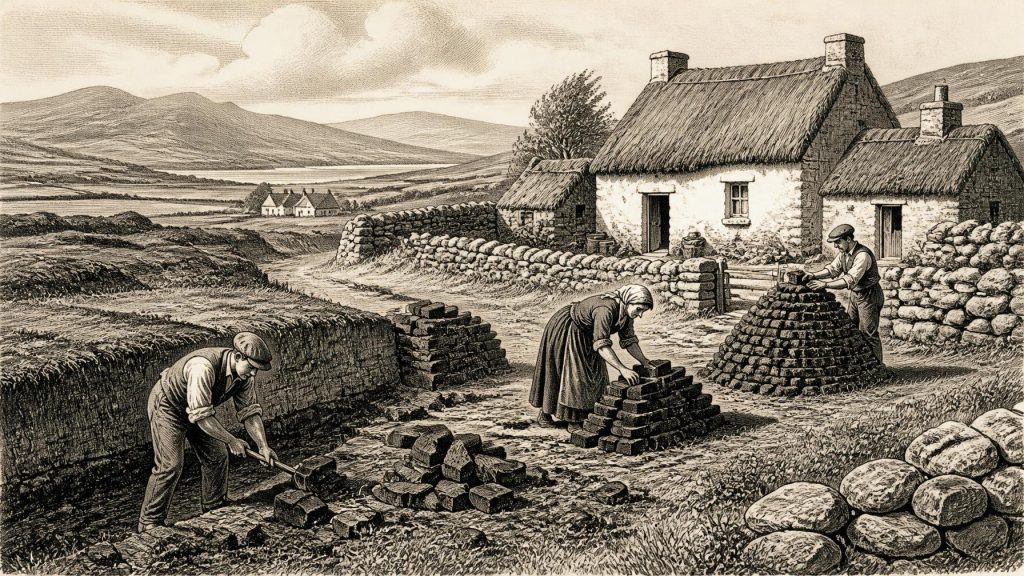
The film’s story of emigration, hardship and return was designed for a transatlantic audience. Its rural scenes included cottages, farms, peat-cutting and landscapes presented as recognisably Irish. A fictional film cannot be treated as a transparent record of ordinary life; it selected and arranged what viewers should see. Yet its production is important evidence of another 1910 development: Ireland was becoming an object of modern visual culture, marketed internationally through stories that joined rural life to the Irish diaspora in America.
An Unfinished Year
By December, Ireland had not acquired self-government, solved western congestion, reconciled nationalism and unionism, or overcome urban poverty. Its most decisive consequences remained in the future. But the year supplied new leverage to Redmond, new administrative tools to land reformers, a pension system whose rules reached into local memory, a renewed labour voice in Connolly, and new cultural forms on stage and screen.
For contemporaries, these developments would not necessarily have appeared parts of one story. A voter following Westminster, an elderly pension claimant, a congested-district tenant, a Belfast organiser, an Abbey actor and a Kerry bystander watching an American camera crew inhabited different Irelands. In retrospect, however, they reveal a country in which constitutional politics and daily life were becoming more closely, though unevenly, connected.
Primary Sources
- Third Home Rule Bill
- January 1910 General Election – Parties
- Connolly, James
- Chronology of James Connolly
- Copy of telegram from James Connolly to William O'Brien to advise that his ship has landed [from the United States] and he will be in Dublin at 1[pm?] on Tuesday, 1910 July 26
- National Library of Ireland 1916 Exhibition: James Connolly
- Larkin, James
- Search Results | Abbey Archives | Abbey Theatre – Amharclann na Mainistreach
- Deirdre Of The Sorrows | Abbey Archives
- History | Abbey Theatre
- Horniman, Annie Elizabeth Fredrika
- The Lad from Old Ireland (1910)
- The O'Kalem Collection: 1910-1915 (2011)
- Early Irish Cinema: From Silent Film to Sound
- Revenue and Old Age Pensions in the 1920s and 1930s
- Old Age Pensions (Ireland), 17 March 1910
- Irish Land Act, 1909
- Irish Land Act, 1909 (PDF)
- Civil Service Supplementary Estimates, 1909–10, 1 March 1910
- Land Purchase (Ireland), 24 October 1912
- Life in 1916 Ireland: Stories from Statistics – James Connolly
- Annie Horniman and the Abbey Theatre