Disestablishment, Westmeath, Ormeau1871 CE
In 1871, Ireland experienced constitutional, demographic, agrarian and civic change. The Church of Ireland was disestablished, ending its privileged state position while preserving it as a self-governing voluntary body. The census recorded 5,412,377 people, confirming continuing post-Famine decline and emigration, alongside Belfast’s industrial growth. Land reform under the 1870 Act offered limited tenant protections, but agrarian violence prompted the coercive Westmeath Act, permitting detention without trial in proclaimed districts. Isaac Butt’s election for Limerick advanced constitutional home government. Belfast opened Ormeau Park, while expanding national education and Trinity’s academic life highlighted uneven access, religious tensions and unresolved inequalities across Ireland.
Dateline
In 1871 Ireland was living through change that was at once constitutional, local and intimate. On New Year’s Day the Church of Ireland ceased to be the established church of the state. On 2 April a census counted an island still shrinking in population after the catastrophe of the Famine and the continuing pull of emigration. In June, Westminster answered agrarian violence in the midlands with an exceptional coercive law. Yet the year also brought a conspicuous civic opening in Belfast, while the election of Isaac Butt for Limerick gave practical parliamentary expression to the young Home Government movement. These developments did not form a single programme. Together, however, they showed an Ireland in which the old Union settlement was being revised without resolving the questions of land, religion, political authority or social inequality.
A Church No Longer Established
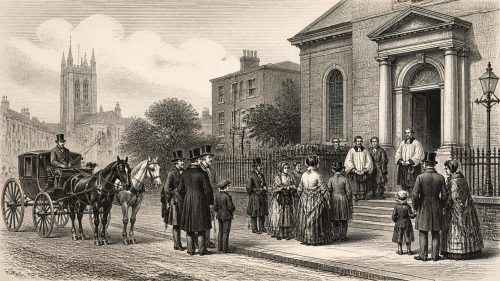
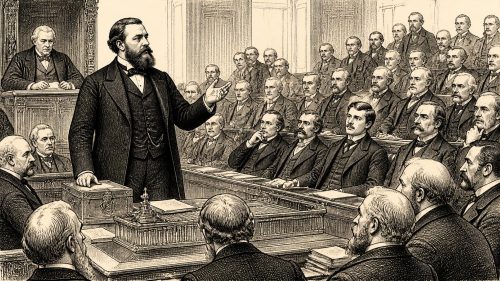
The decisive date was 1 January. Under the Irish Church Act of 1869, the legislative union of the Churches of England and Ireland was dissolved and the Church of Ireland ceased to be established by law. For centuries that church had occupied a privileged legal position despite serving a minority of the island’s people. Its bishops had sat among the Lords Spiritual at Westminster; its ecclesiastical law had legal force; and its property and corporate structures were embedded in the state. The change that took effect in 1871 therefore had a significance beyond theology. It was Gladstone’s attempt to remove a major source of grievance in a country where Roman Catholics were the overwhelming religious majority and Presbyterians constituted another substantial Protestant community.
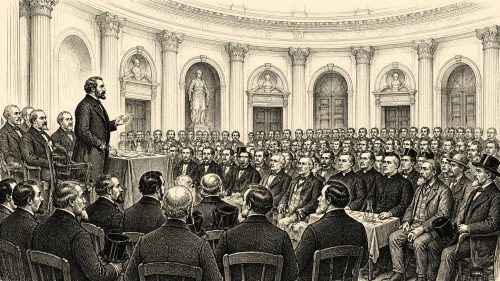
Disestablishment was neither the disappearance of the Church of Ireland nor a simple confiscation of its life. The Act transferred much ecclesiastical property to the Church Temporalities Commissioners, while making provision for existing clergy and office-holders who lost income attached to the old establishment. More fundamentally, it required the church to become a self-governing voluntary body. Its bishops, clergy and lay representatives had used the General Convention of 1870 to devise a constitution before the legal break occurred. The new arrangements rested increasingly on trusts and voluntary support rather than parliamentary authority and compulsory public endowment. Parish worship, pastoral work and charitable activity continued, often with little outward change for people in the pews, but the terms on which the institution existed had altered profoundly.
The year also illuminates the uneven character of religious citizenship. The new internal structures of the disestablished Church of Ireland admitted adult male communicants to lay participation, but not women or younger men. Elsewhere in Protestant Ireland, Westminster passed the Irish Presbyterian Church Act on 16 June, regulating trusteeship of certain Presbyterian property. These measures did not erase denominational rivalry, nor did they satisfy Catholic demands concerning education and public influence. They did, however, make 1871 a landmark in the legal re-ordering of religion: the state had stepped back from one church while continuing to legislate around the property and governance of several.
An Island Counted
On Sunday 2 April the census enumerated the people of the whole island. The published returns eventually gave the population as 5,412,377, down by 386,590 from the 5,798,967 recorded in 1861. The fall was not a temporary fluctuation. It registered the long demographic aftermath of the Great Famine, sustained emigration and changing patterns of marriage, household formation and rural employment. The census was a snapshot rather than an explanation, but it made plain that Ireland’s population continued to move in the opposite direction from that of Great Britain.
Its denominational figures gave hard numerical context to disestablishment. Roman Catholics numbered 4,150,867, about three-quarters of the population. The census recorded 667,998 members of the Church of Ireland and 497,648 Presbyterians, with smaller Methodist, Baptist, Quaker, Jewish and other communities. These totals should not be read as a complete account of belief or political allegiance: denomination did not automatically dictate a person’s politics, class or language. But they demonstrate why an established Anglican church appeared increasingly anomalous to many reformers, while also explaining the apprehensions of Protestants who feared that equality before the state could become vulnerability within a Catholic-majority society.
The census also recorded a changing built landscape. Inhabited houses across Ireland had declined from 995,156 in 1861 to 961,380 in 1871. That aggregate conceals sharply different local experiences. Many western and southern districts had lost people and households, whereas Belfast was expanding fast through industry, port activity and migration from the surrounding countryside. The city’s population was recorded at 174,377 in 1871. Thus the same census that measured rural contraction also captured the growing weight of an industrial Ulster town whose economy and political culture differed markedly from much of the island.
Land Reform, Then Coercion
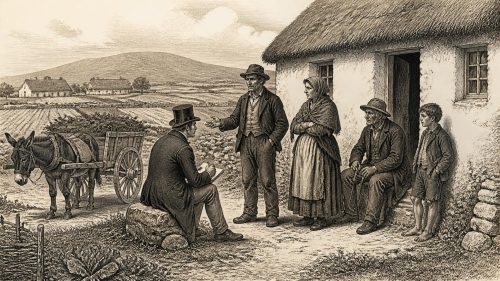
For tenant farmers, labourers and landlords, 1871 was the first full year after the Landlord and Tenant (Ireland) Act of 1870. The Act had recognised, in limited form, that occupiers possessed interests in the land they worked. It provided compensation for improvements and, in certain circumstances, compensation for disturbance following eviction; it also recognised the Ulster tenant-right custom and offered a state-assisted, voluntary route towards tenant purchase. This was a major departure from the older doctrine that treated the landlord’s property right and the tenant’s contract as the whole relationship.
Yet the Act did not establish the later ‘three Fs’ of fair rent, fixity of tenure and free sale. Rents remained beyond systematic independent assessment, and the operation of compensation provisions could depend on legal process, resources and local power. Accordingly, land remained a source of anxiety and conflict. The contrast between reforming legislation and the year’s coercive legislation is important: neither can responsibly be treated as proof that the agrarian question had been settled.
On 16 June Parliament enacted the Protection of Life and Property in Certain Parts of Ireland Act, commonly called the Westmeath Act. It empowered the Lord Lieutenant, acting with the Irish Privy Council, to proclaim County Westmeath and specified adjoining baronies in King’s County and Meath. Within a proclaimed area, people suspected of membership of the Ribbon Society or involvement in crimes directed by it could be arrested and detained without ordinary trial. Parliamentary debate centred on serious agrarian offences and on the low rate of convictions. Supporters presented exceptional powers as necessary protection for life and property; opponents saw them as a grave suspension of normal safeguards and disputed aspects of the government’s case.
The Act’s wording itself is revealing. It attributed violence to a named secret society and defined a bounded emergency district, but rural disorder had deeper roots than any official label could contain: insecurity of tenure, intimidation, disputes over land and authority, and the difficulties of policing communities in which witnesses might not cooperate. The legislation demonstrated the continuing readiness of government under the Union to answer Irish crisis through special powers, even while Gladstone’s ministry was dismantling an older religious privilege.
Butt’s Constitutional Opening
Political dissatisfaction was increasingly being channelled into a constitutional demand for Irish self-government. Isaac Butt, a Donegal-born barrister and former Conservative who had defended Fenian prisoners and led the Amnesty Association, had founded the Home Government Association in 1870. Its aim was not an immediate separatist revolution but an Irish legislature managing domestic affairs within a federal reorganisation of the United Kingdom. The movement sought to unite people who differed in religion and political background, presenting parliamentary self-government as an alternative both to inertia at Westminster and to insurrection.
On 20 September 1871 Butt was returned unopposed for Limerick City. The result did not yet create a disciplined national parliamentary party; the formal Home Rule League lay in the future. Nevertheless, Butt’s return supplied the movement with its leading spokesman in the House of Commons and showed that ‘home government’ could win electoral support. His success belonged to a year in which disestablishment and land reform had raised expectations but had not ended the sense that Irish matters were being managed piecemeal from London.
A People’s Park in Belfast
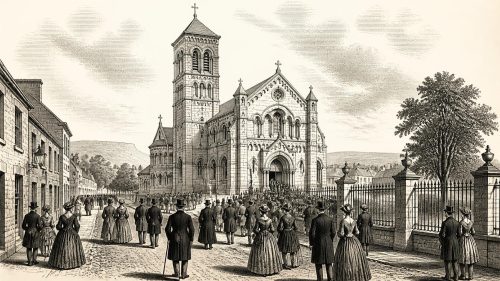
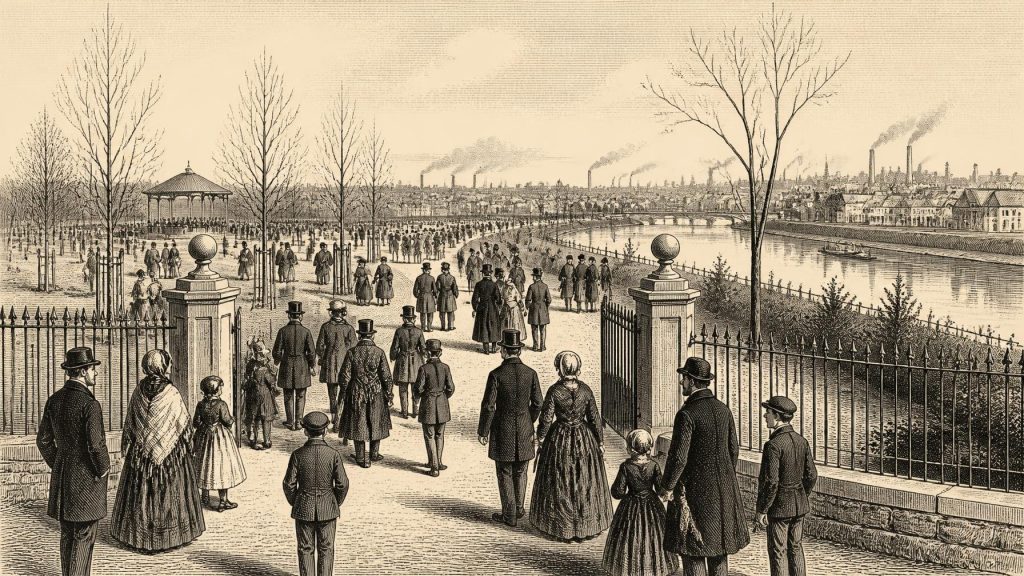
Not all important change occurred at Westminster or Dublin Castle. On Saturday 15 April Belfast Corporation opened Ormeau Park to the public as the city’s first municipal park. The corporation had bought the former Donegall estate in 1869, and the opening took place under the Public Parks (Ireland) Act of that year. Contemporary descriptions emphasised its character as a ‘People’s Park’: unlike the fee-based Botanic Garden, it was intended to provide open recreation for ordinary residents, including the industrial working population of a rapidly growing town.
Ormeau Park was not yet the fully landscaped space later visitors would know; ideas for the design of its hundred acres were invited from the public, and a later competition selected a plan. Even so, its opening was symbolically important. It represented municipal confidence, public health and leisure as civic responsibilities. In an Ireland often described through land, sectarian politics and depopulation, Belfast offered another trajectory: dense urban growth, industrial employment and an enlarging sphere of local government.
Learning and Uneven Opportunity
The census-era educational landscape remained uneven. National schools had expanded greatly since the 1830s: by 1871 there were 6,914 schools under the National Board, with roughly 973,000 pupils on their rolls. Yet enrolment was not the same as regular attendance. Poverty, seasonal work, distance and inadequate buildings could interrupt schooling, especially in rural districts. Religious management also remained central to education, so the question of who controlled schools continued to overlap with the broader disputes sharpened by disestablishment.
At the higher end of learning, John Pentland Mahaffy held Trinity College Dublin’s chair of ancient history from 1871. The appointment was a small event beside the remaking of church-state relations, but it points to the continuing place of Dublin’s university culture within a society debating access, denominational equality and the purposes of education. Ireland in 1871 was not simply a country leaving an old order behind. It was a country testing new institutions while inherited inequalities, religious sensitivities and the unresolved land question ensured that reform remained contested.
Primary Sources
- Irish Church Act, 1869
- Irish Church Act, 1869, Section 2
- Disestablishment
- New Year’s Day 1871 – the Disestablishment of the Church of Ireland
- Disestablishment 150 – A Decade of Disestablishment 1868 to 1878
- The Cost of Democracy: The Church of Ireland and Its Ritual Canons, 1871–1974
- Irish Presbyterian Church Act, 1871
- The Protection of Life and Property in Certain Parts of Ireland Act 1871
- The Protection of Life and Property in Certain Parts of Ireland Act 1871 (original Act PDF)
- Protection Of Life And Property In Certain Parts Of Ireland Bill, 12 May 1871
- Second Reading—Adjourned Debate, 19 May 1871
- Census of Ireland, 1871
- Census of Ireland, 1871, Part 3: General Report
- Area, Houses and Population: Census of Ireland, 1871
- Census Through History
- General Report, Ireland, 1911
- Butt, Isaac
- Mr Isaac Butt
- O'Mara, Stephen
- The Decoupling: Landlord and Tenant Act (Ireland) 1870
- State-aided Land Purchase under the Disestablishment Act of 1869
- Ormeau Park
- Ormeau Park Historic Listing
- City of Belfast: Census Report of Ireland, 1901
- Railways: Statistical and Social Inquiry Society of Ireland
- Previous Deans, Trinity College Dublin