
Westland Row, Gortroe1834 CE
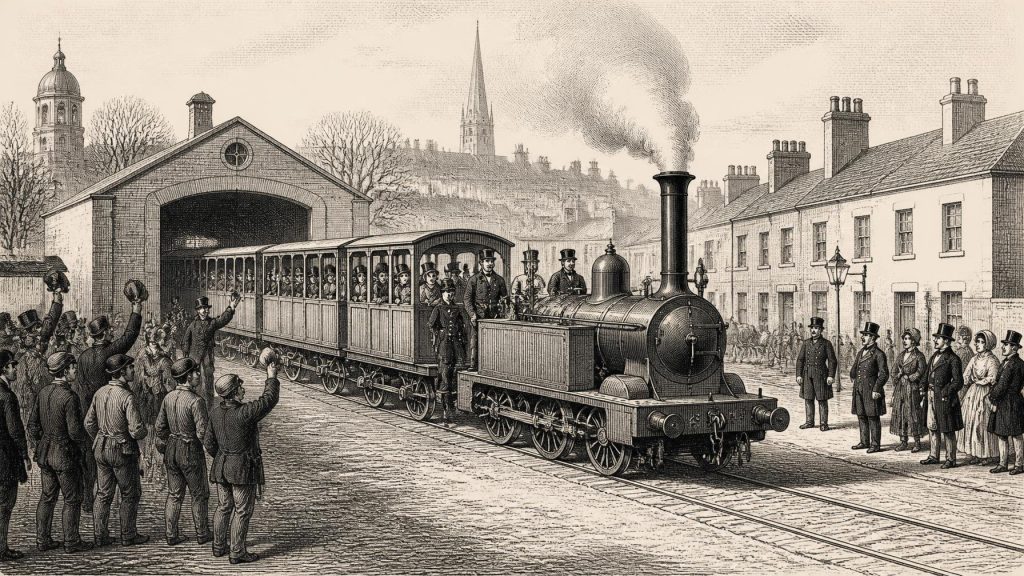
In 1834, Ireland’s contrasts were embodied by the opening of the Dublin and Kingstown Railway and the Rathcormac massacre at Gortroe, County Cork. The railway, Ireland’s first, linked Dublin’s commercial centre with its packet harbour, demonstrating private investment, engineering and growing passenger mobility. Next day, troops protecting tithe collection killed at least nine people resisting payments to the established Church of Ireland. The Tithe War exposed rural poverty, Catholic resentment and dependence on coercion. Westminster debated repeal, tithes and church reform amid ministerial instability. Population pressure, insecure labour, poor housing, disease and limited educational and health measures underscored persistent inequality.
Dateline
In 1834, Ireland displayed two sharply contrasting faces within thirty-six hours of one another. On 17 December, passengers travelled by steam railway from Dublin’s Westland Row to Kingstown harbour. On 18 December, at Gortroe near Rathcormac in County Cork, a tithe-collection expedition protected by constabulary and regular troops ended in fatal gunfire. One event announced a new age of capital, engineering and rapid movement; the other revealed how precarious public order remained where a poor, overwhelmingly Catholic rural population was required to support the established Protestant church.
Those events did not sum up all Irish life in 1834, but they make an unusually vivid frame for the year. The island was populous, predominantly rural and deeply unequal. It was also part of the United Kingdom, so decisions on Irish taxation, churches, coercion and constitutional change were made at Westminster. Dublin merchants and engineers could invest in modern transport, while smallholders and labourers elsewhere faced insecure work, high dependence on the potato, and recurrent disputes over land, rent and tithes.
A Railway Reaches Kingstown
The Dublin and Kingstown Railway opened its regular passenger service on 17 December. It connected Westland Row, close to Dublin’s commercial centre, with the harbour at Kingstown, now Dún Laoghaire. It was Ireland’s first railway and among the earliest suburban passenger railways anywhere. Contemporary excitement was understandable: the line promised a journey by mechanical power between city and port that was faster, more regular and less exposed to road conditions than the familiar coach or car.
The opening followed a more tentative autumn. On 9 October, the locomotive Hibernia had taken invited passengers over the full route in eight carriages. A public opening planned for later October was delayed after storms and flooding damaged parts of the new line, including the bridge over the Dodder. The December service was therefore not merely a ceremonial novelty but the beginning of commercial operation. By the end of its first day, thousands had travelled. Fares differentiated sharply between classes, ensuring that the railway was publicly visible across Dublin society even though comfort and status remained unequal.
The project joined several interests. James Pim, a Quaker banker, stockbroker and transport entrepreneur, had long pressed for a rail connection between Dublin and the growing packet harbour. William Dargan of County Carlow, already experienced in roads, canals and navigation works, won the construction contract; Charles Blacker Vignoles was the engineer. The enterprise was intended to move goods as well as people, linking urban markets, merchants and a port central to communication with Britain. Yet passenger traffic quickly became its defining feature. Kingstown could now function more closely as an extension of the capital, while Dubliners gained an easier route to the coast.
The railway’s material setting mattered. Its course ran through the city’s southern outskirts and along the low-lying shore, requiring bridges, cuttings and embankments. Such works altered drainage and access, brought wage labour to construction sites, and demonstrated what private capital and parliamentary authorisation could accomplish. This was not evidence that industrial transformation had reached Ireland evenly. Rather, it was a concentrated, urban and coastal breakthrough. Most of the country still moved at the pace of walking, carts, horses, canals and sailing vessels.
Gortroe and the Tithe Crisis
The following day brought a far grimmer demonstration of state power. At Gortroe, in the parish of Gortroe near Rathcormac, armed forces accompanied an attempt to collect tithe arrears due to Archdeacon William Ryder of Cloyne. A crowd gathered; the confrontation escalated; troops fired. The subsequent inquest concerned the bodies of nine people killed on 18 December. Later accounts have differed over the total number of dead and wounded, but the death of at least those nine people is firmly established. The episode became known as the Rathcormac, or Gortroe, massacre.
Its immediate setting was the Tithe War, the prolonged resistance that had convulsed much of rural Ireland since 1830. Tithes were legally owed to support the Church of Ireland, the established church, regardless of whether the payer belonged to it. Most people in the district were Roman Catholic; many were poor cultivators or labourers whose economic security could be extremely fragile. The grievance was therefore both financial and confessional. A payment extracted from agricultural produce or its cash equivalent was resented not simply as a charge, but as support for a church that did not represent the majority.
Resistance did not always mean a spontaneous clash between an isolated farmer and a clergyman. It involved collective non-payment, the obstruction of process servers and auctions, threats, organised gatherings and, at times, violence. The authorities responded with police, troops, prosecutions and special legislation. Clergy too were caught within a system that made many of their incomes dependent upon a levy increasingly impossible to collect without public force. The cost of enforcement could be wildly disproportionate to the sums recovered, while every armed collection risked widening resentment.
Gortroe exposed the failure of that arrangement in its starkest form. The purpose of the expedition was fiscal and ecclesiastical; its outcome was deadly. In the months after the killings, the inquest and the conduct of soldiers, magistrates and officials became matters of parliamentary controversy. But the machinery of law did not restore confidence in the tithe system. For rural communities, the event confirmed that an unpopular religious charge could be backed by bayonets. For government, it was further evidence that a durable settlement required more than armed collection.
Westminster Debates, Irish Consequences
Irish questions occupied Westminster throughout 1834. Daniel O’Connell remained the most powerful Catholic political figure in Ireland and the leading parliamentary advocate of repeal of the Union. On 22 April, the House of Commons began a major debate on a proposed inquiry into repealing the Union. The proposal was decisively rejected after several days of discussion. The defeat showed the limits of O’Connell’s parliamentary leverage, but it also placed the constitutional claim for an Irish legislature before a British-wide audience in unusual detail.
Tithes were equally contentious. In debates during May, July and August, ministers and Irish members struggled over how to convert or transfer the burden from occupiers to landlords, how to deal with arrears, and how to preserve church income without perpetuating conflict. No final settlement emerged in 1834. The eventual Tithe Commutation Act lay four years ahead. This distinction matters: the year saw serious legislative effort and political argument, not the resolution of the crisis.
Government itself was unstable. The Whig ministry fell in November after King William IV dismissed Lord Melbourne. Sir Robert Peel’s short Conservative ministry began at the end of December, while the Earl of Haddington was appointed lord lieutenant for the new administration from 1 January 1835. Thus the violence at Gortroe occurred amid transition at the very top of the state. In Ireland, where governance depended heavily on Dublin Castle, magistrates and local forces, uncertainty in London could sharpen anxieties without changing the immediate realities of collection and coercion.
Population, Poverty and Public Health
Broader conditions gave these disputes their force. The 1831 census recorded 7,767,401 people in Ireland, although later archival assessment notes imperfections in the enumeration. The figure nevertheless conveys the pressure on land and employment in the early 1830s. Many households depended on small plots, seasonal labour and the potato. This did not mean that every district was uniformly destitute: commercial farming, market towns, linen districts, ports and prosperous estates formed important parts of the economy. But the gulf between the modern railway terminus and the insecure rural cabin was real.
Henry David Inglis travelled widely through Ireland during the spring, summer and autumn of 1834. His observations were those of an outsider and should not be treated as a statistical survey, yet they recorded recurrent unemployment, inadequate housing and dependence upon low-cost food. Such testimony accords with the larger inquiry into the poorer classes then under way. The inquiry would not produce its final report until 1836, so its conclusions should not be projected backwards into this year. Still, the very fact that commissioners were gathering evidence in 1834 shows that Irish poverty had become an urgent question of administration.
Public health was also addressed, cautiously, in legislation. The Fever Hospital (Ireland) Act of 1834 adjusted provisions under which local fever-hospital bodies could secure small sites from episcopal estates. It did not create a national health service, nor did it solve the connection between poverty, overcrowding and infectious disease. It was instead a limited measure within a patchwork of dispensaries, hospitals, voluntary subscriptions, grand-jury presentments and local authority. Its presence on the statute book is a reminder that disease remained a recognised social danger after the cholera emergency of the early 1830s.
Churches, Schools and Political Restraint
Religion shaped both conflict and efforts at order. The Church Temporalities legislation of 1833 was still being implemented and amended, rationalising the Church of Ireland’s institutional and property arrangements. It did not remove the tithe grievance. Meanwhile, in 1834 the Catholic hierarchy resolved to discourage clergy from direct political activity in churches. The decision reflected concern about the entanglement of priests in electoral and popular mobilisation, even as local clergy remained important figures in community life and tithe resistance.
The national system of elementary education, established in 1831, continued to develop. Its commissioners’ reports for 1834 recorded applications for schools, teachers, buildings, inspection and disputes about religious instruction. The system aimed to teach children of different denominations together in secular subjects, with separate arrangements for religious teaching. In practice, acceptance depended on local trust, clerical attitudes, funding and the availability of buildings and teachers. It was an important institutional experiment, but not yet a universal school system.
Thus 1834 should not be reduced either to a railway triumph or to a rural atrocity. It was a year in which Ireland’s inequalities appeared in exceptionally concentrated form. Steam connected Dublin to Kingstown on a fixed timetable, backed by investors, engineers and Parliament. At Gortroe, nine deaths recorded by an inquest marked the collapse of a different system of connection: the attempt to finance an established church through compulsory payments from a hostile rural society. The first pointed towards new networks of commerce and mobility; the second helped make clear that political and religious governance could not remain unchanged.
Primary Sources
- The Rathcormac Inquest
- Massacre at Rathcormac
- Journal of the Cork Historical and Archaeological Society, 1985
- TITHES (IRELAND), 6 May 1834
- TITHES (IRELAND), 30 July 1834
- TITHES (IRELAND), 5 August 1834
- CHURCH TEMPORALITIES AND TITHES (IRELAND), 4 July 1834
- REPEAL OF THE UNION (IRELAND), 22 April 1834
- Dargan, William
- Pim, James
- O'Connell, Daniel
- Wellesley (Wesley), Richard Colley
- Oireachtas L&RS display case
- Dublin & Kingstown Railway
- The Fever Hospital (Ireland) Act 1834
- Irish Statute Book: Public General Acts, 1834
- Reports for the Years 1834, 1835, and 1836
- Ireland in 1834: A Journey Throughout Ireland, During the Spring, Summer, and Autumn of 1834
- Ireland in 1834
- Census through History
- History of Irish census records
- The Office of the Chief Secretary of Ireland: Chronology
- Richard Whately Papers