
Merrion, Glasnevin, Belfast1864 CE
In 1864, Ireland saw expanding state and cultural institutions alongside social and political division. Civil registration of births, deaths and marriages began, while Dublin’s National Gallery opened and scientific collecting continued. A memorial tower to Daniel O’Connell was begun at Glasnevin, affirming Catholic nationalist memory. Post-famine agricultural consolidation, livestock growth, emigration and the foundation of Cork’s Munster Bank indicated uneven economic change. Belfast’s August sectarian riots caused deaths, injuries and controversy over policing, prompting a royal commission. Meanwhile, the Irish Republican Brotherhood organised clandestinely through The Irish People, and Archbishop Cullen founded the Irish Ecclesiastical Record, strengthening Catholic institutional authority.
Dateline
In 1864, Ireland was being remade in ways that were at once bureaucratic, cultural and deeply contested. A new system of civil registration began to record the ordinary thresholds of life; Dublin acquired a permanent national gallery; a memorial to Daniel O’Connell was advanced at Glasnevin; and a new Cork bank embodied confidence in commercial recovery. Yet the year also exposed a harsher reality. Belfast descended into grave sectarian violence, while the Fenian movement continued to organise beneath the surface of public life. Ireland was quieter than in the famine decade and less visibly convulsed than it would be in the later 1860s, but its institutions, loyalties and divisions were all in motion.
Names Enter the State Record
On 1 January 1864, full civil registration of births, deaths and marriages commenced in Ireland. Registration of non-Catholic marriages had existed since 1845, but the new arrangement extended a legal duty to record births and deaths, as well as Roman Catholic marriages. It did not displace parish registers: Catholic clergy continued to create sacramental records of baptism and marriage, while the state compiled its own civil evidence. Nevertheless, the change was important. For families, it meant that birth, death and marriage increasingly became matters documented in standard forms, through local registrars and superintendent registrars, rather than events known chiefly through household, parish and community memory.
The first annual report of the Registrar-General reveals both the ambition and the limits of the system. It brought together returns from a country whose population had been transformed by famine, mortality and sustained emigration. The report used the 1861 census as its population base and divided Ireland into eight large administrative regions. It also preserved the religious complexity of the island: by the end of 1864, marriages outside the Roman Catholic system could be solemnised in 1,451 Church of Ireland churches and chapels, 573 registered Presbyterian meeting houses, and 188 registered buildings used by other denominations. Civil registration was therefore not merely a genealogical convenience created in retrospect. It was a new form of state knowledge, introduced into a society still ordered by churches, localities and inherited distinctions.
Its initial figures need cautious reading. Registration practice was new, completeness varied, and the report itself acknowledged that its annual rates rested on an earlier census. Yet its local comparisons are revealing. Birth and death rates differed widely from district to district, reflecting uneven population density, rural isolation, poverty, urban conditions and the changing age structure left by migration. Ireland in 1864 was not a uniform post-famine landscape. A rapidly growing industrial town, a western poor-law union and a prosperous grazing district could experience demographic life very differently.
A Public Gallery at Merrion Square
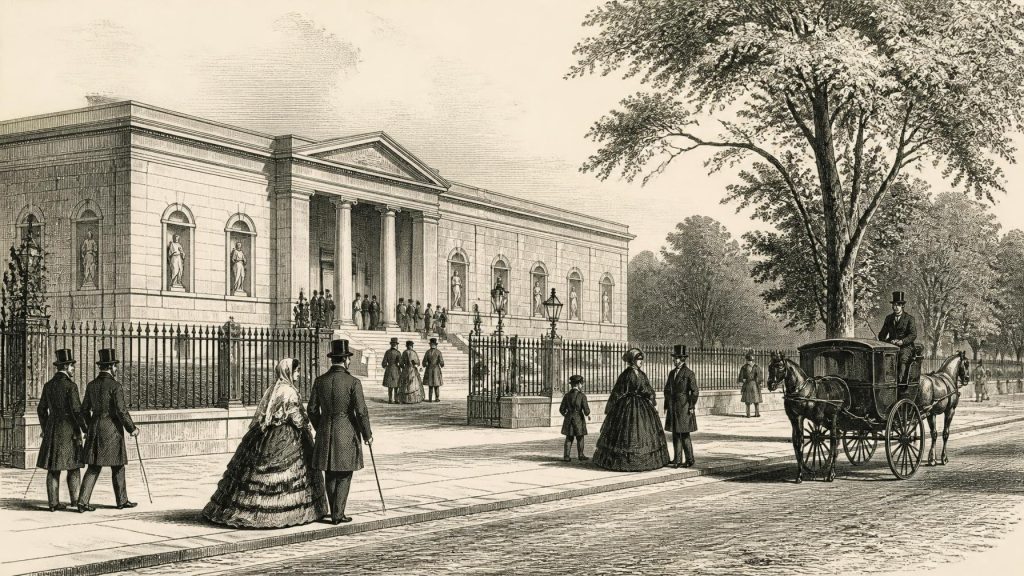
On Saturday 30 January, the Earl of Carlisle, the lord lieutenant, opened the National Gallery of Ireland to the public on Merrion Square. The event marked a durable cultural achievement. Its roots lay in the great Dublin exhibition promoted by railway entrepreneur William Dargan in 1853, which had demonstrated an appetite for art, industry and public display. Campaigners associated with the Irish Institution then pressed for a permanent gallery, and Francis Fowke designed the new building beside the Natural History Museum.
The gallery opened with 112 pictures. Thirty-nine had been acquired in Rome in 1856 and thirty were loans from the National Gallery in London and other lenders. This was a modest collection by European standards, but its significance lay in permanence and public access. It gave Dublin an institution intended to collect, display and teach through art, close to the institutions of learning and government around Leinster Lawn. The building’s sober architecture and its location mattered as much as any single canvas: it stated that Ireland possessed, and deserved, a national cultural life within the United Kingdom.
Science also had a modest but telling place in the year’s intellectual calendar. In May, Admiral Theobald Jones presented the results of his collecting work on Irish lichens to the Natural History Society of Dublin. Such work may appear remote from high politics, but it belonged to the expanding nineteenth-century practice of cataloguing the island: its plants, antiquities, populations, diseases and resources. Ireland was being observed and classified by learned societies and officials even as its people were being counted by new civil registers.
O’Connell’s Memory in Stone
On 8 August, Peter Paul McSwiney, Dublin’s lord mayor, laid the foundation stone of a round-tower memorial to Daniel O’Connell at Glasnevin Cemetery. O’Connell had died in 1847, but his memory remained an immense force in Catholic and nationalist public culture. The choice of Glasnevin, already associated with his burial, linked commemoration to a cemetery that was becoming a major national place of memory. The tower was not the later statue on Sackville Street; it was a distinct memorial project, and its foundation was a deliberately public act of civic remembrance.
The occasion came at a moment when O’Connell’s name could still sharpen political and religious feeling. His constitutional campaign for Catholic emancipation and repeal had mobilised mass support, but it had also become a potent symbol for many Protestants who identified the Union with their security. The public honouring of O’Connell in Dublin did not cause every subsequent disturbance, and it would be misleading to reduce Belfast violence to one ceremony. But the timing was politically charged: the first serious Belfast rioting broke out on the same date, 8 August, and contemporary parliamentary discussion explicitly set the two events beside one another.
Belfast’s August Violence
Belfast in 1864 was an expanding industrial and port city, drawing labour into linen mills, shipyards, building work and associated trades. It was also a city of tightly interwoven but sharply segregated religious and political identities. During August, clashes between Protestant and Catholic crowds escalated into sustained disorder. Contemporary newspaper accounts described street fighting, attacks on homes and workplaces, assaults on travellers and the mobilisation of armed or armed-looking groups. Later accounts and inquiries differed in their emphasis on particular incidents and culpability, but there is no doubt about the seriousness of the crisis: people were killed, hundreds were injured, and normal civil authority proved inadequate.
The violence demonstrated how precarious urban prosperity could be. Belfast’s industrial advance did not dissolve sectarian antagonism; crowded districts, insecure employment, party processions and distrust of the police could make it more combustible. The response required reinforcements of the Royal Irish Constabulary, while the conduct and composition of the borough police and magistracy became subjects of sharp controversy. A royal commission of inquiry followed. Its very appointment showed that the disorder could not be dismissed as an isolated street quarrel. It raised fundamental questions about local government, policing, partisan authority and the ability of the state to protect residents regardless of religion.
The Belfast riots should also prevent an overly smooth picture of mid-Victorian Ireland. In March, ministers could cite a remarkable temporary reduction in reported agrarian crime and boast that no homicide had been reported across Ireland in the preceding month. Such claims reflected one official measure of order, not the whole social reality. By August, Belfast made plain that relative calm in the countryside did not mean peace in every region, nor did economic expansion necessarily produce civic trust.
Farms, Banks and Uneven Recovery
In the countryside, the long aftermath of the Great Famine remained the governing condition of daily life. Holdings had been consolidated, tiny plots had declined in number, and emigration continued to reshape households and labour markets. Parliamentary debate in 1864 often presented this transformation as improvement: larger farms, more capital, better cultivation and agricultural labour replacing precarious subsistence. That was a political interpretation as well as an economic description. Consolidation could increase output and reduce extreme subdivision, but it also meant eviction, departure and diminished access to land for many rural families.
Agricultural returns collected annually by the Royal Irish Constabulary offer a useful, if limited, annual snapshot. Between 1863 and 1864, cattle numbers rose from about 2.54 million to 2.64 million, and sheep from about 3.14 million to 3.18 million; pig numbers fell slightly, from about 913,000 to 896,000. These are not simple measures of wellbeing, but they point to an economy increasingly oriented towards livestock and market production. The potato had not disappeared, but it no longer carried the same overwhelming demographic burden as before the famine.
Commercial confidence was visible in Cork, where the Munster Bank was established in 1864. Founded as a joint-stock concern, it sought to serve a region whose merchants, farmers and traders wanted credit beyond the older banking arrangements. Its later failure in 1885 should not be projected backwards onto its founding year. In 1864, the bank represented optimism about regional commerce and the availability of capital, even though that optimism existed alongside persistent rural hardship and outward migration.
Fenian Networks and Catholic Authority
Constitutional nationalism was not the only political current. The Irish Republican Brotherhood, founded in 1858, remained an oath-bound revolutionary organisation committed to an independent Irish republic. Its Dublin newspaper, The Irish People, was managed by Jeremiah O’Donovan Rossa, who travelled through Ireland marketing the paper and enrolling recruits. The organisation had not yet been broken up by the authorities; that would happen in 1865. In 1864, therefore, Fenianism was an active, clandestine network rather than a retrospective prelude to the rising of 1867.
That world of print, secrecy and transatlantic connection entered domestic life in the marriage of O’Donovan Rossa and Mary Jane Irwin, a Cork-born poet who wrote for The Irish People as “Cliodhna” and “M. J. I.” Biographical accounts agree that they married in 1864 but differ over the precise date, an instructive reminder that even relatively recent nineteenth-century events require care. Their partnership joined political commitment, journalism and literary expression, and foreshadowed the important practical roles women would play in Fenian support networks after the arrests of the following year.
Religion remained inseparable from public life, though not in a single political direction. Archbishop Paul Cullen’s new Irish Ecclesiastical Record, founded in 1864, gave the increasingly organised Roman Catholic Church a learned periodical forum for theology, ecclesiastical affairs and questions affecting Catholic society. Its appearance reflected the confidence of a church building schools, churches, religious orders and institutional authority after emancipation and the famine. At the same time, the Fenian challenge and Belfast violence showed that neither Catholic organisation nor Protestant civic influence could settle Ireland’s contested political future.
Thus 1864 left no single verdict. It was a year of registers and galleries, scientific collecting and banking enterprise; of O’Connell’s memorialisation and Fenian preparation; of agricultural adjustment and urban bloodshed. The institutions founded or strengthened during the year would endure. So would the tensions revealed at Belfast and in the quiet circulation of revolutionary print. Ireland’s modern public life was taking firmer shape, but it was doing so amid profound inequality, competing national allegiances and unresolved sectarian fear.
Primary Sources
- First Annual Report of the Registrar-General of Marriages, Births, and Deaths in Ireland, 1864
- About the General Register Office
- Start Your Research: Civil Records
- History of the Gallery
- From the Archives: The Story of the National Gallery of Ireland
- McSwiney, Peter Paul
- O'Donovan Rossa, Jeremiah
- O'Donovan Rossa, Mary Jane (née Irwin)
- Ireland—Belfast Riots
- Riots at Belfast—The Royal Commission—Party Processions (Ireland)—Question
- The Law Leaves Belfast to Mob Savagery
- News of the Week, 20 August 1864
- Historical Documents: Mr. Adams to Mr. Seward, 25 August 1864
- Context: Letters and News Cuttings Concerning Conditions in Belfast, Including Orange Riots
- English
- Agricultural Population (Ireland)—Resolution
- Farming Since the Famine: General Details
- Agriculture Statistical Yearbook of Ireland 2015: Crops and Livestock
- Munster Bank Ltd. Liquidation Records
- Should the Munster Bank Have Been Saved?
- Hunger and Poverty After the Famine
- A Timeline of Ireland and the British Army
- Reporting the Irish Lichen Flora, 1850–1900
- Admiral Jones Lichen Collection
- Journals
- Background: Chronology of Key Events 1800 to 1967