Earlsfort Glass, Fenian Ink1865 CE
In 1865, Dublin’s International Exhibition at Earlsfort Terrace showcased Irish art, industry and agriculture, affirming civic ambition, imperial connections and establishment loyalty, while masking persistent rural poverty and inequality. July’s restricted-franchise general election returned Palmerston’s Liberals, but offered no agreed Irish political programme. More consequentially, police suppressed the Fenian Irish People in September, arresting leading Irish Republican Brotherhood activists. James Stephens was captured in November but escaped Richmond Bridewell. Green Street trials sentenced O’Leary, Luby and O’Donovan Rossa to penal servitude, creating nationalist symbols. Catholic Archbishop Paul Cullen opposed revolutionary secrecy. Livestock remained vital, and W. B. Yeats was born.
Dateline
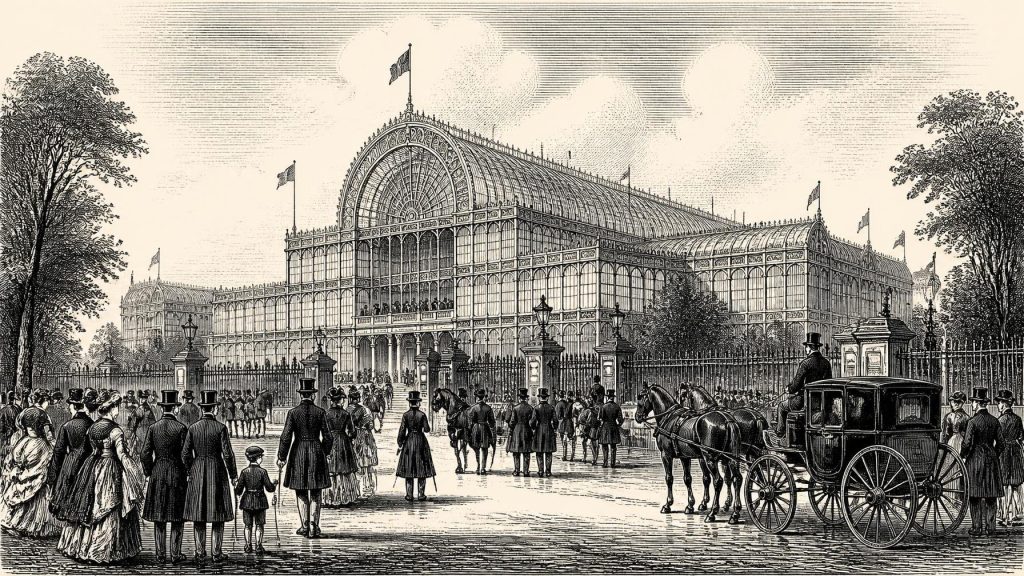
In 1865 Ireland presented two sharply different faces. In Dublin, an immense glass-and-iron exhibition building at Earlsfort Terrace displayed art, machinery and manufactures to visitors attending a major international fair. Elsewhere in the same city, a small nationalist newspaper office became the target of a police operation that exposed the revolutionary Irish Republican Brotherhood (IRB) to public view. The contrast was not merely picturesque. It revealed an island bound into the commercial, political and cultural networks of the United Kingdom and empire, while a clandestine movement prepared to sever that connection by force.
An Exhibition City
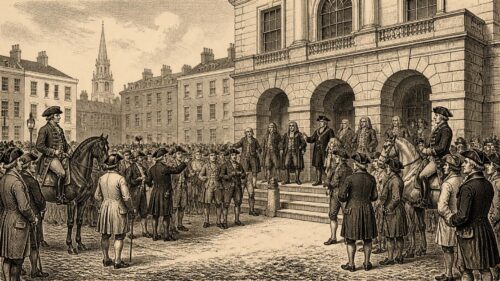
The Dublin International Exhibition of Arts and Manufactures opened on 9 May. The Prince of Wales inaugurated it in an iron-and-glass palace erected on the former Coburg Gardens at Earlsfort Terrace, land made available by the brewer and philanthropist Benjamin Lee Guinness. Its organisers described a purpose larger than trade alone: the building was intended to combine recreation with the improving influence of art. That aspiration belonged to a Victorian confidence in public display, technical progress and civic self-help, but it also had a particular Irish significance. Dublin was asserting its capacity to host an international event on a scale associated with London, Paris and the great industrial cities.
The exhibition brought together fine art, manufactured goods, machinery, agricultural interests and goods from beyond Ireland. For Dubliners it offered new sights, commercial opportunities and evening entertainment; for exhibitors it was an opportunity to seek customers, prizes and recognition. It did not mean that Ireland had become an industrial economy comparable to Britain’s manufacturing districts. Rather, it advertised the products, skills and ambitions that Irish promoters hoped could prosper within an interconnected market. The spectacle’s royal opening, accompanied by civic ceremony and loyal addresses, also made the fair an emphatic demonstration of establishment Ireland: aristocrats, municipal leaders, commercial interests and the crown were all visibly present.
Yet the fair should not be mistaken for a view of ordinary life across the island. Its polished galleries stood in the capital, while most people still lived in a predominantly rural society shaped by small towns, farms, estates, seasonal employment and emigration. Dublin itself contained striking inequalities. The exhibition celebrated improvement, but neither its exhibits nor its ceremonial crowds dissolved the political and economic questions left by the Great Famine and its aftermath.
Votes Within the Union
Political business proceeded in the constitutional sphere as well. The United Kingdom general election was held between 11 and 24 July 1865, and Irish constituencies returned members to Westminster under a franchise restricted by property qualifications. Most adults, including all women and the great majority of working men and labourers, had no vote. Elections nonetheless mattered: they linked local influence, religious allegiance, tenant interests and patronage to the legislature governing Ireland from London.
The election returned Lord Palmerston’s Liberal administration with a majority across the United Kingdom. For Ireland, however, parliamentary politics did not supply a single agreed national programme. MPs might seek local improvements, defend denominational interests, support tenant claims or work through the established parties. The Fenian leadership regarded that route as inadequate. The difference between the ballot box of July and the conspiracy exposed in September was therefore fundamental: one accepted the Union’s political machinery, however limited; the other aimed at an independent Irish republic and prepared for armed action.
The “Year of Action” Collapses
The decisive Irish political development of 1865 was the government’s move against Fenianism. James Stephens, a veteran of Young Ireland, had founded the IRB in 1858 as an oath-bound revolutionary organisation. Its American counterpart, the Fenian Brotherhood, supplied money, publicity and a transatlantic network. Stephens had promised that 1865 would be a “year of action”. The ending of the American Civil War in April gave that promise new urgency: Irish-American veterans, military experience and expectations of support seemed potentially available to the movement.
The weekly Irish People, published in Dublin since late 1863, was central to this effort. It was not simply a newspaper reporting Fenian affairs. It circulated republican arguments, connected recruits and sympathisers, and helped turn a secret organisation into a movement with a public vocabulary. Thomas Clarke Luby was its registered owner and sub-editor; John O’Leary edited it; Jeremiah O’Donovan Rossa managed its business side; and Charles Kickham was among its principal writers. Their political prose, aimed especially at literate young men, clerks, shop assistants and readers beyond Dublin, was one means by which revolutionary organisation reached into everyday urban society.
British officials, aided by police intelligence and informers, had been watching. In July, material relating to projected action reached Dublin Castle after being lost at Kingstown railway station; the authorities also possessed information from within Fenian circles. On 15 September police raided the Irish People offices in Parliament Street, seized its press and papers, and suppressed the newspaper. Luby, O’Leary and O’Donovan Rossa were among those arrested in the ensuing round-up. The final number of the paper was dated 16 September. Its closure was a direct attack not only on a publication but on the organisational infrastructure around it.
The operation damaged the leadership but did not end the crisis. Stephens initially escaped capture, while many IRB circles remained outside the immediate sweep. On 11 November he was arrested at Sandymount, together with Kickham and others. Then, on 24 November, Stephens escaped from Richmond Bridewell. The escape, assisted by men inside and outside the prison, was a humiliating failure for Dublin Castle and an immediate propaganda success for the Fenians. It demonstrated both the movement’s reach and the limits of the state’s apparently decisive September coup.
Green Street and the Prison Ship
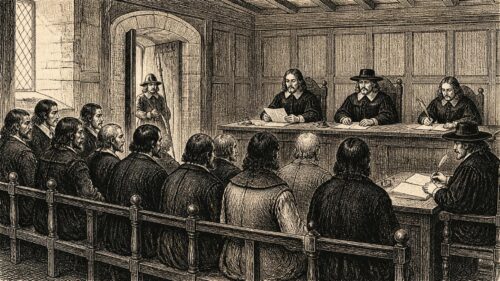
The state sought to make an example through the courts. A Special Commission opened at Green Street courthouse in Dublin on 27 November. The proceedings transformed private documents, police testimony and newspaper articles into evidence of treason-felony. They also gave Fenian defendants a public platform. O’Leary was tried from 1 to 7 December, convicted and sentenced to twenty years’ penal servitude. Luby received the same punishment. O’Donovan Rossa, who used his defence to challenge the prosecution and Judge William Keogh, was sentenced to penal servitude for life.
These penalties carried the prisoners away from Ireland. O’Leary and other convicted Fenians were transferred to England in late December, beginning prison terms associated with hard labour and separation from political allies. The trials did not establish that an insurrection had occurred in 1865; none did. Their importance lay in the destruction of the newspaper organisation, the imprisonment of prominent activists and the conversion of defendants into nationalist symbols. More coercive emergency measures, including the later suspension of habeas corpus in February 1866, belonged to the following year and should not be read back into 1865.
Church, Conscience and Authority
Fenianism also brought a conflict over moral authority. Paul Cullen, Catholic archbishop of Dublin, was convinced that a premature rising would be disastrous and that secret revolutionary societies threatened the Church as well as civil order. In a letter of 2 March 1865 he warned Archbishop Martin John Spalding of Baltimore that an armed revolt could provoke devastation among Ireland’s “half starved and unarmed” people. Cullen’s language reflected both fear of repression and his wider determination to strengthen a disciplined, Roman-centred Catholic Church.
This was not a simple contest between Catholic Ireland and the government. Many Fenians were themselves Catholic, but republican activists rejected episcopal claims to direct their political conscience. Luby’s later courtroom speech made that division explicit, insisting that clergy should not control secular political judgement. In parishes, confessional practice, sermons, family loyalties and local reputations could all affect whether a man joined, avoided or informed on an oath-bound organisation. Religion in 1865 was therefore a powerful social force, but not a uniform political command.
Livestock, Vulnerability and a Newborn Poet
The agricultural returns give one useful, if incomplete, measure of the rural economy. Ireland recorded about 2.834 million cattle, 3.489 million sheep and 1.097 million pigs in 1865. These substantial herds underline the importance of livestock to farm income, food, fairs, transport and trade with Britain. They do not prove general comfort: ownership was uneven, labourers and smallholders remained vulnerable, and the long demographic consequences of famine and emigration continued to shape communities. The cattle plague devastating parts of Britain in 1865 was an additional source of anxiety for a livestock-dependent island, but confirmed outbreaks in Ireland belong to 1866, not this year.
On 13 June, William Butler Yeats was born at Georgeville, Sandymount Avenue, Dublin, to John Butler Yeats and Susan Pollexfen Yeats. The birth was a private family event, not a contemporary national turning point. Its historical resonance comes later: the child born in a city of exhibition halls, police raids and competing national visions would become one of Ireland’s most consequential poets and a central figure in the cultural revival. In 1865, however, Ireland’s immediate story was more unsettled. Earlsfort Terrace offered a bright public image of progress; the seized presses of Parliament Street showed how rapidly confidence could give way to political confrontation.
Primary Sources
- Official Catalogue of the Dublin International Exhibition of Arts and Manufactures, 1865
- Speeches and Addresses of H.R.H. the Prince of Wales: 1863–1888
- The Winning Design for the 1865 International Exhibition Building, Earlsfort Terrace, Dublin
- The Illustrative Record and Descriptive Catalogue of the Dublin International Exhibition of 1865
- 1865 General Election
- Stephens, James
- Luby, Thomas Clarke
- O'Leary, John
- O'Donovan Rossa, Jeremiah
- Kickham, Charles Joseph
- Focus on the Fenians: the Irish People trials, November 1865–January 1866
- British Intelligence and the Fenians, 1855–1880
- First, Second, and Third Reading
- Ireland—Escape Of Stephens
- Cullen, Paul
- The Catholic Church and Fenianism
- Agriculture Statistical Yearbook of Ireland 2017
- Rinderpest (cattle plague)
- Yeats, William Butler
- The Life of W. B. Yeats
- National Gallery (Amendment) Act, 1865
- Origins of the National Museum of Ireland
- Uniting the scattered millions: O’Donovan Rossa’s United Irishman newspaper