
Foster’s Defiant Majority1799 CE
In 1799, post-rebellion Ireland remained militarised and insecure as Cornwallis and Castlereagh sought legislative union with Great Britain. Their proposal was defeated in the Commons, where Speaker John Foster led a narrow anti-union majority, although the Lords approved it. Public celebrations reflected resistance, but the unrepresentative Dublin parliament excluded Catholics. During the pause, government prepared to rebuild support through patronage. Courts martial, disturbed-district proclamations, prosecutions and transportation continued, tempered by Cornwallis’s commutations. Catholic bishops considered state oversight of appointments, while lay Catholics opposed union. Autumn rains damaged potatoes, raising subsistence fears amid wartime financial disruption. Ireland nevertheless faced constitutional change.
Dateline
In 1799 Ireland stood in the unsettled interval between rebellion and Union. The great rising of 1798 had been defeated, French troops had surrendered, and the authorities had reasserted control; but peace was neither simple nor secure. Prisoners still faced courts martial, local districts could be proclaimed disturbed, and armed loyalist bodies remained conspicuous in everyday life. At Dublin Castle, Lord Lieutenant Cornwallis and his chief secretary, Lord Castlereagh, turned the trauma of rebellion and the fear of renewed French intervention into an argument for a far-reaching constitutional change: the abolition of Ireland’s separate parliament through a legislative union with Great Britain.
A Proposal at College Green
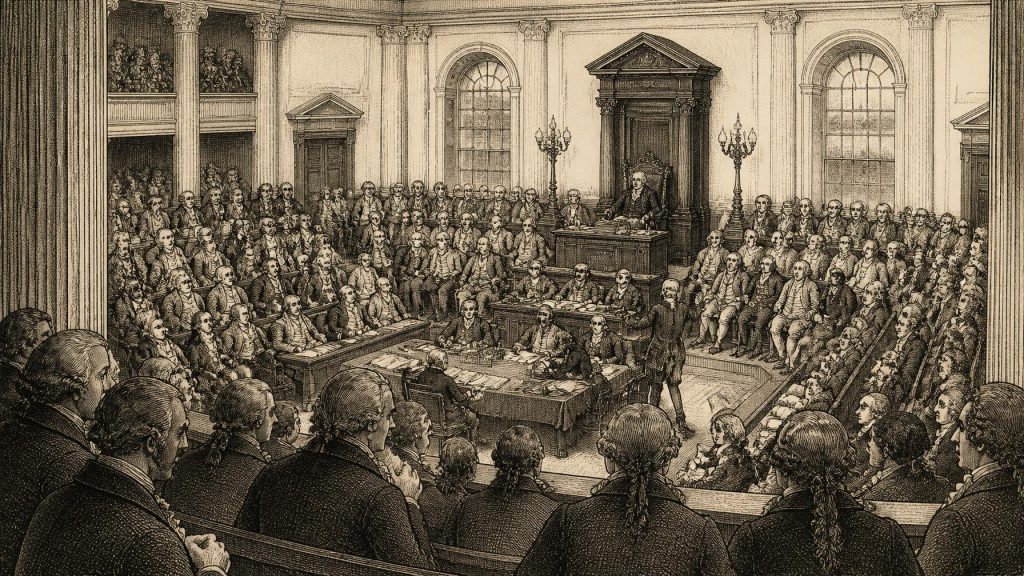
The parliamentary session opened on 22 January. In the ornate Parliament House at College Green, the lord lieutenant delivered the crown’s message to the Irish Lords and Commons. It did not set out a finished bill. Rather, it called on the two parliaments to consider measures that would make the connection between the kingdoms more secure and consolidate the strength and resources of the empire. Its meaning was unmistakable. The British government of William Pitt and the Dublin Castle administration wanted an incorporating union.
The proposal had powerful strategic logic from the government’s perspective. Britain was at war with revolutionary France, and Ireland’s 1798 rebellion, followed by General Humbert’s short-lived French expedition in the west, had exposed how dangerous Irish disaffection could appear to London. A single parliament at Westminster, unionists argued, would make foreign-assisted separation harder and bind Ireland more securely to British military, commercial and imperial power. Cornwallis, who combined the offices of lord lieutenant and commander-in-chief, regarded a union as central to lasting security.
Yet the proposal threatened the very institution through which the Protestant political class exercised its authority. Ireland had possessed its own legislature in Dublin for centuries, and since the constitutional changes of 1782 it had enjoyed substantial legislative independence from Westminster. That parliament was highly unrepresentative: the franchise was narrow, Catholics could not sit in either house, and many Commons seats were controlled by aristocratic patrons. Nonetheless, its defenders could present a resident legislature as Ireland’s constitutional inheritance and as a safeguard against government directed from London.
The Narrow Commons Defeat
The debate that followed was long, intense and revealing. The Speaker of the House of Commons, John Foster, became one of the most important opponents of union. So did figures who had often supported government, including John Parnell, the chancellor of the exchequer. Opposition was not confined to advocates of radical reform or to sympathisers with the defeated United Irishmen; it gathered parliamentary patriots, borough proprietors, office-holders anxious about their position, and men who feared that Dublin’s political and economic life would be diminished if the legislature disappeared.
Over the debates of 22–24 January, the government failed to secure Commons endorsement for proceeding towards union. One crucial division was lost by the extraordinary margin of a single vote, 106 to 105; a subsequent anti-union resolution was carried by 111 votes to 106. The House of Lords, by contrast, accepted an address favourable to union. The divided result demonstrated both the limits of Dublin Castle’s immediate control and the peculiar character of the Irish constitution: an administration responsible ultimately to London could continue in office despite a major rebuff in the elected chamber.
The defeat was celebrated in Dublin. Contemporary correspondence records illuminations and crowds, while Foster was drawn home in his carriage by supporters. Such scenes should not be mistaken for a democratic referendum. Most Irish people had no parliamentary vote and the civic display came chiefly from the urban political world. But it did show that resistance to union could be public, organised and cross-confessional at a moment when the state was still policing the aftermath of a rebellion.
Not the End of Union
The January vote did not preserve the Irish parliament permanently. It merely stopped the government’s first attempt. Castlereagh announced that the question would not be pressed again in that session, and parliament was repeatedly prorogued during the year. Behind the pause, however, the administration reconsidered how union might be carried. The political system was built around patronage, offices, pensions, peerages and borough influence. These were not incidental features of late eighteenth-century government; they were mechanisms through which parliamentary majorities were commonly made. During 1799 the Castle began the work of reconstructing support that would be deployed more successfully in 1800.
The clash also exposed a difficult contradiction in the anti-union cause. Foster and other defenders of legislative independence were protecting a parliament from which the Catholic majority was excluded. Catholic men meeting the property qualification had gained the vote in 1793, but Catholics remained barred from parliament and from the highest offices. Therefore, a defence of Ireland’s independent legislature could be sincere while leaving its governing constitution profoundly unequal. Unionists would later exploit that weakness by associating union with a broader settlement of Catholic claims, though no enforceable Catholic emancipation measure was enacted in 1799.
Order After Rebellion
For many communities, the central fact of 1799 was not the College Green debate but the continuing apparatus of security. Cornwallis sought to replace indiscriminate vengeance with a mixture of discipline, pardons, formal courts martial and transportation. He reviewed large numbers of sentences and commuted many. This did not make the state benign: the punishment of suspected rebels, searches for arms and the authority of soldiers, militia and yeomanry remained part of the landscape of post-rebellion Ireland.
The surviving record gives the year a distinctly local texture. On 13 February the county of Galway was proclaimed disturbed. In Carlow, courts martial continued to hear cases connected with the rising; men could be acquitted, discharged for insufficient evidence, punished physically, transported, or pressed into military service. In Waterford, John Mernin of Dungarvan was tried by court martial in September on accusations connected with the United Irishmen. Sentenced to death, he was instead transported for seven years after Cornwallis judged the evidence insufficient to sustain execution. Such cases reveal a country in which the rebellion had ended as open warfare but had not ceased to shape law, reputation and family security.
Nor was the government’s concern wholly retrospective. France remained Britain’s enemy, and officials feared conspiracy, local violence and another landing. A July order offered reward for the apprehension of persons charged with treasonable offences. In September, a proclamation responded to the burning of the Roman Catholic chapel at Kilmurry. The latter reminder matters: political division and counter-insurgency existed alongside sectarian hostility, and neither government policy nor popular loyalty can be reduced to a simple Protestant-versus-Catholic divide.
Catholic Futures
Religion entered 1799 politics in a more complicated form than public polemic often allowed. On 17 January, ten Catholic bishops who were trustees of Maynooth College considered how the state might be assured of the loyalty of future bishops. Their resolutions contemplated limited government notification and objection in episcopal appointments, subject to the authority of Rome and the discipline of the Church. This was not Catholic emancipation, nor did it settle a lasting agreement. It was, however, evidence that some members of the hierarchy were attempting to secure the Church’s position after rebellion while negotiating with a Protestant state suspicious of French influence and political radicalism.
Lay Catholic politics did not simply follow episcopal caution. Dublin Catholics assembled at the Royal Exchange to oppose union, seeing no reason to exchange a deficient Irish constitution for a distant Westminster parliament in which they would still lack full equality. The distance between clerical security, lay political aspiration and government calculation would remain one of the defining tensions of the coming Union settlement.
Rain, Potatoes and Money
Late in the year another anxiety emerged. In summer, hopes for the harvest had been relatively favourable, but heavy and persistent autumn rain damaged the potato crop. By November the lord lieutenant was informed that potatoes had failed generally across the kingdom. Prices of the foodstuffs most important to poorer households, especially potatoes and oatmeal, were already rising. The wider crisis of 1799–1801 did not become a famine on the scale of the catastrophe of the 1840s, and historians stress the limits of the evidence for its human effects. Even so, the reports mark the beginning of real hardship in a society where labourers and smallholders depended heavily on the potato and had little protection against dear food.
Wartime finance also remained visible. On 29 January a proclamation allowed the Bank of Ireland to resume specie payments for certain small notes issued before the previous October, a narrow easing within the disrupted monetary conditions created by the suspension of cash payments. For merchants, labourers and shopkeepers, political uncertainty, military expenditure and food prices were not separate worlds: each influenced credit, employment and the cost of daily subsistence.
An Unsettled Inheritance
The death in August of James Caulfeild, first earl of Charlemont, first president of the Royal Irish Academy and a veteran of the Volunteer movement, closed the career of a prominent figure from the era of Irish parliamentary confidence. Yet 1799 did not close that era. It made its fragility plain. Foster’s Commons majority had checked union for the moment, while Cornwallis and Castlereagh retained the power, patronage and determination to return to the question. Ireland ended the year still a separate kingdom with a parliament in Dublin, but one living under the shadow of coercion, economic pressure and an approaching constitutional revolution.
Primary Sources
- Parliamentary union
- Letterbook of official correspondence from Dublin Castle, 1799 March 26 – June 5
- Cornwallis, Charles
- Stewart, Robert
- Speech on the Union in the Irish House of Commons, 1799
- A Chronology of Ireland
- Statute Law Revision Act 2015
- Pre-Union British Statutes
- The Union (1799-1800)
- Eyre Coote Papers, Calendar
- Draft letter from Cornwallis to Portland
- The Irish House of Lords, 1780-1800: politics and ideology
- History: Ireland 1778-1803
- Aftermath of the 1798 Rising
- 1798 Rebellion And Waterford: Waterford Court Martial Reports
- The Famine That Wasn't? Ireland, 1799–1801
- The Famine That Wasn't? Ireland, 1799–1801
- George III: Proclamations, 29 January 1799–7 May 1799
- The Royal Veto
- Keogh, John
- Grattan, Henry
- Between Two Parliaments
- The Exchange Business of the Irish Banks in the Eighteenth Century