Acts Union1800 CE
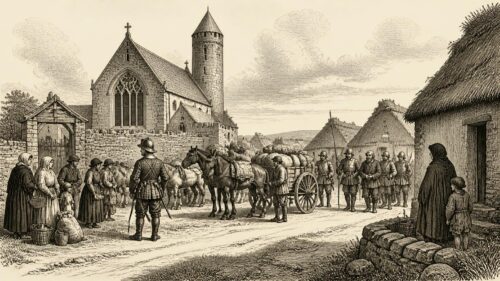
In 1800, Ireland remained a separate kingdom with its own parliament, courts and administration, but the Acts of Union passed in Dublin and London, ending its legislature from 1 January 1801. Cornwallis and Castlereagh secured support amid patronage, compensation and opposition led by Henry Grattan. The Union transferred limited Irish representation to Westminster, preserved the established Protestant church, and left Catholic emancipation unresolved. Post-rebellion repression continued, including Roddy McCorley’s execution, while food scarcity prompted controls on distilling and exports. Parliament also regulated trade, institutions and local improvements. Dublin retained political activity yet faced loss of its resident legislature and disruption.
Dateline
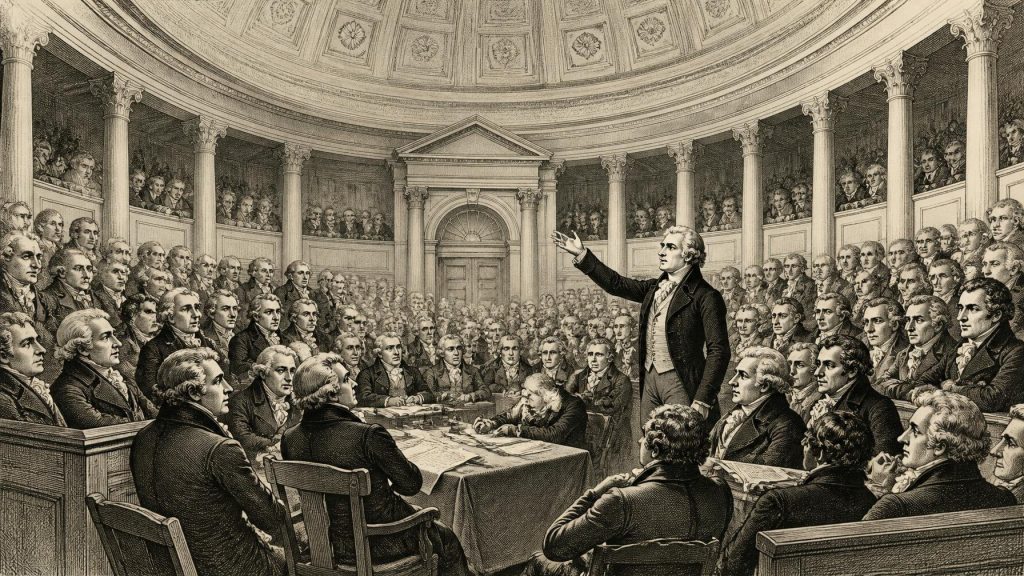
In 1800, Ireland’s political centre of gravity still lay at College Green in Dublin, where the Parliament of Ireland met beneath the great new dome of its House of Commons. Yet the year was defined by legislation designed to end that parliament. The Act of Union was passed in Dublin and London during 1800, although it was not to take effect until 1 January 1801. That distinction matters. Ireland remained a separate kingdom under the crown of George III throughout the calendar year, with its own legislature, courts and administration; but its political future was settled in advance.
The Union was not simply an adjustment between institutions. It emerged from the violence and fear left by the 1798 rebellion, from war with revolutionary France, and from arguments about religion, security, commerce and the constitutional standing of Ireland. It was carried through a parliament elected by a narrow Protestant political elite, while the great Catholic majority remained excluded from membership of either Irish house. For many contemporaries, 1800 therefore combined a formal constitutional decision with an unresolved question: could a new United Kingdom provide Catholics with civil and political equality, or would it preserve Protestant ascendancy under a different legislature?
A Parliament Confronts Its End
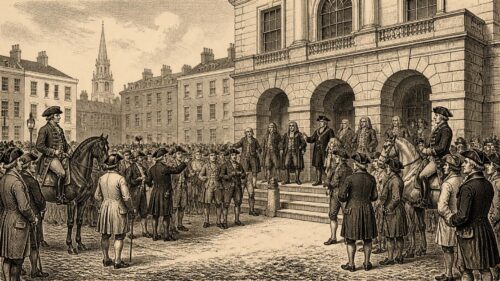
The final parliamentary struggle began when the Irish parliament reassembled on 15 January. The previous year’s ministerial attempt to secure support for a union had failed. The government returned with greater preparation, led in Ireland by Lord Cornwallis, the lord lieutenant, and by the chief secretary, Lord Castlereagh. Their task was to persuade – and, critics charged, to purchase – sufficient support among peers and members of the Commons for a measure that would abolish their own legislature.
Henry Grattan, one of the architects of the legislative settlement of 1782, entered the Commons to oppose the scheme. His resistance expressed a powerful constitutional case. Ireland, he argued, already shared a monarch, executive interests and imperial connections with Britain; incorporation would not make the relationship safer, but would extinguish the legislature through which Ireland could defend its interests. His language was memorable because the stakes were real: this was not an abstract debate about tidier government but an argument over whether a kingdom’s parliament should survive.
Opposition to Union was substantial but divided. Some opponents were Protestant members who valued the autonomy won in 1782 yet had no intention of replacing the restricted political order with a democratic one. Others feared the loss of Dublin’s status, patronage and social life. Outside parliament, many Catholics had good reason to be cautious. They could vote under the relief legislation of the 1790s if they met the property qualification, but they could not sit in parliament, hold the highest offices or enjoy full equality under the constitution. Union supporters suggested that a wider imperial parliament might be better placed to settle the Catholic claims; this was an expectation, not a provision written into the Union.
The government’s campaign exposed the restricted and transactional character of the Irish political system. Borough interests could be bought out, offices and honours bestowed, and individual members drawn towards the administration. Compensation was subsequently provided for parliamentary officers whose employment would disappear or lose value. These arrangements did not mean that every supporter had been bribed, nor that every opponent was disinterested; they do show that the Union was carried through a political world in which property, patronage and representation were closely entwined. The popular consent of Ireland’s inhabitants was not tested by a general electorate.
The Acts of Union
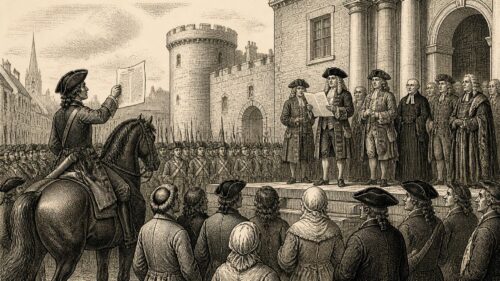
By the spring the terms had been agreed in the Irish houses. The complementary British statute received royal assent on 2 July 1800. The Irish Act, formally An Act for the Union of Great Britain and Ireland, received royal assent on 1 August. The measures decreed that on 1 January 1801 the kingdoms of Great Britain and Ireland would become “one kingdom” under the name the United Kingdom of Great Britain and Ireland.
The articles set out the new constitutional machinery. Ireland would send 100 members to the House of Commons at Westminster: two for each county, two each for Dublin and Cork, one for Trinity College Dublin, and one for each of thirty-one designated cities and boroughs. In the House of Lords, twenty-eight representative temporal peers would sit for life, while four Church of Ireland bishops would sit by rotation. This was representation, but it was also a striking contraction from a resident legislature of its own. Irish political business would henceforth be decided in a parliament across the Irish Sea, where Irish members formed a minority.
Religion was embedded in the settlement. The Union made the Church of England and the Church of Ireland one united Protestant Episcopal church, preserving the established position of the Church of Ireland. Its bishops would continue to hold a constitutional place, while the Roman Catholic Church remained outside the state establishment. The Act did not emancipate Catholics. That omission was fundamental. Cornwallis and William Pitt believed that Catholic relief ought to accompany or follow Union, but George III opposed the policy, believing it incompatible with his coronation oath. The ministerial crisis that followed would unfold in 1801; at the end of 1800, Catholic advancement remained an uncertain prospect rather than an achieved reform.
The legislation also promised a closer commercial union. It envisaged free trade between Britain and Ireland in many goods, while retaining a complicated fiscal arrangement for a transitional period. For advocates, integration offered access to imperial markets and greater economic security in wartime. For opponents, it threatened to subordinate Irish interests to larger British ones. Neither forecast could be cleanly tested in 1800. What can responsibly be said is that the year established the legal framework within which later arguments over Irish industry, agriculture, taxation and trade would be fought.
After Rebellion, Before Emancipation
Politics in 1800 cannot be separated from the aftermath of 1798. The United Irish rebellion had been defeated, French military assistance had failed to transform the rising, and the state remained alert to surviving networks and local disorder. On 28 February Roddy McCorley, a County Antrim United Irishman who had remained at large after the rising, was hanged at Toomebridge following a court martial. His personal role in the rebellion was limited, but the execution revealed the continuing reach of emergency justice. Later songs and stories made McCorley a much larger figure in nationalist memory; in the year itself, his death belonged to the long and punitive closing phase of the rebellion.
Ulster’s divisions also resisted easy political labels. Presbyterians had supplied important United Irish recruits in 1798, but the region was marked by repression, sectarian tension and the growth of loyalist organisation. The Orange Order offered some Protestants protection, fellowship and a public affirmation of loyalty, but it was not simply a governmental instrument and did not speak for all Protestants. Nor did Catholic clergy or lay leaders respond uniformly to Union. Some bishops and leading Catholics treated a union, coupled with relief, as a possible route towards security; others distrusted a bargain that left the essential concession unwritten.
For ordinary households, constitutional debate took place against more immediate anxieties. The harvest failures of 1799 and 1800 created severe hardship and high food prices. Recent scholarship cautions against treating 1799–1801 as identical to the later Great Famine: relief, imports and regulation mattered, conditions varied by locality, and total catastrophe was averted. Nevertheless, poor people dependent on potatoes, oats and casual earnings were highly vulnerable. Scarcity turned food into an urgent matter of government rather than merely a market commodity.
In October 1800, a proclamation prohibited the distilling of spirits from oats, oatmeal, barley and other grain, and prohibited the export of rice and potatoes until 25 March 1801. Such interventions show official concern that foodstuffs be reserved for consumption. They also reveal the limits of state action: stopping distilling did not create an abundant harvest, and controls could unsettle farmers, traders and labourers as well as protect consumers. The year’s food measures should therefore be read as evidence of pressure and precaution, not as proof that every district experienced the same crisis.
Town, Trade and Institutions
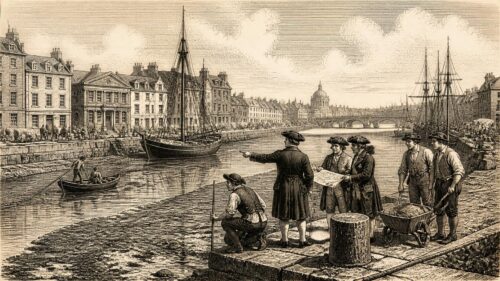
Even as the legislature prepared to disappear, it continued to pass practical Irish measures. Acts of 1800 concerned Dublin quay walls and the promotion of trade, the King’s and Queen’s College of Physicians, leasing powers for cotton factories, enclosure at Dromiskin in County Louth, and Cork’s butter market. Their range is revealing. Ireland was not a country suspended entirely in constitutional drama. Ports, quays, markets, medical institutions, manufacturing leases and common land all required regulation; merchants, artisans, landlords, farmers and town authorities continued their ordinary contests over improvement and livelihood.
Cork’s butter trade, already integral to the provisioning networks of the Atlantic world, was important enough to receive specific legislation. Dublin, meanwhile, remained the island’s administrative and social capital, as well as one of the British Isles’ largest cities. Its courts, revenue offices, learned bodies, theatres, printers and commercial houses would not vanish with Union. But the departure of a resident parliament and much of the seasonal aristocratic society attached to it would alter the city’s economy and rhythms in the years ahead. That later downturn should not be projected backwards as an accomplished fact in 1800; during this year, College Green was still crowded with political purpose.
By November, proclamation had begun to implement the Union’s representative arrangements. Ireland thus ended 1800 in an in-between condition. The Parliament of Ireland had enacted its own extinction, yet continued law and administration remained in place until the appointed new year. The old kingdom had not disappeared, but its constitutional voice had been transferred. The arguments left unresolved – Catholic equality, the legitimacy of the Union, the place of Dublin, and the relationship between popular grievance and state power – would shape Irish public life for generations.
Primary Sources
- History of Parliament in Ireland
- Irish Legislation Database: 1800 Union, Representation and Compensation Acts
- Speech on the Union in the Irish House of Commons, 1799
- Union with Ireland Act 1800
- Act of Union (Ireland) 1800
- Bicameralism in Ireland
- Seanad 100: Origins and Purpose of Seanad Éireann
- The Famine That Wasn’t? Ireland, 1799–1801
- The Famine That Wasn't? Ireland, 1799–1801
- McCorley, Roddy (Roger)
- Statute Law Revision Act 2015
- Statute Law Revision Act 2007
- An Act of Power & Corruption?
- The Act of Union: 200 Years On
- The Rebellion Papers
- Concert Life in Dublin in the Age of Revolution
- Irish Legislation Database: Sources for Irish Legislation, 1692–1800
- Irish Legislation Database: Regnal Years and Statute Numbers
- Projects Completed: Act of Union Virtual Library
- Pratt Manuscripts
- History of the Commercial and Financial Relations Between England and Ireland from the Period of the Restoration
- Part 11 of History of the Commercial and Financial Relations Between England and Ireland from the Period of the Restoration