
Vinegar Hill and Killala1798 CE
In 1798, the United Irishmen attempted a national revolution against British rule, seeking a representative Irish republic uniting Catholics, Presbyterians and reforming Anglicans with French support. Arrests, coercion and weak coordination fragmented the rising into regional conflicts. Wexford rebels captured Enniscorthy and Wexford town, but atrocities including Scullabogue accompanied fighting before defeat at Vinegar Hill. Ulster risings at Antrim and Ballynahinch failed. In August, General Humbert’s French force landed at Killala, won at Castlebar, then surrendered at Ballinamuck. Repression, executions and transportations followed. The rebellion’s violence and French intervention strengthened arguments for union, reshaping Irish politics and leaving divisive legacy.
Dateline
In 1798 Ireland passed through a year of attempted revolution, local civil war and foreign intervention. The rising associated with the Society of United Irishmen was planned as a national insurrection against the British connection and the unreformed political order. Its leaders hoped to unite Catholics, Presbyterians and reform-minded Anglicans in a representative Irish republic, aided by revolutionary France. Instead, arrests, uneven preparation and overwhelming military force turned the plan into a series of regional outbreaks. In counties such as Kildare, Wexford, Antrim, Down and Mayo, events were shaped as much by local fear, religious antagonism, military coercion and personal survival as by the United Irish ideal.
The calendar year therefore cannot be reduced to a single rebellion. It included a state campaign of surveillance and repression; brief rebel administrations and battlefield victories; atrocities by insurgents and Crown forces; a French expedition in the west; and a political reaction that made the abolition of Ireland’s parliament increasingly likely. The scale of death, imprisonment, dispossession and trauma was immense, although precise total casualty figures remain uncertain and vary considerably between accounts.
Conspiracy and Coercion
The United Irishmen had begun in Belfast and Dublin in 1791 as a movement for parliamentary reform and Catholic political rights. By 1798 it was a clandestine, oath-bound organisation seeking separation from Britain. Its programme was intellectually rooted in the Atlantic age of revolutions: American independence, French republicanism and arguments for religious equality all supplied its language. Its social base was diverse. Presbyterian radicals and artisans were important in Ulster; Catholic Defenders, rural labourers, small farmers, tradesmen and some liberal Protestant gentry were prominent elsewhere. This diversity was a strength in aspiration, but difficult to coordinate under pressure.
The government at Dublin Castle treated French assistance and United Irish organisation as an existential danger during wartime. Its intelligence system relied on informers, local loyalist correspondents and military reporting. The arrest of the Leinster United Irish leadership on 12 March badly damaged the proposed national command. Lord Edward FitzGerald, a leading figure in the Dublin organisation, evaded capture for a time but was arrested on 19 May after resisting his captors. He died of wounds in Newgate prison on 4 June. The loss of leaders, safe houses and communications before the rising began deprived the movement of the coordinated direction on which its strategy depended.
For ordinary people, the months before the outbreak were marked by searches for arms, arrests, billeting and the presence of militia, yeomanry and regular troops. Martial law and disarmament measures made political allegiance a daily and dangerous question. Government forces and loyalist auxiliaries used methods that included flogging, house-burning and other coercive practices to extract information and break secret networks. These methods did not simply suppress conspiracy: in several districts they deepened fear and resentment, helping to drive men already exposed to local grievances into open resistance. Yet participation was never universal. Many people sought safety, stayed neutral where possible, or served the Crown.
The Rising Begins
The intended national rising began in the night of 23–24 May. It failed rapidly around Dublin, where the authorities were prepared, and rebel attempts in Kildare met mixed and often disastrous results. At Prosperous, insurgents overwhelmed a garrison and took the town; at Naas and Carlow, attacks on defended positions were beaten back with severe losses. The contrast revealed a central weakness. Large bodies armed chiefly with pikes could be formidable at close quarters, especially against isolated parties, but were vulnerable to disciplined infantry, cavalry and artillery when attacking fortified towns.
In the first days, violence spread beyond formal battlefields. At Dunlavin Green in County Wicklow on 25 May and at nearby Carnew, suspected rebels were summarily executed by government forces. Such killings were part of a wider climate in which legal process was curtailed and rumours of imminent massacre travelled quickly. The distinction between an armed United Irishman, a suspect, a neighbour with a grudge, and an innocent civilian could become perilously thin. The state’s proclamations soon imposed further controls, including passport restrictions on departure from Ireland after 26 May.
What happened in Wexford was the year’s most sustained and destructive insurgency. There, the rising did not merely follow orders from a distant directory. It grew from United Irish preparation but also from the immediate effects of coercion, the mobilisation of local communities and the collapse of trust between neighbours. Rebels defeated a North Cork Militia detachment at Oulart Hill on 27 May, captured Enniscorthy the next day, and established their principal camp on Vinegar Hill above the town. Wexford town fell to the insurgents on 30 May after its garrison withdrew.
Wexford’s Bitter War
For several weeks, rebel-held Wexford possessed elements of an alternative authority: commanders issued orders, prisoners were confined, armed men assembled and supplies were sought from surrounding districts. Leaders included the Protestant barrister Beauchamp Bagenal Harvey, John Henry Colclough, Edward Roche and Catholic priests such as Philip Roche and John Murphy. Their roles demonstrate why it is misleading to describe the rebellion simply as a Catholic rising against Protestants. The United Irish cause had cross-confessional adherents, and Catholics as well as Protestants were among the prisoners held by rebels. Nevertheless, the rising unfolded amid entrenched sectarian suspicion, and Protestant loyalists were especially vulnerable in many localities.
The attack on New Ross on 5 June showed both the rebels’ capacity and their limitations. Thousands entered or pressed into the town, but the garrison held after brutal street fighting and rebel forces withdrew. On the same day, more than a hundred loyalist prisoners were killed at Scullabogue, near Carrickbyrne Hill. The atrocity cannot responsibly be softened into an incidental episode: it was a massacre of civilians and prisoners by rebels. Nor was it the only violence against captives in the county. It became, alongside executions and reprisals by Crown forces, part of the fearful inheritance that made 1798 a profoundly divisive memory.
Rebel attempts to widen their position were checked at Newtownbarry, Gorey and Arklow. The government concentrated troops around Wexford, while the appointment of Lord Cornwallis as lord lieutenant and commander-in-chief on 14 June brought a new senior figure determined to restore control. On 21 June government troops attacked Vinegar Hill from several directions. The rebel force escaped in significant numbers through a gap in the encircling lines, but the position was lost and organised rebel control of most of Wexford collapsed. Subsequent fighting, flight, executions and arrests continued. Harvey and other leaders were captured; Harvey was hanged on Wexford Bridge on 28 June.
Ulster’s Defeated Rising
Ulster supplied some of the movement’s earliest organisers and much of its Presbyterian radical tradition, but its rising came late and without the expected French support. Henry Joy McCracken, a Belfast cotton manufacturer and United Irish organiser, became commander of the insurgents in County Antrim. On 7 June his force attacked Antrim town. Initial success gave way to defeat when anticipated reinforcements did not arrive and government troops struck back. McCracken went into hiding, was captured while attempting to leave from Carrickfergus, court-martialled and hanged in Belfast on 17 July.
In County Down, insurgents took Saintfield and briefly occupied Newtownards before being defeated at Ballynahinch on 12–13 June. These failures demonstrated that the United Irishmen’s imagined national alliance could not overcome poor communications, hesitation among commanders, inadequate weapons and the strength of the Crown’s military system. They also deprived the wider rebellion of an Ulster front that might have forced the government to divide its resources further.
The French in Mayo
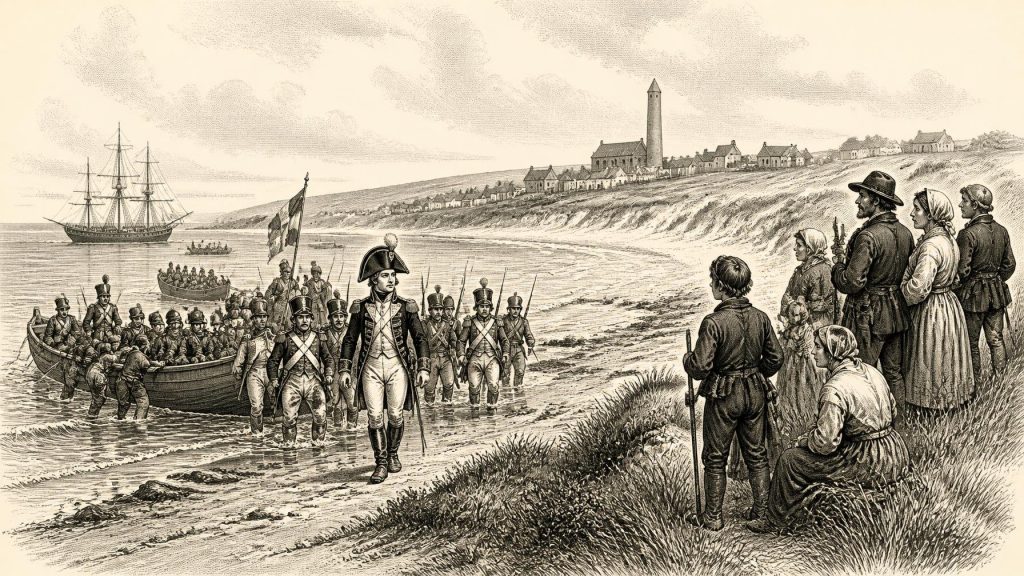
The foreign assistance on which United Irish leaders had long relied finally arrived after the major eastern risings had been broken. On 22 August General Jean Joseph Amable Humbert landed a French force of just over 1,000 men at Kilcummin, near Killala in County Mayo. The arrival transformed the atmosphere in the west. Humbert’s troops occupied Killala and Ballina, drew Irish recruits, and issued proclamations in the language of liberty and French republican support. In Mayo, 1798 became remembered as the “Year of the French”.
Humbert’s column marched inland by difficult routes and defeated a larger government force at Castlebar on 27 August. The rout became known as the “Races of Castlebar”. It was a striking tactical success, but it could not compensate for the expedition’s small numbers, scarce supplies and isolation. The French and their Irish allies moved eastward in the hope of encouraging a wider rising. Instead, Cornwallis and General Gerard Lake assembled far greater forces around them.
At Ballinamuck in County Longford on 8 September, Humbert surrendered. The French were treated as prisoners of war and later repatriated; Irish insurgents faced far harsher consequences, including execution, imprisonment and transportation. A separate French naval expedition carrying Wolfe Tone was intercepted off Donegal in October. Tone was recognised after capture, tried by court martial in Dublin and died in custody on 19 November. His death gave the defeated revolution a martyr whose writings and political ambition would continue to shape Irish republican memory.
A Kingdom Transformed
By the end of the year, armed resistance had largely been crushed, though fugitives and smaller bands remained active in places such as the Wicklow Mountains. Cornwallis combined military severity with selective pardons and an agreement to spare certain imprisoned United Irish leaders from execution in return for information and exile. This did not end the suffering of the year. Courts martial, confiscations, transportations, military occupation and the search for suspects extended its effects into homes, farms, workshops and towns.
1798 also changed the political calculation at the centre of power. For advocates of union, the rebellion and French landing seemed proof that the separate Irish parliament could not guarantee security within the British state. The Irish parliament still sat in Dublin during 1798, but its future was now under direct pressure. The Act of Union was not enacted until 1800 and did not take effect until 1 January 1801; it should not be treated as an event of this year. Yet the path towards it was decisively altered by the failures, violence and fears of 1798.
The year’s legacy was consequently contested from the beginning. It contained a serious attempt to make political rights independent of religious denomination, but also killings that exposed and intensified sectarian division. It brought heroism, opportunism, brutality and courage among people on all sides. Above all, it showed how swiftly high republican principle, state alarm and local grievance could turn an island-wide political crisis into intimate and enduring catastrophe.
Primary Sources
- The Rebellion, State of the Country, and Official Papers Collections
- The Rebellion Papers – Delving Deeper
- Rebellion Papers, Carton 25
- 1798: A Resource Pack
- Tone, Theobald Wolfe
- McCracken, Henry Joy
- Humbert, Jean-Joseph Amable
- Harvey, Beauchamp Bagenal
- Cornwallis, Charles
- FitzGibbon, John
- The Scullabogue Massacre 1798
- The Military Strategy of the Wexford United Irishmen in 1798
- Catholic ‘Hessians’?
- Letter from Jane Adams, containing a private narrative of the rebellion of 1798
- Researches in the South of Ireland
- Statute Law Revision Act 2015
- Background: Chronology of Key Events 1169 to 1799
- Key Events and Timeline of 1798 Rebellion
- Map of the attack on Vinegar Hill
- The French have come!
- Aftermath and Conclusion
- 1798 Rebellion