Membership is completely free, giving members unlimited access to all available resources, services, features, and benefits without any restrictions or fees.
Welcome back. Sign in to continue enjoying unlimited access to all available resources, services, features, and member benefits at no cost.
The coercion act was the year’s clearest assertion of executive force. Its formal title, An Act for the more effectual Suppression of local Disturbances and dangerous Associations in Ireland, reflected official claims that ordinary law could not contain agrarian violence, intimidation and illegal combinations. It gave the lord lieutenant wide authority to prohibit meetings considered dangerous to public safety and, in proclaimed districts, imposed exceptional restrictions upon movement and assembly. A person found outside home under suspicious circumstances between an hour after sunset and sunrise could be detained and required to establish a lawful reason for being abroad. Justices and authorised officers could demand that male inhabitants of houses present themselves at night. The act also made provision for trials before courts martial in specified circumstances.
Glasnevin Cemetery, then commonly called Prospect Cemetery, opened on 21 February 1832. Its first burial followed on 22 February: Michael Carey, an eleven-year-old boy from Francis Street in Dublin. The new ground had been created by the Dublin Cemeteries Committee, an initiative closely associated with O’Connell. It grew from anger at restrictions upon Catholic funerary rites and from the lack of sufficient burial space at Goldenbridge, the committee’s earlier cemetery.
O’Connell’s admission did not mean that political equality had suddenly been achieved. The 1829 settlement allowed Roman Catholics to sit in Parliament and hold many civil offices, but it retained significant exclusions, particularly around the established church, the universities and certain great offices of state. Nor did it restore an Irish parliament: Irish representatives still travelled to Westminster under the Union of 1801. The importance of O’Connell’s seat was therefore symbolic as well as practical. It showed that the Catholic majority could no longer be wholly excluded from the legislature governing Ireland, while also concentrating hopes and grievances upon a small number of MPs in London.
The immediate background belonged to the years before 1829, but it determined the shape of this one. Daniel O’Connell, a Kerry-born barrister and leader of the Catholic Association, had been elected for County Clare in July 1828. As a Catholic, he could not take the existing oath required of a member of parliament. His election nonetheless demonstrated that a Catholic candidate could defeat the nominee of major Protestant property and government influence through open, legal electoral mobilisation. The result placed the ministry of the Duke of Wellington and the home secretary, Robert Peel, under pressure to find a settlement which they had previously resisted.
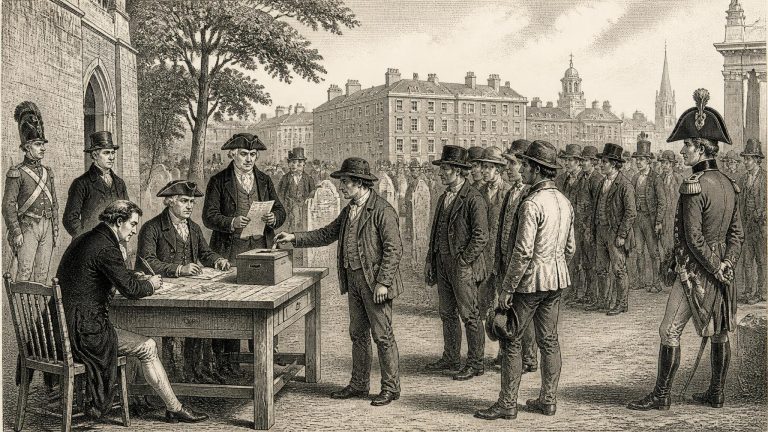
The position of Irish Catholics in 1828 contained a glaring contradiction. Since 1793, qualifying Catholics in Ireland had been able to vote in parliamentary elections, and Catholic candidates could put themselves before an electorate. But a successful Catholic could not take the parliamentary oaths required at Westminster without denying principles of his religion. The franchise thus gave Catholic freeholders a voice in choosing representatives while excluding a Catholic whom they might choose from sitting as one.
The central public question was the continuing exclusion of Roman Catholics from parliament and from a range of public offices. The Act of Union had joined Ireland to Great Britain in 1801, but it had not removed the oaths and tests that prevented Catholics from taking seats at Westminster. For a Catholic majority, this was not an abstract constitutional anomaly. It was bound up with access to authority, the position of the established Church of Ireland, local patronage and the security of Catholic voters and tenants.
On 5 January, the Currency Act of 1825 took effect in Ireland. It assimilated Irish currency to that of Great Britain, establishing sterling as the uniform money of account throughout the United Kingdom. This was not simply a matter of coin in a purse. The Irish pound had stood at a different value from sterling: a British pound had formerly been reckoned as £1 1s. 8d. Irish. The new arrangement required contracts, rents, debts, bank business, public accounts and ordinary commercial calculations to be understood in British currency. The Act expressly sought to prevent disturbance between debtors and creditors, but its practical effect was to make Ireland’s financial language more directly uniform with that of Britain.
The central political event was the Unlawful Societies (Ireland) Act, which received royal assent on 9 March. It extended earlier restrictions on bodies claiming to represent the people or to seek redress of grievances in church or state. Its immediate political target was widely understood to be the Catholic Association, founded in 1823 by O’Connell, Richard Lalor Sheil and others to press for Catholic Emancipation. Its provisions also bore upon Orange organisation. The law did not grant Catholics the parliamentary and office-holding rights they sought; instead, it attempted to remove the national political machinery that had made those demands so powerful.
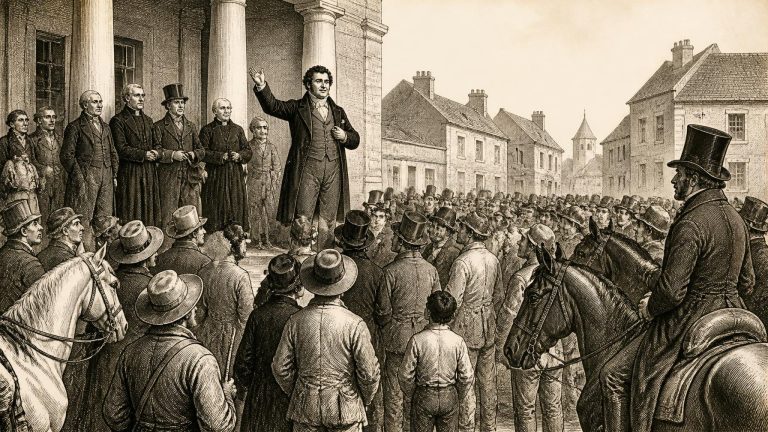
The firmest political turning point of the year came in the Catholic Association’s adoption of what became known as the Catholic Rent. O’Connell had helped found the Association in 1823 to pursue Catholic emancipation: the removal of remaining legal disabilities that excluded Roman Catholics from parliament and important offices. Early in 1824 he advanced a deliberately modest subscription: a penny a month, or a shilling a year, could make a contributor an associate member. The smallness of the payment was the point. It enabled a national political body to draw support from people who could never have afforded the guinea subscription expected of full members.
The firmly dated moment came on 10 May, when an aggregate meeting at Townsend Street Chapel, Dublin, resolved to form the Catholic Association. Lord Killeen chaired the gathering. O’Connell moved the proposal, Sir Thomas Esmonde seconded it, and Richard Lalor Sheil was among its prominent advocates. Its stated object was the redress of Catholic grievances, above all the remaining legal disabilities that denied Catholics full participation in public life. The place was significant: a Catholic chapel in the capital became a venue for political deliberation at a time when religious affiliation still shaped access to power.
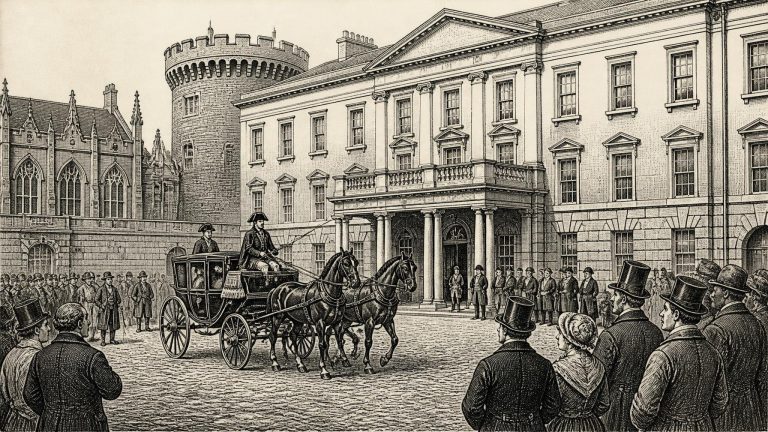
Richard Wellesley, Marquess Wellesley, began his Irish viceroyalty amid considerable expectation. His appointment had been welcomed in addresses from Dublin, Belfast, Cork, Drogheda and Trim during the opening months of 1822. He was a prominent figure, and his reputation for favouring a more conciliatory approach to Catholic claims encouraged hopes among some Catholics and liberal Protestants. Yet Wellesley inherited an administration whose immediate priority was restoring order in a countryside already troubled by organised nocturnal violence.
George IV’s succession did not restore an Irish parliament. Ireland continued to send 100 members to the Westminster House of Commons, while executive administration remained centred on Dublin Castle under the lord lieutenant, the Earl Talbot. The new king’s name could be invoked in addresses, proclamations and ceremonies, but the practical questions facing Irish people were more immediate: rents, employment, debt, religious standing and the limited ability of most inhabitants to influence public decisions.
The inquiry belonged to the long aftermath of war. Peace after 1815 brought falling agricultural prices and discharged soldiers into an economy already short of secure employment. Population continued to grow, while the unusually cold, wet weather of 1816 and subsequent scarcity had exposed the vulnerability of households dependent on small plots, casual labour and the potato. It is important not to project the catastrophe of the 1840s backwards: 1819 was not the Great Famine. Yet it was a year in which hunger, unemployment and epidemic disease combined on a devastating scale, and contemporaries understood that combination clearly.
Ireland in 1814 was governed under the Union of 1801. Its parliament had disappeared, while Irish representatives sat at Westminster and executive authority was exercised through Dublin Castle in the name of the Lord Lieutenant, Charles Whitworth, Earl Whitworth. Robert Peel, Chief Secretary for Ireland since 1812, was the key minister responsible for daily Irish administration. He was only twenty-six when appointed, but in 1814 he drove measures which would have a long afterlife in the history of policing.
The most consequential national issue was Catholic emancipation. Irish Catholics had obtained important civil rights in the late eighteenth century, including the parliamentary franchise for qualifying men, but remained excluded from Parliament and many major offices. The Union of 1801 had not removed those disabilities. Since Irish representation had been transferred to Westminster, the question of political equality was now debated there, though its pressure and consequences were felt intensely in Ireland.
The Catholic cause had survived the Union, but its representative bodies faced a legal and political obstacle. The Convention Act of 1793 was intended to prevent representative assemblies from claiming a rival political authority. Catholic activists therefore had to devise forms of organisation that could petition, correspond and deliberate without giving the Dublin Castle administration an easy legal pretext to suppress them. In 1812, the Catholic Board became the principal vehicle for that work. It drew together members of the Catholic gentry, lawyers, merchants and clergy, while seeking links with county opinion beyond the capital.
On 5 February, parliamentary machinery placed George, Prince of Wales, in the office of Regent because George III was unable to exercise royal authority. This applied to the United Kingdom of Great Britain and Ireland, but it did not produce a new Irish constitutional settlement. Ireland had lost its own parliament at the Union a decade earlier. Government still operated from Dublin Castle through the lord lieutenant, Charles Lennox, fourth Duke of Richmond, and the chief secretary, William Wellesley-Pole, while Irish questions were decided ultimately at Westminster.
Ireland sent one hundred members to the Westminster parliament, but this was not representative government in a modern sense. The franchise was narrow, borough influence was immense, and landlords, patrons and officeholders retained formidable electoral power. Catholics who met the property qualification could vote, but could not sit in parliament. The Church of Ireland was the established church, supported by tithes drawn from a population that was overwhelmingly Roman Catholic. Presbyterian communities, particularly in Ulster, occupied a position different from both the Anglican establishment and the Catholic majority, while also facing religious and political restrictions.
William Pitt the younger died on 23 January 1806. The government formed the following month under Lord Grenville, usually called the Ministry of All the Talents, included men associated with the Whigs and with Charles James Fox. Its arrival mattered in Ireland because Grenville had long held that Catholic emancipation was essential to make the Union durable. Yet hope should not be mistaken for achievement. No general Catholic relief measure was passed in 1806. Roman Catholics still could not sit in parliament, hold many offices, or enjoy full equality within the political system that claimed to represent the whole United Kingdom.
The petition was presented to both Houses of Parliament on 25 March. In the Commons, Charles James Fox introduced it; in the Lords, Lord Grenville did so. The manner mattered. After the violence of the 1798 rebellion and Robert Emmet’s abortive rising of 1803, the petitioners deliberately pursued a constitutional, public and peaceful route. They addressed Parliament as loyal subjects seeking redress, not as a body challenging the Crown or the Union.
The immediate international setting was decisive. Peace with France, secured at Amiens in 1802, had collapsed; Britain declared war on France again on 18 May 1803. The prospect of renewed French invasion made Ireland strategically important and sharpened official anxieties about surviving United Irish networks. For radical veterans of the 1790s, French war also revived a possibility that had shaped earlier plans: an insurrection in Ireland might coincide with, or prepare the ground for, a French expedition.
On 1 January 1801, the legislative Union of Great Britain and Ireland came into legal effect. The Kingdom of Ireland, which had shared a monarch with Great Britain but retained its own parliament, became part of the United Kingdom of Great Britain and Ireland. Ireland’s parliament at College Green had already passed the necessary legislation in 1800; 1801 was the year in which its abolition became an operating fact. This was not an event that altered every parish or household overnight, but it transformed the constitutional setting in which Irish politics, religion, taxation and trade would henceforth be argued. Ireland no longer possessed a domestic legislature capable of making or withholding laws for the kingdom.
The parliamentary session opened on 22 January. In the ornate Parliament House at College Green, the lord lieutenant delivered the crown’s message to the Irish Lords and Commons. It did not set out a finished bill. Rather, it called on the two parliaments to consider measures that would make the connection between the kingdoms more secure and consolidate the strength and resources of the empire. Its meaning was unmistakable. The British government of William Pitt and the Dublin Castle administration wanted an incorporating union.
In 1795 the Kingdom of Ireland remained constitutionally separate from Great Britain, with its own parliament in Dublin, but it was governed within the British imperial state and during a European war against revolutionary France. The year was not yet one of general rebellion. Rather, it was a year in which hopes of reform were dramatically raised, then withdrawn; in which a new Catholic college was legally founded; and in which local violence in County Armagh gave institutional form to a durable Protestant association. These developments did not cause every later crisis by themselves, but together they made the political atmosphere markedly more fearful, divided and combustible.
The year opened with the culminating act of the Catholic Convention, the national gathering that had met in Dublin late in 1792. On 2 January 1793, five delegates—Edward Byrne, John Keogh, James Edward Devereux, Christopher Bellew and Sir Thomas French—presented the Catholics’ petition to George III at St James’s. The petition was the product of a carefully constitutional campaign. Its organisers did not claim a right to overthrow the existing order; rather, they sought relief from laws that made religion a barrier to full civil participation. The Protestant radical Theobald Wolfe Tone, then employed by the Catholic Committee, accompanied the delegation and helped connect Catholic claims with a broader demand for representative reform.
The French Revolution was the great external presence in Irish political life. Its early promise of constitutional renewal, civic equality and an end to inherited privilege excited many reform-minded Protestants, especially among Ulster Presbyterians who were already resentful of restrictions attached to Dissenting religion and of the narrowness of Irish parliamentary representation. Others, including many members of the governing Protestant establishment, saw French events as a warning that reform could dissolve into disorder.