
Lagan Waterway and Dublin Trials1794 CE
In 1794, Ireland combined commercial development with intensifying political repression. The Lagan Canal’s completion linked Belfast to Lough Neagh, improving Ulster’s transport connections, while a gunpowder enterprise at Ballincollig reflected wartime industrial demand. Dublin’s United Irishmen publicly advocated parliamentary reform, but official alarm over French links led to raids and suppression; William Drennan’s acquittal for seditious libel nevertheless encouraged reformers. Rural violence involving Defenders, militia and local grievances demonstrated wider insecurity, though Defenders remained distinct from United Irishmen. Fitzwilliam’s appointment as Lord Lieutenant raised hopes of Catholic concessions. Mary Leadbeater’s educational publication also testified to continuing cultural and moral debate.
Dateline
In 1794, Ireland’s public life was pulled between connection and control. A new inland waterway finally linked Belfast with Lough Neagh; a new gunpowder concern began beside the River Lee at Ballincollig; and, in Dublin, the authorities moved against a reforming political society whose language of religious unity and representative government had become alarming in wartime. These developments did not amount to one national story. They belonged to different regions, classes and institutions. Yet together they show an island in which investment, print, policing and political fear were increasingly interwoven.
A Water Route to Lough Neagh
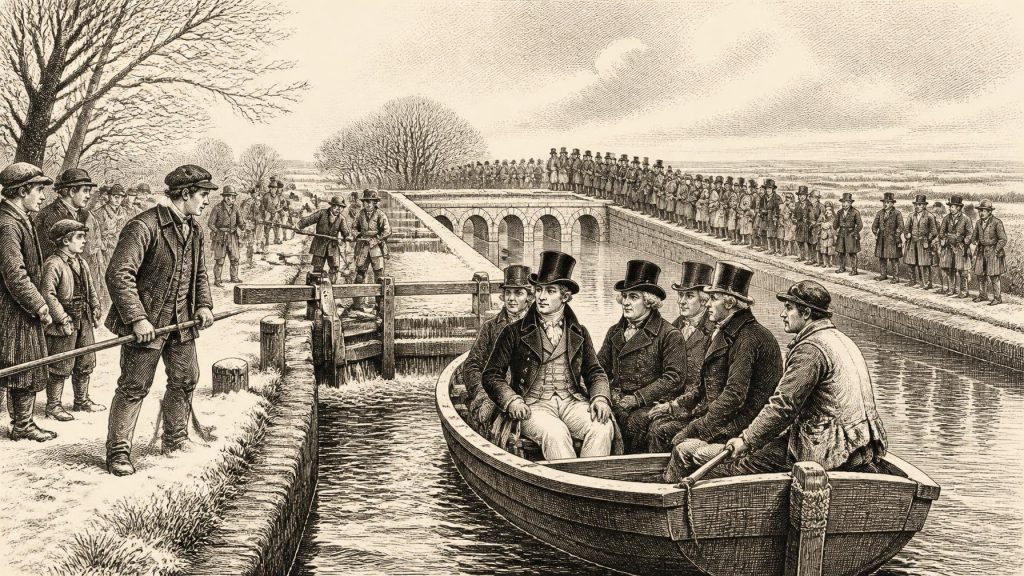
The clearest firmly dated development came on 1 January, when the completed Lagan Canal was formally opened. The new canal section ran from the existing navigation near Lisburn to Ellis’s Gut on Lough Neagh, making a continuous water route between Belfast and the great inland lake. The Marquess of Donegall, the project’s leading financial backer, took part in the opening journey. The final connection had only been cut through to the lough in December 1793, so the ceremony marked the first practical opening of the entire route rather than the beginning of a wholly new scheme.
This was a substantial feat of eighteenth-century engineering. The later canal involved an aqueduct across the Lagan, a summit level, road bridges and flights of locks at Sprucefield and Aghalee. Its construction had proceeded slowly, constrained by finance as well as difficult terrain and water management. Richard Owen, the engineer responsible for the later works, had been employed from 1782; the canal’s completion therefore represented more than a decade of labour and a much longer regional ambition to connect Belfast’s port with the Lough Neagh basin.
The canal mattered because it changed the practical geography of Ulster. It could carry agricultural produce, coal and manufactures more cheaply and in larger loads than many roads allowed, and connected communities around the lough more directly with Belfast’s markets and harbour. It also gave Belfast a link, through other navigations, towards places including Newry, Portadown and Coalisland. Such possibilities should not be mistaken for instant prosperity: traffic patterns, tolls, seasonal water levels and commercial demand still governed whether boats moved and who benefited. But the opening was a real enlargement of the region’s commercial infrastructure at a moment when war was making dependable internal communications and supplies more valuable.
Reform Under Pressure
While boats travelled the Lagan route, political space was narrowing in Dublin. Ireland remained a separate kingdom with its own parliament in College Green, but executive power was exercised through Dublin Castle under the Crown, and the electoral system was profoundly unrepresentative. Roman Catholics had gained the parliamentary vote under the Relief Act of 1793, but could neither sit in parliament nor hold many offices. The established Church of Ireland retained its privileged position, while Presbyterians, Catholics and others experienced unequal legal and political standing. The war between Britain and revolutionary France, begun in 1793, made government ministers increasingly likely to treat ambitious reform as a security problem.
Early in 1794 the Dublin Society of United Irishmen still presented a public programme of parliamentary reform. Its Plan of an Equal Representation of the People of Ireland, published in March, proposed 300 electorates arranged broadly by population, annual parliaments, payment for representatives, restrictions on office-holders sitting as MPs, and measures against bribery. It was an unusually democratic programme for its day, though it was not universal adult suffrage: the plan spoke of male electors and set an age of twenty-five for representatives. Its importance lies in what it reveals about the society’s stated constitutional purpose in that particular spring.
The society’s public career in Dublin was soon interrupted. In April, the authorities discovered contacts involving the radical Anglican clergyman William Jackson, who had come from France to assess the prospects for French assistance to an Irish rising. The episode gave Dublin Castle compelling grounds, in its own view, to connect domestic reformers with a hostile foreign power. In May the Dublin Society of United Irishmen was raided, its papers seized and its activities suppressed. This did not mean that every member had supported rebellion, or that the organisation immediately became a unified underground army. It did, however, end the society’s open reforming phase in the capital and helped drive politically committed members towards secrecy.
William Drennan’s trial gave this contest a human face. A Belfast-born physician, poet and one of the intellectual founders of the United Irishmen, Drennan was prosecuted for seditious libel over an earlier address to Volunteers. His defence was conducted by John Philpot Curran. The case came before a Dublin grand jury on 25 June 1794, and the prosecution relied heavily on the evidence of William Paulet Carey, an informer whose credibility Curran attacked in cross-examination. Drennan was acquitted. Contemporary reports and later historical work alike show why the case travelled quickly in print: an acquittal was read by supporters as a rebuff to government intimidation, even as it exposed the risks carried by radical publication and association.
Rural Disorder and State Force
The political pressures of 1794 were not confined to pamphlets, courtrooms or Dublin drawing rooms. In many districts, economic dependence, disputes over land, tithes and local authority, as well as sectarian antagonism, fed a volatile countryside. The Defenders, an oath-bound popular movement with strong Catholic participation, had expanded through parts of Ulster and the midlands. They were not simply an early version of the United Irishmen: their roots lay in local self-defence, agrarian grievance and communal conflict. In 1794, the two movements had not yet formed the closer alliance that developed later. Keeping that distinction clear is essential.
Nonetheless, government officials viewed Defender activity, French war and radical politics as aspects of a single mounting danger. Reports from Cavan illustrate the atmosphere. At Kilnaleck fair on 13 May, a serious confrontation involving Defenders and militia ended in violence and a death. Elsewhere, prosecutions for armed gatherings, alleged Defender membership, seditious drinking and attacks on houses showed the state testing criminal law, informers and military force against local networks. Individual cases cannot measure the entire island’s condition, but they show why the language of order and insurrection had acquired immediate meaning far beyond the capital.
For ordinary people, this was an unsettling combination. The militia, raised in the previous year amid fears of invasion and internal revolt, brought uniforms, billets and the prospect of service into local communities. Farmers and labourers faced rents, dues, poor roads and uncertain markets; Catholic households remained excluded from full civic equality despite the recent relief legislation. Protestant tenants and artisans could also resent landlord power, political corruption and economic insecurity. The appeal of the United Irish ideal of a ‘union’ across religious divisions rested partly on these shared dissatisfactions, but real divisions of religion, locality, status and interest remained formidable.
A New Viceroy in Prospect
High politics produced a different, more cautious source of expectation in the closing weeks of the year. In December 1794 William Wentworth-Fitzwilliam, fourth Earl Fitzwilliam, was appointed Lord Lieutenant of Ireland. He did not arrive in Dublin until January 1795, so it would be wrong to assign the actions of his short viceroyalty to 1794. But his appointment itself mattered. Fitzwilliam was associated with the Whig interest of the Ponsonby family and with Henry Grattan, and many Irish Catholics and reform-minded Protestants hoped that a more conciliatory administration might follow.
Those hopes centred especially on the unresolved Catholic question. The Relief Act of 1793 had widened rights but had stopped far short of political equality. Fitzwilliam’s prospective arrival therefore encouraged expectations that Catholic eligibility for parliament and office might be considered. At the same time, the government that selected him was a wartime coalition in London, not an administration committed to a settled Irish reform programme. The ambiguity of late 1794 was real: reformers saw an opening, while defenders of the Protestant ascendancy feared one. The clash would become public in 1795, but its anticipations belonged to this year.
Industry, Reading and Wartime Materials
War also shaped economic choices. At Ballincollig, west of Cork, Charles Henry Leslie and John Travers began a gunpowder enterprise in 1794. The site combined access to water power on the Lee valley with proximity to Cork, a major port. The surviving complex is evidence of the industrial logic involved: watercourses and canals could power machinery and move materials while separating dangerous stages of production. The later, much enlarged works should not be projected backwards onto the first year, but the establishment of the mill was already a significant investment in a commodity needed by military and naval forces as well as civilian mining and quarrying.
Print offered a quieter counterpoint. At Ballitore, County Kildare, the Quaker writer Mary Leadbeater published anonymously in Dublin Extracts and Original Anecdotes for the Improvement of Youth. The small educational work mixed prose and verse, religious and moral instruction, material on Quaker history and passages opposed to slavery. Its appearance reminds us that 1794 was not only a year of state surveillance and armed anxiety. It was also a year in which provincial religious communities participated in Dublin’s book trade and in wider debates about education, conscience and moral improvement.
The year thus ended without the dramatic rupture that later generations associate with the 1790s. Yet its developments were consequential. The Lagan Canal promised a more integrated northern economy; Ballincollig embodied the material demands of war; and the suppression of the Dublin United Irishmen showed that the constitutional reform movement could no longer rely on public organisation without grave risk. Ireland in 1794 was still governed through its own parliament, still capable of public debate and commercial construction, but it was moving into a period in which reform, security and revolution would become increasingly difficult to separate.
Primary Sources
- Lagan Canal – Data Catalogue
- The Lagan Navigation
- Lagan History
- Lagan Waterway History
- Timeline of the Lagan Navigation
- The Right Honourable John Philpot Curran
- The Trial of William Drennan
- The Dublin Society of United Irishmen and the Politics of the Carey–Drennan Dispute, 1792–1794
- The United Irishmen: Popular Politics in Ulster and Dublin, 1791–1798
- The Transformation of the Society of United Irishmen into a Mass-Based Revolutionary Organisation, 1794–6
- The Personnel of the Dublin Society of United Irishmen, 1791–4
- The United Irishmen’s Plan of Parliamentary Reform
- Ireland in the Age of Revolution, 1760–1805, Part II, Volume 4: 1791–1797
- Pre-Union Irish Statutes 1169 to 1800
- Statute Law Revision Act 2007, Schedule 1
- History: Ireland 1778–1803
- Disturbance in 1794
- Ballincollig Gunpowder Mills, Ballincollig, Cork
- Ballincollig Gunpowder Mills
- Industrial Heritage of County Cork
- Mary Leadbeater
- Roman Catholic Petition
- A Short History of the Irish People from the Earliest Times to 1920
- The Origins and Transformation of Early Irish Republicanism