
Oakboys and the Lord Hertford1763 CE
In 1763, Ireland’s expanding economy exposed social and religious inequalities. The Treaty of Paris ended the Seven Years’ War, reshaping imperial trade while restrictions continued to limit Irish commerce, except the linen industry. In Ulster, the Hearts of Oak protested county cess, compulsory road labour, tithes and established-church charges; troops and local concessions contained them. Conversely, the Lagan Navigation opened between Belfast and Lisburn, improving transport for linen and bulk goods while highlighting unequal costs of development. Hugh Percy became lord lieutenant, and the Freeman’s Journal began publishing. Catholic and Presbyterian institutions also developed despite penal laws and Protestant privilege.
Dateline
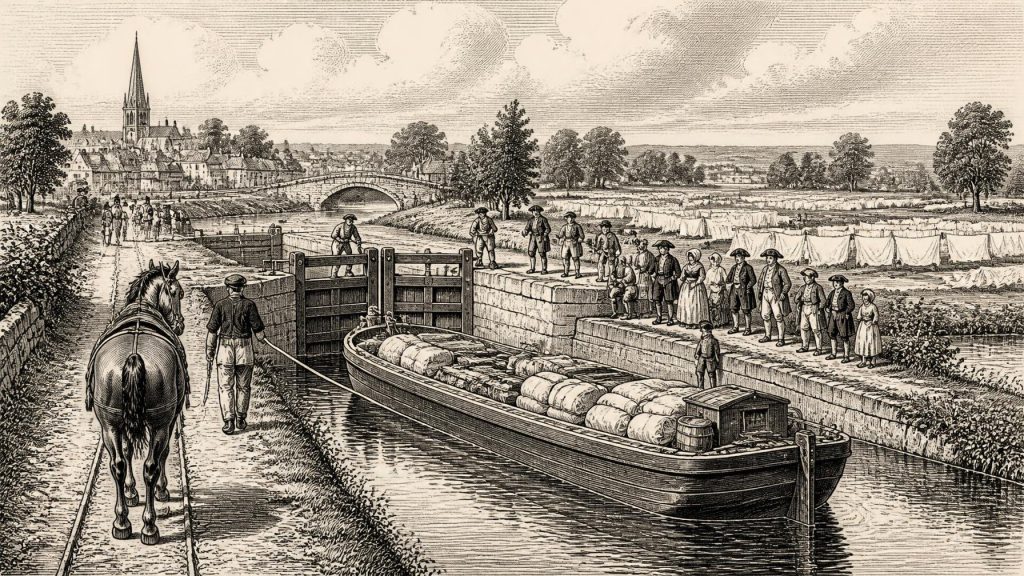
In 1763, Ireland’s most revealing story lay in the contrast between a new waterway and a rural uprising. In September, a loaded barge travelled from Belfast to Lisburn on the newly opened Lagan Navigation, a conspicuous promise of commerce, faster carriage and linen-led improvement. During the summer, however, crowds known as the Hearts of Oak, or Oakboys, had assembled across much of Ulster to resist the taxes, labour obligations and ecclesiastical charges that helped make such “improvement” burdensome to ordinary households. The same year also brought a new lord lieutenant, a new Dublin newspaper, and notable developments in Catholic and Presbyterian organisation. It was not a year of constitutional transformation, but it exposed the social tensions beneath eighteenth-century Ireland’s expanding economy.
A Peace with Irish Consequences
On 10 February 1763, the Treaty of Paris ended the Seven Years’ War between Britain, France and their allies. Ireland was not a separate party to the treaty: George III appeared in it as king of Great Britain, France and Ireland, and Irish people experienced the settlement as subjects within a widening British empire. Yet the peace mattered directly. Irish merchants, shippers, provision dealers and manufacturers operated within imperial routes whose risks and opportunities had been altered by war. The end of fighting brought prospects of more regular trade, while Britain’s enlarged territories and continuing military commitments ensured that imperial finance and administration remained pressing concerns.
Peace did not mean commercial freedom for Ireland. Its overseas trade was still shaped by a system in which English legislation, imperial navigation rules and British ports limited what Irish producers could import, export and manufacture. Linen was the great exception in policy as well as practice: encouraged as an Irish industry after severe restrictions had damaged the woollen trade, it had become central to Ulster’s economy. Flax growers, spinners, bleachers, weavers, merchants and carriers all had a stake in moving cloth and yarn efficiently. This background is essential to understanding both the Lagan Navigation’s celebration and the anger that erupted in the countryside.
The Hearts of Oak
The most serious domestic disturbance firmly placed in 1763 was the Hearts of Oak movement. Its principal outbreak came in July, beginning in and around County Armagh and spreading through broad areas of Ulster. Contemporary observers and later writers often emphasised its Presbyterian character, but that label can obscure as much as it explains. The protesters’ grievances were practical and local: county cess, church dues and compulsory road labour. They were joined by people whose religious identities varied, and their demands addressed the costs imposed on tenants, small farmers, labourers and weavers rather than a single denominational cause.
The county cess was a local rate levied through the grand-jury system. It paid for roads and a range of county business, but its burden fell heavily upon occupiers of land. Road-building had formerly relied in part on compulsory labour: households could be required to give days of work to the roads. By the early 1760s, cash assessments had become more important, while old labour expectations had not simply vanished. In northern counties, gentry who wanted better communications for markets and manufacture had reasons to press expenditure. Those expected to pay and work could see a different reality: decisions taken by landowners and magistrates, with bills passed downwards.
Church payments sharpened the resentment. The Church of Ireland was the established church, but it served only a minority of the population. Presbyterians and Roman Catholics nevertheless encountered tithes and other charges connected with its clergy. The Oakboys therefore brought together objections to taxation, labour and unequal religious establishment. Their chosen name, evoking oak branches or emblems, gave a common identity to crowds who marched, issued notices and sought redress. It was a disciplined protest in some places and a coercive one in others; it should not be romanticised as either a modern democratic campaign or mere lawlessness.
By mid-July, the scale of mobilisation alarmed Dublin Castle and local elites. Reports described large gatherings, and troops were sent north. The presence of the army was a reminder that the Irish state possessed coercive power even where local administration depended on landlords, magistrates and grand juries. The disturbances did not become a national rebellion. In Armagh, concessions and adjustments by local authorities helped to ease immediate pressure, while the movement’s force diminished as 1763 wore on. Its significance lay in its breadth and in the warning it delivered: economic development could produce resistance when its costs were levied unequally.
The Lagan Opens to Lisburn
Only weeks after the height of the Oakboy crisis, a very different public spectacle took place on the River Lagan. The Belfast-to-Lisburn section of the Lagan Navigation opened in September 1763. Work on this improvement had begun in 1756 under the engineer Thomas Omer, who adapted river and canal stretches, with locks and associated works, to make navigation more dependable. The first section did not yet create a complete water route to Lough Neagh; that larger project would take many more years. But it gave Belfast and Lisburn a usable inland connection at a moment when both towns were increasingly tied to linen manufacture and trade.
The inaugural voyage was made by the Lord Hertford, a barge associated with Belfast merchant Thomas Greg. Local accounts describe it carrying coal and timber as well as prominent passengers, and record crowds, music and celebrations at Lisburn. Such details belong to the commemorative side of the opening, but the cargo is equally revealing. Coal was needed by urban households and workshops; timber was a basic material for building, vessels, tools and industry. The navigation lowered the difficulty of moving bulky goods overland and linked the port more closely to the bleaching greens, markets and manufacturing districts of the Lagan valley.
The waterway was thus a genuine achievement, built by extensive manual labour and backed by statutory and civic authority. Yet its opening also illuminates the Oakboys’ complaints. Roads and navigations were presented by their promoters as public improvements, but financing them required taxes and could reshape local obligations. Linen prosperity did not flow evenly to every household. A merchant able to fit out a laden barge stood at one end of the economy; a tenant compelled to meet cess, tithe and labour demands stood at another. In 1763, Ulster displayed both positions with unusual clarity.
Government and Public Print
In April, Hugh Percy, Earl of Northumberland, was appointed lord lieutenant of Ireland. The office represented the crown and the British ministry in Dublin, operating through Dublin Castle and alongside Ireland’s Protestant parliament. Northumberland’s appointment did not itself settle the enduring question of how much authority should rest with Irish political interests and how much with ministers in London. Rather, it placed a new and wealthy aristocratic figure at the centre of an administration already reliant on patronage, parliamentary management and the cooperation of leading Irish families. Surviving lists of vice-regal dinner guests begin in October 1763, offering a small but concrete trace of the social world through which high politics was conducted.
On 10 September, the Freeman’s Journal began publication in Dublin. Its first editor was the writer Henry Brooke, and Charles Lucas, the Dublin politician and prominent critic of governmental influence, was closely associated with its early political character. The paper originated as a commercial publishing venture rather than as a simple organ of one man or party; nevertheless, it opened another channel for political argument, advertisements, commercial intelligence and public controversy. In a city where official information was associated with the Dublin Gazette and where access to office remained narrow, an independent-spirited newspaper mattered.
The later reputation of the Freeman’s Journal should not be projected backwards without care. In 1763 it was not yet the nineteenth-century nationalist institution it would become. Its earliest environment was the Protestant political world of Dublin, including the “patriot” criticism advanced by Lucas and others. Still, the launch was important because print could connect parliamentary debate, mercantile interests and urban readers more rapidly than manuscript correspondence or official proclamation. The newspaper’s founding belongs securely to this year; its later influence belongs to a longer story.
Churches under Unequal Laws
Religious life in 1763 was marked by institutional activity, but within a hierarchy of legal privilege. The Church of Ireland was established and supported by tithes. Presbyterians formed a substantial part of Ulster society but faced disabilities, including exclusion from many offices under the sacramental test. Roman Catholics, a majority of Ireland’s people, continued to live under penal laws that constrained property, education, clergy and public standing, even though enforcement varied greatly by place and period.
Against that setting, the Reformed Presbyterian Church in Ireland constituted its first presbytery in 1763. This Covenanter body was distinct from the larger Presbyterian structures and reflected a commitment to a particular Scottish Reformed inheritance. The event was modest beside the state church’s resources, but it demonstrates that Irish Protestantism was not politically or theologically uniform. Its organisation also belongs beside the Oakboy unrest: Presbyterian communities could be deeply embedded in a society whose economic burdens and religious inequalities generated friction.
On 16 April, John Butler was nominated to the Roman Catholic see of Cork and was consecrated bishop in June. His appointment did not signal Catholic equality; it instead shows the continued functioning of a Catholic episcopal structure beneath the penal order. Butler had been educated at the Irish College in Rome and had worked within the Butler ecclesiastical network before becoming bishop. For Cork Catholics, the filling of the see was a practical matter of pastoral governance, ordinations, discipline and continuity. It is a useful corrective to any assumption that legal constraint meant religious life had disappeared.
By year’s end, 1763 had offered no single Irish turning point. Its importance is cumulative. A peace treaty shifted the imperial setting; a new viceroy and a new newspaper altered the political stage; a Catholic bishop and a Reformed Presbyterian presbytery showed diverse religious organisation; a barge on the Lagan advertised improvement; and the Hearts of Oak revealed who might bear its costs. Ireland’s future arguments over trade, representation, tithes, land and religious rights were not settled in this one year, but many of their tensions were plainly visible.
Primary Sources
- A ‘Presbyterian insurrection’? Reconsidering the Hearts of Oak disturbances of July 1763
- Communications
- Lagan Waterway History
- Heritage Sign at Navigation House
- Buildings: Lock 3, Lagan Navigation
- A Glimpse of Drumbeg, 1750–1800
- Early Days of Transportation on the Lagan Canal
- The Freeman's Journal
- ‘A great Daily Organ’: the Freeman’s Journal, 1763–1924
- Public Register or The Freeman's Journal
- Presbyterian Historical Society of Ireland
- Timeline for Presbyterianism in Ireland
- The Irish Reformed Presbytery
- Butler, John
- Bishop John Butler
- Chief Governors of Ireland—Continued
- Lists of Guests at Dinners Given by the Lord Lieutenant, Hugh Percy, 1st Duke of Northumberland, between 2 October 1763 and 15 March 1764
- Treaty of Paris, 1763
- Milestones in the History of U.S. Foreign Relations: Treaty of Paris, 1763
- History of the Commercial and Financial Relations between England and Ireland: Part VIII
- The Royal Dublin Society and the Legacies of Empire Project, 1731–1877
- ‘Reasonable Inconveniences’: The Theory and Practice of the Penal Laws
- A Chronology of Ireland