
Linen, Salmon and Turnpikes1764 CE
In 1764, Ireland’s Protestant-led parliament enacted wide-ranging legislation on linen, fisheries, roads, urban regulation, prisons, trade and public order. Measures promoted manufacture, navigation and turnpikes while regulating coal, food, markets, charitable gifts and civic administration. Linen exports demonstrated economic importance but also dependence on imperial constraints. Acts concerning land burning, salmon, tithes, Protestant property and riots reflected rural conflict, environmental pressures and the continuing Whiteboy movement. Government operated through Dublin Castle, Lord Lieutenant Northumberland and powerful undertakers, as George Stone and Henry Boyle died. Cultural developments included Old Moore’s Almanac, William Ashford’s arrival, and births of Emmet, O’Conor and Hope.
Dateline
For Ireland, 1764 was marked less by one spectacular public drama than by a remarkably revealing burst of legislation. On 12 May, at the close of a parliamentary session that had begun in October 1763, royal assent was given to a wide range of Irish measures. Their subjects ran from linen manufacture and salmon preservation to roads, coal prices, gaols, fisheries and the policing of riots. Taken together, they offer an unusually close view of what the Protestant governing class regarded as the kingdom’s urgent business: making trade more productive, improving communications, managing towns, protecting revenue and property, and containing social tension.
The statutes did not create an equal or nationally representative system. Ireland remained a separate kingdom under George III, with its own parliament in Dublin, but one constitutionally subordinate to the British Crown and constrained by Poynings’ Law. Political power rested overwhelmingly with the established Church of Ireland landowning interest. Roman Catholics, who formed the great majority of the population, had been excluded from the parliamentary franchise since 1728. The legislation enacted in 1764 therefore reveals both practical ambitions for improvement and the narrow religious and social foundations on which authority rested.
A Crowded Statute Book
The session’s final day, 12 May, brought an extraordinary cluster of enactments. There were measures to regulate grand-jury presentments, parish watches and highways; to clarify the supply of corn and flour to Dublin; to control customs and excise fraud; and to restrain harsh or unjust exactions by gaolers from prisoners. One act freed people acquitted of indictable offences from the fees that might otherwise have kept them in prison. Such a provision should not be mistaken for a modern doctrine of equal justice, but it did acknowledge a real abuse of the fee-based penal system.
Several acts addressed the fabric of urban life. Dublin’s coal-price legislation continued efforts to prevent excessive charges for an essential household fuel. The City of Cork measure dealt with coal sales, street lamps, bread assize, street and highway upkeep, protection of quays by parapet walls, and the city’s court of conscience for smaller civil debts. These were not glamorous concerns, but they mattered directly to household budgets, night-time movement, food quality, commercial credit and the safety of a busy port city. Dublin also received further powers to secure vessels trading in its harbour.
The statutes show an administration preoccupied with regulation rather than simple laissez-faire. Leatherworkers and shoemakers were subject to anti-fraud provisions; hawkers and pedlars required licensing; and a law concerning charitable gifts sought better discovery of donations and bequests. In a society where local government was fragmented among corporations, parish officers, magistrates, grand juries and private interests, parliamentary acts supplied the framework through which practical authority was exercised.
Manufacture, Water and Roads
Economic policy gave particular prominence to linen. The flaxen and hempen manufactures act continued earlier encouragement, while a further act sought better regulation of linen and hempen production. This emphasis reflected linen’s central position in Irish overseas commerce, especially in Ulster, where spinning and weaving linked small farms, rural households, bleachers, merchants and ports. Recorded linen-cloth exports for the year ending at Lady Day 1764 exceeded fifteen million yards, though the value was below that recorded for the preceding year. The figure conveys both the scale of the industry and its exposure to changing markets.
That prosperity had limits imposed by the wider imperial economy. Irish linen enjoyed encouragement in ways that Irish woollens and hempen manufactures did not. British restrictions and competing bounties narrowed the scope for Irish producers in several branches of manufacture. The 1764 legislation could improve quality, organisation and incentives at home, but it could not remove the commercial constraints created by the relationship with Great Britain. Regulation was therefore an attempt to make the most of an economy whose opportunities were substantial but unevenly distributed.
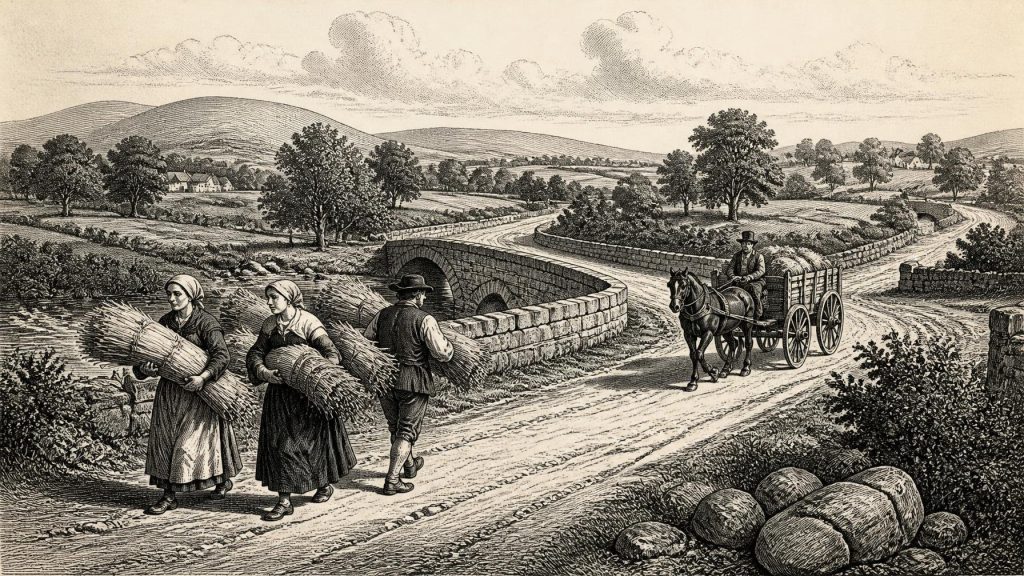
Waterways and roads were treated as instruments of that commercial future. The Lagan Navigation Act continued and amended the project to make the river navigable and to open a water passage between Lough Neagh and Belfast. It connected the developing Belfast district more closely to its inland hinterland, facilitating the movement of bulky goods at a time when overland carriage was slow and costly. Road acts addressed the routes from Dublin to Dunleer, Dundalk to Banbridge, Dublin through Kilcullen and Carlow to Kilkenny, and Kinnegad to Athlone. A new turnpike route was also authorised around the south, west and north sides of Dublin, from the Donnybrook road towards Cavendish Street.
These measures did not mean that Ireland suddenly acquired a modern transport network. Improvement depended on finance, turnpike trustees, labour, local compliance and continuing maintenance. Yet the named routes indicate how legislators imagined regional change: Dublin connected to its northern and southern approaches; the north-east linked from Dublin through Louth towards Ulster; and the midlands drawn into a stronger east–west corridor. Roads, canals and port works were as much statements of economic priority as physical works.
Land, Food and Rural Strain
Legislation also registered the pressures of a predominantly rural society. An act sought more effectively to prevent the burning of land, while another amended laws for the preservation of salmon. Both acknowledge that land and rivers were economically valuable, environmentally vulnerable and contested. Burning could be associated with agricultural practice, carelessness or deliberate damage; salmon law addressed a resource upon which coastal and river communities, estate owners and markets all depended. A broader fisheries act declared its purpose to encourage the fisheries of the kingdom.
The same year must be set against the continuing Whiteboy movement, whose first major phase ran from 1761 to 1765. It had begun in Munster amid grievances over the enclosure of commonage, the expansion of pasture, rents and the exactions associated with tithes. Whiteboys operated at night, often in white shirts over their clothes, attacking fences and intimidating those held responsible for local injustices. It would be wrong to attach every rural difficulty in 1764 to Whiteboy activity, or to present the movement as a single centrally directed rebellion. But its persistence forms essential context for the Riot Act passed that May, which indemnified those assisting in dispersing riots and apprehending rioters.
Religion sharpened these material conflicts. Tithes supported the established Church of Ireland and were payable by people of other denominations as well as Anglicans. Parliament passed a tithes act in 1764, while also passing a measure confirming Protestant titles and quieting Protestant possession. Its language, including provision for converts from ‘Popery’ to meet legal requirements of conformity, makes plain the confessional assumptions of the state. The act was not a new comprehensive penal code; rather, it belonged to a still-operative legal order that privileged Protestant property, office and political membership.
Government and Its Leading Men
Hugh Percy, Earl of Northumberland, was lord lieutenant during 1764. The viceregal court at Dublin Castle was a centre of patronage and sociability as well as executive authority: surviving lists record dinners given by Northumberland between October 1763 and March 1764. Behind ceremony lay a political system in which influential office-holders and great landowners, often called ‘undertakers’, could manage parliamentary support. The year’s legislation demonstrates that Dublin Castle still required their co-operation to govern effectively.
Two deaths late in the year signalled a changing of the guard. George Stone, Church of Ireland archbishop of Armagh and a major political prelate, died in London on 19 December. His death removed one of the most formidable figures in mid-century Irish administration. Eight days later, on 27 December, Henry Boyle, first earl of Shannon, died at his Dublin residence in Henrietta Street. Boyle had been speaker of the Irish House of Commons and remained an important political organiser after entering the peerage. Their near-consecutive deaths did not transform policy overnight, but they closed a chapter in the dominance of the older undertaker interest.
Print, Learning and New Lives
1764 also had quieter cultural significance. Theophilus Moore’s almanac, initially issued as The Irish Merlin, first appeared this year and became the origin of the long-running Old Moore’s Almanac. An almanac united calendar, practical information, weather lore, calculation and prediction in a cheap, portable form. Its emergence points to the commercial reach of print beyond elite bookshelves, while also warning against a simple division between ‘educated’ knowledge and popular belief.
In Dublin, the Birmingham-born William Ashford received an appointment in the ordnance office at a salary of £40 a year. He would later become one of Ireland’s best-known landscape painters, but in 1764 he arrived as a young official whose work involved the condition of arms held at forts and barracks. His career is a reminder that the capital’s expanding administrative and military establishments could also bring artists, craftsmen and technical knowledge into Irish life.
The year saw births that would acquire later historical resonance: Thomas Addis Emmet was born in Cork on 24 April; Charles O’Conor, later a catholic priest, librarian and antiquary, at Belanagare, County Roscommon, on 15 March; and James ‘Jemmy’ Hope, future United Irishman and radical democrat, in County Antrim on 25 August. None could foreshadow the political worlds they would inhabit. Yet their births, alongside the year’s laws on manufacture, religion, order and improvement, locate 1764 at a point where Ireland’s established structures were still powerful, but the social and intellectual forces that would challenge them were already being formed.
Primary Sources
- Irish Legislation Database
- Pre-Union Irish Statutes
- List of Acts of the Parliament of Ireland, 1761–1770
- Journals of the House of Commons of the Kingdom of Ireland
- The Dublin Gazette, Number 1460: Tuesday, 14 August 1764 to Saturday, 18 August 1764
- Bringing the Past to Life with the Oireachtas Library and the Virtual Record Treasury of Ireland
- History of the Commercial and Financial Relations between England and Ireland from the Period of the Restoration
- The Whiteboy Movement, 1761–5
- Whiteboys
- Stone, George
- Boyle, Henry
- Ashford, William
- Ward, Ralph
- Brooke, Sir Arthur
- Emmet, Thomas Addis
- Hope, James (‘Jemmy’)
- O'Conor, Charles
- Lists of Guests at Dinners Given by the Lord Lieutenant, Hugh Percy, 1st Duke of Northumberland
- Lord Lieutenant of Ireland (1763–1765: Northumberland)
- General Orders of the Incorporated Society, 1764
- Old Moore’s Almanac: Welcome to Theo’s Blog
- Statute Law Revision Act 2007, Schedule 2