
Lucas’s Censor and Cork’s Swadlers1749 CE
In 1749, Irish tensions appeared in political print, official measures, economic debate and religious conflict. Dublin apothecary Charles Lucas used The Censor and civic addresses to challenge municipal corruption, defend Protestant constitutional rights and question Dublin Castle’s authority. Parliament denounced his publications as seditious, ordered his arrest, and forced his flight. Government proclamations addressed quarantine, coin clipping and rural crime, reflecting administrative reliance on local institutions and military power. Thomas Waite’s account emphasised linen, restricted woollen trade and military spending, while improvement schemes favoured elite direction. In Cork, Charles Wesley’s Methodism provoked unrest, exposing intersecting confessional, civic and social rivalries.
Dateline
In 1749 Ireland’s public life became unusually visible in print, pulpit and proclamation. There was no single national upheaval, but several well-dated episodes exposed the tensions of a kingdom governed from Dublin Castle in the name of George II, closely bound to Britain, and divided by property, religion and access to power. The most conspicuous controversy centred on Charles Lucas, a Dublin apothecary whose campaign for civic accountability became a test of how much criticism the Irish political establishment would tolerate. At the same time, Methodist preaching helped provoke bitter unrest in Cork, while official papers recorded an island shaped by linen, military expenditure, restricted trade and the enduring Catholic majority.
A Printer’s Political Campaign
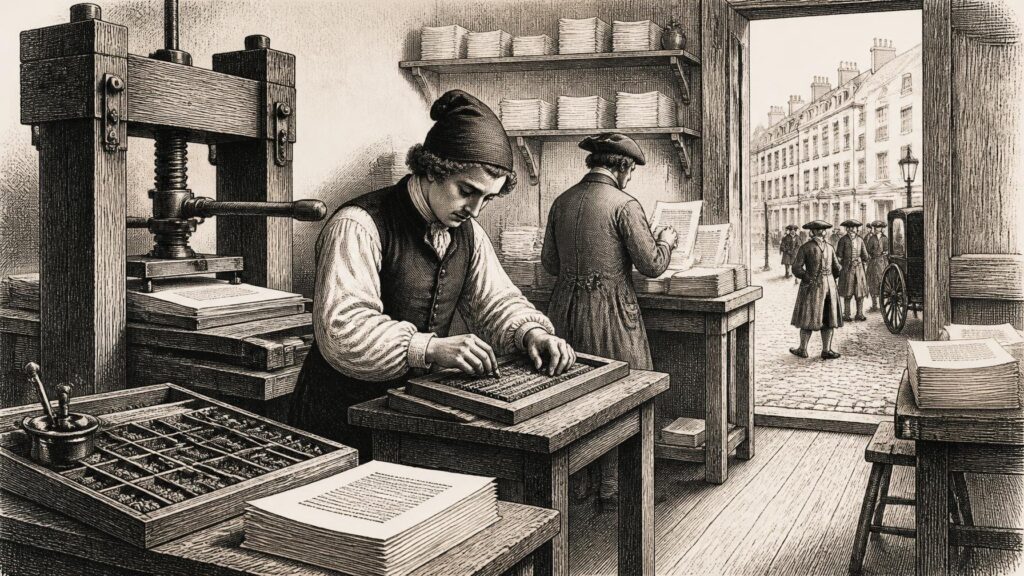
On 3 June, Lucas began publishing The Censor, or Citizens’ Journal in Dublin. Its title announced a purpose familiar in eighteenth-century political culture: to inspect, expose and judge public conduct. Lucas had already made himself prominent in the contested Dublin parliamentary election of 1748–49. He was not an aristocrat or a great landowner, but a practising apothecary with a talent for controversy, a command of civic records and an energetic use of pamphlets, addresses and newspapers. His appeal was principally to the city’s Protestant freemen and freeholders, men whose votes and municipal privileges mattered within the tightly restricted political system.
Lucas’s immediate quarrel concerned the government of Dublin Corporation, especially the authority exercised by its aldermanic elite and the handling of civic revenues. Yet he made the dispute larger. He invoked the city’s old chartered rights, denounced political corruption and argued that Ireland’s Protestant inhabitants were entitled to constitutional liberties comparable to those claimed in Britain. His rhetoric reached beyond a complaint about city administration towards questions that were highly sensitive in 1749: Poynings’ Law, the relationship between the Irish and British parliaments, and the power of the Dublin Castle administration. This was not a democratic movement in the modern sense. Most Irish people, especially Catholics, remained outside the franchise and the political institutions Lucas wished to reform. But it was an important assertion that a public, reading citizenry could scrutinise its governors.
The campaign was conducted through paper rather than streets alone. Lucas issued a stream of addresses to Dublin’s citizens, and the surviving catalogues of his 1749 publications show the density of the dispute. A fourth letter to the commons and citizens, signed on 25 July, answered a censure imposed by the Common Council. That exchange illustrates a central fact of the year: municipal power could be contested, but the contest was fought within a narrow, Protestant civic world whose corporate officers possessed formidable legal and social authority. Printers, booksellers, coffee-house readers and election-minded freemen formed the audience to which Lucas spoke.
Parliament Answers Back
The confrontation sharpened when the Irish parliament met in October. Lord Harrington, the lord lieutenant, had returned to Ireland before the 1749–50 session amid complaints about Lucas’s writings. Lucas presented the viceregal administration with material including his edition of the city’s ‘Great Charter’, seeking to carry his case beyond the Corporation. The gesture was audacious: a private citizen was asking the representative of the Crown to recognise arguments that embarrassed both Dublin’s governing oligarchy and the wider political connection with Britain.
On 16 October the House of Commons passed resolutions against him. It declared Lucas an enemy to his country and directed that he be arrested, detained and prosecuted for seditious publications and for violating the House’s privileges. The language was deliberately severe. The Commons was defending more than personal reputation; it was asserting that attacks upon its authority and the established constitutional order could be treated as threats to public peace. Lucas fled, initially to the Isle of Man, rather than await prosecution. A further proclamation of 11 December called for his apprehension on account of seditious papers.
His departure did not make the episode insignificant. In the short term, it demonstrated the limits imposed on opposition by a parliament whose members were overwhelmingly drawn from the Protestant landed and urban elite, and by an executive ultimately responsible to ministers in London rather than to the Commons. In the longer view, Lucas’s 1749 language of civic rights, corruption and Irish constitutional claims supplied a vocabulary later associated with Protestant patriot politics. That later influence should not obscure the result in this calendar year: the authorities successfully drove the journalist and candidate from Ireland.
Order, Money and the State
Official actions across 1749 reveal a government attentive to security in several forms. A proclamation ordered a general thanksgiving on 25 April, although the surviving calendar entry alone does not safely identify the occasion being commemorated. On 10 July, quarantine restrictions on vessels from West Barbary were continued and extended to ships arriving from ports on the Barbary Coast in the Mediterranean and the Strait of Gibraltar. Such measures place Ireland within wider maritime networks. Dublin, Cork and other ports depended on seaborne commerce, but ships could also carry feared epidemic disease; quarantine was part of the practical government of an island economy.
Currency and rural security likewise troubled officials. On 3 October, a reward was offered for information about coin clipping, the illicit removal of precious metal from coins. Later that year James Simon published An Essay Towards an Historical Account of Irish Coins, and of the Currency of Foreign Monies in Ireland. Its appearance in Dublin was a notable work of antiquarian scholarship and a reminder that currency was both a daily necessity and a subject of historical investigation. The proclamation and the book should not be treated as directly connected, but together they show why coinage mattered in a trading society dependent on reliable means of payment.
On 27 December another proclamation ordered men presented by grand juries as ‘tories, robbers and rapparees’ in Limerick, Queen’s County, Antrim, Tipperary, Wexford and Kilkenny to surrender. In this usage ‘tory’ meant an outlaw or armed offender, not a member of a later political party. The document does not prove a single island-wide insurgency; its wording instead records official anxiety about robbery and armed disorder across widely separated counties. It also indicates the reach, and the limits, of eighteenth-century policing: government relied on grand juries, local information, rewards, proclamations and the military rather than a modern professional police force.
An Economy of Linen and Constraint
A revealing contemporary assessment was prepared in May by Thomas Waite, an English-born Dublin Castle official, for private circulation among political contacts in England. His ‘present state of Ireland’ must be read critically. It was the view of a Protestant administrator, built from official returns, printed reports and elite informants, rather than a neutral survey of all Irish lives. Even so, it offers a close connection to conditions in 1749. Waite drew attention to recent public accounts in which military costs dominated expenditure, evidence of the continuing importance of the Irish establishment after the War of the Austrian Succession.
Waite called linen the kingdom’s staple and most considerable branch of trade. He estimated annual linen production at £1 million sterling, with about half exported; these are contemporary calculations, not precise modern national accounts. His emphasis nevertheless captures the economic horizon of 1749. Flax cultivation, spinning, weaving, bleaching and marketing joined rural households to merchants and overseas consumers. Linen offered employment and export income, but the gains were uneven and much work was seasonal, domestic and poorly rewarded. Waite also stressed the restrictions on Irish woollen exports. The gap between Ireland’s productive capacities and the trading opportunities allowed under imperial regulation fed the language of ‘improvement’ as well as political resentment.
The Dublin Society was an established advocate of such improvement in 1749, encouraging agriculture, manufacture, useful arts and practical knowledge through premiums and publications. It had not yet received the royal charter that incorporated it in 1750, a distinction worth keeping clear. Its ambitions nevertheless belonged squarely to the world of 1749: more flax, better husbandry, new skills, managed resources and work for the poor. Improvement promised prosperity, but it also assumed that land, labour and education should be directed by gentlemen, clergy and office-holders. It was not a programme devised by the labouring people whose work it sought to reshape.
Religion and Conflict in Cork
Religious life was no less unequal. Waite repeated the official assumption that Catholics greatly outnumbered Protestants, describing an estimated island-wide ratio of four Catholics to one Protestant. The figure was an administrative estimate, coloured by Protestant insecurity, not a census. Yet the underlying reality was unmistakable: the established Church of Ireland possessed political privilege and much property, while the Catholic majority maintained a dense religious life despite the penal-law framework. Catholic chapels, priests, schools and informal networks continued to serve communities across the island, even as officials represented them as a problem of security.
During August and September Charles Wesley made his second visit to Ireland. His evangelical Methodism urged conversion, disciplined conduct and emotionally charged preaching, often in fields or other large open spaces. In Cork, Methodists had already attracted followers and opponents. By the end of 1749 hostility had become serious enough to form the opening phase of the anti-Methodist riots of 1749–50. At the Cork assizes, Wesley and other preachers were presented by a grand jury as persons of ill fame, vagabonds and disturbers of the peace. The charge reveals the precarious position of a movement that was Protestant but did not fit comfortably within established religious authority.
The disturbances cannot responsibly be reduced to a simple clash between Catholics and Protestants. Modern research shows that many rioters were Catholic, but that grievances were political and theological, while tensions also existed among different Protestant groups and within the Methodist world itself. The events of 1749 therefore illuminate a society in which religious identity could overlap with urban status, civic influence and local rivalry. In Dublin, Charles Lucas tested the bounds of political speech; in Cork, Methodists tested the bounds of acceptable worship. Both controversies ended the year with authority reasserting itself, but neither removed the pressures that had brought them into view.
Primary Sources
- Lucas, Charles | Dictionary of Irish Biography
- Select document: ‘The present state of Ireland’, 1749
- Statute Law Revision Act 2015
- ‘Five pounds for a swadler’s head’: the Cork anti-Methodist riots of 1749–50
- The Journal of Charles Wesley (1707–1788)
- Charles Wesley Manuscript Journal
- A Fourth Letter to the Commons and Citizens of the City of Dublin
- An Essay Towards an Historical Account of Irish Coins
- A Seventeenth Address to the Free-Citizens and Free-Holders of the City of Dublin
- The Tryal of Mr. Charles Lucas
- A Letter to the Commons and Citizens of the City of Dublin
- A Letter of Advice to the Censor
- Journals of the House of Commons of the Kingdom of Ireland
- The Dublin Society: Setting Forth
- RDS Manuscripts
- Our History | RDS
- A Chronology of Ireland
- History of the Commercial and Financial Relations Between England and Ireland from the Period of the Restoration
- National Library of Ireland Sources: Exports and Imports; Linen and Linen Trade
- Proclamations, 1749–1750
- Lucas, Flood, Grattan and Burgh
- The Royal Dublin Society and the Legacies of Empire Project, 1731–1877