

Powell’s July Patent1550 CE
In 1550, Sir Anthony St Leger restored negotiation to Tudor Irish policy, promoting surrender and regrant despite disputes favouring military coercion. French approaches in Ulster exposed fragmented lordships and competing dynastic interests rather than a united anti-English alliance. The crown ordered surveys and proposed leasing in Leix and Offaly, beginning systematic plans for territorial intervention without securing control. A proposed Irish mint reflected fiscal ambitions. Humphrey Powell received funding for a Dublin printing press, linking Edwardian religious reform with state communication, though printing and the English liturgy began later. Language, local power and limited resources constrained government ambitions across Ireland.
Dateline
In 1550 Ireland stood at a point of transition, but not of simple transformation. Edward VI was king, and the Dublin administration claimed authority over the whole lordship and kingdom; yet its effective power was concentrated in the Pale, garrisoned towns, selected ports and the territories of co-operating magnates. Beyond them, Gaelic and Gaelicised lordships retained their own political languages, laws, military followings, learned families and networks across the Irish Sea. The year’s surviving record is therefore unusually revealing: it shows government plans for coinage, printing and land survey alongside diplomacy in Ulster and the hard realities of contested local power.
A Return to Conciliation
Sir Anthony St Leger was again lord deputy during 1550. His renewed administration followed the severe and expensive rule of Sir Edward Bellingham, who had departed late in 1549. St Leger’s approach was characteristically more conciliatory. Rather than imagining that a small English army could simply conquer every lordship, he sought agreements with leading families, recognitions of royal sovereignty, rents, leases and the gradual extension of English legal forms. Historians call this programme “surrender and regrant”: lords were encouraged to hold land from the crown and accept new titles or tenures in exchange for security and status.
That policy was neither benign nor universally workable. It treated the crown’s jurisdiction as potentially comprehensive, pressed inherited claims to land and expected political communities organised around kinship, clientship and elective succession to conform to English assumptions about property and inheritance. Its immediate weakness was practical as well as constitutional. Dublin lacked the money, soldiers and local consent to turn every paper settlement into everyday government. Nevertheless, in 1550 St Leger’s restoration made negotiation, rather than continuous campaigning, central to official policy.
The limits of that policy were already visible. Later in the year Andrew Brereton and Sir Nicholas Bagenal attacked St Leger’s accommodating stance towards Conn Bacach O’Neill, earl of Tyrone, alleging disloyalty. The dispute was more than a quarrel among officials. It exposed a persistent division within Tudor government: whether Irish lordships should be managed through alliances and concessions, or weakened through garrisons, confiscation and military pressure. St Leger warned early in 1551 that the more aggressive course was counter-productive, but the argument belonged squarely to the political atmosphere of 1550.
Ulster and French Overtures
Foreign diplomacy gave that argument an international edge. A conventional chronology places French envoys in north-west Ireland in February 1550 and records treaties with O’Neill, O’Donnell and O’Doherty. The surviving evidence, however, requires caution about treating this as a single, united anti-English compact. Manus O’Donnell, lord of Tír Chonaill, is specifically recorded as refusing to meet French envoys who landed in his territory that year. That refusal is important: it shows that external emissaries could arrive, but could not command an automatic response from the rulers whose support they sought.
Ulster was not a bloc. Conn Bacach was an ageing but still significant figure in Tír Eoghain, while rival claims within the O’Neill dynasty shadowed his authority. In Tír Chonaill, Manus O’Donnell remained lord, but his son Calbhach had already challenged him violently. O’Doherty power in Inishowen, neighbouring lordships and Scottish connections further complicated the scene. France’s interest was alarming to Dublin because Ireland lay across the western approaches to England and because Irish Sea contacts could bring soldiers, weapons, ships and intelligence. Yet the events of 1550 demonstrate contingency rather than an inevitable alliance: local rulers weighed overseas offers against immediate dynastic interests.
Political communication itself was diverse. Manus O’Donnell’s household was not merely martial. He had assembled texts, commissioned translations and maintained written administrative records in Irish; his earlier life of St Colum Cille and documents concerning lordly dues reflect a sophisticated learned culture. The French visit of 1550 occurred in a region where diplomacy could be conducted through messengers, letters, clerics, kin and seaborne contacts, rather than through a single national government.
Measuring Leix and Offaly
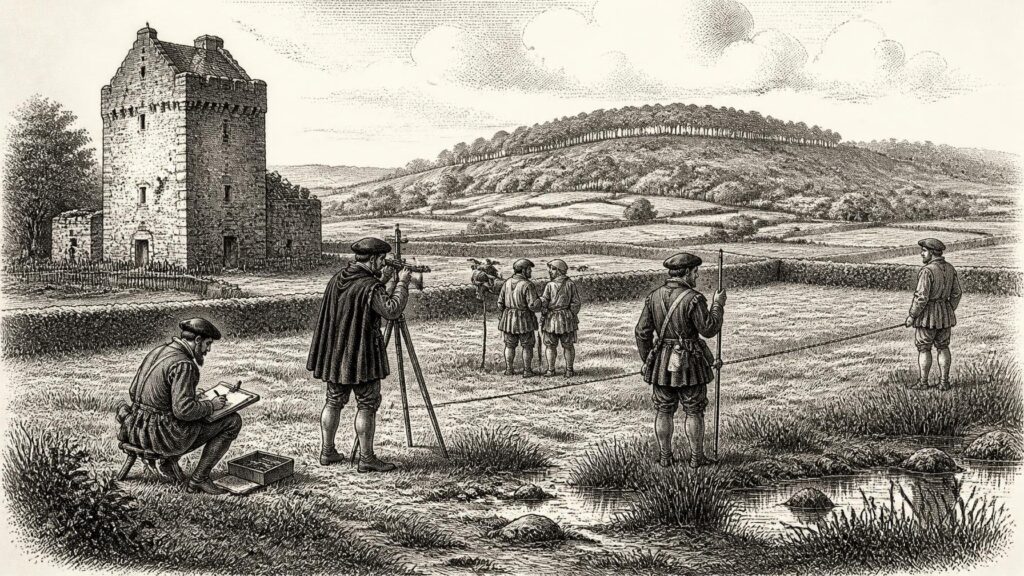
The most consequential governmental initiative of the year lay in the midlands. In July, instructions were issued for the resumption, survey and leasing of Leix and Offaly, territories associated with the O’Mores and O’Connors Faly. During November, an official survey of Offaly was undertaken, following orders to inquire into the lands and regalian rights claimed by O’Connor Faly and O’More. This was not yet the later formal creation of King’s County and Queen’s County under Mary I. It was, however, a major step towards the plantation logic that would reshape the region.
A survey was an instrument of power. It translated a landscape of lordship, seasonal grazing, tribute, fortresses, church lands and overlapping customary rights into named places, estimated values and leasable holdings. Such paperwork did not make the crown secure on the ground, but it supplied a framework through which officials and prospective settlers could imagine dispossession, rent and military occupation. The process therefore affected more than elite title. It threatened the arrangements by which tenants, dependants, hereditary officers and religious communities had access to land and protection.
For people living in Leix and Offaly, the immediate experience was likely uncertainty rather than a completed new order. Crown papers were planning a different future; local families still possessed armed followings and intimate knowledge of woods, bogs, routes and strongholds. The survey’s importance in 1550 lies precisely in this gap between administrative ambition and actual control. It marked the moment when the crown began to prepare a systematic territorial intervention, not the moment when that intervention was finished.
Coin, Print and Religious Change
On 27 June the English privy council resolved to establish a mint in Ireland. The decision should not be mistaken for proof that a fully functioning mint immediately transformed daily exchange. It was a governmental resolution, revealing concern with money, revenue and the circulation of authority. Coinage mattered to soldiers paid from the treasury, merchants in Dublin and the ports, landholders receiving rents, and a government chronically anxious about the cost of garrisons. A mint would also have been a visible assertion that the Tudor state intended Ireland to be governed through regular fiscal institutions as well as through bargains with lords.
Even more enduring was the decision concerning Humphrey Powell. On 18 July 1550 the English privy council authorised £21 towards the costs of establishing a printing press in Ireland. Powell, already a London printer and a member of the Stationers’ Company, did not arrive in Dublin until the following spring. His press therefore was not operating in Ireland during 1550, and no Irish book should be dated to this year merely because the grant had been made. But the warrant was the indispensable beginning of printing in Ireland under royal patronage.
The immediate purpose was religious as well as administrative. Edwardian reformers wished to introduce the English Book of Common Prayer, while the government hoped that print could provide authorised, repeatable texts. In 1550, however, the change was still difficult to “plant”. A request was made for the prayer book to be translated into Latin because English was little understood in Gaelic-speaking districts. The first known use of the new English liturgy in Ireland came only at Easter 1551, and Powell’s Dublin prayer book followed then. Thus 1550 belongs to the preparatory phase: a royal project existed, but linguistic reach, clerical acceptance and local practice remained unresolved.
This difficulty was fundamental. Latin was familiar to clerics and the learned, Irish was the principal spoken language in much of the island, and English was strongest in Dublin, the Pale and some towns. A press printing exclusively in English could strengthen the administration’s voice without making it universally intelligible. Archbishop George Dowdall of Armagh would soon reject the abolition of the Mass and leave Ireland; that later crisis should not be projected backwards as though it had already been settled in 1550. What can be said securely is that the year’s printing grant connected religious reform to state-building and to the problem of language.
Conflict, Buildings and Chronology
Not every incident commonly attached to 1550 can safely bear that date. Modern summaries often state that Tadhg Caoch O’Carroll burned Nenagh town and its Franciscan friary in 1550. The Annals of the Four Masters, however, place the burning within their entries for 1548, amid O’Carroll’s conflict with the “Red Captain” and the garrison at Nenagh. The distinction matters. The destruction belongs to the immediate background of O’Carroll power in Éile and the unsettled Ormond frontier, but it should not be presented as a firmly dated event of 1550.
A more plausible architectural marker is Craggaunowen Castle in east Clare, traditionally dated to about 1550 and attributed to John Mac Síoda MacNamara. The word “about” is essential. A tower house was both residence and defensive statement: built in stone, vertically organised, and suited to a landscape in which lordly households needed security, storage and a visible claim to status. Whether its construction fell exactly within the calendar year cannot be proved, but its conventional dating usefully evokes the continuing investment in fortified domestic architecture outside the government’s principal centres.
An Unfinished Programme
1550 was not a year of a single spectacular conquest or rebellion. Its significance lies in connected beginnings and pressures: French envoys testing northern possibilities; the crown mapping a route into Leix and Offaly; a proposed mint; and a printer’s warrant intended to carry authorised religion and government into print. These measures reveal a Tudor state becoming more ambitious about information, territory and communication. They also reveal how incomplete its reach remained. Irish rulers continued to calculate their own interests, languages limited reform, and surveys could describe land more readily than they could command it. The future of Ireland was being planned in councils, manuscripts and measurements, but it was not yet decided.
Primary Sources
- Calendar of State Papers, Ireland: Tudor Period, 1547–1553
- State Papers Ireland 1509–1782: government papers on Irish affairs
- Calendar of the State Papers Relating to Ireland, 1509–1573
- Powell, Humphrey
- St Leger, Sir Anthony
- Croft(s), Sir James
- Dowdall, George
- O’Neill (Ó Néill), Conn ‘Bacach’
- O’Donnell, Manus (Ó Domhnaill, Maghnas)
- O’Carroll (Ó Cearbhaill), Sir Tadhg Caoch
- O’Neill, Shane (Seaán)
- Annals of the Four Masters, Part 5
- Annals of the Four Masters, Part 6
- Calendar of Ormond Deeds, Volume V, 1547–1584
- Printing of Ireland’s First Book to Be Commemorated
- Why the Reformation Failed in Ireland
- ‘Singing the Pope’s Dregs’: the Liber Precum Publicarum of 1560 and Its Use
- The Craggaunowen Project
- Texts Beginning with the Letter C
- The Study of Liturgy: The Ordinal