

Clonmacnoise and Belfast1552 CE
In 1552 Tudor authority in Ireland expanded through military expeditions, administrative reforms, currency measures and ecclesiastical appointments, yet remained limited and contested. Soldiers from Athlone garrison plundered Clonmacnoise, stripping its churches of bells, books, images and valuables. In Ulster, Sir James Croft’s campaigns against O’Neill forces and Scottish allies reached Belfast, where a castle was fortified, but gained neither peace, hostages nor submission. Financial difficulties prompted currency reform and mining inquiries. Protestant nominees Hugh Goodacre and John Bale were selected for Armagh and Ossory, although religious change remained uneven. Croft’s departure brought joint rule by Thomas Cusack and Gerald Aylmer.
Dateline
In 1552, the Tudor government’s reach in Ireland was conspicuous but sharply limited. Its officers could commission inquiries, alter the currency, create offices of state and send armies out from Dublin, Athlone and the Pale. Yet the year’s most vivid records show how readily that authority met resistance: in Ulster, a costly expedition achieved neither submission nor durable peace; in the midlands, soldiers from a royal garrison stripped one of Ireland’s great ecclesiastical settlements; and in the north, Gaelic succession disputes gave Crown policy both opportunities and severe constraints. The events securely assigned to this year reveal not a kingdom steadily mastered from Dublin, but a patchwork of contested jurisdictions.
Clonmacnoise Stripped
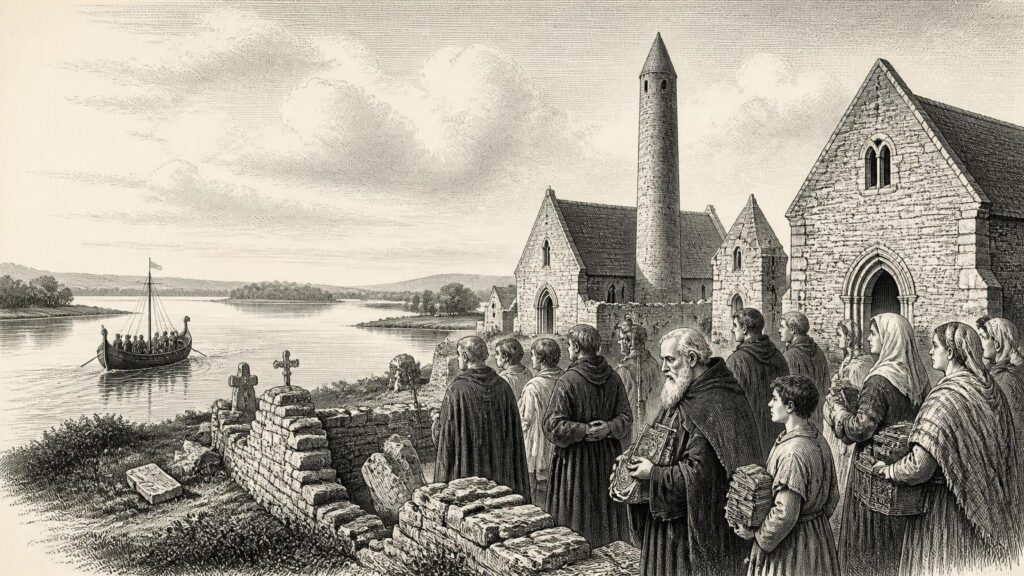
The most enduringly shocking event recorded for 1552 was the plundering of Clonmacnoise by the English garrison of Athlone. The Annals of the Four Masters, compiled later but preserving Irish annalistic traditions, state plainly that the settlement was “plundered and devastated”. Its account lists what was removed or destroyed: the great bells from the round tower, smaller bells, images, altars, books, gems and even window glass. The annalist’s lament for the “city of Ciarán” conveys the scale of the cultural and religious loss as contemporaries or near-contemporaries understood it.
Clonmacnoise stood on the Shannon, south of Athlone, at a crossing-place between regions and political worlds. Founded in the early medieval period, it remained a bishop’s seat and a place of burial, devotion and memory even after its wealth and political standing had declined. Its churches, crosses, grave-slabs, manuscripts and bells represented accumulated religious patronage over centuries. The raid was therefore more than the taking of portable valuables. It damaged an institution whose significance extended far beyond its immediate neighbourhood.
The precise date, immediate trigger and chain of command for the attack are not securely supplied by the annalistic notice. It should not automatically be described as a centrally ordered act of Protestant iconoclasm. Soldiers based at Athlone operated in a frontier garrison economy, and plunder could serve material as well as political purposes. Nonetheless, the episode occurred within an Edwardian programme that had transferred extensive church property to the Crown and pressed religious change from Dublin. For local communities, distinctions between military requisition, opportunistic looting and religious hostility may have mattered less than the visible result: a revered complex had been stripped of objects used in worship, learning and commemoration.
Athlone itself was a crucial Crown bridgehead on the Shannon. Sir William Brabazon, vice-treasurer and constable there, had helped repair and garrison its castle after 1547. The position enabled the administration to project force into the midlands, including territories disrupted by the recent conflicts over Laois and Offaly. But the destruction at Clonmacnoise also exposed the costs of maintaining such outposts. A garrison designed to secure royal communications and revenue could become a source of acute insecurity for neighbouring religious and civilian communities.
War Around Belfast
The principal campaign of 1552 unfolded in Ulster, where Lord Deputy Sir James Croft faced a conflict involving the O’Neill dynasty, the Clandeboye O’Neills, Scottish fighting men and the Dublin administration’s own allies. The background was Conn Bacach O’Neill’s imprisonment. Conn, the first earl of Tyrone under the Crown’s settlement of 1542, had been arrested in 1551 after his rival claimant, Matthew Feardorcha O’Neill, baron of Dungannon, presented himself as the king’s loyal man. Conn’s legitimate son Shane rejected Matthew’s position and fought to restore his father’s authority.
The dispute was not merely a family quarrel. It determined who could command men, exact support and negotiate with the Crown across Tyrone and neighbouring lordships. In the summer of 1552 Shane’s forces dealt Dungannon a serious defeat while he was bringing reinforcements towards Croft. The defeat drastically weakened the Crown’s preferred O’Neill ally. It also made Conn’s release a condition in negotiations, demonstrating that the government’s custody of an earl could not settle the political realities of Tír Eóghain.
To the east, Hugh O’Neill Óg of Clandeboye was resisting Croft alongside Scots who had become an important force in north-eastern Ireland. The Four Masters describes a broad war between the English on one side and Ulstermen and Scots on the other, while acknowledging that not every Ulster lord took the same position. That qualification matters. Alliances in the region were practical and changeable; Gaelic lords could seek assistance from the Crown against rivals, while also opposing Crown garrisons and exactions when their own interests required it.
One expedition reached Belfast. An advance party of English troops and their allies, seeking cattle, was met and defeated by Hugh O’Neill Óg; the annalist gives the enemy dead as forty or sixty, including Mac an tSabháisigh. Croft’s main force then crossed the Lagan and erected or strengthened a castle at Belfast. The government thereby secured a foothold at a strategically useful river-mouth, but the expedition did not produce the political submission it sought. The annals say that the force gained neither hostages nor spoils, conventional measures by which success might be demonstrated.
The campaign was costly even before its conclusion. Brabazon accompanied the Ulster expedition and died on 9 July, apparently from natural causes, while it was under way. His death removed an experienced, formidable and controversial official who had shaped Crown policy from Athlone for years. The annalistic account adds a telling detail: his body was carried by ship to Dublin, while his heart was later sent to the king as a token of loyalty. Whether read as ritual, political theatre or both, the gesture linked an official’s death on the Irish frontier directly to royal service.
A further hosting in the autumn proved no more decisive. According to the annals, Croft’s army destroyed cornfields, lost many men and returned without peace or submission. The burning of crops was a familiar instrument of warfare, intended to weaken opponents by attacking their capacity to feed households, retain followers and sustain armed resistance. It also meant hunger, lost seed and damaged livestock systems for people who were not commanders. The campaign’s failure was thus not bloodless simply because it ended without a single decisive battle.
Money, Mines and Administration
The Ulster war coincided with serious problems in the government’s finances. Croft’s administration inherited an Irish currency badly damaged by debasement. In early June, Edward VI’s government ordered a payment for Ireland and the calling down of the Irish coinage, with bullion to be sent to Dublin for a new issue. The policy aimed to bring Irish money closer to the English standard, but any reduction in the nominal value of coins risked immediate hardship for soldiers, suppliers, wage-earners and debtors. In a military administration dependent on paid troops and purchased provisions, monetary instability was a matter of security as well as commerce.
Croft had also been commissioned in January to examine mining in Ireland, including a dispute involving mining specialists. The inquiry shows London searching for resources that might lessen the cost of governing Ireland. It does not, however, justify claims of a mining boom in 1552. The significant point is the government’s need to find new revenue while its established finances were under scrutiny. An inquiry into the Irish exchequer was under way, and Brabazon’s past disbursements had become a particular concern before his death.
On 2 February, Edward VI formally created the office of Ulster King of Arms and Principal Herald of Ireland. The new officer was given authority over arms, genealogical and heraldic matters, precedence and courtly protocol. The title’s jurisdiction—“all Ireland”—was ambitious. It expressed the Crown’s claim to order the island as a single realm even while its practical authority remained strongest in Dublin, the Pale, garrison towns and districts where local elites co-operated. Such offices were not trivial: they created records, ranked people and made royal authority visible in ceremony. Yet they could not by themselves command obedience in Clandeboye or Tír Eóghain.
Religion and Appointments
Religious policy also hardened in 1552, though its implementation in Ireland remained uneven. George Dowdall, archbishop of Armagh, had left Ireland in 1551 rather than accept the Edwardian reforms. On 28 October 1552 the Crown nominated Hugh Goodacre, an English Protestant cleric, to Armagh. Six days earlier, on 22 October, it had nominated the polemicist John Bale to the bishopric of Ossory. These were nominations, not evidence that either diocese had already accepted a reformed church order: both men arrived and were consecrated only in 1553.
The appointments nevertheless marked a change in approach. Croft had found that enforcing royal supremacy and the reformed liturgy through existing Irish bishops met passive resistance. Goodacre and Bale were chosen precisely because they were committed Protestants from England. The 1552 English prayer book was being introduced in England, but it did not straightforwardly replace the 1549 prayer book already printed and used in Ireland. Later disputes surrounding Bale’s consecration show how uncertain liturgical practice remained even in Dublin. In much of the country, language, local clerical loyalties and limited governmental reach made uniform worship an aspiration rather than a reality.
A Change of Governors
Croft’s departure closed the year’s cycle of frustrated campaigning. On 7 November, Edward VI appointed the lord chancellor, Sir Thomas Cusack, and Sir Gerald Aylmer, chief justice of the king’s bench, to govern jointly in Croft’s absence. They were sworn as lords justices on 4 December. Their appointment placed experienced Irish office-holders, rather than another incoming soldier, at the head of government.
Elsewhere, the annals record the hanging of Teige O’Rourke, tanist of Breifne, by his own people; the killing of members of the MacSweeney family in a monastery; conflict within Thomond; and a new war between O’Reilly and the English. These brief notices should not be inflated into a single national crisis. They do, however, show that power in 1552 was negotiated and fought locally as well as between Dublin and its opponents. Clonmacnoise’s emptied churches, Belfast’s contested fortification and Croft’s unrewarding hostings together capture the year’s central reality: Tudor institutions were extending their presence, but Ireland’s political landscape had not been made governable on Tudor terms.
Primary Sources
- Annals of the Four Masters, Part 6: Annal M1552
- Croft(s), Sir James
- Bale, John
- Goodacre, Hugh
- Brabazon, Sir William
- O'Neill (Ó Néill), Conn ‘Bacach’
- O'Neill (Ó Néill), Matthew (Feardorcha)
- O'Neill (Ó Néill), Shane (Seaán)
- Dowdall, George
- Cusack (Cusacke, Cusake), Thomas
- Office of the Chief Herald of Ireland
- Office of Arms
- Norroy and Ulster King of Arms
- Creation of Ulster King of Arms (1552)
- Book of Common Prayer
- Printing of Ireland's First Book to Be Commemorated
- Clonmacnoise Visitor Guide
- An English Bishop Afloat in an Irish See: John Bale, Bishop of Ossory, 1552–3
- Calendar of State Papers: Ireland, Tudor Period 1547–1553
- Calendar of Ormond Deeds, Volume V, 1547–1584
- The Coinage of Edward VI in His Own Name
- History of England, Volume V: Edward VI's Journal and the Irish Coinage
- Life of Chancellor Cusack: Concluded