

Daingean and Kilmacrennan1537 CE
In 1537, Henry VIII’s government intensified its authority in Ireland, executing Silken Thomas FitzGerald and five uncles, investigating Lord Deputy Leonard Grey, and enacting Reformation statutes asserting royal supremacy, restricting Rome and enabling religious suppression. Their impact remained uneven beyond government-controlled districts. Grey’s expedition demolished Daingean castle in Offaly, yet O’Conor Faly recovered power. In Tír Chonaill, Aodh Dubh O’Donnell died and Manus O’Donnell was inaugurated at Kilmacrennan, though rivalry persisted; Manus subsequently campaigned in Lower Connacht. Conflict also disrupted Clandeboye and Fermanagh, where Cuconnacht Maguire was killed. Deaths, warfare and legislation reshaped lordships, but Gaelic structures proved resilient locally.
Dateline
In 1537, Ireland was not a country in which one political development could be assumed to govern every region alike. The Dublin administration of Henry VIII was attempting to turn a contested lordship into a more direct instrument of royal authority, while Gaelic and Gaelicised lordships retained their own military resources, succession practices, diplomatic connections and religious institutions. The year therefore brought several distinct but connected shocks: the final destruction of the senior Kildare leadership, legislation reshaping church and crown, a hard campaign in Offaly, and consequential changes of lordship in Tír Chonaill and Fermanagh.
The End of Silken Thomas
The most firmly dated political event came on 3 February, when Thomas FitzGerald, known to later history as ‘Silken Thomas’, was executed at Tyburn in England with five of his paternal uncles: James, Oliver, John, Walter and Richard FitzGerald. Thomas had led the Kildare revolt of 1534, after reports that his father, the ninth earl, had been killed in London. The rebellion had been defeated, but the executions made clear that Henry VIII would not restore the family which had so long dominated the government of the English lordship in Ireland.
This was more than a punitive episode at a distance from Ireland. The Kildare earldom’s lands, offices and affinity had bound together many people in Leinster and the Pale, including clergy, tenants, armed retainers and neighbouring lords. The removal of its adult male leaders created both a vacuum and a danger. The young Gerald FitzGerald, Thomas’s half-brother and eventual claimant to the earldom, remained beyond royal control. In the language of crown government, association with the Geraldine cause could now be made to look like treason; in the experience of many Irish families, it was a question of kinship, protection and local survival.
Lord Deputy Leonard Grey stood awkwardly at the centre of this new order. He had accepted Thomas’s surrender in 1535 after giving assurances for his life, only for the king to ignore them. By 1537 Grey was expected to secure the frontier, cut military costs and win obedience from Irish lords, yet he also inherited the political consequences of the Kildare destruction. His critics in Dublin and at court increasingly suspected his motives and conduct. On 31 July Henry VIII appointed George Paulet and Sir Anthony St Leger to investigate accusations against the deputy. No decisive verdict followed immediately, but the commission shows that the crown’s Irish administration was itself divided while it pressed its claims outward.
A Reformation by Statute
The parliament summoned in 1536 continued its work into 1537. Its surviving statute roll is unusually important: it is the only complete roll from Henry VIII’s Irish Reformation parliament to survive the destruction of the Four Courts records in 1922. The measures associated with its 1536–7 sittings gave statutory force in Ireland to Henry’s supremacy over the church, restricted appeals to Rome, expanded the reach of treason law and advanced the legal process by which religious houses could be suppressed and their property transferred to the Crown.
These enactments made a formidable claim, but not an instant transformation of belief or practice across the island. The king’s writ was strongest in the Pale and other districts accessible to the Dublin government. Beyond them, lordship, churches and religious communities remained embedded in local political worlds. The legislation nevertheless mattered everywhere in principle: it declared that Henry and his heirs, rather than the pope, possessed supreme headship over the Church of Ireland. It also made refusal and resistance more dangerous for office-holders and clergy within the government’s reach.
For monasteries, friaries, priories and nunneries, 1537 marks the beginning of a sustained and disruptive process, not the moment when every house suddenly vanished. Modern research emphasises the uneven pace of suppression. Only a small number of houses closed in the summer of 1537, while many more survived for years, especially outside areas effectively controlled from Dublin. Yet the direction of travel was unmistakable. Endowments, tithes, mills, farms, hospitality and burial rights could all become objects of official enquiry and lay ambition. Religious communities were not simply buildings: they offered worship, alms, schooling, lodging and employment, and their landed revenues connected them to tenants, craftsmen and patrons.
The Annals of the Four Masters, compiled in the seventeenth century from earlier materials, gives a strongly Catholic retrospective account of this rupture. Its 1537 entry denounces the royal claim to headship and describes the seizure of religious property and the destruction of sacred objects. That testimony should not be read as a literal, simultaneous record of every Irish monastery’s fate in this single year; the annalist telescoped a longer process. It is, however, powerful evidence of how the Henrician changes were remembered in learned Gaelic historical culture: as an attack on inherited religious life, its communities, relics and material supports.
Daingean and Offaly
Military events showed the limits of parchment authority. Annála Connacht records that the English justiciar led an expedition into Offaly and demolished the castle of Daingean, described by the annalist as exceptionally strong in both position and equipment. The force killed people, took booty and devastated O’Conor Faly territory. The date is securely placed in 1537, though the annal does not assign a day or month.
The destruction of a castle was a political act as well as a military one. Strongholds protected a lord’s household, stores and dependants; they could also anchor control of routes and exactions. Their demolition announced that the crown could strike at the infrastructure of lordship on the Pale’s western approaches. But the campaign did not settle Offaly. The Annals of the Four Masters reports that O’Conor Faly regained dominion in his territory during the same year, against the wishes both of the English deputy and rival kinsmen. The pattern is revealing: a royal expedition could burn, seize and break fortifications, while local power could revive through family alliances, armed followings and knowledge of the country.
For non-combatants, such warfare had immediate consequences. Annalists measure success in cattle, spoils, burnt settlements and destroyed corn because these were the resources on which communities lived. A campaign through Offaly or Lower Connacht was therefore not a remote contest between leaders. It threatened stored food, livestock, seasonal labour, household goods and the security of people who might be compelled to provide guides, provisions, hostages or military service.
A New O’Donnell
The north-west experienced an important succession on 5 July. Aodh Dubh O’Donnell, lord of Tír Chonaill, died at Donegal Franciscan monastery after taking the Franciscan habit, according to the Annals of the Four Masters. The annal gives the day as a Wednesday and portrays him as a ruler whose influence reached far beyond Donegal, into Fermanagh, Lower Connacht, Inishowen and other neighbouring territories. Its praise is conventional and partisan, but it accurately conveys the scale of lordship which was at stake.
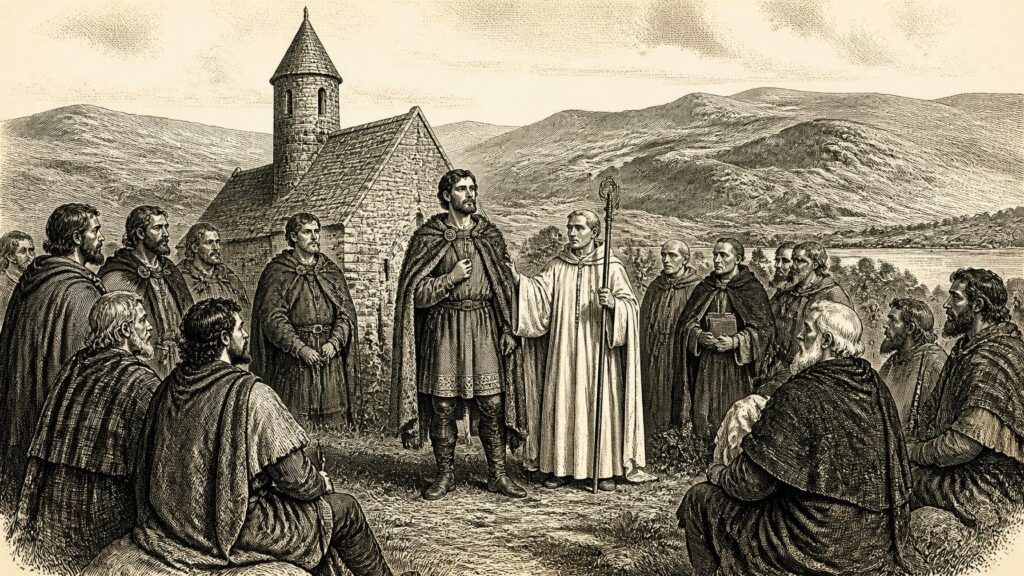
Manus O’Donnell was inaugurated in his father’s place at Kilmacrennan by the successors of St Colum Cille, with the advice of Tír Chonaill’s lay and ecclesiastical nobles. This was not primogeniture operating automatically. Inauguration required recognition by leading kin, churchmen and learned custodians of a local sacred and political tradition. Manus inherited a lordship already troubled by rivalry with his half-brother Aodh Buidhe, who held Donegal castle with support from the sons of O’Boyle. Thus the accession did not end disorder; it established a new centre from which Manus had to negotiate, reward allies and fight.
His correspondence also points to the wider connections available to a Gaelic ruler. Bristol merchants carried news of Aodh Dubh’s death and Manus’s inauguration to Lord Deputy Grey. Such letters were practical diplomacy: they enabled Manus to present himself to Dublin as the acknowledged lord while seeking room to manage his domestic enemies. He was already a cultivated figure, known for patronage of Gaelic learning and for the earlier compilation of a life of St Colum Cille. In 1537, political authority, religious prestige and learned culture remained closely interwoven at Donegal.
By September Manus was asserting that authority with force. The annals record his expedition into Lower Connacht, where corn was destroyed and districts including Carbury, Tireragh, Corran and Tírerrill were burned. He took O’Hara Reagh’s castle and carried O’Hara away as a hostage after granting him protection. The paired ideas of destruction and protection are important. Violence was used not solely to eliminate opponents but to extract submission, hostages and future service.
Unsettled Lordships
Other northern events underline how rapidly political fortunes could change. Conn O’Neill entered Trian Conghail, or Clandeboye, plundering widely, but his son was captured near Belfast. When the local lord Niall Óg O’Neill died suddenly, Conn returned and recovered his son; a dispute over the lordship followed. In Fermanagh, Cuconnacht Maguire was killed on 8 October on an island in Lough Erne belonging to the friars. His burial was first at Devenish and later at Donegal Franciscan monastery, a reminder that religious houses remained active centres of burial, memory and elite connection even as the Dublin parliament remade ecclesiastical law.
1537 thus left no simple picture of a crown steadily conquering an island. Henry VIII’s government gained laws, confiscatory powers and striking military successes, but it faced resilient and adaptive lordships. The deaths of FitzGerald, O’Donnell and Maguire rearranged political landscapes without making them predictable. At Daingean, Kilmacrennan, Donegal and Lough Erne, the year exposed the competing structures through which people in Ireland understood security, authority, religion and inheritance.
Primary Sources
- Annála Connacht: Annal 1537
- Annals of the Four Masters
- Grey (Gray), Lord Leonard
- O'Donnell, Manus (Ó Domhnaill, Maghnas)
- O'Donnell (Ó Domhnaill), Sir Aodh Dubh
- FitzGerald, Thomas (‘Silken Thomas’)
- Statute Rolls of the Irish Parliament
- Ireland in the Reign of Henry VIII
- Treason and Dissimulation in the Henrician Reformation: Leonard Grey and the Polarisation of Politics in the Irish Pale, 1534–40
- Religious Communities and Their Closures in Ireland during the Sixteenth Century
- Why the Reformation Failed in Ireland
- Female Religious Communities and the Henrician Suppression Campaigns
- Dissolution of the Monasteries, 1536–1540
- Calendar of State Papers, Ireland: Tudor Period, 1509–1547
- Calendar of the State Papers Relating to Ireland, 1509–1573
- Letters and Papers, Foreign and Domestic, Henry VIII
- Library Catalogue: Lord Leonard Grey Manuscripts
- Letter from the Lord Deputy and Council of Ireland in Answer to the King's Letter, 20 April 1537
- Reform as Process: The Viceroyalties of Lord Leonard Grey and Sir Anthony St Leger, 1536–1547
- Reform Government, 1536–1578
- The Irish Reformation Parliament of Henry VIII, 1536–7
- The Viceroy and His Critics: Leonard Grey's Journey Through the West of Ireland, June–July 1538