

Maynooth’s Broken Pardon1535 CE
In 1535, the Kildare rebellion collapsed through military defeat, fractured alliances and Thomas FitzGerald’s surrender. Crown artillery captured Maynooth Castle in March, after which surrendered defenders were executed, creating the notorious memory of Maynooth’s pardon. Gaelic allies submitted or negotiated as royal pressure intensified. Leonard Grey received Thomas’s surrender in August and escorted him to England, where imprisonment preceded execution in 1537. Government forces also captured Dungarvan, while northern agreements revealed dependence on powerful local lords. Skeffington’s death closed a campaign. Victory dismantled Geraldine power without establishing secure government across Ireland, leaving authority contested through rivalries, coercion and fragile bargains.
Dateline
A Rebellion Reaches Its Breaking Point
In 1535, Ireland stood in the violent aftermath of the Kildare rebellion. Thomas FitzGerald, tenth earl of Kildare and better known in later tradition as ‘Silken Thomas’, had renounced obedience to Henry VIII in Dublin in June 1534. Yet it was the campaigning of 1535, rather than that dramatic declaration, which determined the rebellion’s fate. The year brought the destruction of the FitzGerald military centre at Maynooth, the progressive unravelling of Thomas’s alliances, his surrender and removal to England, and the death of the crown commander who had defeated him. It also exposed how precarious royal authority remained beyond the towns and lordships most closely tied to Dublin.
The conflict was not a straightforward contest between an English state and an Irish population. Thomas FitzGerald was an Old English magnate, heir to a family that had dominated the king’s government in Ireland for generations. His opponents included fellow Old English families, especially the Butlers, as well as crown officials and a substantial English expeditionary force. His support came from his own tenants and retainers, from Gaelic Irish lords with their own interests, and from people whose loyalty could change quickly when military pressure, hostages, kinship or local rivalries required it. The collapse of Kildare power therefore reshaped politics in Leinster and the midlands far beyond the rebellion’s immediate battlefield.
The Siege of Maynooth
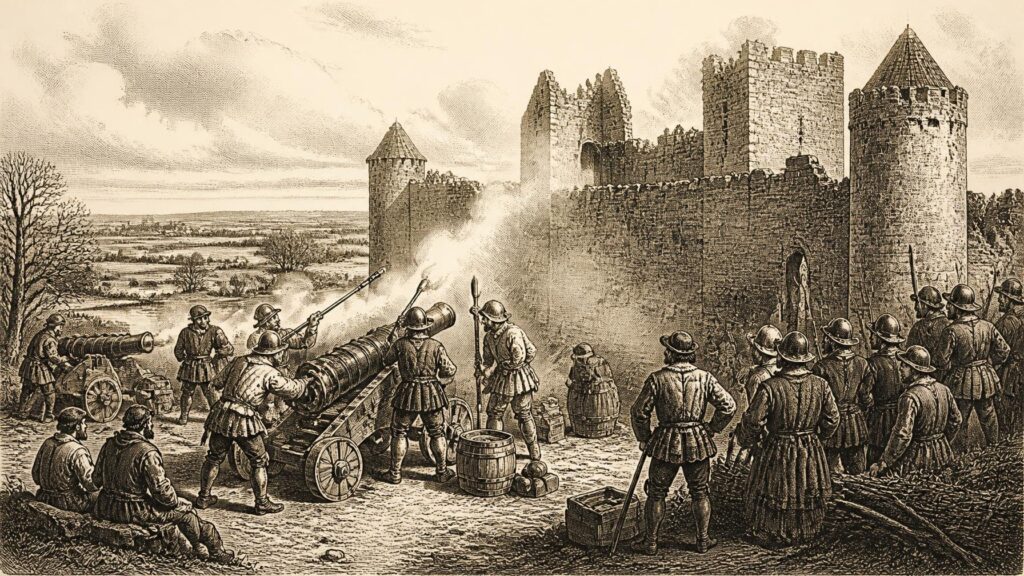
The most firmly dated event of the year was the crown assault on Maynooth Castle, the FitzGeralds’ great residence in County Kildare. Sir William Skeffington, the lord deputy, began the siege on 14 or 15 March; by 23 March the outer works had fallen and the castle was in government hands. Sources agree on the essential outcome, though some details in later narratives are less secure. The fortress was breached by artillery, a conspicuous demonstration of the destructive capacity which royal forces could bring against a great lord’s medieval stronghold. Maynooth was not merely a defensible building: its hall and household had long been a centre of Geraldine patronage, administration and political culture. Its loss was therefore materially and symbolically devastating.
The siege became notorious because the defenders who capitulated were executed. The episode was remembered as the ‘Pardon of Maynooth’, an ironic phrase for a surrender followed by death. Christopher Paris, the castle’s constable and Thomas FitzGerald’s foster-brother, was widely said to have yielded the place for a bribe; accounts also report that he, too, was executed. The precise sequence and extent of his alleged betrayal cannot be treated as beyond doubt, but the execution of prisoners after surrender is well attested. Skeffington’s action secured the castle, yet it damaged his standing and supplied opponents with a durable example of royal bad faith.
For people living around Maynooth, the campaign meant more than the fall of a castle. Both sides relied on raiding, the destruction of supplies and the seizure of livestock to deny resources to their opponents. Military columns required food, fodder, transport and labour; communities on contested routes faced plunder, displacement and coercive demands. The government’s English troops, local gentry, mounted men, artillery crews and Irish kern were not detached from the country through which they moved. Their maintenance was a direct burden on it. Evidence does not permit a detailed reconstruction of every village’s experience in 1535, but the destruction of Geraldine settlements and the dispersal of armed followers make clear that the war reached well beyond aristocratic households.
Allies, Hostages and Submission
Maynooth’s fall shattered Thomas FitzGerald’s strategic position. He had avoided a decisive pitched battle against Skeffington’s larger force, instead depending on the castle, mobile forces and support from Gaelic allies. Once the fortress was gone, the alliance began to fracture. Conall O’More of Laois was compelled in April to leave the Geraldine side, give hostages and promise support to the government. Other figures in the midlands adjusted their positions as royal troops and Butler pressure advanced. Such submissions did not mean that the crown had permanently mastered these lordships. They show, rather, how political allegiance in a crisis could be negotiated through hostages, protection, military threat and calculation.
Thomas sought refuge first in Leinster and then in Thomond, where Conchobhar O’Brien gave him shelter. The wider conflict entered his refuge as well. In October, O’Brien wrote to Henry VIII attempting to excuse his conduct, evidence of the pressure created by the rebel leader’s presence. Thomas had hoped to obtain help from abroad, particularly from Spain, but no rescue materialised. This was an age in which Irish political actors watched continental affairs closely and could imagine alliances with England’s enemies. In 1535, however, the expected external support did not arrive in a form capable of reviving the Geraldine cause.
In July, Skeffington reached an agreement at Drogheda with Con Bacach O’Neill. O’Neill promised allegiance to Henry VIII in return for the deputy’s protection and support. The arrangement was significant not because it made Tyrone securely royal, which it did not, but because it reveals the crown’s immediate method: negotiated connections with powerful lords, not direct control of the whole island. In the north-west, Aodh Dubh O’Donnell was simultaneously entangled in a dynastic struggle with his son Manus and sought assistance from Skeffington. These northern developments were not caused simply by the Kildare rebellion, but they demonstrate why Dublin’s government could never treat 1535 as a conflict confined to Kildare alone.
Leonard Grey and Thomas FitzGerald
Lord Leonard Grey arrived in Ireland on 28 July as marshal of the royal army, not yet as lord deputy. His family connection made his role especially delicate: his sister Elizabeth was Thomas FitzGerald’s stepmother. On 24 August Thomas and Brian O’Connor Faly surrendered to Grey. Contemporary and later accounts differ in tone over the terms. Annalistic writers portrayed Grey as having enticed Thomas with assurances of pardon, while English governmental evidence suggests wording sufficiently encouraging to trouble the Irish council after Henry VIII rejected any generous settlement. What can safely be said is that Thomas expected mercy or, at least, hoped for it; Henry’s government was unwilling to let so formidable a dynastic rival recover his liberty and estates.
Grey escorted Thomas to England in September, and the earl was lodged in the Tower of London. His eventual execution with five FitzGerald uncles belongs to February 1537, not to 1535. That distinction matters. In this year, the rebellion was militarily defeated and its leader imprisoned, but the full legal destruction of the Kildare house still lay ahead. Nor did Thomas’s surrender remove every source of resistance. Geraldine retainers, displaced allies and competing lordships remained active factors in Irish politics.
Government Beyond Kildare
Royal success in Leinster encouraged Skeffington and the Butlers to pursue other strategic objectives. In September, Skeffington and James Butler captured Dungarvan Castle in County Waterford from FitzGerald interests. The operation demonstrated that the crisis of Kildare authority created opportunities for rivals in Munster as well as Leinster. Dungarvan was a fortified coastal town and manor with local economic importance; control of it concerned rents, jurisdiction, harbour access and regional influence, not merely a point on a military map. The campaign also sharpened the rivalry between the Butler interest and those officials who feared that one victorious magnate might become dangerously dominant in the vacuum left by the Kildares.
The administration itself was unstable. Thomas Cusack was appointed chief justice of the court of common pleas in May, but lost the office in August after only a few months. Such changes indicate that victory did not bring an orderly political settlement. Officials had to balance military expenditure, local alliances, the claims of the Butlers and the question of how far former Geraldine supporters could be reconciled. Crown lands and confiscated rebel property offered rewards, but also invited competition. The huge costs of the expedition and garrison made the apparent restoration of authority an expensive achievement.
Religion formed part of the rebellion’s background but should not be overstated for this particular year. Thomas’s earlier revolt had used language hostile to Henry VIII’s breach with Rome, and Catholic loyalties could be politically mobilised. Yet the Irish parliamentary legislation establishing the royal supremacy and initiating large-scale dissolution measures came in 1536, after Skeffington’s death. In 1535, monasteries, parish churches and cathedral institutions still stood within their established legal framework. Religious houses also remained embedded in lordly networks: the Annals of Connacht record the death and burial at Donegal monastery of Siubhán O’Neill, wife of Manus O’Donnell, a small but revealing reminder that dynastic life, commemoration and monastic places continued amid political upheaval.
An Unfinished Victory
Skeffington died at Kilmainham on 31 December 1535, having summoned a parliament that he would not live to see meet. His death closed a year in which artillery, executions, negotiated submissions and the removal of one young earl had overturned the political order centred on Maynooth. But it did not create a settled Tudor Ireland. The former Kildare sphere had become a contested frontier, Gaelic and Old English lords retained formidable power, and the crown still governed much of the island through fragile bargains. The events of 1535 made later reform, confiscation and conquest more likely; they did not yet make them inevitable or complete.
Primary Sources
- Skeffington, Sir William
- FitzGerald, Thomas (‘Silken Thomas’)
- Grey (Gray), Lord Leonard
- O'Connor Faly (Ó Conchobhair Failghe), Brian
- O'More (Ó Mordha), Conall
- O'Brien (Ó Briain), Conchobhar
- Paris, Christopher
- Cusack (Cusacke, Cusake), Thomas
- Eustace, Sir Thomas
- O'Donnell (Ó Domhnaill), Sir Aodh Dubh
- O'Donnell, Manus (Ó Domhnaill, Maghnas)
- Annála Connacht: 1535
- Annals of the Four Masters: 1535
- Annales Breves Hiberniae
- State Papers, Volume II
- Maynooth Castle
- Maynooth Castle
- The Age of Atrocity: Massacre in Naas, 1535
- Rebel Women in Tudor Ireland—Some Case-Studies
- One World: The Communities of the Southern Dublin Marches
- County Waterford: City Urban Archaeological Survey