

Bellahoe and Holy Trinity1539 CE
In 1539, Conn Bacach O’Neill and Manus O’Donnell allied, solemnising their pact at a Donegal friary, while Manus consolidated influence through tribute, hostages and agreements. Their raid through Meath reached Tara but ended in defeat when Lord Deputy Leonard Grey intercepted their returning force at Bellahoe. The battle demonstrated Dublin’s capacity to punish incursions, though northern lordships remained resilient. Meanwhile, Henrician commissioners advanced religious reform, suppressing houses, redistributing property and remodelling Holy Trinity, Christ Church, as a secular cathedral. Deaths, disputed successions and destructive June storms further exposed widespread persistent insecurity. Royal authority and reform remained uneven outside government-controlled districts.
Dateline
In 1539, Ireland’s political and religious tensions became unusually visible in two very different places: at Bellahoe, on the Monaghan–Meath frontier, where Lord Deputy Leonard Grey routed a northern confederate army; and in Dublin, where the Crown pressed forward with the dissolution and remaking of religious institutions. These were connected developments. Henry VIII’s government sought not merely obedience from Irish lords but a new order in which royal authority, reformed religion and confiscated ecclesiastical resources reinforced one another. Yet the year also shows the limits of that ambition. Beyond the government’s strongest districts, Gaelic lordships retained their own political languages, alliances, clerical networks and methods of rule.
A Northern Accord
The most consequential Irish alliance of the year joined Conn Bacach O’Neill, lord of Tír Eoghain, with Manus O’Donnell, lord of Tír Chonaill. Their partnership was notable precisely because the two dynasties had long competed for influence in Ulster. The Annals of Ulster place O’Neill in Donegal around the beginning of Lent, and record that, about Easter, he and Manus made a firm peace in the O’Donnell town. The agreement was sworn upon the relics of the Franciscan friary and bound the parties to aid one another against all opponents. This was both a diplomatic compact and a religiously solemn act: relics, friars and sacred space could still supply the public guarantees by which major political commitments were made.
Manus had entered 1539 from a position of strength. In the winter between Christmas and St Brigid’s Day he led a hosting into lower Connacht, exacting three years’ tribute and taking hostages before returning safely to Tír Chonaill. Hostages were not incidental prisoners but instruments of government: their delivery demonstrated submission and gave an overlord leverage over a dependent community. Manus’s rule also rested on writing as well as warfare. On 23 June, an agreement concerning Sligo Castle recorded that Tadhg O’Connor would hold that strategically important place from O’Donnell. The compact was guaranteed by leading clerics and learned families of Tír Chonaill, evidence of the continuing political importance of professional churchmen and literate hereditary learned lineages in Gaelic administration.
The O’Neill–O’Donnell understanding coincided with wider Geraldine discontent after the destruction of the Kildare earldom. Grey’s enemies in Dublin feared that northern lords intended to advance the cause of the young Gerald FitzGerald, the surviving Kildare heir, while resisting the Henrician religious programme. Such anxieties were heightened by reports of Scottish military involvement and by the continuing presence of Hebridean mercenaries and settlers in north-east Ireland. They should not, however, be mistaken for a unified national movement. The coalition was a contingent alignment of lords with different territorial aims, family interests and grievances against the Dublin government.
Marches, Raids and Bellahoe
Grey had already tested northern power in the spring. The Annals of Ulster report that, around May Day, the lord deputy led a hosting against O’Neill and spent two nights at Armagh. The descendants of Aodh O’Neill asked him not to destroy or burn the town of their patron saint; Grey accepted their counsel, and a fortnight’s truce followed. This brief episode illuminates the practical constraints on war. Armagh mattered as a sacred and political centre, and even an army sent to coerce O’Neill had reason to avoid alienating local interests by attacking it.
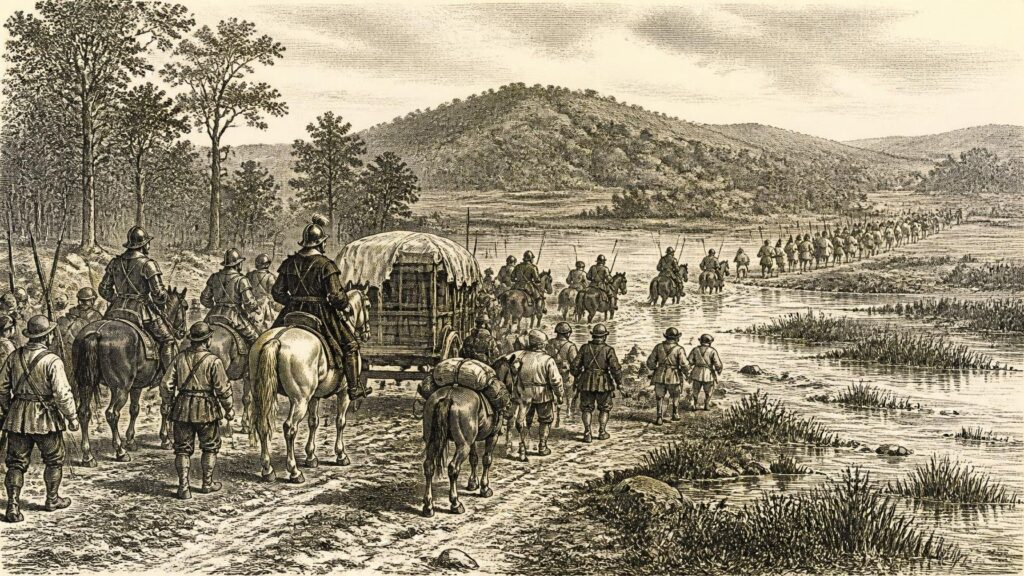
Later in the year, the northern allies carried the conflict south into Meath. The Annals of the Four Masters say that O’Neill and O’Donnell marched with a single purpose, burning and spoiling communities as far as Tara which refused submission. They took substantial movable wealth—gold, silver, copper, iron and other goods—and plundered Ardee and Nuachongbhail, generally identified with Navan. The annalist’s language naturally magnifies the achievement, but it conveys an important reality: raids were designed to acquire cattle, goods and political obedience while exposing the inability of a rival authority to protect its people. For inhabitants of the route through Meath, the immediate experience was the loss of foodstocks, livestock, household goods and the security of settled life.
Grey’s response was rapid and collective. According to the same annalistic account, he summoned the English of Ireland, the forces of the leading Meath towns, ecclesiastical as well as lay, and vessels from nearby harbours, especially Carlingford Lough. The description should not be read as a precise muster roll, but it captures the resources on which the Dublin administration depended: Pale landholders, urban communities, church interests, coastal communications and the deputy’s own soldiers. This was not a simple encounter between “English” and “Irish”. Grey’s army drew upon Irish towns and local allies, while O’Neill and O’Donnell commanded lordships with their own mixed networks of tenants, clients and fighting men.
The government force caught the returning army at Bellahoe, in Farney, County Monaghan. The Four Masters state that the northern host was unable to form proper battle order, ignored advice to hold its ground, and broke into flight, abandoning much of its own property and the spoil taken in Meath. The annalist records losses among ordinary followers and names one prominent casualty, Máelmhuire Mac Suibhne. Modern reference accounts therefore describe Bellahoe as a serious defeat for O’Neill and O’Donnell, but the surviving evidence does not justify a confidently precise body count or a detailed reconstruction of the fighting. Its political significance is clearer than its tactical detail: Grey had demonstrated that a large raid into the Pale could still be pursued and punished at the northern approaches.
Reforming the Religious Landscape
While armies moved through Ulster and Meath, the government intensified its assault on the institutional church in the areas it could reach. A royal commission of 3 February ordered investigation and removal of images and relics associated, in its hostile language, with pilgrimage and “superstition”. On 7 April, commissioners including Lord Chancellor John Alen, Archbishop George Browne, William Brabazon, Robert Cowley and Thomas Cusack received instructions concerning the surrender of religious houses. These measures formed part of the Henrician Reformation, but in Ireland their effectiveness was uneven and geographically limited. The official rhetoric of idol-breaking travelled further than the government’s secure administrative power.
The pressure created immediate material incentives. Archbishop Browne wrote on 21 May that news of suppression was so widespread that religious communities were disposing of goods before the commissioners arrived, to the prospective loss of the king. On the same date Grey and the Irish council urged Thomas Cromwell to preserve six major houses in altered form. Their argument was revealingly practical: such establishments housed councillors and officials, and educated young people, including girls as well as boys, in virtue, English language and behaviour. Even advocates of the Crown’s programme therefore recognised monasteries and collegiate churches as lodgings, schools, employers, landlords and storehouses of local expertise—not merely religious communities.
Dublin offered the clearest instance of adaptation rather than straightforward destruction. All Hallows, already surrendered in late 1538, was granted with its possessions to Dublin corporation early in 1539, partly in acknowledgement of the city’s suffering and service during the Kildare rebellion. Its case shows how dissolution could redirect religious property into civic hands, although the transfer also generated manoeuvring over leases and valuables. Christ Church was more difficult still. It was at once an Augustinian priory, a cathedral and a venue for parliamentary and council business. Dublin’s civic leaders and Grey argued that its loss would encourage the king’s enemies. The royal warrant of 12 December 1539 ended the monastic constitution of Holy Trinity while preserving the church’s cathedral role through a new secular arrangement.
The process had personal consequences. A September warrant provided pensions for former members of St Thomas’s Abbey in Dublin, including Patrick Clinch, identified as its organist. Such records offer a rare glimpse beyond high politics: the disappearance of a house meant altered livelihoods not only for abbots and priors but for musicians, servants, tenants, artisans and dependants. The survival of pensions did not replace the communal routines, patronage and charitable functions formerly sustained by a religious house. Nor did religious change erase older loyalties. In Gaelic regions, friaries continued to serve as places of devotion, commemoration, diplomacy and learned activity, as the Donegal oath earlier in the year makes plain.
Loss, Succession and Weather
Other events underscored how unstable lordship could be. On 26 April, Cormac Maguire, tanist of Fermanagh, was killed by members of his own following. The annals also record killings and contested authority among the Maguires, O’Boyles and O’Melaghlins. In Thomond, Conor O’Brien died and Murrough O’Brien was inaugurated in his place. In Leinster, Piers Ruadh Butler, eighth earl of Ormond and first earl of Ossory, died in August, removing a formidable magnate whose recovered Ormond title had helped rebalance politics after Kildare’s fall. These were not peripheral notices: succession, assassination and inauguration determined who could command men, collect dues and make peace.
The year also brought an environmental shock. The Annals of Ulster record exceptional thunder and lightning in mid-June which destroyed much of the crops and fruit. No island-wide harvest calculation survives, and the annal cannot establish a general famine. It does, however, preserve a local warning of vulnerability in a society where grain, orchards, livestock and stored produce underpinned rents, hospitality and military provisioning. Against that background, the raids in Meath and the institutional disruption in Dublin carried an even sharper human weight. By year’s end, Bellahoe had checked a northern offensive and Holy Trinity had been remade, but neither royal power nor religious reform had settled Ireland.
Primary Sources
- Annals of the Four Masters, Part 4
- Annals of Ulster, Part 162
- Grey (Gray), Lord Leonard
- O’Neill (Ó Néill), Conn ‘Bacach’
- O’Donnell, Manus (Ó Domhnaill, Maghnas)
- O’Donnell (Ó Domhnaill), An Calbhach
- Butler, Piers (‘Piers Ruadh’)
- O’Neill (Ó Néill), Matthew (Feardorcha)
- Religious Communities and Their Closures in Ireland during the Sixteenth Century
- State Papers: King Henry the Eighth, Volume III
- Letters and Papers, Foreign and Domestic, Henry VIII, 1539
- Christ Church
- Agreement between Ó Domhnaill and Tadgh Ó Conchobhair concerning Sligo Castle (23 June 1539)
- On the Fringe and in the Middle: The MacDonalds of Antrim and the Isles 1266–1586
- The Archaeology of the Medieval Irish Church, 1100–1700
- Irish Church Music, 1538 to 1598
- The Dissolution of the Monasteries
- Annales Hiberniae
- The Annals of Ulster
- The History of the Diocese of Dromore
- Tales of the Butlers of Ormonde