

Lifford’s Autumn Surety1524 CE
In 1524, severe weather and cattle losses heightened insecurity across Ireland, where raiding, dynastic conflict and magnate rivalry shaped political life. Henry VIII restored Gerald FitzGerald, ninth earl of Kildare, as lord deputy, ending Piers Butler’s tenure but not their feud. Allied with Conn Bacach O’Neill, Kildare campaigned in Tír Chonaill against Aodh Dubh O’Donnell. After night fighting, negotiation produced a peace guaranteed by Kildare and reinforced by spiritual kinship. Violence nevertheless continued in Ulster, Breifne and Munster. Annalistic obituaries stressed hospitality, patronage and charity as essential marks of lordship, while warfare’s costs fell upon rural communities throughout the island.
Dateline
In 1524, Ireland’s political map was not divided simply between an English-controlled Pale and an independent Gaelic world. Authority was negotiated through kinship, military following, hostage-taking, tribute, office and personal reputation. The year brought a striking illustration in the north-west, where Gerald FitzGerald, ninth earl of Kildare and the king’s lord deputy, marched into Tír Chonaill with Conn Bacach O’Neill of Tír Eógain, only to make peace with their opponent, Aodh Dubh O’Donnell. Kildare’s role as guarantor of that settlement briefly made him a broker between powerful Irish lordships. It also showed the limits of that achievement: the rivalries that had produced the expedition were far from settled.
A Harsh Beginning
The year opened under difficult conditions. Both the Annals of Ulster and Annála Connacht record severe weather and losses among cattle at its beginning. Neither chronicle quantifies the damage, and it would be unsafe to turn their terse notice into a claim of general famine. Yet cattle were central to wealth, food, transport, dairy production, rent and compensation. A destructive season therefore affected households far beyond the people who owned large herds. For tenants and smaller farmers, the loss of animals could narrow the margin between security and debt; for lords, it reduced the movable resources on which hospitality, warfare and political obligations depended.
That vulnerability formed the background to a year in which raiding remained a normal, if ruinous, instrument of politics. Armies did not live apart from the countryside. They took cattle, burned crops and buildings, seized prisoners and demanded food, while communities concealed goods in woods, islands and defended places. The annals’ attention to plunder should not be mistaken for a complete account of ordinary life, but it makes clear that conflict was experienced in fields, farmyards and settlements as much as in set-piece encounters.
Kildare Returns to Office
In Dublin and the Pale, 1524 marked a major change in government. The contest between Kildare and his old rival Piers Butler, earl of Ormond, had paralysed the administration. Butler had held the deputyship from 1522, while Kildare, returned from England in January 1523, behaved as a man determined to recover it. Their followers’ private quarrels and rival alliances made the dispute more than a personal feud: it shaped the Crown’s ability to protect the four obedient shires and to exercise authority beyond them.
Henry VIII intervened in May, removing Butler and appointing Kildare lord deputy. The appointment did not end the rivalry. A settlement binding the two magnates to peace followed in July, but it rested on fragile promises. On 4 August Kildare formally assumed office. Conn Bacach O’Neill, his kinsman and ally, carried the sword of state in the ceremonial entry. That detail mattered. It displayed a political partnership between the chief governor appointed in the king’s name and one of the greatest Gaelic rulers in Ireland. The deputyship was a royal office, but in practice its effectiveness depended upon such personal connections.
Kildare’s new commission also placed restraints upon him. An indenture of 4 August required him to govern with the advice of council in important matters and reflected official anxiety about exactions, pardons and disorder on the Pale’s frontiers. It sought, too, to encourage English dress and manners among the king’s subjects in the shires. These provisions reveal a government attempting to regulate conduct and extract clearer obedience, but they should not be read as evidence that daily life suddenly changed in 1524. Kildare’s own lordship was deeply intertwined with Gaelic service, language and custom. His household included Gaelic learned men and military retainers as well as English-speaking officials and tenants.
Fracture in Tír Chonaill
The most dramatic fighting recorded early in the year came from within the O’Donnell kindred. Niall Garbh and Eóghan, sons of Aodh Óg O’Donnell, had first joined together against the ruling lord, Aodh Dubh O’Donnell. They then turned upon one another over the crannog of Loch Beatha, a defended island dwelling or settlement that Eóghan seized although he had been placed there as its protector. Their dispute ended in a clash after Niall lay in ambush near the place: Eóghan was killed immediately and Niall mortally wounded.
Annála Connacht places these deaths in the first month of summer. The episode was a family tragedy, but also a political one. Lordship in Tír Chonaill rested upon a wide ruling kin-group, not an automatic succession from father to eldest son. The loss of two active contenders altered the balance within that group at the very moment when O’Donnell faced pressure from Tír Eógain and the deputy. Crannogs, small fortifications and household retainers were not marginal features of this world; they were practical means through which lordly families secured people, goods and claims.
The September Campaign
In September, according to Annála Connacht, Kildare and Conn Bacach led an army into Tír Chonaill. Their immediate purpose was to support O’Neill in his contest with O’Donnell, particularly over influence in disputed northern territories. For Kildare, the expedition also proclaimed that his restored deputyship could project force well beyond the Pale. The force entered a landscape already marked by conflict. Earlier in the year O’Donnell had raided Tír Eógain, burning and ravaging the country before returning safely.
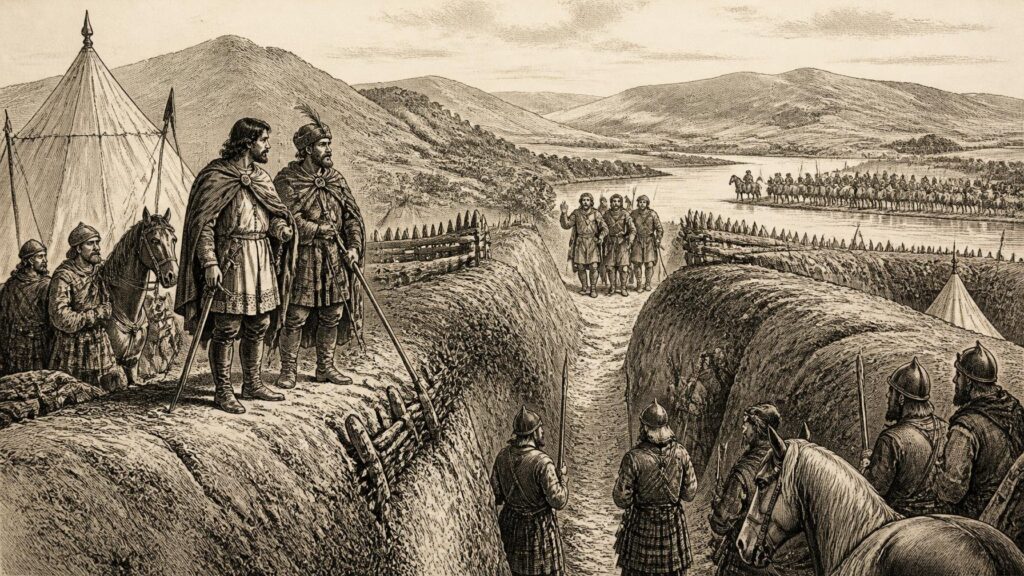
Kildare’s army made camp at Port na dTrí Namhad, a defensible position associated with earthworks and broad trenches. The annals describe the site as secure against O’Donnell, whose resistance had brought together the forces of Tír Chonaill and a substantial Scottish contingent. Alexander MacDonnell, son of Eoin Cathanach, and MacDonnell Gallóglaigh were among the leaders named. Their presence demonstrates the close military and familial connections across the North Channel. Scottish gallóglaigh were not exotic auxiliaries in Ireland: heavily armed professional fighters from Gaelic-speaking kindreds were a long-established part of warfare, while maritime links connected Ulster and western Scotland.
No general battle followed. On the night before a proposed confrontation, Manus O’Donnell led a party of gallóglaigh and Scots against Kildare’s camp, showering it with arrows and preventing rest. The Annals of the Four Masters adds that Kildare’s men had ordnance, a factor that made O’Donnell reluctant to attack the fortified position directly. The record therefore captures an army using both older and newer military resources: mobile infantry, archery, defensive earthworks and firearms or artillery. Calbhach, son of Bran Ó Broin, was killed in the night action, a loss remembered beyond the immediate campaign.
On the following day, the leaders chose negotiation. Kildare sent messengers, and he made peace between O’Neill and O’Donnell, standing surety for both. He and O’Donnell also established gossipry, a spiritual kinship created through godparenthood. This was not a sentimental flourish. In late medieval and early modern Ireland, fosterage and spiritual kinship could create binding social relationships across political divisions. The agreement spared Tír Chonaill a pitched battle and allowed Kildare to present himself as peacemaker as well as commander. But its very form revealed that peace depended upon personal guarantees rather than a permanent institutional settlement.
A Peace Immediately Tested
The return journey brought a further killing. Kildare and O’Neill encountered Aodh, son of Niall, lord of Trian Conghail in east Ulster, who was ravaging Tír Eógain with a large force. His men moved away with cattle and other spoil while he remained behind with a smaller party. He was overtaken and killed. The Annals of the Four Masters gives the date as 6 October. The annalists mourned him as a generous nobleman, protector of poets and supporters of learning. Such praise was conventional, but it also conveys something essential about lordship: military success alone did not establish standing. Hospitality, gifts, patronage and the protection of scholars were public duties through which status was made visible.
The same values appear elsewhere in the year’s notices. The death of Diarmait, son of Gilla Dubh O’Brien, is framed in terms of hospitality, aid to petitioners and patronage. Niall Mór Mac Suibhne of Tir Boghaine died at his castle of Rathain on 14 December after receiving the rites of the church; he too was praised for maintaining a large household and guest-house. Gormlaith, daughter of Aodh Ruadh O’Donnell and wife of Aodh of Trian Conghail, was remembered as a charitable benefactor of churches and learned men. These obituaries cannot describe every household, but they show the cultural expectations attached to elite wealth. Food, lodging, alms and rewards for poets, clerics, physicians and jurists were instruments of both piety and political authority.
Conflict Across the Island
Other entries caution against treating the northern campaign as the whole of Ireland’s story. In Breifne, the capture of Cathal, son of Eoghan O’Reilly, by rival kinsmen helped bring devastation between competing branches of the dynasty. Conn Bacach twice led forces into the region, while a young prior was killed by a shot at Tullymongan Castle. In the north-east, conflict among the Uí Catháin involved the deaths of several leading men. In Munster, Conchobhar O’Connor Kerry was defeated and captured after raiding Duhallow, while Donnall MacCarthy Reagh was captured after a raid into Glenflesk. These were local struggles, but they shared familiar consequences: displacement, loss of livestock, captives and insecurity.
Thus 1524 was not a year of unified government or of simple confrontation between two peoples. It was a year in which Tudor office, magnate rivalry, Gaelic dynastic competition and cross-channel military networks overlapped. Kildare’s restoration and his September peace at Port na dTrí Namhad were firmly dated political successes. They did not resolve the underlying contest between Kildare and Butler, nor the rivalry of O’Neill and O’Donnell. The year’s weather losses, raids and commemorations of hospitality remind us why that instability mattered: power was fought over, but its costs were borne across the countryside.
Primary Sources
- Annals of the Four Masters, Annal M1524
- The Annals of Ulster, Year U1524
- Annála Connacht, Annal 1524
- FitzGerald, Gerald (Gearóid Óg, Garrett McAlison)
- O’Neill (Ó Néill), Conn ‘Bacach’
- Butler, Piers (‘Piers Ruadh’)
- O’Donnell, Manus (Ó Domhnaill, Maghnas)
- Letters Patent of Henry VIII Relating to the Appointment of the Earl of Kildare as Lord Deputy
- Harley MS 3756: Material Relating to the Lands of Gerald fitzGerald, 9th Earl of Kildare
- State Papers Ireland 1509–1782: Government Papers on Irish Affairs
- CELT: Annals of the Four Masters, Editorial and Bibliographical Information
- CELT: The Annals of Ulster, Editorial and Bibliographical Information
- CELT: Annála Connacht, Editorial and Bibliographical Information
- Annals of Loch Cé
- The Annals of Ulster Otherwise Annala Senait, Annals of Senat
- Annála Connacht
- O’Neill (Ó Néill), Matthew (Feardorcha)
- O’Donnell, Hugh McHugh Dubh (Aodh Ó Domhnaill)
- Garrett, Ninth Earl of Kildare (1513–1534)
- Facial Hair and the Performance of Early Modern Masculinity