

Donegal’s Franciscan Chapter1530 CE
In 1530, Ireland remained divided among the Pale, Anglo-Irish magnates and Gaelic lordships. Gerald FitzGerald, ninth Earl of Kildare, returned from England alongside the new deputy, Sir William Skeffington, whose government relied uneasily on Kildare’s influence. Their forces compelled midland submissions from the O’Mores and O’Connors. Aodh Dubh O’Donnell raided Connacht and Breifne, extracting tribute, burning settlements and making temporary peace. Donegal hosted a Franciscan chapter lavishly supported by O’Donnell patronage. Annals also record deaths, dynastic killings and hospitality, illustrating authority founded on armed followings, negotiated settlements, religious patronage and household generosity rather than stable national rule throughout the island.
Dateline
In 1530, Ireland was not one political unit so much as a country of overlapping jurisdictions, rival lordships and shifting personal alliances. The English crown’s effective authority was concentrated in and around the Pale, while great Anglo-Irish families and Gaelic dynasties exercised power across most of the island. The year’s surviving records show this clearly. They preserve a return to Ireland by the Earl of Kildare alongside a newly appointed English deputy, campaigning in the midlands, destructive lordly raids through Connacht and Breifne, a killing within the O’Boyle kindred, and a Franciscan chapter at Donegal supported on a lavish scale by the ruling O’Donnell.
These entries should not be read as a complete diary of the year. The Irish annals were compiled later from earlier materials and naturally favour deaths, raids, successions and notable acts of patronage. Yet, taken with English administrative evidence, they offer an unusually sharp view of the forces governing life in 1530: military power rested on households and followings; churches and learned communities depended upon noble patrons; and peace was commonly a local, negotiated and reversible condition.
Kildare Returns with Skeffington
The major constitutional development was the return of Gerald FitzGerald, ninth earl of Kildare, to Ireland in the summer of 1530. Kildare had spent a prolonged period under restraint in England, where Henry VIII’s government had grown wary of the extraordinary influence he had exercised as lord deputy. The crown did not simply restore him to his former predominance. Instead, Sir William Skeffington, an English soldier and royal servant with experience in ordnance and fortification, was appointed lord deputy in June. Kildare was permitted to accompany or follow him back under strict expectations of co-operation.
The arrangement tried to square an enduring problem of Tudor government. Kildare had extensive kinship ties, military clients and political connections among both the English of Ireland and Gaelic lords. He could make government function beyond Dublin in a way that crown officials could not easily match. But that usefulness made him difficult to control. Skeffington’s early assessment of Irish government had stressed the shortage of money and manpower available to the Dublin administration. His instructions were therefore practical and political: maintain agreement among leading magnates, work through the Irish council, and call a parliament. They reveal that the crown hoped to strengthen its authority without immediately attempting a wholesale conquest.
Contemporary Gaelic annals described Kildare’s return more harshly. Annála Connacht says that the earl and an English justiciar caused “much damage” to the Gaels and reports that an O’Reilly was seized after coming to meet them under protection. The wording conveys a serious breach of trust from a Gaelic perspective, though it does not identify the precise circumstances sufficiently to reconstruct the encounter in detail. What can safely be said is that the new regime arrived not as a neutral arbiter but as an armed power whose diplomacy could include coercion and detention.
War on the Midland Marches
By late 1530, Skeffington and Kildare had mounted a campaign against the O’Mores of Leix and the O’Connors of Offaly, two neighbouring powers whose territories bordered the vulnerable western approaches to the Pale. The operation was a success in the limited contemporary sense: it forced submissions and temporarily checked resistance. Conall O’More was compelled to accept Kildare’s overlordship in November. The achievement came through a harsh expedition, not through the creation of settled administration.
For communities in Leix and Offaly, such campaigning meant far more than a contest between named lords. Armies lived by requisition, plunder and the driving of cattle; crops, houses and stores could be destroyed to deny support to opponents. The frontier between the Pale and its neighbours was consequently not a neat line on a map. It was a zone in which local tenants, herders, clergy, retainers and small landholders faced the demands of rival military followings. A submission won in one season could dissolve when a lord’s alliances changed or when the deputy’s forces withdrew.
The campaign also exposed the fragility of the new partnership. Kildare supported Skeffington during this first phase, but both men possessed incompatible claims to authority. The deputy governed by the king’s commission; Kildare governed through inheritance, affinity and reputation. Their open breach belonged to 1531, not 1530, but the seeds of it lay in this year’s uneasy experiment: royal government required Kildare’s assistance while simultaneously seeking to curb the power that made his assistance indispensable.
O’Donnell’s Connacht Offensive
Far from Dublin, the most extensive recorded warfare of the year was led by Aodh Dubh Ó Domhnaill, lord of Tír Chonaill. In the middle month of summer, according to Annála Connacht, his army crossed from the north-west through Moylurg and over the Shannon. It ravaged Muintir Eolais, moved west across the Connacht plain, attacked the lands of Clann Connmaig and burned the settlements of Glinsk, Kilcroan and Ballintober. The annal also records an imposed payment from Ó Conchobair Ruadh: six pence on every quarter of land.
This was not a modern tax survey, and the annal’s figure should not be mistaken for a full account of revenue. It does, however, show that raiding could be directed towards political extraction as well as immediate booty. The taking of cattle, food and goods demonstrated dominance, while a levy acknowledged it. Such actions were part of lordship: an armed host travelled through dependent or contested territories, punished enemies, rewarded followers and made claims on labour and produce visible.
The same expedition devastated western Breifne and burned the celebrated wooden house of Mac Consnámha on Lough Allen, which the annalist called the finest in Ireland. That praise is revealing. A great timber residence was an important political object: it housed a lord’s household, received guests, stored goods and proclaimed standing. Burning it was therefore both material damage and a deliberate attack on prestige. Yet Ó Domhnaill’s force also suffered losses near Leitrim Castle. Even a successful hosting was dangerous, dependent on routes, supplies, local intelligence and the ability to get men and booty home.
In the middle month of autumn, Ó Domhnaill again entered Connacht, this time against Mac William Burke. After part of the country was devastated, a peace was made and the army returned. The sequence of raid and settlement was characteristic. Peace did not necessarily mean reconciliation; it could be a practical agreement reached after a display of force, preserving the possibility of renewed conflict later.
Connacht also lost Richard Burke, Mac William of Clanricarde, in late spring after a short illness. The annalist praised him as a leading governor among both Gaels and Galls, the latter term generally denoting people of English or Anglo-Norman descent. The obituary captures an important reality: by 1530 political identity was not reducible to a simple Gaelic-English divide. Families of colonial origin such as the Burkes were deeply embedded in Gaelic-speaking regional politics, while Kildare’s Anglo-Irish lordship relied heavily on Gaelic alliances.
Donegal’s Religious Assembly
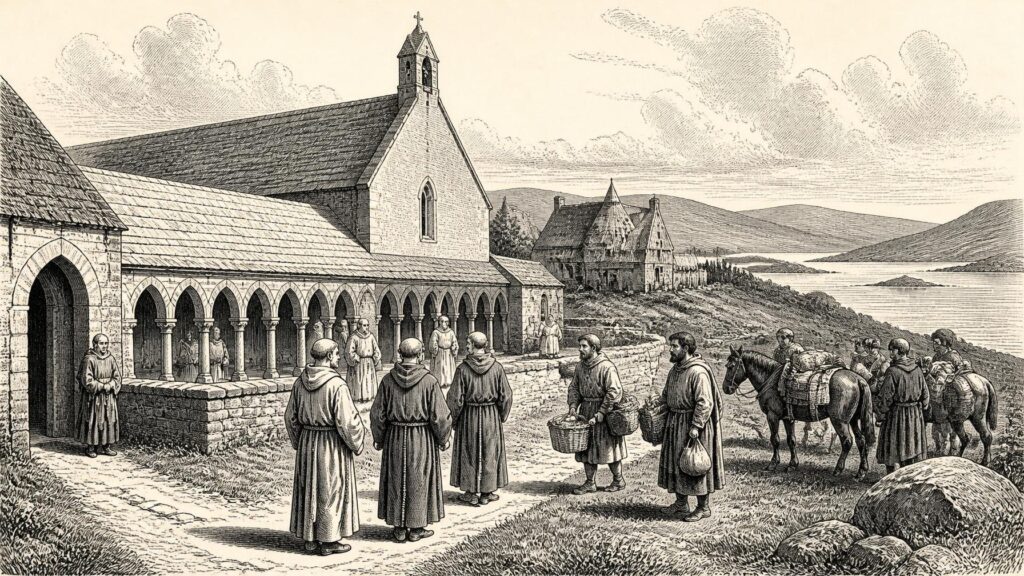
Amid the warfare came an event of a very different kind. A chapter of the Friars Minor was held at Donegal, and the annals agree that Ó Domhnaill provided everything required during its meeting. This was a substantial public act. Franciscan chapters brought friars together to address the order’s internal life, including discipline, governance and the practical concerns of religious communities. Hosting one demanded food, lodging, transport, servants and security. It displayed the host lord’s wealth and piety before clerics, learned men and visitors drawn from beyond his own territory.
The Donegal friary stood beside the O’Donnell centre at the mouth of the Eske, a foundation of the 1470s associated with the ruling family. It was not merely a secluded house of prayer. Franciscan friaries could be places of worship, burial, education, hospitality and political encounter. Their links with patrons made them important institutions in the landscape of Gaelic lordship. In 1530, before the later Irish legislation establishing royal supremacy over the church, such Catholic institutions continued to function within established patterns of aristocratic and dynastic support.
The chapter also belongs to the cultural setting of Tír Chonaill. Manus Ó Domhnaill, Aodh Dubh’s son and a prominent figure within the dynasty, was already active in politics and learning; two years later he would complete his Irish life of Colum Cille. That later work should not be projected backwards as an event of 1530, but it helps explain why Donegal was capable of serving as a meeting-place for a religious order. The O’Donnell court supported military power, clerical patronage and literary production together, rather than treating them as separate spheres.
Loss, Hospitality and Local Order
The annals also record the death of the bishop of Elphin, called “the Greek Bishop”. The sobriquet is securely recorded, but its exact origin is not explained by the surviving entry, so it is safer not to invent one. The same notice praises his charity. Elsewhere, obituaries commemorate people for maintaining guest-houses, aiding poets, exiles and the poor, or showing generosity to visitors. Gilla-Pádraig Maguire of Coole was remembered as keeping the best house of hospitality in Fermanagh for a man of his means; Síle, wife of Cairbre Ó Birn, was praised for never refusing poet or exile.
Such formulae were conventional, but they point to real social expectations. Hospitality was a duty and a political resource. A lordly or clerical household fed travellers, dependants and professional men; in return it gained honour, alliances, information and the services of poets, lawyers and churchmen. This was especially valuable in a country where authority travelled with people and households as much as with written institutions.
There was violence within lordships as well as between them. On 6 January, Conor Óg Ó Baoighill, tanist of Boylagh in western Tír Chonaill, was killed by kinsmen at Leacach; his son Féilim was subsequently slain by the same branch. The precise motives are not supplied. Nonetheless, the deaths underline the insecurity of succession in a system where the tanist was a recognised heir or successor within the ruling kin, and where competing lines of a dynasty could resort to force.
Thus 1530 was neither a simple prelude to later Tudor conquest nor a year defined by one national event. It was a year in which the crown renewed an unstable experiment in governing through Kildare, armed hosts imposed short-term settlements across the midlands and west, and the Franciscan chapter at Donegal demonstrated the enduring reach of Gaelic religious and cultural patronage. In Ireland’s many political worlds, power was exercised through raids and submissions, but also through food, shelter, learning, worship and the public performance of generosity.
Primary Sources
- Annála Connacht: Annal 1530
- Annals of the Four Masters: Annal M1530
- Annals of the Four Masters: Annal M1530 (Irish text)
- The Annals of Ulster
- FitzGerald, Gerald (Gearóid Óg, Garrett McAlison)
- Skeffington, Sir William
- O'Donnell, Manus (Ó Domhnaill, Maghnas)
- O'Neill (Ó Néill), Conn ‘Bacach’
- O'More (Ó Mordha), Conall
- Colum Cille (Columba)
- Henry VIII and Ireland, 1509–34
- Calendar of State Papers: Ireland, Tudor Period, 1509–1547
- State Papers Ireland 1509–1782: Government Papers on Irish Affairs
- Letters and Papers of Henry VIII
- Abbey of Donegal
- Donegal Franciscan Friary
- The Diamond, Donegal Town: Archaeological Impact Assessment
- Tudor Re-Conquest in County Kildare
- Lansdowne MS 159: Various Papers Concerning the State and Government of Ireland
- State Papers: King Henry the Eighth, Part III, Volume 2