Knockdoe’s Nine Battalions1504 CE
In 1504, Gerald FitzGerald, eighth earl of Kildare and king’s deputy, led a broad Gaelic and settler-descended coalition against Uilleag Fionn Burke of Clanricard and Turlough Donn O’Brien. The conflict arose from Burke’s attacks on O’Kelly territory and seizure of Galway, but reflected wider struggles for Connacht. At Knockdoe near Galway on 19 August, Kildare’s army won a devastating battle, with annals reporting nine gallowglass battalions almost destroyed. Burke surrendered hostages, restoring Kildare’s influence without securing lasting royal control. The year’s annals also commemorate clerics, scholars, physicians and patrons, revealing religious, learned and hospitable networks alongside warfare across medieval Ireland.

Dateline
In 1504, a dispute in south Connacht drew together one of the largest armies seen in Ireland for generations. Its climax was the Battle of Knockdoe, fought near Galway on 19 August. The encounter was not a simple contest between an English government and an Irish resistance. Gerald FitzGerald, eighth earl of Kildare and the king’s deputy in Ireland, led an alliance made up of lords and fighting men from the English Pale, Leinster, Ulster and Connacht. His principal opponent, Uilleag Fionn Burke, lord of Clanricard, was himself the head of a family of Anglo-Norman descent long embedded in Gaelic political life. Burke was supported by Turlough Donn O’Brien of Thomond and other Munster allies. The battle revealed an Ireland of overlapping lordships, marriages, obligations and rival ambitions, in which political allegiance was seldom decided by ancestry alone.
A Contest for Connacht
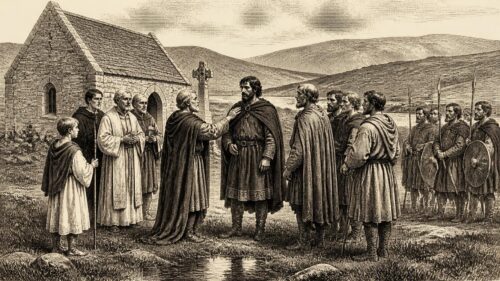
The immediate cause lay in the struggle between Clanricard and the Ó Ceallaigh or O’Kelly lordship of Uí Mháine, east of Galway. The Annals of the Four Masters records that Ulick Burke demolished three O’Kelly castles—Garbh-dhoire, Muine-an-mheadha and Gallach. Máel Sechlainn O’Kelly then appealed to Kildare, identified by the annalist as Lord Justice. That sequence gives the campaign a direct local origin. Yet it was also the latest stage in a broader contest for influence across the Shannon basin. The Burke–O’Brien alliance had grown formidable in Connacht and northern Munster, while Kildare had cultivated the O’Kellys and other lords as clients and partners.
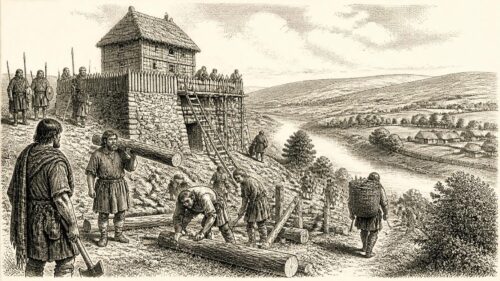
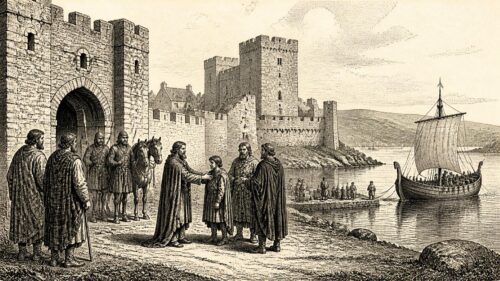
Galway mattered especially. The walled port had received a royal charter in 1484, empowering its burgesses to elect a mayor, bailiffs and corporation. Its merchants were connected to Atlantic trade, while its markets tied the town to the produce and people of its hinterland. Control of Galway was therefore more than a symbolic prize. When Burke took the town in 1504, he challenged both the civic privileges of its townspeople and Kildare’s authority as the crown’s governor. Kildare’s westward march was an intervention on behalf of an ally, but it was also an assertion that royal office could reach far beyond the Pale.
Kildare’s Wide Coalition
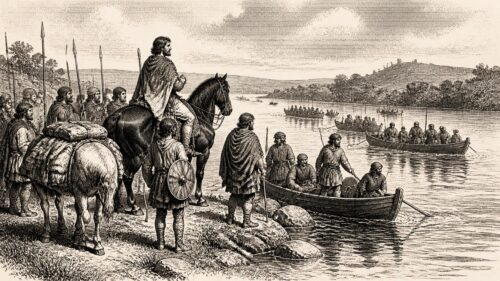
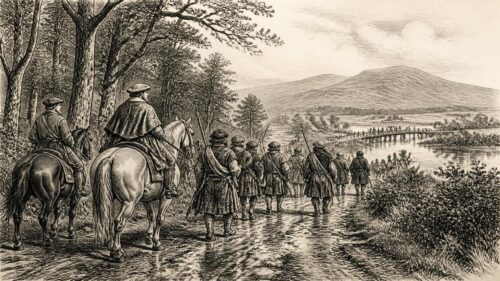
The scale of Kildare’s response was remarkable. The Connacht annalist says that Gerald assembled the Galls and Gaels of Leinster and Leath Cuinn—the northern half of Ireland in traditional geographical language—and invaded Clanricard. The Four Masters gives a longer, if inevitably selective, roll-call: Aodh Ruadh O’Donnell of Tír Chonaill and his son, leading figures from Cenél Conaill, Aodh O’Connor Roe and Mac Diarmata of Moylurg, together with Art O’Neill, Magennis, MacMahon, O’Hanlon, O’Reilly, O’Farrell, O’Connor Faly, O’Kelly and the Burkes of Mayo. Leinster Irish and magnates of the Pale also joined Kildare.
This was not a centrally recruited national army. It was a host assembled through lordship: kinship, clientage, negotiated interest and the expectation of gain or protection. Aodh Ruadh O’Donnell’s participation is particularly important. The elderly ruler of Tír Chonaill had his own reasons to curb the power of Clanricard, whose interests clashed with O’Donnell expansion in Connacht. Kildare needed northern manpower for a campaign so far from his estates and the Pale; O’Donnell needed a powerful partner against Burke. Their cooperation is better understood as an alliance of strong rulers than as a straightforward relation between governor and subordinate.
Burke’s opponents were similarly diverse. Turlough Donn O’Brien, lord of Thomond, came with his kinsmen and forces; the Four Masters also names the Síol Aodha, Mulrony O’Carroll of Ely, and chiefs from Ormond and Arra. Their decision, according to the annal, was not to give submission or hostages but to fight at Cnoc Tuagh, Knockdoe, the “hill of the axes”. The opposing hosts consequently represented political networks extending from Donegal and Ulster to Thomond and Munster. This breadth helps explain why contemporaries treated the clash as exceptional.
The Battle at Knockdoe
The battle is firmly associated with 19 August 1504, although the Irish annals themselves record it under the year rather than narrating a day-by-day campaign. Near the low hill of Knockdoe, north-east of Galway, Kildare’s coalition defeated the combined forces of Uilleag Fionn Burke and Turlough Donn O’Brien. The language of the annals is vivid but should not be mistaken for a modern battlefield report. The Four Masters evokes the noise of charging leaders, endangered troops and shouting youths; the Annals of Ulster describes the field after the fighting as choked with weapons and bodies. Both agree on the essential point: the slaughter was immense, and men on Kildare’s side also died in large numbers.
The Ulster annalist states that, of nine closely arrayed battalions of gallóglaigh, only one thin, broken battalion survived. Gallóglaigh were heavily armed professional warriors, often maintained by lords as military retainers. The Four Masters likewise refers to nine battalions and speaks of broken spears, shields and swords. Such descriptions make clear that this was a set-piece battle, not merely a raid or a castle siege. They do not, however, permit a secure modern casualty total. Later writers have supplied striking figures, but the contemporary evidence supports only the conclusion that losses were catastrophic by the standards of the time.
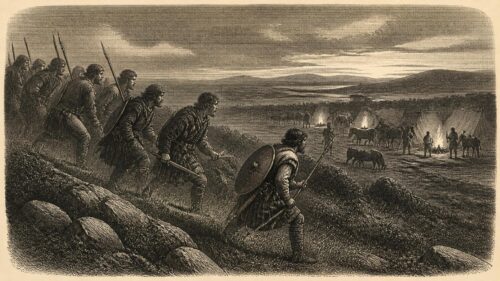
Victory did not mean that Kildare’s force pressed instantly onwards. In the Four Masters’ account, he proposed moving at once to Galway, but Aodh Ruadh O’Donnell advised an overnight camp so scattered followers could find the army’s standards and rejoin it. This small detail conveys the practical disorder left by a great battle: wounded men, missing retainers, dispersed contingents and the need to gather a coalition before it could move again. On the following day Kildare and O’Donnell went to Galway, then to Athenry, before the allied lords departed for their own territories.
Hostages, Authority and Limits
The campaign restored Galway to Kildare’s side and compelled Burke to yield children as sureties for his conduct. Here the sources differ on a detail worth preserving rather than smoothing away. The Four Masters says Kildare held two sons and a daughter; the Annals of Ulster says two sons and two daughters. Hostage-taking itself is beyond doubt, but the precise number cannot be settled from these accounts. Such hostages were not incidental captives: they were instruments of diplomacy, intended to bind a defeated lord to an agreement through the safety and status of his family.
Knockdoe greatly enhanced Kildare’s standing. He had demonstrated the reach of his office and his unusual capacity to mobilise both Gaelic and settler-descended powers. Earlier in the year, on 28 February, he had also been appointed treasurer of Ireland, concentrating yet more authority in the hands of a magnate whose own estates and affinities already made him dominant in the lordship. Henry VII later recognised the military achievement by making Kildare a Knight of the Garter in 1505. Yet the battle did not permanently remake western Ireland. Clanricard remained a major Connacht power, and the O’Briens remained entrenched west of the Shannon. Kildare’s triumph checked an expansion; it did not establish continuous royal control over Connacht.
Church, Learning and Local Life
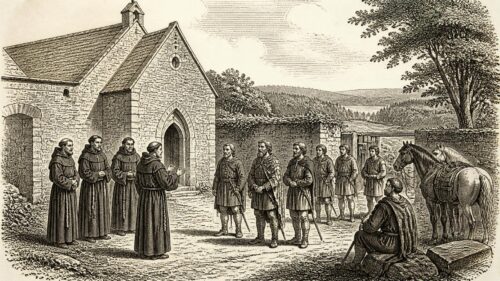
The annals for 1504 also offer a different view of Irish society: one in which monasteries, churches, hereditary learned families and systems of hospitality remained central. Manus Mac Donnchadha, abbot of Holy Trinity on Lough Key, died and was buried on Trinity Island. The Connacht annalist remembered him not only as an ecclesiastical figure but as a generous patron of poets and minstrels. His death was described as a grievous blow to Ireland’s artists. That obituary is valuable evidence for the continued place of learned and performing people within aristocratic and ecclesiastical patronage.
Other notices record the deaths of Gilla-Patrick O’Conolly, abbot of Clones who had obtained the bishopric of Clogher; Philip O’Reilly, abbot of Kells, and his brother Eoghan, a canon there; and Turlough Maguire, canon chorister at Clogher, parson of Derryvullan and prior of Lough Derg. Turlough died after falling down a stone staircase at Athboy around the feast of St Patrick. These careers show that clerics could hold several offices spanning considerable distances, linking parishes, monasteries and dioceses.
The same year brought the death of Pierce O’Cassidy, medical ollamh to the Maguires, praised as a master of learning and medicine who maintained an open guest-house. The Ulster annalist says that he, Máel Sechlainn Ó hEodhusa and several clerics died of the “King’s Game”, a contemporary expression whose exact medical meaning should not be assumed. Andrew Magrath, hereditary church officer of Termon Davog, was similarly remembered for honour and hospitality. These brief records suggest a world where care, learning, food and lodging were obligations carried by religious and learned households as well as by secular lords.
Thus 1504 was dominated by one terrible battle, but it was not defined by it alone. Knockdoe exposed the military reach of Kildare’s alliance and the fragility of Connacht’s balance of power. The deaths recorded across Clones, Kells, Lough Key, Cavan and Fermanagh reveal another Ireland: regionally connected, institutionally Christian, and sustained by scholars, physicians, patrons and hosts. Both worlds—warfare and learning—were woven into the same networks of lordship that shaped the year.
Primary Sources
- Annals of the Four Masters: Annal M1504
- The Annals of Ulster: Year U1504
- Annála Connacht: Annal 1504
- FitzGerald, Gerald (Gearóid Mór)
- Burke (de Burgh), Uilleag (‘Uilleag Fionn’)
- O'Donnell (Ó Domhnaill), Aodh Ruadh
- The English Lordship of Ireland and the Irish Sea World: Re-assessing the Origins of the Kildare Ascendancy, c.1390–c.1513
- The English Lordship of Ireland and the Irish Sea World: Re-assessing the Origins of the Kildare Ascendancy, c.1390–c.1513 (PDF)
- Irish Historic Towns Atlas: Galway, No. 28
- Galway City & County
- Medieval Galway
- The Battle of Knockdoe
- Irish History Online: Battle Accounts
- Vol. 57, 2005 of Journal of the Galway Archaeological and Historical Society
- Knockdoe (1504): the archaeological & historical significance of one of Ireland's great but forgotten battles
- Calendar of the Carew Manuscripts Preserved in the Archiepiscopal Library at Lambeth: The Book of Howth, Volume 5
- Ireland under the Tudors, Volume I
- FitzGerald, Gerald (Gearóid Óg, Garrett McAlison)
- CELT Project: Annals of the Four Masters
- CELT Project: Annals of Ulster Otherwise Annala Senait, Annals of Senat
- An Atlas of Irish History