

Monabraher’s Broken Rearguard1510 CE
In 1510 Gerald FitzGerald, eighth earl of Kildare and justiciar of Ireland, led a expedition into Munster. His authority combined royal office with estates, personal connections and agreements among powerful lords. The campaign demonstrated that government from Dublin depended upon negotiated alliances as much as commands from Henry VIII. Resistance likewise emerged from a coalition of interests rather than a simple division between Gaelic and English communities. Annalistic evidence places the fighting within a wider landscape of overlapping lordships and shifting loyalties. Monabraher’s broken rearguard illustrates the military risks and political limits confronting the Great Earl’s ambitious exercise of power.
Dateline
In 1510 the most consequential Irish event recorded by the annals was a major expedition into Munster led by Gerald FitzGerald, eighth earl of Kildare. Gerald, often called Gearóid Mór or ‘the Great Earl’, was justiciar of Ireland: the chief governor acting for Henry VIII, who had succeeded to the English throne in 1509. Yet the campaign shows why this office cannot be understood simply as an extension of royal government from Dublin. Kildare’s authority rested on his own estates, affinities and bargains with lords across the island. His army was a coalition, and the resistance that checked it was another coalition. Ireland in 1510 was not divided neatly between an English state and Gaelic opponents, but was shaped by overlapping lordships, changing alliances and local control of castles, routes and cattle-rich countryside.
A Southern Expedition
The Annals of Ulster and Annála Connacht, independent annalistic compilations, both place Kildare’s Munster expedition in 1510. They do not give a month or day, so the sequence of operations cannot responsibly be dated more precisely. They report that Kildare led a host into Munster and built a castle at Carrigkittle, described as an act done in defiance of the Gaels of Munster. A new or renewed fortification was more than a military convenience. It announced an attempt to hold ground, secure communications and turn a raid into political leverage.
Hugh Dubh O’Donnell, lord of Tír Chonaill in north-west Ulster, joined Kildare with a small force. His participation is a striking measure of the expedition’s reach. The lord of Tír Chonaill had his own extensive power base, including influence in parts of north Connacht, and was not Kildare’s subordinate in any simple sense. Their collaboration was an alliance of interest against Thomond. O’Donnell’s force travelled through Meath into Munster, then entered Ealla or Duhallow, where it captured Kanturk Castle and plundered the surrounding country. The force then moved into Great Desmond, taking Pallis Castle and castles along the River Maine before returning safely towards County Limerick.
These reports reveal the practical grammar of lordly warfare. Castles were objectives because they guarded people, stores, crossings and claims to jurisdiction; cattle, movable goods and food supplies were prizes and instruments of pressure. The annals’ terse reference to harrying the country should not be softened. Raiding exposed cultivators, herdsmen, tenants and religious houses to the immediate costs of elite competition: lost livestock, disrupted sowing or harvest, requisitioned food and insecurity on the roads. But they do not provide a harvest account, a civilian casualty total or evidence for a general famine in 1510. Such wider claims would go beyond the surviving record.
Coalitions at the Shannon
After the initial raids, Kildare’s following assembled again near Limerick. It included James FitzGerald, son of the earl of Desmond, other Munster Geraldines, the annalists’ ‘Foreigners’ of Munster, Domnall MacCarthy Reagh, Cormac Óg MacCarthy, and contingents from Meath and Leinster. The old annalistic contrast between Gallaibh, usually rendered ‘Foreigners’, and Gaedhil, or Gaels, marks political and cultural categories familiar to the writers; it should not conceal the fact that both descriptions occur within Kildare’s host. The campaign depended on cross-community lordship rather than a single ethnic bloc.
The opposing host was gathered by Toirdelbach, or Turlough, O’Brien, king or lord of Thomond. With him were Mac Conmara of east Clare, the Síol Aodha, and Clanricarde, the powerful Burke lordship of south Connacht. This was an equally broad alliance. Thomond’s rulers had long had to defend the approaches to their territory, particularly the Shannon crossings and the corridor around Limerick. The political geography mattered: a host entering from Limerick had to move through narrow routes and across water barriers before it could threaten the heartland of O’Brien authority.
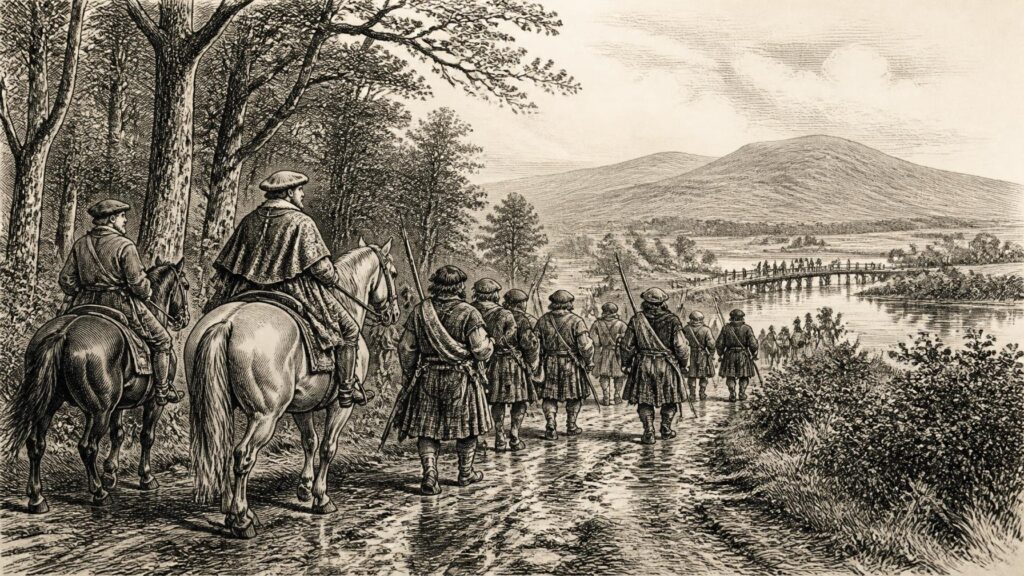
Kildare’s army passed through places named by the annals as Belach na Fadbaige and Belach an Gamna until it reached a strong wooden bridge over the Shannon made by O’Brien. Kildare broke the bridge, then camped for the night. O’Brien’s army made camp so close by that, according to the Annals of Ulster, each side could hear the other’s conversation and storytelling. This memorable detail should not be treated as a literal transcript of a night in camp, but it conveys something important: the opposing armies were close enough for a battle to be expected, while the camp remained a social as well as a military world. Men ate, watched, talked and heard the voices of their enemies across the darkness.
The Rearguard at Monabraher
The following day, Kildare arranged his army with Munster contingents in the van and men from Meath and Dublin in the rear. O’Donnell dismounted with his small company and took station among the rearguard. The annals then describe the decisive encounter. Kildare’s force took the shorter route through Móin na mBráthar, conventionally rendered Monabraher, towards Limerick. There the Síol mBriain attacked the ‘Foreigners’, killing Baron Kent, Barnewall of Crickstown and other leading men whose names the annalist did not list.
Later accounts often label this the battle of Cratloe, after the wider district in County Clare. The contemporary annals, however, locate the action on the route through Monabraher and do not supply an exact battlefield, date or full roll of casualties. It is therefore safer to describe a defeat and rearguard attack near the Thomond–Limerick frontier than to imagine a precisely mapped set-piece battle. What is firm is that Kildare’s host withdrew ‘in plight of defeat’, while O’Brien’s men returned with many chattels. The campaign that had projected Kildare’s strength into Munster ended with Thomond’s coalition intact and enriched by captured spoils.
O’Donnell emerged from the retreat with considerable credit. The annalist judged that no arm on Kildare’s side, whether Gaelic or ‘Foreign’, was more renowned that day than his in bringing off the rearguard. This praise does not erase the defeat, nor does it mean that O’Donnell controlled the whole operation. Rather, it demonstrates how a lord could gain personal prestige through disciplined service to an ally while preserving his own standing. For Kildare, the reverse was a reminder of the limits of office and military display beyond the core territories where his influence was strongest.
Rome, Cavan and Religious Life
In the same year, the annals record that Hugh O’Donnell went on pilgrimage to Rome, ‘in the midst of his age and power’. The statement is firmly attached to 1510, although no departure date, route or arrival date survives. A later biographical reconstruction connects the journey with thanksgiving after the danger at Monabraher; that is plausible, but it remains an interpretation rather than an explicit explanation in the annals. The pilgrimage nevertheless illustrates the international horizon of a Gaelic lord. Rome was spiritually central to western Christendom, and an arduous journey there could express penitence, devotion, rank and access to networks beyond Ireland.
Religion was also being reshaped at a local level. John O’Reilly, son of Cathal, died in 1510. The Annals of Ulster credit him with establishing the Franciscan Minor Order of Strict Observance at Cavan. This needs careful wording: the annal records his death in 1510 and attributes the foundation to him, rather than securely dating every stage of the reform to that year. Even so, it places Cavan within the wider late-medieval movement for stricter Franciscan observance. Such reform was not merely institutional. Friaries were places of preaching, prayer, burial, hospitality, education and contact between ruling families and townspeople. The O’Reilly lordship’s patronage of observant Franciscan life was a public statement of piety and authority.
Deaths in the Learned Orders
The year’s obituaries also record losses among hereditary learned families. Eoghan Ruadh Mac an Bhaird, ollamh or chief learned man to O’Donnell, died on Inis Mic an Duirn. Fergal O’Fialain, praised as eminent in poetry and humanity, died; so did Uaithne Mac Lochlainn. Eoghan, son of Brian Ó hUiginn, described as a leading teacher of poetry in Connacht, also died. Annála Connacht adds the death of Aibhilín, daughter of Niall Óg Ó hUiginn and wife of an Ó Duibhgeannáin.
These notices are brief, but their accumulation is revealing. Poetry, history, genealogy, law and learned memory were sustained through professional families whose service to lords could span generations. An ollamh was not an ornamental court poet: learned people preserved pedigrees, composed praise and elegy, taught pupils, advised patrons and helped articulate the legitimacy on which lordship rested. Their deaths mattered sufficiently to enter chronicles beside warfare and the deaths of rulers. In 1510, therefore, Ireland’s political landscape was contested not only with armed hosts and castles but also through the institutions of learning that defined rank, kinship and reputation.
A Year of Reach and Resistance
1510 left no securely dated parliamentary statute, nationwide economic measure or recorded environmental crisis comparable to the expedition into Thomond. Its surviving record is instead concentrated on movement: armies crossing provinces, castles taken or built, a bridge broken, a rearguard forced back, a lord travelling towards Rome, and scholars passing from the learned world they had served. Kildare’s Munster campaign demonstrated the scale of his connections, but the encounter at Monabraher demonstrated the resilience of regional power. Turlough O’Brien and his allies prevented a northern and Leinster-led coalition from converting a destructive raid into lasting dominance in Thomond. The year’s annals preserve that outcome with unusual vividness: two camps within hearing of one another, and, next day, a defeated army retreating towards Limerick.
Primary Sources
- The Annals of Ulster: Year U1510
- Annála Connacht: Annal 1510
- Annals of the Four Masters, Volume 5 English Translation
- Annals of the Kingdom of Ireland, Volume V
- FitzGerald, Gerald (Gearóid Mór)
- O'Donnell (Ó Domhnaill), Sir Aodh Dubh
- FitzGerald, Gerald (Gearóid Óg, Garrett McAlison)
- Tudor Policy and the Kildare Ascendancy in the Lordship of Ireland, 1496–1534
- Factions, Feuds and Noble Power in the Lordship of Ireland, c. 1356–1496
- The English Lordship of Ireland and the Irish Sea World: Re-assessing the Origins of the Kildare Ascendancy, c.1390–c.1513
- Cratloe: Historical Background
- A Volume Made Up of Independent Documents, Containing the Rental of Gerald FitzGerald, Earl of Kildare
- Food and Power in Sixteenth-Century Ireland: Studying Household Accounts from Dublin Castle
- Gaelic Law and the Tudor Conquest of Ireland
- Ó hUigínn, Maol Muire
- A History of the Franciscan Order in Ireland
- Cavan Town, Co. Cavan
- Cavan Franciscan Friary
- Observant Reform in Religious Orders
- The Church: Crisis and Survival in Late Medieval Ireland