Cavan’s Observant Turn1502 CE
In 1502, Ireland was shaped by local lordship, dynastic violence, religious reform and environmental hardship. Raids and feuds across East Breifne, Fermanagh, Monaghan and Ulster killed warriors, professionals and kin, while alliances enabled armed retinues to cross boundaries. John O’Reilly secured Cavan’s Franciscan monastery for the Strict Observance through Rome, demonstrating both reforming connections and secular authority. Church offices remained contested and hereditary. Severe weather killed cattle and disrupted cultivation throughout Ireland, threatening subsistence and lordly resources. The deaths of poet Domnall Ó hUiginn and learned figures show scholarly networks. Munster experienced change, while English administration remained limited around Dublin.
Dateline
The surviving record for 1502 does not offer a single national event or a clear calendar of kings and parliaments. Instead, it presents an Ireland of intensely local politics, in which raids, killings, church disputes and weather bound distant regions together. The fullest contemporary notices come from the northern and midland annals. They must be read with care: entries are assigned to the year, but normally not to a day or month, and their concentrated attention to lordly families does not mean that only lords experienced the year’s shocks. On the contrary, the annalists’ terse reports of burned settlements, fleeing livestock and failed husbandry reveal how quickly elite contests reached farmers, herders, clergy, learned families and household dependants.
Fighting Across the Northern Borderlands
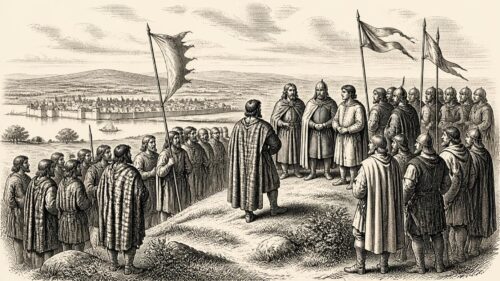
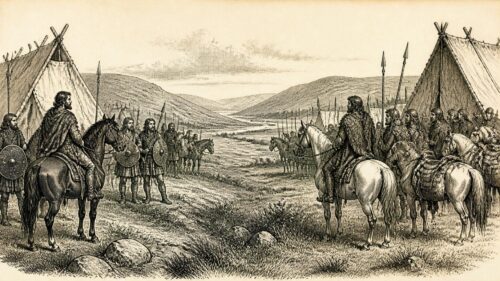
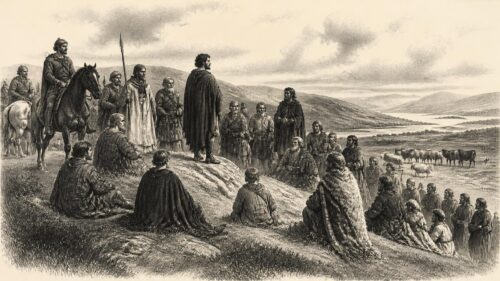
Much of what can be placed securely in 1502 occurred in the connected lordships of East Breifne, Fermanagh, Monaghan and south Ulster. John O’Reilly, ruler in East Breifne, led an incursion against Philip, son of Toirdelbach Maguire. His force crossed and burned the lowland country above Clann Awley, killing Edmund, son of Philip Reagh Mac Awley, and others. Yet raiding parties were vulnerable once dispersed: Donnell-an-Mhagh, O’Reilly’s own son, and Conor Mac Mael-Martin were killed from the raiders’ side. Such encounters were not set-piece wars between modern states. They were contests over authority, cattle, land, followers and the ability of one lord to protect—or punish—communities on another’s frontier.
Maguire politics were similarly fractured. The annals record an attack by the son of John Mag Mathghamhna ‘the Tawny’ and the sons of Edmund Maguire upon the sons of Flaithbertach Maguire. Brian ‘the Scarred’ was captured and injured; Toirdelbach was left for dead; and Conor Ó Caiside, described specifically as an eminent physician, received wounds from which he died. Donchadh, son of Conor Maguire, also died during the year from wounds sustained earlier at the defeat of Sliabh Beatha. These notices underline an uncomfortable reality of lordship: dynastic competition repeatedly consumed members of the same extended political world, while skilled professionals attached to a lordly household could be killed alongside fighting men.
Violence was not confined to the Maguires. Niall O’Boyle and his two sons were killed by the sons of Toirdelbach O’Boyle. In the O’Neill kindred, Art, son of Henry son of Eoghan, was killed by a relative, Art son of Conn; in the same week Eoghan, son of Aodh son of Art, was killed by Aodh, son of Conn. The Four Masters also place in 1502 the defeat of Tulach Finn in Glen Eidhneach, where Niall Boy O’Boyle and two sons died after an ambush he had himself planned against his nephews. The circumstances are a reminder that succession in Gaelic lordships was not automatic primogeniture. Seniority, military following, kinship and negotiation all mattered, and the struggle to secure them could become lethal.
One campaign shows that alliances could cross lordship boundaries even while internal feuds continued. Hugh Óg, son of Aodh Ruadh O’Donnell of Tír Chonaill, joined John Maguire in an incursion into Dartry-Coninse, against the son of John Boy Mac Mahon. Their men burned the opponent’s settlement and, according to the annalists, the wider territory. Men of Oriel, branches of the O’Reillys and Maguires, and other pursuers then opposed their retreat. Hugh Óg and Maguire nevertheless fought their way home, killing several pursuers, including Feidhlim, son of Conor son of Feidhlim O’Reilly. The exact route and season are not supplied, but the episode firmly belongs to 1502 and illustrates the mobility of armed retinues across the Erne–Monaghan borderlands.
A Roman Decision at Cavan
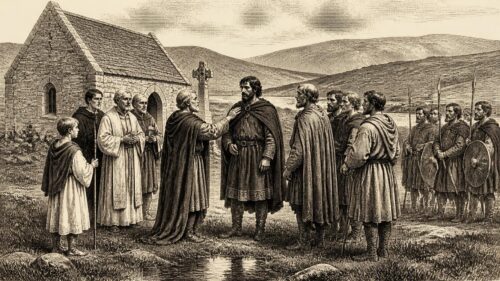
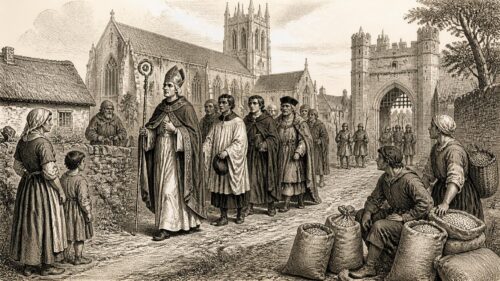
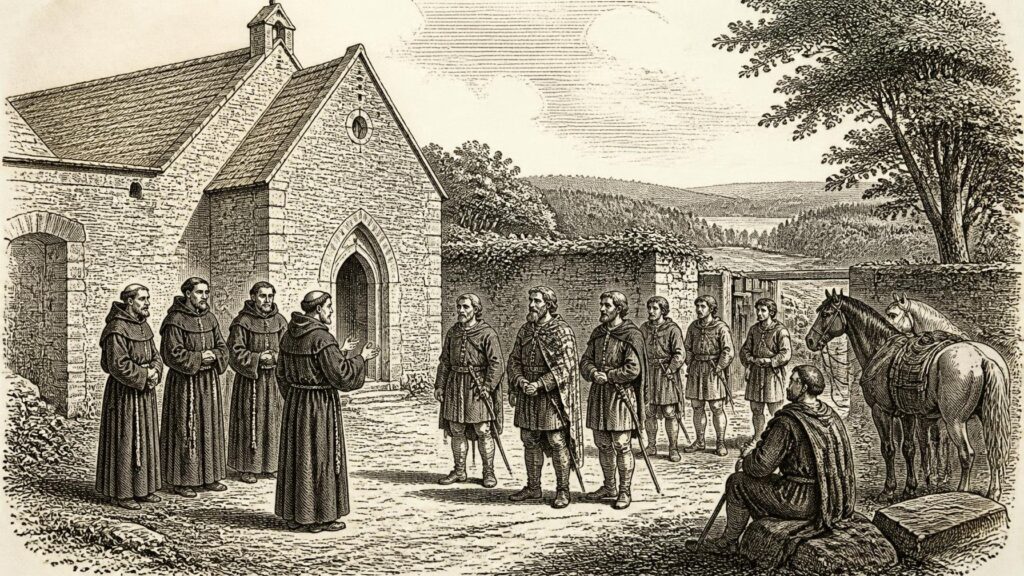
Against this background of force, a religious decision of unusual reach was recorded at Cavan. John O’Reilly obtained from Rome the monastery of the friars at Cavan for the Franciscans of the Strict Observance, in opposition to friars described as belonging to the Common Life. The wording preserves a local intervention in a wider reform movement within the Franciscan world. Observant friars sought a more rigorous adherence to the order’s ideals, especially poverty and disciplined religious life. The entry should not be inflated into a sudden transformation of Irish religion: no surviving notice fixes the precise date of the Roman grant, describes a ceremony of transfer, or tells us how every friar and lay supporter responded. It does, however, establish that a leading secular lord had used connections reaching Rome to reshape a religious house in his territory.
The change mattered because friaries were more than isolated places of prayer. They were sites of worship, burial, hospitality, preaching and patronage, connected to town life and to the reputations of ruling families. Cavan’s monastery had long been associated with the O’Reilly lordship. Securing it for the Observants therefore expressed both religious preference and political capacity. In an Ireland divided among many jurisdictions, access to papal authority could reinforce local standing rather than supersede it.
Other ecclesiastical notices make 1502 appear less serene than a reforming charter might suggest. Art O’Gallagher and John O’Loiste, rival abbots who had long contested the abbacy of Assaroe on the Erne, died within a day of one another, according to the Four Masters; the Annals of Ulster say within two days and a night. James Mac Mathghamhna, coarb of Clones, died at the reported age of ninety. These records show a church embedded in hereditary offices, local rivalries and kin networks, while also remaining part of an international Latin Christian system capable of sending business to Rome.
Weather, Herds and Husbandry
The broadest entry for the year is also among the most important. The Annals of Ulster report ‘very great inclemency’ which killed much of Ireland’s cattle and hindered cultivation by husbandmen. The annalist does not identify the exact form of the weather—whether prolonged cold, exceptional rain, storms, or a damaging combination—and responsible history should not supply details the source does not give. But its consequences are clear enough. Cattle were central stores of wealth, sources of dairy produce, traction and manure, and objects of tribute, exchange and raiding. Losses on a wide scale damaged both household subsistence and the resources with which lords rewarded followers.
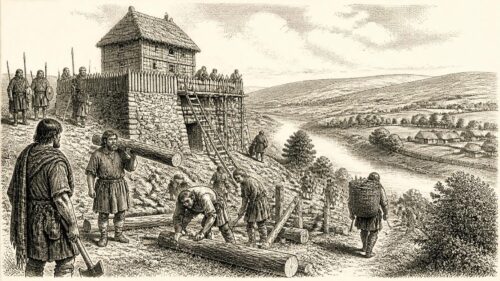
The reference to impeded husbandry is equally revealing. Much labour depended upon a seasonal sequence of ploughing, sowing, grazing, haymaking and harvest. Bad conditions at one stage could reduce food supplies long after the weather improved. For tenants and smallholders, an already dangerous year of raids could therefore become materially harsher. For ecclesiastical houses and lordly households, diminished rents and food renders could strain hospitality and patronage. The annal is not a demographic survey, so it cannot tell us how many people went hungry or where losses were worst. Its island-wide phrasing nonetheless justifies seeing environmental stress as a defining condition of 1502, rather than treating it as a minor postscript to warfare.
Learning Amid Loss
1502 also brought the death of Domnall, son of Brian Ó hUiginn, whom the Annals of Ulster call preceptor of the schools of Ireland and Scotland in poetry. The title is a valuable indication of the reach of Gaelic learned culture. Bardic instruction was not a casual accomplishment: it involved formal study, highly regulated metres, genealogy, history, language and the arts of praise, counsel and elegy. Learned families such as the Ó hUiginns supplied professional poets to patrons across Ireland and had links extending into Gaelic Scotland. Domnall’s obituary therefore records the loss of an individual and of a figure within an educational network spanning the North Channel.
That scholarly world coexisted with conflict rather than standing apart from it. A member of the Mac Ribertaigh learned family, Máel Sechnaill, son of Cú Chonnacht, was killed treacherously in 1502; he was identified as the son of Maguire’s ollamh in poetry. The death of Conor Ó Caiside, the physician wounded in a dynastic attack, offers another glimpse of hereditary professional expertise. Annals principally remembered the powerful, but these notices preserve the names of poets and physicians because such people were indispensable to lordly society and to the maintenance of cultural prestige.
Munster and the Narrow Crown Reach
In Munster, the Four Masters record the death of Donough O’Brien, lord of a substantial district stretching from Adare towards Limerick and from Baile Nua to Monasternenagh, with authority also in Aharlagh and Coill Bheithe. The annalist praises him as a source of Munster’s prosperity and affluence. That is a conventional but meaningful form of commendation: a successful lord was expected to sustain dependants, uphold hospitality and secure productive territory. The notice provides no precise day of death and should not be made to imply the collapse of O’Brien authority. It does indicate that political change was occurring in the south as well as in the better-recorded northern lordships.
Meanwhile, the English crown’s formal lordship of Ireland remained strongest in and around the eastern towns and counties, not an even administrative grip over the island. Henry VII was lord of Ireland, while Gerald FitzGerald, eighth earl of Kildare, remained his powerful deputy. Financial material associated with 1502–3, including the accounts of William Darcy, receiver-general of crown lands, points to the limited but real fiscal machinery centred on the Dublin administration and its surrounding counties. It should not be mistaken for a national balance sheet. The very different records of Cavan, Fermanagh, Donegal, Monaghan and Thomond show that power in 1502 was enacted chiefly through regional lordships, negotiated loyalties and local institutions.
Thus 1502 was not merely an interval before the better-known battles and Tudor interventions of later decades. Its securely dated annals reveal an Ireland in which Roman reform reached Cavan, learned culture linked Ireland and Scotland, regional rulers launched destructive expeditions, and severe weather endangered cattle and cultivation across the country. The year’s apparent fragments form a coherent picture: communities lived where the claims of church, kin, lordship and environment met, often with grave consequences.
Primary Sources
- The Annals of Ulster, Year U1502
- Annals of the Four Masters, Annal M1502
- Annals of the Four Masters: CELT Project Edition
- Annales Breves Hiberniae
- Annála Connacht
- Irish Texts at CELT
- FitzGerald, Gerald (Gearóid Óg, Garrett McAlison)
- Darcy, Sir William
- O'Reilly (Ó Raghallaigh), Cathal
- O'Donnell (Ó Domhnaill), Aodh Ruadh
- O'Donnell (Ó Domhnaill), Sir Aodh Dubh
- O'Neill (Ó Néill), Conn ‘Bacach’
- O'Rourke (Ó Ruairc), Eoghan
- O'Rourke (Ó Ruairc), Donnchadh
- Ó hUiginn, Tadhg Óg
- Ó hUiginn, Pilib Bocht
- Ó hUigínn, Maol Muire
- Mac Bruaideadha, Tadhg mac Dáire
- Cavan Abbey, in Breifny Archaeological Society Journal
- Cavan, An Incorporated Market and Post-Town, in A Topographical Dictionary of Ireland
- History of the City of Limerick
- O'Brien, Donough