Fitzsimons Deputation1492 CE
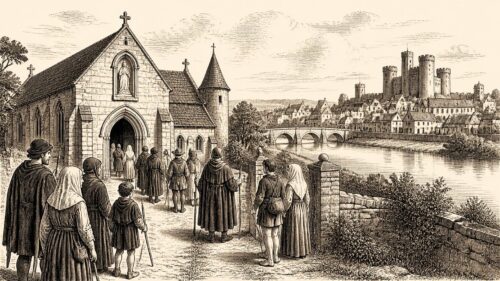
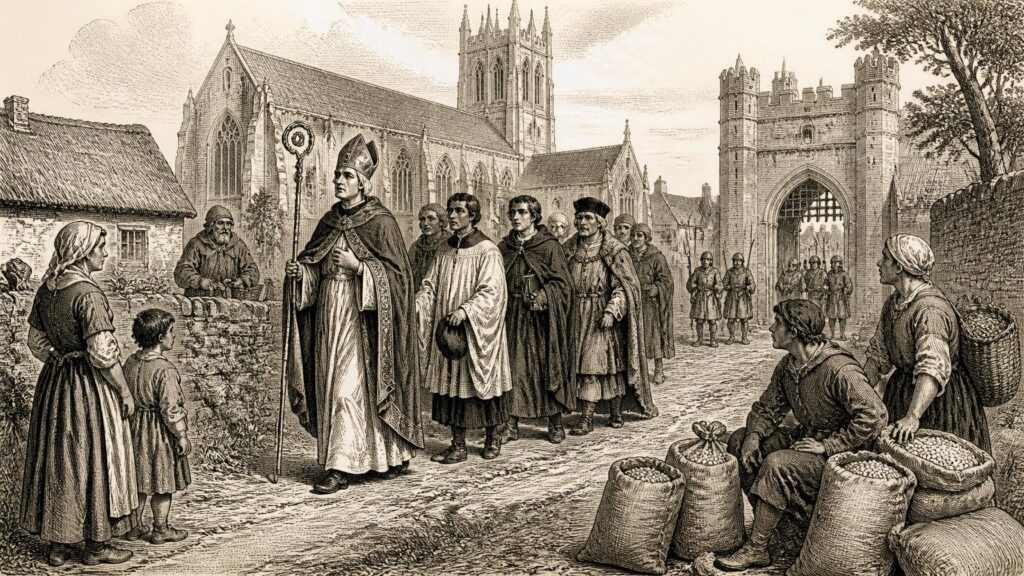
In 1492, Ireland endured famine, disease and conflict amid Henry VII’s attempt to weaken Gerald FitzGerald, earl of Kildare. Suspected because of Yorkist links and Perkin Warbeck’s Cork landing, Kildare was replaced in government by Archbishop Walter Fitzsimons and Sir James Ormond. The changes intensified rivalries across the Pale, Leinster, the midlands and East Breifne, where Gaelic and Anglo-Irish lords fought, raided and contested succession. Poor weather damaged grain before famine; a hot summer and sweating sickness compounded insecurity. Ulster saw truces, killings, imprisonments and raids. Ecclesiastical life continued, while Thaddeus MacCarthy died returning from Rome. Central authority remained fragile.
Dateline
In 1492 Ireland faced a convergence of hunger, sickness and political instability. The year is unusually vivid in the Irish annals: they record a “great famine in Ireland”, a notably hot summer, the recent arrival of a sweating plague, local war from East Breifne to Ulster, and the weakening of the authority exercised from Dublin. At the same time Henry VII of England attempted a major remaking of the administration of the English lordship of Ireland. The replacement of Gerald FitzGerald, eighth earl of Kildare, by Archbishop Walter Fitzsimons and Sir James Ormond was intended to curb a magnate whom the king distrusted. Instead, it helped open a fresh and destructive struggle.
A Crown Government Recast
The immediate background was the Yorkist pretender Perkin Warbeck. He had landed at Cork in November 1491, presenting himself as Richard, duke of York, the supposedly murdered younger son of Edward IV. His support in Munster alarmed Henry VII. In March 1492 Warbeck was corresponding with James IV of Scotland; by October he had been invited to France by Charles VIII. These developments did not prove that Kildare had openly embraced Warbeck, but the earl’s inactivity and his earlier Yorkist associations made him suspect in the king’s eyes.
During May and June, Henry displaced Kildare from the deputy governorship. Walter Fitzsimons, archbishop of Dublin, became deputy lieutenant, while Sir James Ormond became treasurer and shared in the government. Alexander Plunkett received the chancellorship. The removal of Roland FitzEustace, Lord Portlester, from the offices he had long held was equally consequential. Portlester was Kildare’s father-in-law and a central figure in the earl’s political affinity. These appointments were therefore not simply routine changes of office: they were an attempt to detach the Dublin administration from the Kildare interest.
Fitzsimons was a significant choice. A Dubliner closely connected with St Patrick’s Cathedral, he had supported Lambert Simnel’s Yorkist rising in 1487 but had subsequently been reconciled to Henry VII. His elevation showed that royal service, rather than an unblemished past, mattered most to the Tudor king. Sir James Ormond was an even sharper instrument. The illegitimate son of John Butler, sixth earl of Ormond, he combined Butler descent, connections among the O’Briens and a commission from the absentee seventh earl of Ormond, Thomas Butler. Henry hoped that he could counter both Kildare and Sir Piers Butler, who had long acted as Thomas Butler’s local deputy.
Yet the reconstructed government rested on unstable ground. Fitzsimons was responsible for the Pale, the zone around Dublin where the English crown’s institutions had their strongest roots; Sir James had his own military following and competing interests in the Ormond lordship. Neither could simply command the networks of tenants, allies, clients and Gaelic neighbours on which Kildare’s power depended. The change at the top of government thus made local loyalties more important, not less.
Kildare’s Withdrawal and Midland War
The Annals of Ulster state that Kildare resigned both the justiciarship and his protectorate over the “Foreigners of Meath” because they would not assist him against the son of the earl of Ormond. In the annalist’s vocabulary, “Foreigners” meant the English or Anglo-Irish inhabitants of Meath. The consequence was grave: Gaelic forces plundered and burned them from every side. The entry offers a hard corrective to any picture of a neatly bounded Pale defended by a dependable royal system. Protection depended on bargains with powerful lords, and when those bargains failed, communities on the frontier were exposed.
By the winter of 1492 the quarrel between Kildare and Sir James Ormond had become a broader contest across Leinster and the midlands. Maolruanaidh O’Carroll of Éile supported Sir James, whose upbringing and kinship gave him useful allies beyond the formal English lordship. The O’Briens and Clanricard Burkes also favoured the Butler cause. Kildare’s interests, meanwhile, were intertwined with those of Piers Butler. The rivalry was not a simple contest between “English” and “Irish”: both sides drew support from families of Anglo-Norman origin and Gaelic lordships, and both used violence, alliance and territorial pressure to advance political claims.
East Breifne, roughly centred on modern County Cavan, illustrates the damage done when greater politics entered a succession dispute. A very great war continued between rival branches of the O’Reilly dynasty. Cathal O’Reilly, aided by the sons of Réamonn MacMahon, raided the lands of Seaán O’Reilly and burned the territory of the O’Gowans. Kildare had supported Cathal’s challenge to Seaán, while Sir James Ormond assisted the latter’s resistance. Raiding was more than spectacle or private revenge: it meant seized cattle, ruined crops, captives, disrupted labour and a direct assault on a lord’s ability to protect dependants.
Hunger, Heat and Disease
Against this background, the annalist’s brief judgement is stark: “Great famine in Ireland this year.” No surviving source permits a national death toll or a precise reconstruction of prices, harvests and migration. It would be wrong to claim that every district suffered equally. Nevertheless, the statement should be taken seriously, particularly because the Annals of the Four Masters, looking back on 1491, describe a wet and unfavourable summer and autumn in which Ireland’s corn crops decayed. The failure of grain after prolonged rain offers a plausible immediate context for the famine reported in 1492.
The Annals of Ulster also calls 1492 a hot summer, remembered as the first such summer for twenty-one years. Heat did not automatically mean abundance. A food system reliant on seasonal grain, livestock, stored produce and local transport could be damaged by one bad harvest and then strained further by drought, conflict or the movement of armed companies. In a year of scarcity, raids on crops and cattle became still more destructive. Hunger would have been experienced not as an abstract national condition but through empty stores, reduced diets, weakened household resources and difficult decisions about service, debt, movement and dependence.
Disease added another danger. James Fleming, seventh Baron Slane, died on 20 March from what the annals call the recently arrived “plague of sweating”. The description is important but limited: it identifies a severe and recognisable illness, not a modern diagnosis or a measured epidemic curve. Fleming’s death demonstrates that the sickness reached the higher ranks of the lordship; its wider effects on towns, villages and armies cannot be safely quantified. Still, famine, mobility and military campaigning created conditions in which illness carried especially fearful significance.
Truces and Fractures in Ulster
Ulster was no more politically united than the Pale or the midlands. Conn O’Neill and Aodh Ruadh O’Donnell agreed a truce lasting until May Day, a useful reminder that diplomacy, as well as war, structured lordship. Such a time-limited agreement gave each side a temporary breathing space while leaving future conflict unresolved. Elsewhere, violence continued. John, son of Cairpre O’Neill, was killed on 20 June at Sradbaile, near Dundalk, by the sons of Ó hAnluain and of Redmond Ó hAnluain. Feidhlimidh O’Neill was killed in the summer by a kinsman, Henry O’Neill.
Several annalistic notices show how power was contested within as well as between dynasties. Conn, son of Aodh O’Donnell, was imprisoned by his own father. Domnall O’Neill was captured, escaped from Monaghan castle after about a week, while other men were killed or taken in the same episode. In Fermanagh, a late-year raid by Maguire kinsmen ended in disaster when fourteen of their chosen men drowned during retreat. These were not marginal incidents in an otherwise settled kingdom. They reveal a political landscape in which lordship rested on command of kin, control of strongholds, the taking of prisoners and the protection—or loss—of followers.
Conflict could also imperil sanctuaries. On 14 March, at Cell-Srianain in Muintir Eolais, Hubert Mag Raghnaill was killed; the church there was burned, along with sixteen people, women and men, and other property. The annals’ inclusion of the victims and the burning underlines the particular gravity of violence reaching a church. The same source records a lightning strike that killed Colla Mac Domnaill in his house, burned the building and badly injured several others. Such entries preserve sudden household catastrophes otherwise absent from the record.
Church, Learning and Memory
Religion remained deeply woven into public life, even amid political disorder. The annals recorded the death of Diarmait Mag Craith, coarb of the Termon of St Dabeog, at the end of harvest, and praised Aengus Mac an Ulltaigh, a Franciscan friar of the Strict Observance, who died in autumn as a reputable preacher. Their notices show the continued importance of hereditary ecclesiastical offices, pilgrimage landscapes and reforming friars in late medieval Ireland.
The year also had an Irish ecclesiastical drama extending far beyond the island. Tadhg Mac Cárthaigh, or Thaddeus MacCarthy, bishop of Cork and Cloyne, had struggled unsuccessfully to gain possession of his see against powerful local interests. On 18 July 1492 Pope Innocent VIII called upon regional bishops and lords to assist him. MacCarthy died on 24 October at Aosta, near Ivrea in Piedmont, while returning from Rome with papal backing. His death did not resolve the problems of church patronage in south-west Ireland, but it exposed how Irish diocesan disputes could be argued through Rome and played out across Europe.
A later and much-loved Dublin tradition places a reconciliation between the FitzGeralds and Butlers at the door of the chapter house of St Patrick’s Cathedral in 1492, where Kildare is said to have risked his arm through a hole cut in the door to offer peace. The cathedral preserves the story and the door associated with it. It should, however, be treated as tradition rather than as proof that the wider conflict ended in that calendar year. Contemporary political evidence instead points to escalating tension and warfare through the winter.
1492 therefore deserves to be remembered not merely as the year of a famous gesture, but as a year in which government changed hands, famine pressed upon the population and rival lordships exposed the thinness of central control. Fitzsimons’s administration began with royal purpose, but the reality it encountered was an Ireland of negotiated authority, regional conflict and acute human vulnerability.
Source References
Hover over a number to see the source. Select it to open the source.

- [1] The Annals of Ulster: Year U1492
- [2] Annals of the Four Masters
- [3] Annála Connacht
- [4] FitzGerald, Gerald (Gearóid Mór) | Dictionary of Irish Biography
- [5] FitzSimons, Walter | Dictionary of Irish Biography
- [6] Butler, James (‘Sir James Ormond’; ‘Black James’) | Dictionary of Irish Biography
- [7] Plunkett (Plunket), Sir Alexander | Dictionary of Irish Biography
- [8] Warbeck, Perkin | Dictionary of Irish Biography
- [9] Butler, Thomas | Dictionary of Irish Biography
- [10] Butler, Piers (‘Piers Ruadh’) | Dictionary of Irish Biography
- [11] FitzEustace, Roland | Dictionary of Irish Biography
- [12] O’Carroll (Ó Cearbhaill), Maolruanaidh | Dictionary of Irish Biography
- [13] O’Reilly (Ó Raghallaigh), Cathal | Dictionary of Irish Biography
- [14] Fitzgerald, Maurice fitz Thomas | Dictionary of Irish Biography
- [15] MacCarthy, Blessed Thaddeus (Mac Carthaigh, Tadhg, Thady) | Dictionary of Irish Biography
- [16] Payne, John | Dictionary of Irish Biography
- [17] Poynings, Sir Edward | Dictionary of Irish Biography
- [18] Simnel, Lambert | Dictionary of Irish Biography
- [19] Plunket, Thomas | Dictionary of Irish Biography
- [20] The Door of Reconciliation | Saint Patrick’s Cathedral
- [21] The English Lordship of Ireland and the Irish Sea World: Re-assessing the Origins of the Kildare Ascendancy, c.1390–c.1513
- [22] Ireland under the Tudors, Volume I
Primary Sources
- The Annals of Ulster: Year U1492
- Annals of the Four Masters
- Annála Connacht
- FitzGerald, Gerald (Gearóid Mór) | Dictionary of Irish Biography
- FitzSimons, Walter | Dictionary of Irish Biography
- Butler, James (‘Sir James Ormond’; ‘Black James’) | Dictionary of Irish Biography
- Plunkett (Plunket), Sir Alexander | Dictionary of Irish Biography
- Warbeck, Perkin | Dictionary of Irish Biography
- Butler, Thomas | Dictionary of Irish Biography
- Butler, Piers (‘Piers Ruadh’) | Dictionary of Irish Biography
- FitzEustace, Roland | Dictionary of Irish Biography
- O’Carroll (Ó Cearbhaill), Maolruanaidh | Dictionary of Irish Biography
- O’Reilly (Ó Raghallaigh), Cathal | Dictionary of Irish Biography
- Fitzgerald, Maurice fitz Thomas | Dictionary of Irish Biography
- MacCarthy, Blessed Thaddeus (Mac Carthaigh, Tadhg, Thady) | Dictionary of Irish Biography
- Payne, John | Dictionary of Irish Biography
- Poynings, Sir Edward | Dictionary of Irish Biography
- Simnel, Lambert | Dictionary of Irish Biography
- Plunket, Thomas | Dictionary of Irish Biography
- The Door of Reconciliation | Saint Patrick’s Cathedral
- The English Lordship of Ireland and the Irish Sea World: Re-assessing the Origins of the Kildare Ascendancy, c.1390–c.1513
- Ireland under the Tudors, Volume I