Dublin Pestilence1489 CE
In 1489, Ireland experienced a severe epidemic, recorded by the annals among ruling, learned, military and ecclesiastical households, though its precise nature and scale remain unknown. A November royal order demanded Dublin remove refuse, dung and swine, reflecting fears that polluted air caused pestilence and harmed commerce and government. Northern lordships remained violent: Conn Ó Néill raided Ó Catháin territory and seized hostages, while dynastic deaths altered regional politics. After harvest, Aodh Ruadh Ó Domhnaill campaigned eastwards, raided the Route, captured Belfast Castle and reportedly demolished it. Despite disaster and conflict, civic, religious, learned and lordly institutions continued functioning precariously.
Dateline
For Ireland, 1489 is remembered above all through two sharply different but connected images: a devastating outbreak of plague, and the taking and demolition of the castle at Belfast by Aodh Ruadh Ó Domhnaill of Tír Chonaill. One speaks to vulnerability in households, religious houses and towns; the other to the hard military politics of late-medieval Ulster. A royal order concerning Dublin’s filthy streets, issued on 14 November, adds a third image: civic government attempting to protect life, trade and authority through the removal of dung, pigs and refuse. These were not isolated curiosities. Together they reveal an island in which power was dispersed, local society was highly organised, and disaster could interrupt both ordinary work and ambitious political action.
Evidence and Its Limits
Much of what can responsibly be said about this year comes from the Irish annals, particularly the Annals of Ulster and the later compilation known as the Annals of the Four Masters. Their entries are terse, selective and principally concerned with people of rank, violence, ecclesiastical figures and remarkable calamities. The Four Masters were compiled in the seventeenth century from earlier materials, so their wording cannot simply be treated as a contemporary report. Yet the Ulster annals independently record many of the same deaths, raids and dates. The result is unusually strong evidence that a serious epidemic and a sequence of northern conflicts belonged to 1489, even where its human scale cannot be measured in modern terms.
A Plague Across Ireland
The Four Masters state plainly that a “great plague” raged in Ireland and that it was so severe that people did not bury the dead. This is powerful testimony, but it should be read as an annalistic judgement on catastrophe rather than a statistical count of mortality. Neither source allows the disease to be identified securely. It should not automatically be called bubonic plague or the Black Death. Medieval and later writers used broad terms for epidemic sickness, while clinical symptoms, transmission routes and mortality rates were rarely recorded.
The Annals of Ulster place at least one plague death, that of Redmond Ó Raghallaigh, around the feast of St Brigid in early February. They also record the death, around that feast, of Connla Ó Maoltuile, physician to the Ó Raghallaigh. The Four Masters name further victims from Breifne and Connacht, including Feidhlimidh Óg Ó Raghallaigh, Donnchadh Ó Maolchonaire, a scholar intended to become ollamh of Síol Muirí, Cormac Ó Conghaile, described as leader of the gallowglasses in Ó Conchobhair’s rearguard, and members of the Ó hAnluain and Mac Diarmada kindreds. The list reaches across learned, military and ruling households. It does not prove that every community suffered equally, but it makes clear that the epidemic cut through networks on which lordship, service and cultural life depended.
Its practical effects must have been severe. In a society dependent on seasonal agricultural labour, household service, livestock management and the movement of people between estates, markets, monasteries and lordly centres, illness and bereavement could disrupt the work of an entire locality. The annals do not describe deserted fields or failed harvests in 1489, and such consequences should not be invented. They do, however, record the plague alongside deaths of people who were socially important: a physician, clerics, soldiers, heirs and learned men. This suggests a shock felt not only in private grief but in the capacity of families and lordships to govern, fight, remember genealogies and maintain hospitality.
Dublin’s Unhealthy Streets
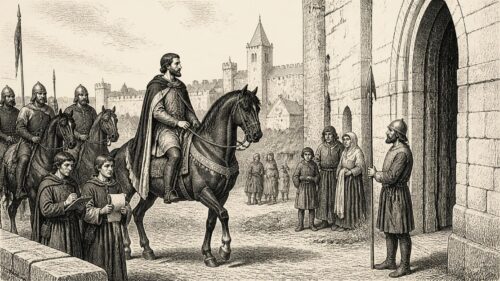
A firmly dated document reveals how urban authorities and the crown’s representatives interpreted dangers to health. On 14 November 1489, a royal order addressed to Dublin’s mayor and bailiffs complained that dung-heaps, swine, hog-sties and other nuisances in the streets, lanes and suburbs infected the air and produced mortality, fevers and pestilence. It ordered the removal of swine and refuse. The language reflects late-medieval ideas about corrupt air rather than modern germ theory, but the civic problem was real enough: animals, manure, waste and crowded living conditions made sanitation a pressing concern.
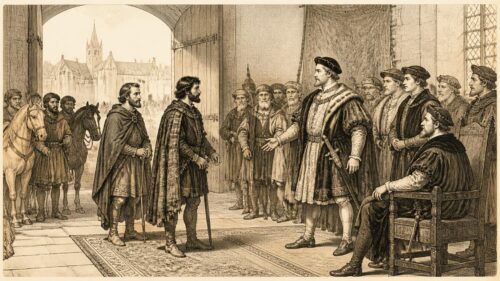
The order also linked cleanliness to government and commerce. It complained that fear of sickness discouraged lords, churchmen and lawyers from coming to Dublin, to the detriment of royal business as well as inhabitants’ welfare. Thus an urban street was not merely a local thoroughfare. It was part of the infrastructure of the lordship of Ireland: a place through which visitors, litigants, merchants, officials and supplies moved. The instruction to expel Irish vagrants and homeless people likewise shows that responses to disease and disorder could be punitive, targeting vulnerable outsiders as well as dirt and animals. The document does not prove that Dublin’s conditions caused the wider epidemic, but it securely shows official anxiety about pestilence in the same year.
Hostages and Raids in Ulster
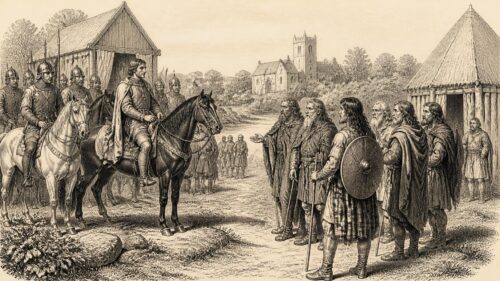
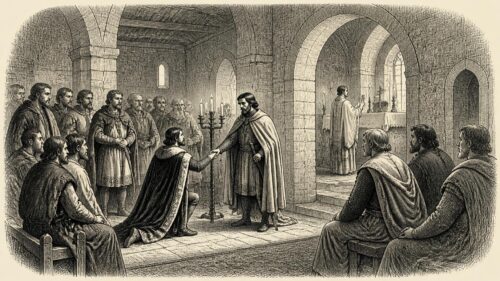
While disease spread, rival lords continued to make war. In northern Ulster, Conn Ó Néill, son of Henry Ó Néill, entered the territory of the Ó Catháin and carried off hostages after inflicting what the annals call great devastation. Hostages were a central instrument of political power. Their seizure did not simply humiliate a rival; it furnished leverage over a lordship’s future conduct and could underpin a demand for submission, tribute or alliance. The annals also record that Godfrey Ó Catháin was captured by Conn in 1489.
Dynastic violence accompanied these larger contests. Máel Sechlainn Ó Néill was killed by kinsmen in the opening of spring; the annals date the death of Ruaidhrí Ó Mórdha, tánaiste of Laois, to Wednesday 29 April; and Geoffrey Mac Giolla Phádraig, lord of Ossory, died after Christmas, having been blind for some time. Henry Ó Néill died on 15 June, while John Ó Cearbhaill, king of Éile, also died during the year. Such entries demonstrate that political geography was made not by a single Irish state but by interlocking lordships, each vulnerable to succession disputes, targeted killing and the loss of experienced rulers.
The Demolition at Belfast
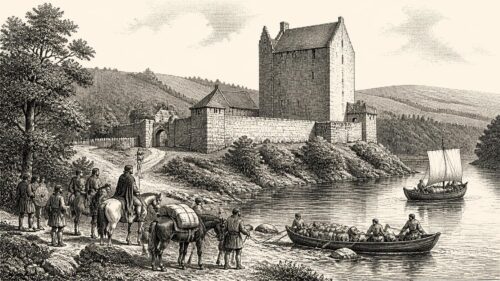
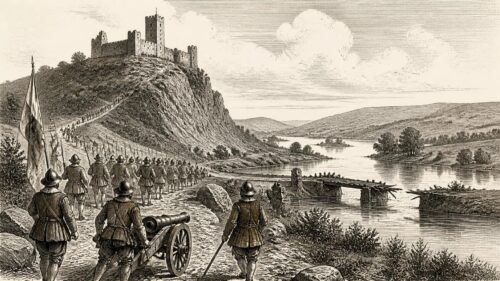
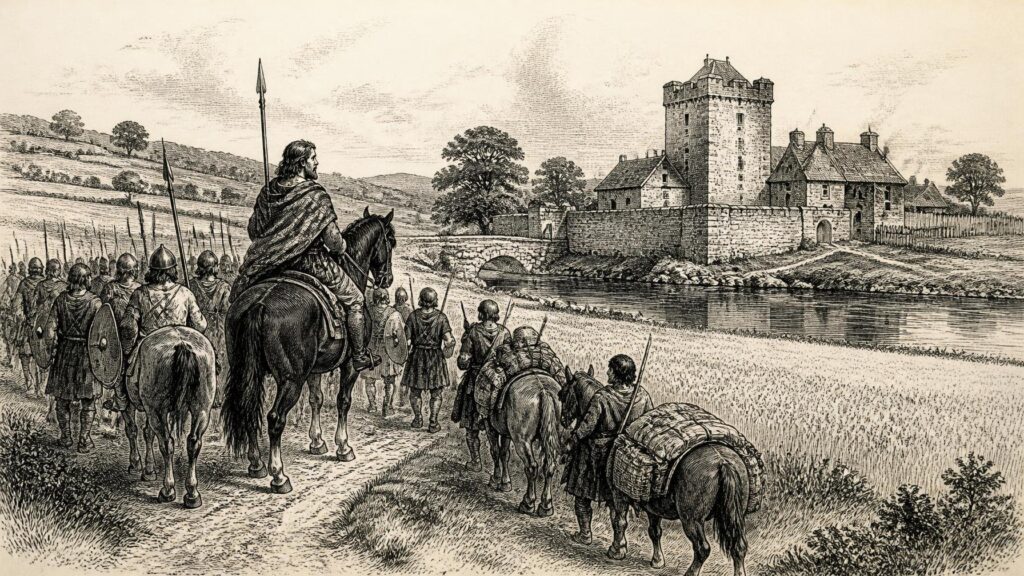
The year’s best-known military event occurred at the end of harvest. Aodh Ruadh Ó Domhnaill, lord of Tír Chonaill, led an army east into Trian Conghail, broadly the territory of Clandeboye in east Ulster. He raided the Route, the district associated with the Mac Uibhilín or MacQuillan lordship, and his son Conn was wounded. He then took Belfast castle and, according to the Four Masters, demolished it before returning home with substantial spoil. The Annals of Ulster corroborate the expedition, the wounding of Conn and the taking of the castle, though they do not repeat the fuller claim of demolition.
This was not the Belfast of later industrial and urban history. It was a strategically placed castle and small settlement at the crossing where the River Farset met the Lagan system, within a contested Clandeboye landscape. Archaeological and historical work suggests that the late-medieval castle was probably a tower-house or similarly defensible stone structure, rather than the nineteenth-century Belfast Castle on Cave Hill familiar today. Its repeated appearance in campaigns is significant. A castle could store goods, shelter a garrison, dominate a route and embody a lord’s claim to jurisdiction. To take or slight it was to deny an opponent a usable strongpoint, even if it might later be repaired and reoccupied.
Ó Domhnaill’s expedition therefore showed the reach of Tír Chonaill’s ruler, whose base lay far to the north-west around Donegal. It also demonstrates that Gaelic warfare did not consist only of pitched battles. Raiding at harvest time struck food resources and movable wealth; the capture of fortifications affected communications and prestige; and the taking of hostages created diplomatic capital. The annalists’ emphasis on spoils reflects an economy in which cattle, horses, foodstuffs and other portable goods were both wealth and the immediate reward of campaigning. Yet the sources do not permit a precise reconstruction of the army’s size, the castle’s garrison or the number of local inhabitants harmed.
Church, Learning and Memory
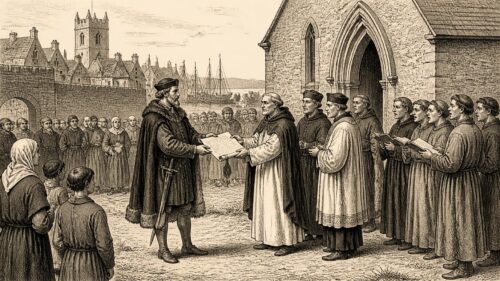
Religious and learned life continued amid these losses. Nicholas Ó Cathasaigh, vicar of Devenish on Lough Erne, and Tadhg Ó Mathghamhna, a monk of Boyle, died in 1489. The Ulster annals also commemorate the death of a member of the Ó hEoghusa learned family as a poet, teacher, instrumentalist and singer honoured among both “Foreigners and Irish”. Such notices matter because they show a multilingual, culturally connected elite world in which ecclesiastical institutions, hereditary learned families and lordly patronage preserved teaching, music, poetry, history and law. The plague’s death toll included people within these networks, making its cultural as well as demographic cost visible.
A Year of Exposure
1489 does not yield a single national narrative. Dublin’s municipal crisis, epidemic mortality across several regions, Ó Néill pressure on the Ó Catháin, and Ó Domhnaill’s destructive eastern expedition belonged to different political worlds. But all reveal exposure: to sickness, to poor urban sanitation, to hostile raiders and to the frailty of dynastic succession. The sources also reveal resilience. Dublin’s government was ordered to act; castles were worth taking because places continued to be defended and rebuilt; learned and religious offices still mattered; and rulers still mobilised men, negotiated obedience and pursued advantage. The year was catastrophic for many, but it was also one in which the structures of late-medieval Irish life remained vigorously, if precariously, at work.
Source References
Hover over a number to see the source. Select it to open the source.

- [1] Annals of the Four Masters, Annal M1489
- [2] The Annals of Ulster, Year U1489
- [3] Annals of Ulster otherwise Annala Senait, Year U1489 (Irish text)
- [4] CELT Project: Annals of the Four Masters
- [5] O'Donnell (Ó Domhnaill), Aodh Ruadh
- [6] O'Donnell (Ó Domhnaill), Sir Aodh Dubh
- [7] FitzGerald, Gerald (Gearóid Mór)
- [8] Belfast 400: The Medieval Settlement
- [9] About Belfast Castle and Estate
- [10] Dirty Dublin: Royal Order of 14 November 1489
- [11] CIRCLE, 5 Henry VII (1489–90)
- [12] Trinity Historians Reconstruct Thousands of Medieval Documents Bombed in the Four Courts
- [13] The Hospital in Medieval Ireland, 1170–1540: An Archaeology
- [14] Crisis and Survival in Late Medieval Ireland
- [15] Ireland, Chapter 21 in The Complete History of the Black Death
- [16] From blefed to scamach: Pestilence in Early Medieval Ireland
- [17] A Tract on the Plague
- [18] A Breath of Fresh Air: Approaches to Environmental Health in Late Medieval Urban Communities
- [19] Calendar of Ormond Deeds, Volume III, 1413–1509
- [20] National Library of Ireland Sources Database: Late Medieval Irish Records
Primary Sources
- Annals of the Four Masters, Annal M1489
- The Annals of Ulster, Year U1489
- Annals of Ulster otherwise Annala Senait, Year U1489 (Irish text)
- CELT Project: Annals of the Four Masters
- O'Donnell (Ó Domhnaill), Aodh Ruadh
- O'Donnell (Ó Domhnaill), Sir Aodh Dubh
- FitzGerald, Gerald (Gearóid Mór)
- Belfast 400: The Medieval Settlement
- About Belfast Castle and Estate
- Dirty Dublin: Royal Order of 14 November 1489
- CIRCLE, 5 Henry VII (1489–90)
- Trinity Historians Reconstruct Thousands of Medieval Documents Bombed in the Four Courts
- The Hospital in Medieval Ireland, 1170–1540: An Archaeology
- Crisis and Survival in Late Medieval Ireland
- Ireland, Chapter 21 in The Complete History of the Black Death
- From blefed to scamach: Pestilence in Early Medieval Ireland
- A Tract on the Plague
- A Breath of Fresh Air: Approaches to Environmental Health in Late Medieval Urban Communities
- Calendar of Ormond Deeds, Volume III, 1413–1509
- National Library of Ireland Sources Database: Late Medieval Irish Records