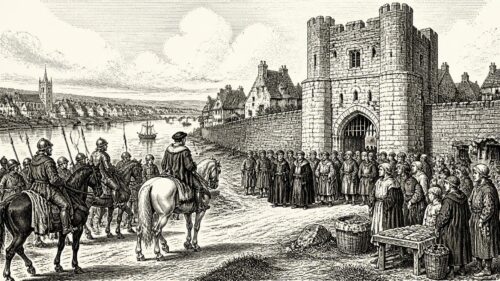
Athleague’s Reversed Conquest1499 CE
In 1499, Gerald FitzGerald, earl of Kildare and royal deputy, campaigned in Connacht, seizing Athleague, Tulsk, Roscommon and Castlerea, redistributing lordship and hostages among allied factions. Mac William Burke and displaced O’Kelly forces soon recovered Athleague and Tulsk, demonstrating the fragility of imposed authority. Succession and conflict reshaped Moylurg, Tír Chonaill, Fermanagh and Thomond, where O’Donnell raided, negotiated with Kildare and suppressed internal rebellion, while an O’Brien force defeated Butler followers. Annals also record religious and aristocratic hospitality, and Pale parliamentary regulation. Warfare, castles, cattle, hostages, tribute and negotiation repeatedly remade Ireland’s overlapping political order across Ireland’s contested regional frontiers.

Dateline
The Irish annals make 1499 a year of movement rather than settlement: armies crossed provincial frontiers, castles changed hands more than once, hostages were redistributed, and established lordships faced abrupt successions. The best-recorded theatre was Connacht, where Gerald FitzGerald, eighth earl of Kildare and the English king’s deputy in Ireland, led an expedition west of the Shannon. Yet the year also illuminates the limits of his authority. Kildare could seize strongholds and compel submissions, but local alliances rapidly recovered ground. Elsewhere, contests within the O’Donnell and Maguire worlds of the north-west, a succession in Thomond, and an O’Brien victory over Butler forces showed that political power in Ireland remained many-centred.
Kildare Crosses the Shannon
The Annals of the Four Masters place Kildare’s Connacht campaign firmly in 1499. The lord deputy took Athleague from the sons of William O’Kelly and transferred it to rival O’Kelly kinsmen, the sons of Aodh son of Brian. The defeated branch was driven west across the River Suck. This was not merely the capture of a castle. Athleague stood at a major crossing between east Connacht and Uí Mháine, and possession of it offered influence over communications, cattle-routes and the tribute relationships of the surrounding lordships.
Kildare then took Tulsk from the descendants of Felim Cleireach O’Conor. Their hostages were handed to Hugh O’Conor, described by the annalist as the second lord among the Síl Muiredaig. Roscommon and Castlerea castles were also taken during the expedition. The pattern is revealing. A deputy’s army did not simply destroy opponents: it selected clients, installed or favoured one faction over another, and held hostages as security for the new arrangement. Fortified places, dynastic claims and personal guarantees formed one political system.
The campaign belonged to Kildare’s wider restoration after his reappointment as deputy in 1496. Henry VII had returned to the cheaper and more practical strategy of governing through a powerful Irish magnate after the costly intervention of Sir Edward Poynings. Kildare’s commission gave him unusually broad scope to defend the lordship and recover crown interests. His force was therefore both an instrument of royal government and an extension of the FitzGerald network. In Connacht, where no English administration possessed routine control, the distinction could be difficult to sustain.
Athleague Changes Hands Again
The annalistic account refuses to present the expedition as a permanent conquest. Mac William Burke, drawn in by Hugh O’Conor and the displaced sons of William O’Kelly, came to their aid. Athleague was retaken and restored to the latter. Conor O’Kelly, identified as the second lord of Uí Mháine, was captured there and delivered with the hostages of subordinate chiefs to Melaghlin, son of Tadhg son of Donough, who assumed full lordship of Uí Mháine. At Tulsk, Mac William and O’Conor likewise recovered the castle; a son of Cairbre son of Brian was killed there by a gunshot. The annals do not name the weapon, but the notice is a clear reminder that firearms had become a practical element in Irish warfare.
This reversal gives 1499 its distinctive character. Kildare’s advance was formidable enough to take several castles, banish rivals and reorder hostage networks; it was not strong enough to freeze Connacht’s politics in the form he preferred. Mac William Burke’s intervention restored a local balance. He then negotiated peace between Hugh O’Conor and Cormac MacDermot, requiring each side to place hostages with the other. Such settlements were not signs of weak government. They were the means by which lordship worked: peace was made tangible through people whose safety bound families and territories to an agreement.
Moylurg’s New Lord
Succession sharpened these struggles. Tadhg MacDermot, lord of Moylurg, died in his island stronghold on the Rock of Lough Key, and his kinsman Cormac son of Rory succeeded. The Annála Connacht remembers Tadhg in more expansive terms: as a ruler who had subdued nearby neighbours and as a patron of poets, exiles, poor people and those in need. Such praise was conventional, but it still indicates what a successful Gaelic ruler was expected to provide—protection, hospitality, a court open to learned dependants, and the resources to feed them.
Hugh O’Conor was driven west across the Shannon by MacDermot, with the consent of the Síl Muiredaig, before Mac William’s later mediation altered the position again. Meanwhile Aodh Ruadh O’Donnell marched against Cormac MacDermot. He avoided the defended Curlieu pass by moving through Muintir Eolais and crossing the Shannon near Leitrim Castle, then raided Moylurg. Cormac made what the annals call a perpetual peace, paid tribute, returned prisoners from the earlier defeat of Bealach Buidhe, and gave back the Cathach, a revered manuscript-shrine associated with the O’Donnells. The episode joined war, diplomacy, sacred prestige and material restitution in a single settlement.
Meeting Across Political Worlds
The same year Aodh Ruadh O’Donnell went into the English-held territory to meet Kildare. The encounter is tersely recorded, and its terms are not supplied, but its occurrence matters. O’Donnell was no subordinate official of the Dublin administration; he was a leading lord of Tír Chonaill, whose family’s power rested on alliances, warfare and authority in the north-west. His meeting with the deputy demonstrates the practical diplomacy connecting the English lordship and Gaelic Ireland. They were not sealed-off worlds. They were rival and overlapping political systems whose leaders could negotiate when interests required it.
Conflict within O’Donnell territory nevertheless continued. Donnchadh na nOrdóg, a son of Aodh Ruadh, seized Bundrowes Castle from his father’s warders. Aodh Ruadh and his son Aodh Óg besieged it, assisted by Maguire and Philip son of Toirdelbach Maguire. In a personal encounter Philip captured Donnchadh after his horse was killed, and the castle was retaken the same day. Donnchadh was handed to Maguire for custody; Philip received sixty cows from O’Donnell for his service. This compact account captures the texture of lordly warfare: castles mattered, but so did personal combat, cattle payments, kinship and the trusted keeping of prisoners.
Further east in the lake country around Lough Macnean, a captive Mac Rannall was carried to an island by members of the O’Rourke family. Rory Maguire attacked across the water, killed the two O’Rourkes and recovered prisoners. Aodh Ruadh later ransomed Mac Rannall and received Leitrim Castle in return. Such incidents were local in scale but politically consequential. Control of a small island, a captive nobleman or a lakeside castle could shift the relationship between Fermanagh, Breifne and Tír Chonaill.
Thomond and the Butlers
In Thomond, Turlough O’Brien Gilla Dub, son of Turlough O’Brien, died and Turlough Donn, son of Tadhg O’Brien, took his place. The Annals of Ulster also record a major O’Brien defeat of Piers Butler ‘the Red’. The sovereign of Kilkenny and many of Butler’s followers were said to have been killed, while as many as 320 corslets were captured—an estimate the annalist cautiously qualifies with ‘as some say’. The battle’s precise location is not provided in that entry, so it should not be invented. Its significance, however, is plain: an O’Brien lord could carry war into the Butler sphere and win a conspicuous victory over a powerful Anglo-Irish rival.
Church, Hospitality and the Pale
1499’s annals also preserve quieter measures of status. Lochlainn Mac Gilla-Calma, vicar of Cuil Mháine, died and was praised as wise, humane and pious. Cormac MacDonnell of Clann Kelly was buried at Clones after being remembered for charity and hospitality. Edmund Butler, grandson of Piers Butler, was similarly recalled as an eminent leader who maintained a general guest-house. Such notices are not incidental decoration. Hospitality was an obligation of lordship and religious standing, sustaining travellers, clients, poets, clerics and the poor while publicising a household’s resources.
Within the English Pale, parliamentary business associated with the 1498–99 session continued the work of defining a narrower lordship through taxation, customs and regulation. Surviving statutory references include poundage on merchandise, a land subsidy, provisions concerning parliamentary dress, and confirmation of older legal arrangements. Castledermot, a fortified frontier town with close FitzGerald connections, served as a parliamentary venue in this period. Yet these enactments had limited reach beyond the lordship’s core. The year’s campaigns and reversals in Connacht show why: law made at a Pale parliament could support government, but it could not by itself command the shifting alliances west of the Shannon.
Thus 1499 was not a simple story of English advance or Gaelic resistance. It was a year in which Kildare could take castles, O’Kelly and Burke alliances could take them back, MacDermot and O’Conor fortunes could turn through hostages, and O’Donnell could raid, make peace and meet the deputy. Ireland’s political geography was held together by roads, rivers, cattle, fortified sites, fosterage and negotiation as much as by formal jurisdictions. Athleague’s rapid reversal was the year’s clearest lesson: authority was real, but it had to be repeatedly made and remade.
Primary Sources
- The Annals of Ulster: Year U1499
- Annals of the Four Masters, Volume 4 English Translation
- Annála Connacht
- FitzGerald, Gerald (Gearóid Mór)
- O'Brien (Ó Briain), Toirdhealbhach Donn
- O'Donnell (Ó Domhnaill), Sir Aodh Dubh
- English Lordship of Ireland and the Irish Sea World: Re-assessing the Origins of the Kildare Ascendancy, c.1390–c.1513
- County Kildare Urban Archaeology Survey
- County Roscommon Urban Archaeology Survey
- Statute Law Revision Act 2007
- Pre-Union Irish Statutes
- The Bills and Statutes of the Irish Parliaments of Henry VII and VIII (1486–1543)
- Statute Rolls of the Irish Parliament
- The Early Interpretation of Poynings’ Law, 1494–1534
- Henry VII (1485–1509): Records of Convocation
- Gearóid Mór – The Great Earl of Kildare
- The Medieval Walled Towns of Kildare
- Castledermot Sewerage Scheme: Archaeological Report
- Castledermot: Medieval History and Key Features
- Tulsk, County Roscommon
- The Irish Ecclesiastical Record, Volume 6
- The Bills and Statutes of the Irish Parliaments: National Library of Ireland Catalogue